
A fractional sales team is an outsourced, part-time or shared sales function that works as an extension of a company’s go-to-market (GTM) organization: experienced sales professionals who sell on the company’s behalf without the cost, commitment or lead time of building a full in-house team.
The Fractional Model Explained
The fractional sales model is used across the technology industry, but it is particularly useful for international market entry. Rather than hiring a full-time country manager and sales team before product-market fit is proven, a SaaS company can engage a fractional team that brings local market knowledge, existing relationships and a working sales process from the start, at lower cost and risk than a local hire.
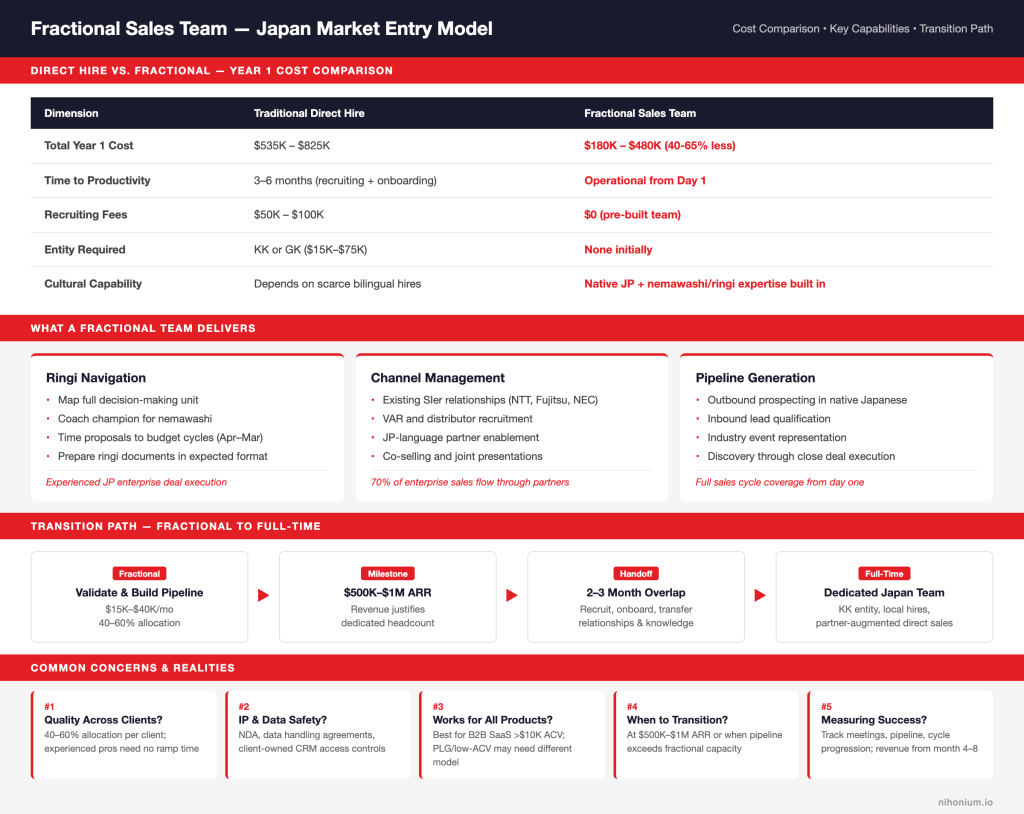
A fractional sales team usually combines some of the following roles, allocated part-time or by project: a country or regional lead who sets the sales plan and runs day-to-day activity; business development representatives (BDRs) who build pipeline through outbound prospecting and inbound qualification; account executives who run deals from discovery to close; and channel managers who develop partner relationships. The team usually works under the client’s brand, uses the client’s tools and processes, and reports to the client’s revenue leadership.
“Fractional” means the team’s time is shared across several clients, which spreads the cost while still giving each client professional coverage. The allocation is agreed in the engagement: smaller during an initial validation phase, larger as the market opportunity is proven, until the company is ready to hire full-time.
Application to Japan Market Entry
Japan makes a particularly strong case for the fractional model, for four reasons:
High cost of local talent: Experienced enterprise sales professionals in Japan are expensive. Robert Walters’ 2026 salary survey puts Tokyo base salaries in software sales at JPY 10 to 20 million for account managers, JPY 7 to 15 million for sales development representatives and JPY 15 to 25 million for sales managers, before bonuses. For a SaaS company still validating its Japan opportunity, committing to several such salaries before any local revenue is a significant risk.
Difficulty of recruiting: Bilingual technology sellers are in demand from both Japanese and foreign companies. In JETRO’s 2025 survey of foreign-affiliated companies, 44.5% said they struggle to hire, and sales roles were the hardest to fill. A search can take months; a fractional team avoids that wait.
Cultural and linguistic requirements: Selling to Japanese enterprises takes native-level Japanese, a working knowledge of business practice (including nemawashi, 根回し, informal consensus-building, and ringi, 稟議, formal written approval) and relationships in the target industry. These take years to build and cannot be learned from training alone. A fractional team brings people who already have them.
Entity requirements: A foreign company does not need a Japanese entity to engage a fractional team, so market validation can begin before the cost of setting up a kabushiki kaisha (KK) or godo kaisha (GK). How contracts are signed, and by whom, affects your tax position in Japan, so agree that with a tax adviser at the outset.
Cost Advantages Over Direct Hires
The economics favour the fractional model mainly at the start, when the Japan opportunity is still unproven:
Direct hire approach: A minimal Japan team (a sales manager, an account executive and a BDR) means three salaries in the Robert Walters ranges above, plus the employer’s share of social insurance (about 15% of salary in Tokyo in fiscal 2026, capped on high salaries), recruiting costs and several months of recruiting and ramp-up before the team is productive. Employing staff directly usually means a local entity too: JETRO’s Tokyo model case puts the filings at about USD 6,200, and the set-up of a two-person subsidiary at USD 264,000 to 289,000, including JPY 30 million of paid-in capital and before salaries. Ending an employment relationship is also hard: under Article 16 of the Labor Contracts Act, a dismissal without objectively reasonable grounds is void.
Fractional team approach: A fractional engagement replaces those fixed costs with a service fee for a share of a team that already exists, with no recruiting, no entity needed to start and no office. Fees depend on scope and allocation, and no public benchmark exists, so compare proposals on what they include: who does the work, how many hours, and which activities (outbound, deal management, partner work, account management).
The difference is less about the monthly bill than about commitment and time. A fractional team can start selling within weeks and be scaled down if Japan disappoints; a direct team cannot do either.
Ringi Navigation Capability
One of the most valuable things a fractional sales team brings to Japan market entry is the ability to support the ringi approval process behind enterprise purchases. A ringi is a formal written proposal (ringisho, 稟議書) that circulates through several levels of approval, and its success depends on the nemawashi that precedes it. Our guide to ringi decision-making explains the process.
Experienced sales professionals in Japan know how to:
Map the decision-making unit: Identify everyone who will need to approve the ringi, including people who are not obvious from the organization chart. Japanese enterprises often have informal influence networks that differ from formal reporting lines, and buying groups are large: in One Marketing’s 2025 survey of 600 B2B buyers, an average of 18.3 people were involved in high-price purchases.
Coach the internal champion: Give the champion the materials and talking points for nemawashi, tailored to each stakeholder’s concerns: Japanese-language ROI analyses, security and compliance documentation, competitive comparisons and reference customer stories.
Time the process correctly: The national government and most large Japanese companies run an April to March fiscal year, and IT budgets are usually settled in the January to March planning window, though each prospect’s year-end should be checked. Obon in mid-August and the year-end holidays are slow periods.
Manage the document: Help the champion prepare the ringisho so that it answers likely questions in the format and language Japanese approvers expect. A ringisho that raises no new questions has the best chance of moving through approval without being sent back.
Partner Channel Management
Partners carry much of Japan’s enterprise software sales. Zoom is the usual illustration: about 70% of its Japan sales came through partners, against roughly 90% direct sales in the US (Zoom’s figure, reported by Firstlight Capital, not a market statistic). The structure behind it is that about 72% of Japan’s ICT professionals work at IT vendors rather than at user companies (MIC White Paper 2018). A fractional sales team’s ability to work with partners therefore matters:
SIer engagement: Systems integrators (SIers) such as Fujitsu, Hitachi, NEC and NTT Data, the leading IT services vendors in IDC Japan’s 2024 ranking, are a main technology procurement route for Japanese enterprises. Working with them means finding the right business unit, learning their internal processes and showing that your product fits profitably into their services. Team members who already know people at SIers can shorten this.
VAR and distributor management: Value-added resellers and distributors give reach into the mid-market and smaller companies. A fractional team can identify suitable partners and manage the day-to-day relationship, deal registration and joint selling.
Partner enablement: Japanese-language partner materials, training sessions, joint customer meetings and partner pipeline reviews are all work a fractional team can take on.
Co-selling: Joining partners’ sales calls and presentations, answering product questions and supporting the partner’s sales process with the end customer.
When to Transition from Fractional to Full-Time
The fractional model is usually a stepping stone, not a permanent arrangement. The time to move to a full-time team typically comes when:
Revenue justifies it: Japan revenue has reached a level at which dedicated headcount pays for itself. Set that threshold in your own plan; there is no market standard.
Pipeline volume requires it: Deal volume exceeds what a fractional allocation can handle, and opportunities are being lost for lack of capacity.
Strategic importance increases: Japan becomes a top-priority market and the board wants dedicated, full-time focus.
Institutional knowledge warrants it: The market knowledge built during the fractional phase needs to be held permanently inside the company.
Manage the transition carefully. The best fractional engagements plan a handover in which the fractional team onboards the permanent hires and introduces them to customers and partners over an overlap period, so that relationships carry over.
Practical Considerations for SaaS Companies
The fractional sales team addresses the central paradox of Japan market entry: you need local expertise and presence to validate the market, but you should not invest heavily until the market is validated. With experienced, culturally fluent sellers who can build pipeline from the start, a SaaS company can test the Japanese market at manageable risk while laying the foundation for a permanent team. When you evaluate fractional partners, look for specific SaaS sales experience, relationships in your target industries, native Japanese and a record of selling for foreign technology companies in Japan. Nihonium’s own fractional sales team for Japan provides Japanese-speaking sales, from the first email to closing to account management.
Key Takeaways
- Lower commitment than direct hiring: A direct Japan team means salaries of JPY 7 to 25 million each (Robert Walters 2026, base), employer social insurance, recruiting time and usually an entity; a fractional team replaces these with a service fee and can start within weeks.
- Immediate cultural and linguistic capability: Fractional teams bring native Japanese speakers with enterprise sales experience, nemawashi and ringi know-how and existing channel relationships.
- Designed as a stepping stone: The fractional model validates the market and builds pipeline at manageable risk, with a planned handover to a permanent team once Japan revenue justifies it.
- Partner access from the start: Partners carry much of Japan’s enterprise software sales (about 70% of Zoom’s Japan sales, for example), and team members who already know SIers and resellers shorten partner development.
- Risk-managed market validation: The model resolves the paradox of needing local expertise to validate the market before you want to invest heavily in it.
Working with Nihonium. We are a Japan go-to-market partner for B2B SaaS companies: fractional sales team (Japanese-speaking sales, first email to closing to account management) and Japan go-to-market strategy. Talk to us about your Japan entry.
Sources
- Robert Walters, Japan Salary Survey 2026: IT software sales base salaries, East Japan.
- JETRO, survey of foreign-affiliated companies in Japan (2025): hiring difficulties; and Tokyo set-up model case: filing and subsidiary set-up costs.
- Japanese Law Translation, Labor Contracts Act: Article 16 on dismissal.
- Firstlight Capital, System Integrators: The Key to Success for SaaS in Japan: Zoom’s direct and partner sales mix.
- One Marketing, BtoB購買プロセス白書2025: people involved in B2B purchases. Also cited: MIC Information and Communications White Paper 2018 (ICT professionals at IT vendors); IDC Japan, 2024 IT services vendor ranking.
Frequently Asked Questions
How does a fractional team maintain consistent quality across multiple clients?
Professional fractional teams manage their client portfolios to avoid conflicts of interest, such as selling for two competitors, and agree each client’s time allocation in the contract. Team members often specialize by industry or product category. Regular reporting and pipeline reviews keep the team accountable, and experienced sellers work efficiently because they do not need the market-learning time a new hire does.
What metrics should we use to evaluate a fractional team?
Useful indicators are qualified meetings per month, pipeline value created, deal progression and partner relationships activated. Closed revenue matters but should be judged against realistic timelines: as a planning assumption, allow two to three quarters for a first mid-market deal and nine months to a year or more for an enterprise deal. In the early months, leading indicators such as meeting quality, champion engagement and partner pipeline say more. Agree the KPIs and the reporting rhythm at the start.
Is the fractional model suitable for all SaaS products?
It works best for B2B SaaS products with contract values large enough to justify a sales conversation, sold to mid-market companies or enterprises. Products that need deep technical pre-sales may need extra technical resources. Self-service or product-led products with low prices may be better served by marketing and localization than by a sales team. Products in regulated industries such as financial services or healthcare benefit from sellers with experience in that sector.
How do we protect our IP and customer data when using a fractional team?
Fractional sales engagements are governed by a service agreement that should include confidentiality, data handling and IP ownership clauses. Team members work under your brand and follow your data security policies, and the CRM and communication tools sit in your accounts with access controls you set. Non-solicitation provisions protect your customer relationships. Have Japanese counsel review the agreement before you sign.