

Japan is one of the most structurally complex and promising markets for Legal and RegTech SaaS, combining rapid digital transformation with entrenched paper-based legal processes, significant regulatory requirements, and a government push to modernize how documents, contracts and approvals are handled.
The domestic legal tech market has grown steadily, led by electronic contracts. Yano Research Institute estimated it at JPY 22.8 billion in 2018, up 15.2% on the year, and forecast JPY 35.3 billion in 2023, growth of 9.8% a year from 2016; electronic contract services alone were JPY 3.9 billion in 2018. We found no more recent public figure. Demand comes from the government’s digital transformation agenda, the Qualified Invoice System (in effect since 1 October 2023), the rule that documents exchanged electronically must in principle be kept as electronic data (since January 2024), and the data-handling questions every buyer asks under the Act on the Protection of Personal Information (APPI). For Legal and RegTech vendors this is a real opportunity, provided they approach the market with Japan-specific localization, a regulatory position settled with Japanese counsel, and a culturally appropriate sales motion.
Key Capabilities for Legal & RegTech Market Entry
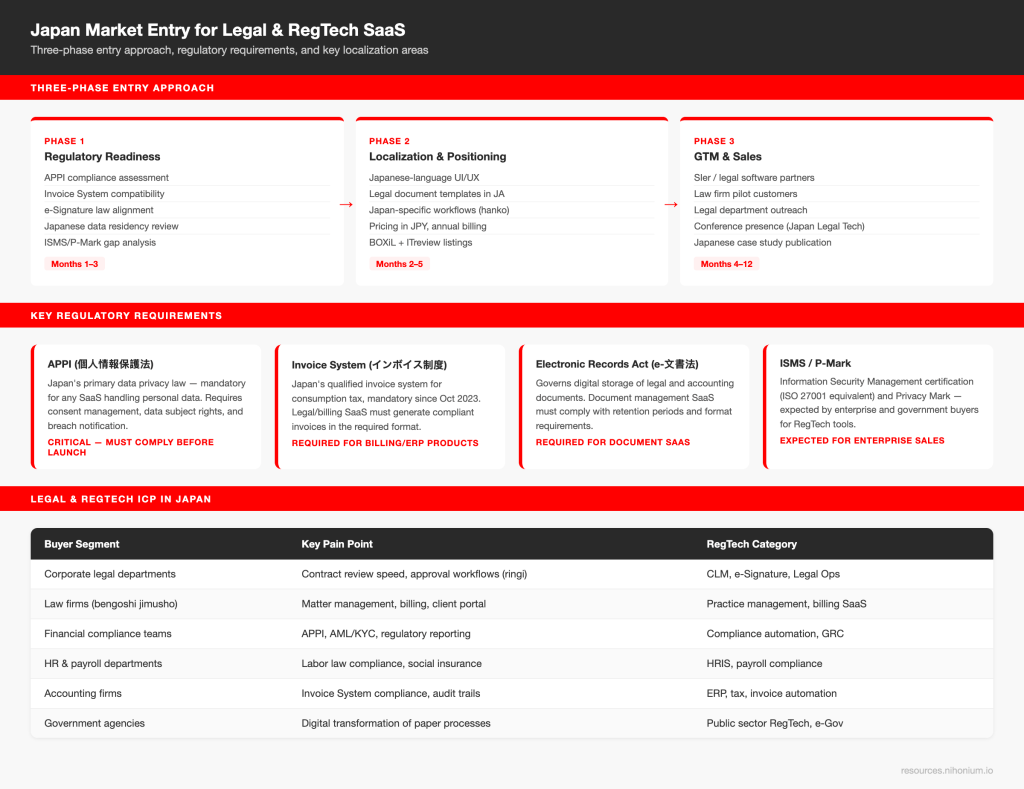
Japan Legal & RegTech Entry Capabilities
| Capability | What It Does | Benefit |
|---|---|---|
| APPI position (Japanese counsel) | A Japanese lawyer reviews the product’s data flows against the APPI, including transfers abroad | Answers the first legal question in Japanese procurement |
| Invoice System localization | Adapts billing and invoicing features to the qualified invoice format (registration number, tax rate and tax amount) | Required for finance, accounting and legal billing tools |
| Legal workflow localization | Adapts approval workflows to ringi, hanko and Japanese contract formats | Aligns product UX with how Japanese legal teams actually work |
| ISMS/P-Mark readiness | Your security team prepares for ISMS (ISO/IEC 27001) certification through an accredited certification body, or for the PrivacyMark run by JIPDEC | Meets a common expectation in enterprise and public-sector procurement |
| Japanese contract templates (prepared by counsel) | Japan-standard NDA, SaaS and service agreements in Japanese, drafted or reviewed by a Japanese lawyer | Reduces friction in legal and compliance buyers’ evaluation |
| Regulatory watch | Tracks APPI amendments, e-signature guidance and the Ministry of Justice guidelines on AI legal services, with counsel advising on what changes | Keeps the product and its claims current as rules evolve |
How Nihonium’s Legal & RegTech Entry Program Works
A Japan entry for Legal and RegTech SaaS usually runs in three overlapping phases, each with its own owner. Japanese counsel owns the regulatory position, your product team owns the changes, and our part is the go-to-market, through the five services listed on our services page: Japan go-to-market strategy; localization by SaaS experts; a sales and marketing funnel (awareness, SEO, local leads); a fractional sales team that runs Japanese-speaking sales from the first email to closing and account management; and local thought leadership, including evangelism alongside local thought leaders.
Phase 1: Regulatory Readiness (with Japanese counsel). Before sales and marketing begin, a Japanese lawyer reviews the product against the rules buyers will ask about: the APPI, the Qualified Invoice System (for billing products), the Electronic Books Preservation Act (for document management tools) and the Electronic Signature Act (for CLM and contract platforms). Products that review or draft contracts with AI also need a view on Article 72 of the Attorney Act, which bars non-lawyers from handling legal matters for a fee; the Ministry of Justice published guidelines on AI contract services in August 2023 and supplemented them on 21 August 2026. This phase sets the minimum product work needed before Japanese procurement.
Phase 2: Localization and Positioning. The interface, documentation and help content are localized, with legal templates prepared by counsel. For Legal and RegTech tools this includes approval workflows that support the ringi (稟議, the written proposal circulated for approval) process, hanko (判子, personal seal) or electronic approval fields where relevant, and Japanese terminology that matches the Civil Code and the documents legal teams already use. BOXIL and ITreview listings are set up in this phase, in the legal software categories.
Phase 3: Go-to-Market and Sales. A Japanese-speaking sales team reaches the legal and compliance buyer segments: corporate legal departments, law firms (法律事務所, hōritsu jimusho), financial compliance teams and public-sector buyers. Key channels include SIers and distributors that serve legal departments, pilots with a few anchor customers, and legal tech conferences and events.
Japan Legal & RegTech Buyer Segments
| Buyer Segment | Key Pain Points | RegTech Category | Decision Timeline |
|---|---|---|---|
| Corporate legal departments | Contract review speed, ringi approval integration | CLM, e-signature, legal operations | Months; longer at large enterprises |
| Law firms (hōritsu jimusho) | Matter management, billing, client portal | Practice management, billing SaaS | Long; partner-led and reference-driven |
| Financial compliance teams | APPI, AML/KYC, regulatory reporting | Compliance automation, GRC platforms | Long; security review comes first |
| HR and payroll departments | Labour law changes, social insurance | HRIS, payroll tools | Often tied to the fiscal year |
| Accounting firms | Invoice System, electronic record keeping, audit trails | ERP, tax, invoice automation | Shorter for small firms |
| Government agencies | Digital transformation of paper legal processes | Public sector RegTech, e-Gov platforms | Longest; tied to budget and tender cycles |
Japan Legal & RegTech vs General SaaS Market Entry
Entering Japan’s legal and regulatory technology market takes a different approach from horizontal SaaS. Three differences stand out. The timelines in the table above are tendencies, not benchmarks: we found no published Japanese data on legal tech sales cycles.
Regulatory questions come earlier. A general SaaS product can often enter Japan with localization and a standard security review. Legal and RegTech products face more questions before procurement: their APPI position, security certification such as ISMS, Invoice System support, and, for AI contract tools, where they stand under Article 72 of the Attorney Act. Settle these with Japanese counsel before the first enterprise deal.
Sales cycles are longer. Law firms and corporate legal departments are conservative technology buyers, and they want references from peers. As a planning assumption, allow nine to twelve months or more for an enterprise deal, against a shorter cycle for productivity SaaS sold to smaller companies.
Channel partners help. Distributors and SIers that already serve legal and finance departments bring credibility and buyer relationships that take years to build independently. A partnership with one or two of them can shorten the path to the first references.
Key Takeaways
- Japan’s legal tech market is led by electronic contracts: Yano Research Institute forecast JPY 35.3 billion for 2023 (9.8% a year from 2016), and the Invoice System, electronic record keeping and the APPI keep legal and finance departments looking for software.
- Regulatory readiness must come before sales: the APPI position, Invoice System support, e-signature and, for AI tools, the Attorney Act guidelines are questions buyers ask early; settle them with Japanese counsel before marketing investment begins.
- Ringi and hanko shape the workflow: Japanese legal teams need approval workflows that fit the ringi sign-off process, and products that cannot fit Japanese approval chains struggle at the trial stage.
- Channel partnerships accelerate trust: partners that already serve legal departments bring buyer relationships and credibility; there is no published figure for how much they shorten a sales cycle, so track it in your own pipeline.
- Nihonium handles the go-to-market side: strategy, localization, the sales and marketing funnel, fractional sales and local thought leadership, alongside the Japanese counsel who handle the law. Talk to us about your Japan legal tech entry.
Sources
- Yano Research Institute, legal tech market survey (press release No. 2224, 27 September 2019).
- Ministry of Justice, guidelines on AI legal services and Article 72 of the Attorney Act (August 2023; supplemented 21 August 2026).
- Personal Information Protection Commission, the 2026 APPI amendment.
- Further reading on nihonium.io: the Qualified Invoice System, APPI checklist for SaaS and SaaS contracts in Japan.
- Also relied on, cited in plain text: National Tax Agency (Qualified Invoice System; electronic transaction data under the Electronic Books Preservation Act); Electronic Signature Act (Act No. 102 of 2000).
Frequently Asked Questions
Does a Legal SaaS product need ISMS certification to sell in Japan?
ISMS (ISO/IEC 27001) certification is not legally required to sell in Japan, but enterprise buyers in the legal, financial and public sectors often expect it or an equivalent, such as SOC 2 Type II, and their security questionnaires ask for it. For smaller firms the bar is lower, but a Japanese security whitepaper still helps.
What is the Invoice System and does it affect my Legal SaaS product?
Japan’s Qualified Invoice System (適格請求書等保存方式, tekikaku seikyūsho tō hozon hōshiki) took effect on 1 October 2023. A buyer can deduct the consumption tax it paid only with a qualified invoice from a registered issuer, showing the registration number, the tax rate and the tax amount, so any Legal or RegTech SaaS that issues or processes invoices must support the format. Whether your own sales to Japan fall under the system or under the reverse charge for cross-border B2B services is a question for a tax adviser.
How do Japanese law firms make SaaS purchasing decisions?
Law firms are conservative technology buyers. A decision usually starts with a partner identifying a need and runs through an evaluation by IT staff, office managers and practice group leaders, with heavy weight on references from other Japanese firms. One recognized Japanese firm as a reference helps before approaching the wider market; free or reduced-price pilots are a common way to win it.
Is Japan’s e-signature law compatible with Western e-signature standards?
Japan’s Electronic Signature Act (Act No. 102 of 2000, in force since April 2001) sets when an electronic signature carries legal presumptions, and government Q&As since 2020 explain how cloud “signing on the user’s instruction” services can fit it. Western standards such as eIDAS (EU) and ESIGN (US) are not automatically recognized under Japanese law. Vendors offering e-signature functionality should have a Japanese lawyer review their Japan position and confirm that their signature method meets the Act for the intended use.