
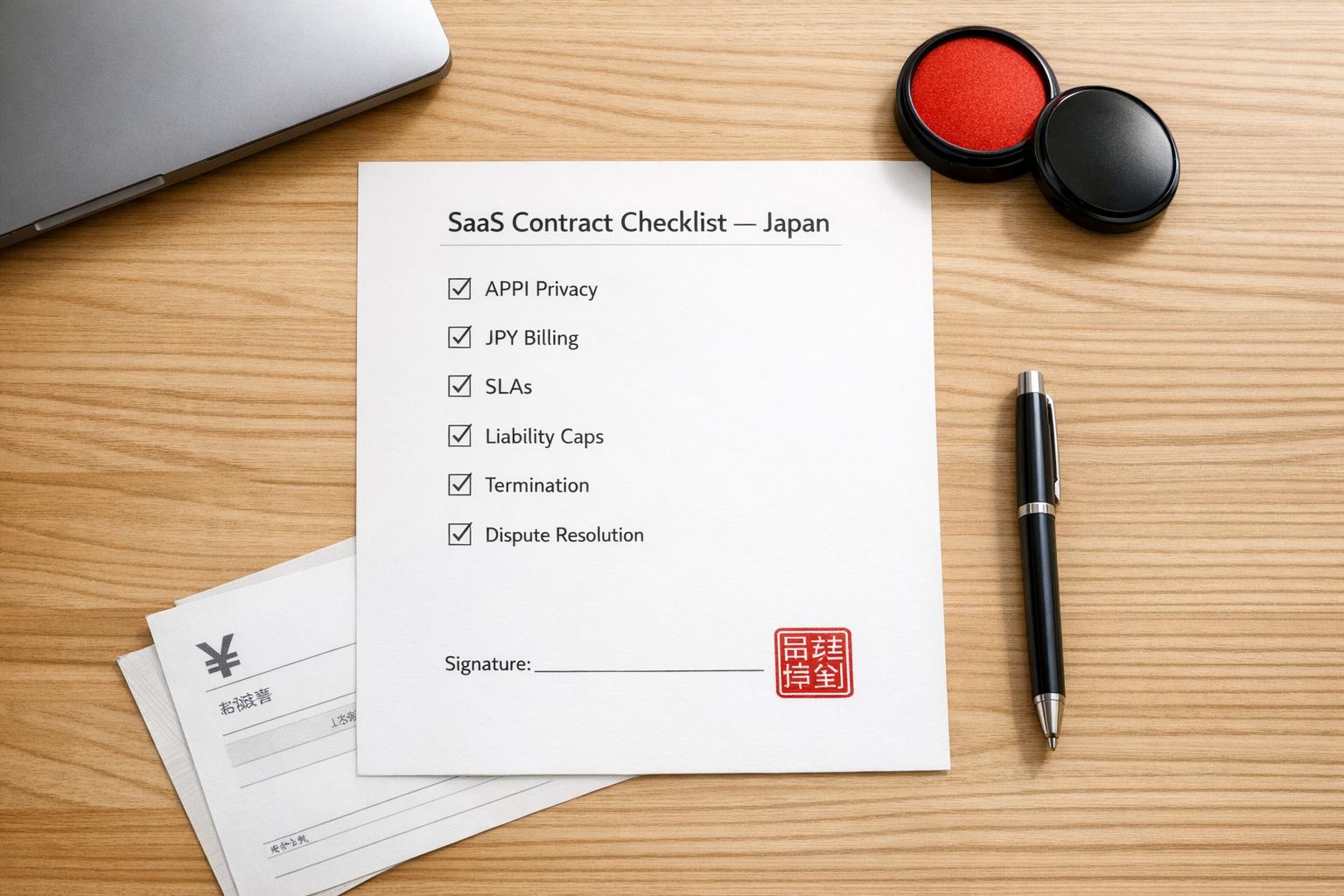
Navigating SaaS contracts in Japan requires understanding unique legal, cultural, and procedural factors. Key considerations include compliance with Japan’s strict privacy law (APPI), long sales cycles, and precise contract terms. Here’s what you need to know:
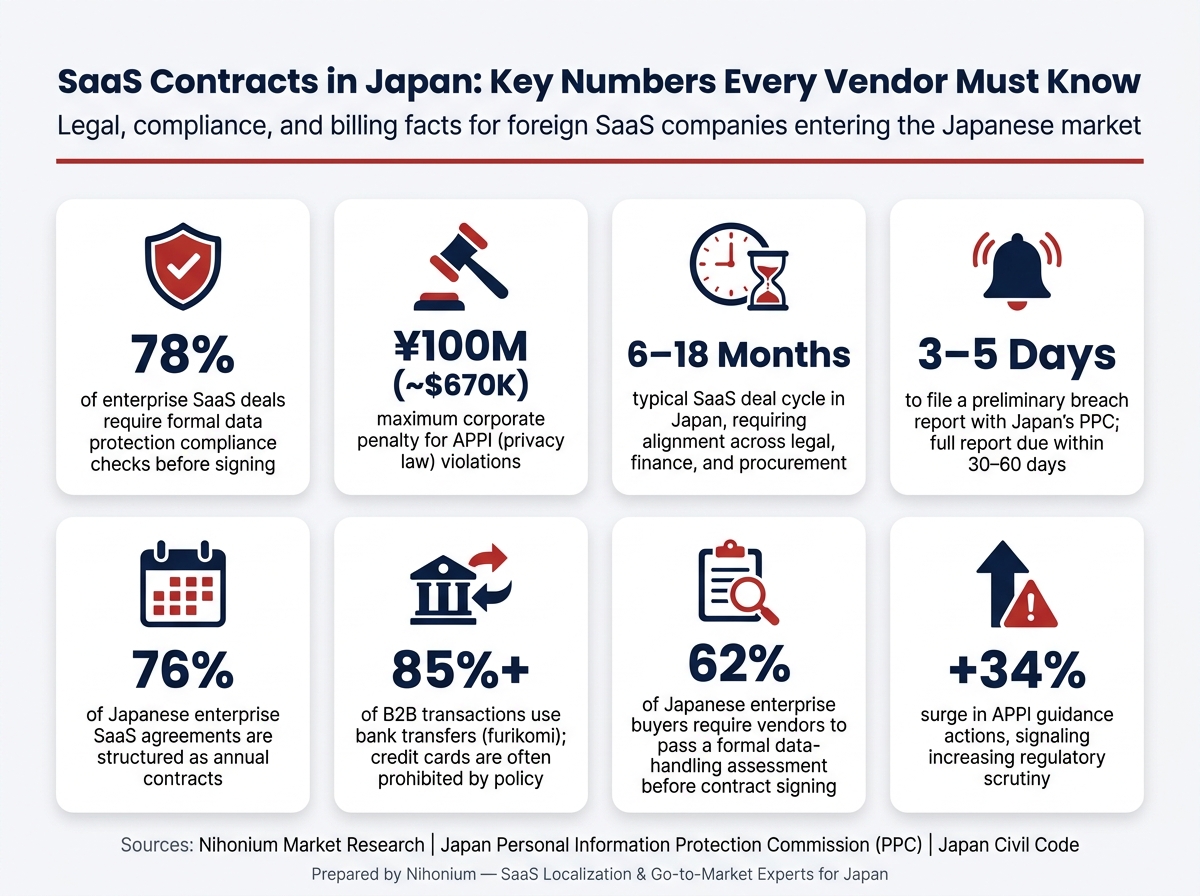
- Privacy Compliance: APPI applies to any company handling data of individuals in Japan, with penalties up to ¥100 million (~$670,000). Over 78% of enterprise SaaS deals require data protection checks.
- Sales Cycles: Deals take 6–18 months, requiring alignment across legal, finance, and procurement teams. Japanese buyers value trust and reliability over pricing.
- License Scope: Clearly define "user", access permissions, and usage limits to avoid delays. Prohibit ID sharing and specify update terms.
- Billing Preferences: Annual contracts dominate (76% of agreements). Use Japanese Yen pricing and bank transfers (furikomi), ensuring compliance with Japan’s Qualified Invoice System.
- Service Levels: Uptime guarantees are binding, with financial penalties for breaches. Offer Japanese-language support during business hours.
- Data Protection: Explicitly outline data use, ensure local hosting or consent for cross-border transfers, and comply with APPI breach notification timelines.
- Liability Terms: Cap liability for data breaches separately due to APPI penalties. Exclude indirect damages unless gross negligence or willful misconduct is involved.
- Termination Clauses: Specify renewal, cancellation, and exit terms, including data export formats and post-termination obligations.
- Dispute Resolution: Domestic contracts favor Japanese courts, while cross-border agreements often use international arbitration.
Preparation is key. Missteps in compliance, billing, or contract clarity can derail deals. For tailored support, consult local experts like Nihonium.
SaaS Contracts in Japan: Key Legal Stats & Compliance Figures
1. Define the SaaS scope and license use
This section highlights the importance of clearly outlining the service scope and license terms when entering SaaS agreements.
In Japan, SaaS contracts typically grant a "license to use" (使用許諾) rather than transferring ownership. Operating outside the agreed scope can lead to copyright violations.
One common issue for foreign vendors is defining "user" too vaguely. Japanese enterprise legal teams will carefully examine whether the license applies solely to full-time employees or if it also includes contract workers, temporary staff, and employees at parent or subsidiary companies. To avoid delays during procurement, explicitly define who qualifies as a "user" and specify broader access permissions if necessary.
It’s also critical to clarify details like service access locations and capacity limits. For example, indicate whether overseas branches can use the platform and outline restrictions on IDs, simultaneous logins, storage, or API calls. Be transparent about whether exceeding these limits will result in automatic charges. This level of specificity helps build trust with Japanese enterprises, which value precise contractual language.
"Japanese enterprise buyers rank product localization among their top three evaluation criteria when selecting foreign SaaS vendors." – Yuga Koda, Co-Founder, Nihonium
Make sure to explicitly prohibit ID sharing, as it’s a common issue flagged during audits. Additionally, confirm the provider’s right to update service features, ensuring prior notice is given for any major changes.
sbb-itb-a752276
2. Set pricing, billing, and renewal terms
When it comes to pricing and billing in Japan, the approach is quite different from what you might see in Western markets. For starters, most Japanese corporations and government entities operate on an April-to-March fiscal year, with budgets typically finalized between January and March. This makes the first quarter of the calendar year a prime time to secure annual contracts. These fiscal norms heavily influence how agreements are structured.
In Japan, annual contracts are king, accounting for about 76% of SaaS agreements in the enterprise sector. The reason lies in the ringi (稟議) process – a consensus-based decision-making system. With annual contracts, only one formal approval is needed each year. In contrast, monthly billing creates hurdles, as it requires repeated internal justifications, which can stall or even derail deals.
"The fundamental difference is structural: Japanese companies budget annually and approve purchases through consensus, making annual contracts the path of least resistance." – Yuga Koda, Co-Founder, Nihonium
For payments, bank transfers (furikomi) dominate, used in over 85% of B2B transactions. Many large organizations are bound by policies that prohibit credit card payments, so requiring one could exclude you from enterprise procurement. To avoid this, make sure your system supports furikomi and offers standard net-30 to net-60 payment terms. Additionally, you’ll need to issue a formal invoice (seikyu-sho) that complies with Japan’s Qualified Invoice System (Inboisu), introduced in October 2023. This means your invoice must include a registered T-number and clearly show the 10% Japanese Consumption Tax (JCT) – both tax-inclusive and tax-exclusive amounts – so buyers can claim tax credits.
For your pricing model, it’s critical to set fixed prices in Japanese Yen (JPY) without decimal places. Automatic currency conversions can erode trust and disrupt the procurement process. Additionally, include a 10–20% discount for annual commitments in your pricing structure. This is a common expectation in Japan and helps buyers justify the expense internally. When it comes to auto-renewals, ensure your contract provides clear advance notice of the renewal date and the deadline to opt out. This aligns with Japan’s Civil Code requirements on Standard Terms (Teikei Yakkan).
3. Specify service levels and support
Japanese enterprise buyers have extremely high expectations for reliability when it comes to SaaS vendors. They view SLA targets as binding contractual commitments, not as flexible goals. For them, uptime is a guarantee, and failing to meet it often results in financial penalties for the vendor.
To meet these expectations, it’s essential to define "unavailability" in precise terms. For example, Money Forward ME considers an outage to occur if 5% or more users lose access to the service. On the other hand, Google Cloud Storage calculates uptime as 100% minus the average five-minute error rate during the billing period. These clear definitions make it easier to establish compensation terms that are equally specific.
When it comes to compensation, there are two common approaches. Chatwork offers a cash refund equal to 10% of the monthly fee if uptime drops below 99.9%, though users must submit a manual claim to receive it. Slack, in contrast, automatically credits customers an amount equal to 10 times the cost of the downtime if uptime falls below 99.99%. The automatic credit model is gaining traction because it eliminates the need for manual claims and helps maintain a positive relationship with clients.
"Japanese enterprise users expect to resolve issues in Japanese. An English-only help center signals high support friction." – Munehiro Hiraki, Japanese Localization QA Specialist, Hiraki Localization
Support terms should be as clearly defined as pricing and service scope. To minimize friction, support must be available in native Japanese during standard business hours (9:00–18:00 JST, Monday through Friday). Additionally, it’s important to include clauses that specify SLA exclusions, such as planned maintenance or force majeure events, to avoid misunderstandings about when compensation applies.
4. Allocate data protection and data-use rights
Japan’s main privacy law, the Act on the Protection of Personal Information (APPI), applies to any foreign SaaS company collecting or processing data from individuals in Japan – even if the company doesn’t have a physical office there when considering options for Japan entry. This means that simply handling data tied to Japanese individuals brings your business under its scope.
One key distinction between APPI and the GDPR is that APPI doesn’t recognize a "processor" safe harbor. Under APPI, any entity handling personal data is treated as a "business operator" with direct legal responsibilities. In other words, you can’t transfer compliance obligations to your customers through contracts. This legal framework significantly impacts how data-use terms should be structured in your agreements.
"You cannot contractually delegate compliance to a customer and claim reduced responsibility." – Yuga Koda, Co-Founder, Nihonium
When drafting contracts, define data usage as specifically as possible – for example, billing, support, or analytics. If you plan to use customer data for broader purposes like AI training or product enhancements, these must be explicitly stated in both the contract and your privacy policy, with an opt-out option provided. Over 62% of Japanese enterprise buyers require vendors to pass a formal data-handling assessment before signing contracts. Ambiguous terms can lead to delays or even lost deals.
Regarding data breach notifications, APPI enforces a strict timeline. Companies must file a preliminary report with Japan’s Personal Information Protection Commission (PPC) within 3–5 business days of discovering a breach, followed by a comprehensive report within 30 days – or 60 days for breaches caused by malicious attacks. To help your customers meet their own obligations, you should include a clause requiring customer notification within 24–48 hours of any suspected breach. The LINE Corp case in March 2024 serves as a clear example: after a cyberattack exposed over 400,000 user records, inadequate oversight of a foreign contractor led to mandatory improvement plans and ongoing scrutiny from the PPC.
For cross-border data transfers, Japan doesn’t have blanket adequacy agreements with the U.S., China, or Singapore. This means you’ll need to secure explicit user consent – disclosing the destination country’s data protection standards – or establish a contractual agreement ensuring equivalent safeguards. Many companies sidestep this complexity by hosting their data locally in Japan, using services like AWS Tokyo or Osaka, which eliminates the need for cross-border data transfers entirely.
5. Limit liability and define indemnities
Most SaaS vendors tend to cap liability at the fees paid over the previous 12 months. This aligns with Japan’s Civil Code Article 416, which holds a breaching party accountable for both "normal" damages and "foreseeable special" damages by default. Without clear contract language, liability can quickly spiral beyond expectations.
Vendors often aim to exclude categories like "special damages" (tokubetsu songai), lost profits (isshitsu rieki), and indirect damages. Japanese courts generally uphold these exclusions unless there’s evidence of willful misconduct (koyi) or gross negligence (ju-kashitsu). These exclusions create a foundation for managing risks, especially those tied to data protection.
When discussing liability caps, it’s essential to address data protection separately. This area demands a distinct "super cap" due to the potential financial impact of APPI penalties, which can reach ¥100 million (about $640,000 USD). Notably, guidance actions related to APPI compliance have surged by 34%. A common approach is to apply a higher liability cap specifically for breaches involving data protection, security, and confidentiality.
"The purpose of a liability clause is to allocate risk. While the negotiations often centre around legal principles and drafting, risk is ultimately a commercial issue." – Norton Rose Fulbright
For intellectual property indemnification, vendors increasingly limit their responsibility to "finally adjudicated" third-party claims and associated costs.
Additionally, Japanese-language contracts must clearly differentiate between keiyaku sekinin (contractual liability) and fuhō kōi sekinin (tort liability). This distinction is crucial to avoid unintentional gaps in liability protection.
6. State Termination, Suspension, and Exit Rights
Termination clauses in Japanese SaaS contracts demand precise wording, reflecting the detailed nature of these agreements, which often differ from global SaaS standards. Typically, these contracts cover four termination scenarios: non-renewal, mid-term cancellation, termination for cause, and provider termination.
Automatic Renewal and Non-Renewal
In Japan, automatic renewal (jidō kōshin) is a common practice. Contracts often start with an initial term of one to two years and automatically renew unless a non-renewal notice is sent. This notice period is usually 30 to 90 days before the contract ends. Missing this deadline means being locked into another full term. For critical systems, it’s wise to require a six-month notice before discontinuing service to ensure smooth transitions. Clear terms for mid-term cancellation are equally important to avoid misunderstandings.
Mid-Term Cancellation and Payment Obligations
If a customer cancels mid-term, they are generally required to pay for the remaining contract period. For instance, the Mcloud Terms of Service explicitly state:
"If the contract is terminated due to the user’s reasons during the term, the user shall pay the usage fees for the remaining contract period." – Mcloud Terms of Service
However, for B2C or small-business contracts, Japan’s Consumer Contract Act (Article 9) limits cancellation fees to the provider’s "average damages." This means clauses demanding full-term payment may not hold up in cases involving consumers.
Suspension vs. Termination
It’s critical to differentiate between suspension and termination. Immediate service suspension is appropriate for non-payment, confirmed anti-social ties, or severe security threats. For less straightforward issues, like policy violations, Japanese courts typically require a cure period of 7 to 30 days before suspension can proceed. A notable case from the Tokyo District Court on December 18, 2008, held a provider liable for tort damages after deleting a user’s listing due to a vague "site policy violation" without giving specific reasons or a chance to address the issue.
Exit Procedures
Exit procedures should prioritize fairness and clarity for both parties. Contracts should outline:
- The format for data exports (e.g., CSV or JSON).
- A 30-day grace period for data access after termination.
- The provider’s responsibility to confirm complete data deletion, as required by APPI Article 22.
Additionally, specify which obligations survive the contract, such as confidentiality, intellectual property rights, and indemnification, to prevent disputes after the agreement ends.
7. Choose Governing Law and Dispute Resolution
Japan’s Civil Law system operates quite differently from the U.S. Common Law framework. In Japan, SaaS agreements are typically treated as contracts with quasi-mandate characteristics. This means that unless the contract explicitly defines fixed terms or specific termination rights, either party can terminate the agreement at any time. The Civil Code steps in to fill any gaps in the contract, making it critical to draft agreements with precise and thorough definitions, as emphasized earlier.
Another key distinction lies in how evidence is handled. Japanese courts may look beyond the written contract, considering emails, meeting notes, and prior conversations as supplementary evidence. This approach contrasts sharply with the U.S. Parol Evidence Rule, which views the written contract as the final word. To avoid disputes arising from differing interpretations, maintaining a complete and organized paper trail throughout negotiations is highly recommended.
Most Japanese SaaS contracts also include a "sincere consultation" clause (協議条項). This clause obligates both parties to attempt amicable resolution before escalating disputes. As GVA Professional Group explains:
"Japanese contracts often include ‘gentlemen’s clauses’… This reflects the philosophy that not every contingency can be exhaustively covered in the contract itself; instead, unforeseen issues should be resolved based on the principle of mutual trust."
However, to prevent misuse of this clause as a delay tactic, it’s wise to include a specific timeframe – usually 30 to 60 days – after which either party can move forward with formal dispute resolution.
Domestic and Cross-Border Dispute Resolution
For domestic B2B contracts, litigation in a designated Japanese court is the standard approach. Typically, the Tokyo District Court is specified. When drafting this clause, use the term "exclusive" (専属的) to ensure the jurisdiction is limited to the specified court. Without this specificity, the clause could be interpreted as non-exclusive, potentially allowing proceedings in other jurisdictions.
For cross-border agreements, international arbitration is often the preferred route. Arbitration awards issued by bodies like the Japan Commercial Arbitration Association (JCAA) or the ICC are enforceable globally under the New York Convention. This makes arbitration a more reliable option compared to Japanese court judgments, which lack the same level of international enforceability. The JCAA provides a model arbitration clause that can be included in contracts:
"Any dispute, controversy, or claim arising out of or relating to the Agreement shall be referred to and finally resolved by arbitration under the Commercial Arbitration Rules of The Japan Commercial Arbitration Association."
When drafting arbitration clauses, be sure to specify the arbitration institution, seat, and language. Leaving out these details can lead to costly disputes over procedural matters.
For global SaaS providers entering the Japanese market, from optimizing Japanese SaaS landing pages to aligning governing law and dispute resolution clauses with local practices is crucial. Partnering with local experts, such as Nihonium, can help navigate these complexities and ensure compliance with Japanese legal norms effectively.
Conclusion
Understanding and navigating Japan’s legal framework is essential for SaaS companies aiming for success in this market. Entering without a properly localized contract introduces both legal and operational risks. With over 78% of Japanese enterprise procurement processes now requiring data-protection compliance checks, any oversight – like missing Specified Commercial Transaction Act disclosures or vague liability clauses – can derail deals before they even reach key decision-makers.
The stakes are high. APPI violations can lead to corporate penalties of up to ¥100 million (around $700,000), and courts may dismiss liability caps in cases of gross negligence or intentional misconduct. Addressing these legal details from the outset can save significant time and expense down the line.
Industry experts stress the importance of preparation:
"APPI readiness is a gating factor for pipeline velocity rather than a back-office formality."
This isn’t just about compliance; it’s about signaling reliability. Every element – whether it’s the license scope, dispute resolution clauses, or SLA structures – plays a role in shaping your reputation as a dependable partner in Japan. Legal readiness isn’t merely a checkbox exercise; it’s a foundation for building trust and gaining traction in the market.
For SaaS companies planning to expand to Japan, Nihonium offers specialized localization and go-to-market services to help you succeed.
FAQs
What APPI clauses do Japanese customers expect in a SaaS contract?
Japanese businesses require SaaS contracts to align with the Act on the Protection of Personal Information (APPI). To meet their expectations, contracts should cover:
- Purpose of use: Clearly outline how personal data will be used.
- Consent requirements: Obtain explicit approval for sharing data with third parties or transferring it across borders.
- Incident response: Include a framework for managing data breaches.
- Data protection: Ensure robust security measures and respect data subject rights, such as access and deletion requests.
These elements are not just legal necessities – they’re key to meeting procurement standards and earning customer trust in Japan.
How should we handle Japan-only billing (JPY, invoices, bank transfer)?
When handling billing exclusively in Japan, it’s essential to offer bank transfer (furikomi) as a payment option. This method is widely used for B2B transactions in the country. To streamline the process, set up a local Japanese business bank account and connect it to your billing system for automated operations.
Invoices must adhere to the Qualified Invoice System requirements. Make sure to include the following details:
- Your T-number (T + 13 digits)
- Transaction date
- Applicable tax rates and amounts
Additionally, all invoices should be issued in JPY without decimals. Ensure compliance with the Electronic Bookkeeping Act by storing invoices digitally.
What contract terms most often delay Japanese enterprise procurement?
Delays in Japanese enterprise procurement often occur due to the ringi system, a process that involves securing approvals from multiple stakeholders. A few common hurdles include strict requirements around data privacy, security protocols, and operational compliance. Challenges also emerge when invoices are not issued in Japanese yen or when Western-style contract templates fail to clearly define service scope, deliverables, and liability terms. Nihonium works with SaaS companies to tackle these issues by offering tailored localization strategies that align with Japanese business practices.
Related Blog Posts
- APPI vs GDPR: Key Differences for SaaS
- Regulatory Compliance for SaaS in Japan: Key Rules
- Checklist: Localizing SaaS Onboarding for Japan
- Japan SaaS Market: Data Privacy as a Selling Point
 English
  Japanese