

B2B SaaS sales in Japan place a strong emphasis on hierarchy, respect, and polite communication. Keigo, the Japanese system of honorific speech, is a key tool for navigating this environment. It demonstrates respect for clients, strengthens credibility, and aligns with the expectations of Japanese decision-makers, 80% of whom prefer interactions in their native language.
Key points:
-
Keigo forms:
- Sonkeigo: Elevates the client’s actions (e.g., go-ran ni naru for "to see").
- Kenjougo: Shows humility for your own actions (e.g., mousu for "to say").
- Teineigo: General polite speech (e.g., desu and masu endings).
- Why it matters: Misusing keigo can harm relationships. Correct usage builds trust and reflects a commitment to long-term partnerships.
- Challenges for non-natives: Keigo is complex, even for Japanese speakers. Mistakes may go uncorrected, making it hard to improve without formal training.
- Solutions: Professional services like Nihonium offer bilingual sales teams trained in keigo and Japanese business etiquette, ensuring accurate communication and smoother market entry.
Keigo isn’t just about language – it’s a cornerstone of relationship-building in Japan’s $135 billion software market. Companies that invest in mastering it or use professional localization services can better connect with Japanese clients and secure lasting business relationships.
Understanding Keigo in Japanese Enterprise Sales
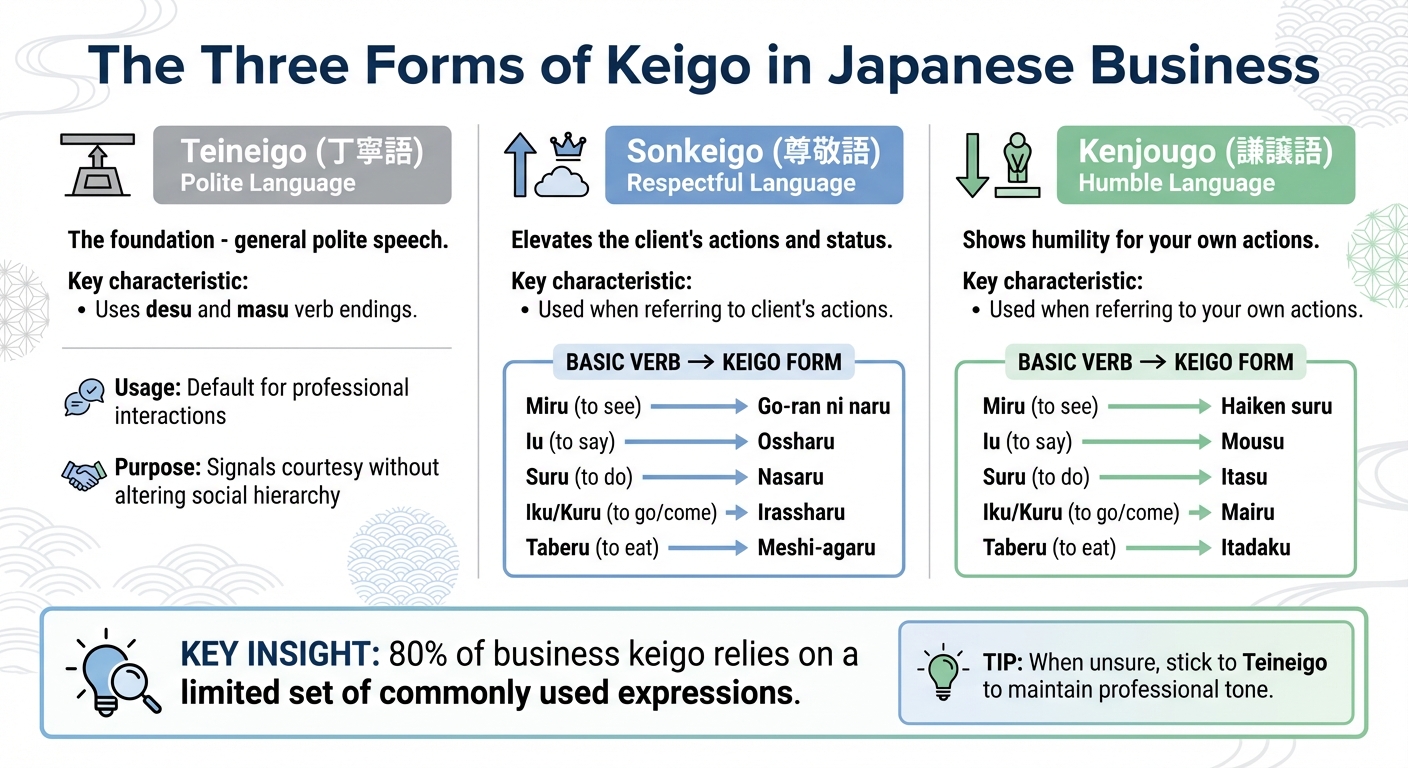
Japanese Keigo Forms Comparison: Sonkeigo vs Kenjougo vs Teineigo
Keigo operates through three distinct forms, each tailored for specific business communication needs. Teineigo (丁寧語) serves as the foundation – polite language characterized by desu and masu verb endings. This is the default for professional interactions, signaling courtesy without altering the social hierarchy. It’s the starting point for navigating the more nuanced elevated and humble forms used in business settings.
Sonkeigo (尊敬語) is used to elevate the actions or status of the person you’re addressing or referring to. For example, when a client reviews your proposal, you would say go-ran ni naru instead of miru. Similarly, if you’re referencing something the client has said, you would use ossharu instead of iu. As expert Ponz explains, keigo goes beyond politeness; it reflects the social hierarchies and relationships at play.
Kenjougo (謙譲語), on the other hand, emphasizes humility by downplaying your own actions. For instance, when presenting to a client, you might say haiken suru (the humble form of "to look") when referring to documents you’ve reviewed, or mousu instead of iu when describing something you said. These distinctions are especially important in interactions with clients. The uchi-soto (in-group/out-group) rule plays a vital role here: even when referring to your own CEO, you would use humble language in front of a client, as they are considered the elevated "out-group."
In practice, mastering keigo is less about perfect grammar and more about using the right phrases in the right context, a key part of localization for SaaS products. Interestingly, about 80% of business keigo relies on a limited set of commonly used expressions. For instance, during a business card exchange (meishi kōkan), you might humbly introduce yourself by saying, "[Name] to moushimasu" (meaning "I am called [Name]"). Similarly, when confirming a client’s request, the phrase kashikomarimashita conveys professional respect. If you’re unsure, sticking to teineigo ensures you maintain a polite and professional tone.
| Basic Verb | Sonkeigo (Client’s Action) | Kenjougo (Your Action) |
|---|---|---|
| Suru (To do) | Nasaru | Itasu |
| Iku/Kuru (To go/come) | Irassharu | Mairu |
| Iu (To say) | Ossharu | Mousu |
| Miru (To see) | Go-ran ni naru | Haiken suru |
| Taberu (To eat) | Meshi-agaru | Itadaku |
sbb-itb-a752276
1. Keigo Usage in Japanese Enterprise Sales
Cultural Relevance
Keigo reflects the deeply rooted hierarchies in Japanese business culture, where respect is shaped by factors like age, seniority, and title. As Paul Smith, Director of Shinka Management, explains:
Japanese business etiquette remains challenging even for native professionals.
This isn’t just about politeness; it’s about recognizing and respecting the client’s elevated status. The philosophy that "the customer is king" is central in Japan. When speaking to a client, sonkeigo (respectful language) is used to honor their actions, while kenjougo (humble language) is used to downplay your own. This delicate balance helps maintain wa (harmony) and avoids unnecessary conflict. These cultural principles form the backbone of daily business interactions.
Practical Application
Given its importance, many Japanese companies train employees in proper etiquette and polite language as part of their onboarding process. For instance, professional emails often begin with, "O-sewa ni natte orimasu" (Thank you for your continued support), to establish a polite tone. Similarly, exchanging business cards follows a precise ritual to build rapport immediately.
Punctuality is another cornerstone of Japanese business culture. Arriving 5–10 minutes early, a practice called the "5-minute prior action" (5-fun mae koudou), showcases respect for the client’s time. Keigo also extends beyond spoken language. For example, handling business cards properly is crucial. Using a meishi-ire (card case) is expected, as Migaku highlights:
In Japan, the card represents the person, so crumpling it or writing on it during the exchange is basically insulting them directly.
These careful practices are more than just formalities – they play a key role in establishing trust and building lasting relationships.
Impact on Trust and Relationships
When used correctly, keigo strengthens trust and creates strong professional bonds. It shows a commitment to understanding the market and the importance of localization and sets you apart from less formal approaches. The Zentern Team underscores this point:
Using the right level of politeness can make just as strong an impression as your actual skills.
While minor mistakes by foreigners are often overlooked, completely ignoring keigo can come across as disrespectful. In Japan, business relationships are seen as long-term commitments, not just transactions. Unlike Western practices that often focus on quick results, Japanese enterprise sales emphasize relationship-building through careful attention to social and linguistic nuances.
Striking the right balance between formality and warmth ensures keigo feels genuine rather than robotic. Observing senior colleagues’ interactions with clients can offer valuable lessons on how to use respectful and humble language effectively. This approach not only fosters trust but also lays the groundwork for enduring partnerships.
2. Nihonium‘s Localization and Sales Support Services
Cultural Relevance
Nihonium takes localization to the next level by weaving cultural understanding into its strategies, helping global SaaS companies connect with Japanese enterprise clients. For instance, they recognize that most Japanese decision-makers prefer conducting business in their native language when exploring new solutions. But this isn’t just about translating words – it’s about grasping the deeper cultural context, like the Uchi-Soto (In-Group/Out-Group) dynamic that shapes interactions. A key part of this is mastering keigo (polite language). Nihonium’s bilingual sales professionals skillfully use Kenjougo (humble language) when discussing their own company or colleagues, signaling respect and showing their dedication to understanding Japan’s unique business culture.
Practical Application
Nihonium’s fractional sales team undergoes extensive training in both business etiquette and keigo to meet the high expectations of Japanese clients. Unlike the often casual, direct communication style favored in the West, Nihonium adopts a more formal, multi-step process. This starts with carefully crafted emails, followed by printed materials, and concludes with polite follow-up calls – methods that align with Japanese business norms. Every interaction, from initial contact to onboarding and ongoing support, is conducted entirely in Japanese. This tailored approach is particularly significant in a market where annual software spending is around $135 billion. By paying attention to these details, Nihonium helps build trust and credibility with Japanese clients.
Impact on Trust and Relationships
The meticulous focus on cultural and linguistic precision not only makes communication smoother but also fosters trust – an essential component of doing business in Japan. Nihonium’s use of keigo and culturally attuned practices plays a central role in this. As highlighted by Harvard Business Review:
Trust-building and rapport are non-negotiable prerequisites in Japanese sales.
Their sales materials and communication strategies are designed to reflect local business norms, which resonates deeply with Japanese buyers. Appen reinforces this point:
Japanese buyers equate true localization with a provider’s long-term commitment to the market.
Pros and Cons
When stepping into the Japanese enterprise market, you’re faced with a key decision: dedicate time to learning keigo (formal Japanese) yourself or rely on professional localization services. Each option comes with its own set of advantages and challenges, which can affect your market entry speed, reputation, and overall costs.
Choosing to master keigo yourself shows dedication and sets you apart from competitors who stick to English. This effort can help establish trust with potential clients. The main cost here is your time, making it an appealing option if you’re working with a limited budget. However, keigo is notoriously difficult – even native speakers often need formal training to use it correctly. For non-natives, achieving fluency typically demands years of immersion in a Japanese business environment.
One significant hurdle is that Japanese business culture emphasizes harmony and avoiding embarrassment, so clients are unlikely to correct your language mistakes. This means you could be making errors without realizing it. Paul Smith, Director at Shinka Management, explains the difficulty:
The reality is that Japanese business etiquette is a topic that is difficult even for Japanese business professionals themselves!
Misusing or overusing formal expressions can make you sound unnatural, potentially damaging the trust you’re trying to build. This complexity makes options for entering the Japanese market a tempting alternative.
On the other hand, services like Nihonium offer immediate access to native-level communication. Their bilingual sales teams manage everything from initial outreach to drafting complex contracts, ensuring both linguistic accuracy and cultural appropriateness. This is particularly crucial since over 80% of Japanese decision-makers prefer interacting with vendors in Japanese when assessing new solutions. While these services come with a higher price tag, the speed and precision they provide can justify the expense in a market valued at approximately $135 billion annually.
| Approach | Learning Keigo Yourself | Nihonium’s Services |
|---|---|---|
| Time to Market | Years of study required | Immediate native-level presence |
| Cost | Low upfront; high opportunity cost | Premium service fees |
| Accuracy | High risk of unnatural or incorrect usage | Native-level nuance guaranteed |
| Credibility | Builds personal rapport through effort | Instant professional authority |
| Documentation | Hard to produce quality materials | Handles complex contracts seamlessly |
| Relationship Building | Limited by language barriers | Navigates consensus-driven committees |
This breakdown highlights the balance between investing time to build skills and gaining instant credibility in Japan’s business landscape.
Conclusion
Keigo is more than just a formality in Japan – it’s a cornerstone of building trust in the enterprise software market. Using the right level of formal language demonstrates respect for hierarchy and strengthens credibility with Japan’s consensus-driven buying committees. Without this cultural sensitivity, even a top-tier product can come across as out of touch.
Mastering keigo takes significant effort and a strong grasp of Japanese business etiquette. It’s not just about knowing the rules – it’s about understanding the nuances and avoiding missteps like awkward phrasing or inappropriate levels of formality. Combining this cultural awareness with skilled execution is key to thriving in Japan’s business landscape.
Companies like Nihonium help bridge this cultural gap. Their bilingual sales teams handle everything from initial outreach to intricate contract negotiations. More than just translators, they adapt workflows, ensure APPI compliance, and create materials tailored to Japanese business standards. This is critical because over 80% of Japanese decision-makers prefer to work with vendors who communicate in their native language when evaluating solutions.
The best approach combines cultural understanding with professional precision. By mastering keigo and Japanese etiquette, you align with client values. Pair this with expert services for seamless communication, and you’ll be well-positioned to build the long-term relationships that are vital in Japanese enterprise sales.
As Appen notes, “Japanese buyers equate true localization with a provider’s long-term commitment to the market”. Getting the language right isn’t just important – it’s essential for making a lasting impression in Japan.
FAQs
When should I use sonkeigo vs kenjougo?
In Japanese business communication, sonkeigo (respectful language) and kenjougo (humble language) play a crucial role in showing respect and maintaining professionalism.
- Sonkeigo is used to elevate the status of the person you’re speaking to, such as a client or a superior. This form of speech emphasizes their importance and is a way to show deference.
- Kenjougo, on the other hand, is used to lower or humble yourself when referring to your own actions. It demonstrates modesty and places the focus on the other party.
Mastering these forms is essential for building trust and fostering strong professional relationships in Japanese workplaces.
What keigo phrases matter most in sales calls and emails?
The most important keigo phrases for sales calls and emails convey respect, humility, and professionalism. These phrases often include honorific forms and polite expressions tailored for formal interactions. Using this kind of language not only demonstrates cultural awareness but also helps establish trust and strengthen business relationships with Japanese clients.
How can I avoid keigo mistakes if clients won’t correct me?
To avoid common pitfalls with keigo, start by getting a solid grip on the basics – especially the honorific and humble forms. These are the foundation of polite Japanese speech. Always aim to maintain a respectful and formal tone in your interactions.
Incorporate polite language, use appropriate formal titles, and lean on indirect phrasing to express respect effectively. It’s also helpful to regularly review commonly used expressions and practice them in real-life scenarios. Even if you don’t receive feedback from clients, consistent practice will help you improve over time.
 English
  Japanese