

The Japanese SaaS market is growing rapidly, projected to reach ¥2 trillion by 2027 with a 25% annual growth rate. However, only 34% of SMEs have adopted SaaS solutions, presenting a huge opportunity for companies willing to navigate Japan’s unique business culture. Success requires understanding key factors like consensus-driven decision-making (Ringisho), a strong emphasis on trust (shinrai), and the importance of localization beyond just translation.
Key Takeaways:
- Decision-Making: Japanese buyers prefer detailed research and documentation over quick demos. Tailored content and local case studies are essential.
- Localization: Proper use of language, cultural norms, and even script choices (Kanji, Hiragana, Katakana) impact user engagement.
- Trust: Long-term reliability and local social proof are critical for building relationships.
- Sales Approach: Shifting from Product-Led Growth (PLG) to Sales-Led Growth (SLG) often works better, focusing on downloadable documents and role-specific content.
Case Studies:
-
Wondershare Filmora:
- Achieved market leadership by combining online SEO efforts with offline retail presence in 200+ stores.
- Partnered with local influencers and ran campaigns tailored to Japanese preferences.
-
CloudTech Solutions:
- Increased organic traffic by 320% through localized SEO and keyword strategies.
- Boosted trial signups by 45% with dual CTAs catering to Japanese user behavior.
-
Cloud Security SaaS:
- Secured enterprise clients by aligning messaging with local IT pain points and using role-specific content.
- Partnered with niche B2B publishers to build credibility.
Lessons for Success:
- Use local expertise and fractional sales support to manage costs.
- Prioritize downloadable resources and local case studies.
- Build trust by addressing Japanese-specific concerns and preferences.
Japan offers immense potential for SaaS companies, but thriving here requires patience, deep localization, and a long-term approach.
Case Study: Wondershare Filmora‘s Market Leadership
Wondershare Filmora secured the top spot in Japan’s creative software market after 14 years of closely studying local consumer behavior. Recognizing the Japanese preference for face-to-face interactions, Filmora crafted a strategy that blended a strong online presence with a notable offline footprint. Today, the brand is featured in over 200 major retail stores across Japan, including Bic Camera, Yodobashi Camera, and Yamada Denki. This effort is supported by a network of more than 5,600 partners and 30 agents. On the digital front, Filmora’s local content team produced over 500 SEO-optimized articles, driving millions of visitors to their platform and achieving an impressive 85%+ success rate in securing top keyword rankings. This multi-faceted strategy laid the groundwork for further localized marketing efforts.
Localized Marketing and Partnerships
Filmora’s success in Japan is also tied to its ability to align with local preferences and cultural nuances. The company partnered with pixiv, a leading platform for anime and illustration enthusiasts, and collaborated with influencers like YouTuber Kazuki no Tane to strengthen its reputation within Japan’s creative community.
In December 2024, Wondershare launched its "A New Wonder to Share" campaign in Tokyo’s vibrant Shibuya district. This campaign utilized Shibuya’s iconic digital screens, physical advertisements on the Yamanote and Yokosuka · Sōbu train lines, and an online video challenge. The challenge encouraged participants to create 20-second videos using Filmora 14, offering prizes like iPads and ¥20,000 gift cards.
Filmora’s retail strategy further emphasized its local focus. In December 2025, the company introduced Filmora V15 to over 200 stores, complete with dedicated counters. These counters allowed customers to interact with the software’s AI-driven features and offered flexible purchasing options, including cross-platform permanent licenses and subscriptions. Speaking about the importance of physical retail, the Head of Wondershare Technology’s Japanese Market noted:
"Physical retail channels remain a key scenario for Japanese consumers to learn about and make purchasing decisions regarding digital creative software products. These channels complement online platforms and assist users in making clearer choices"
.
sbb-itb-a752276
Case Study: SEO-Driven Growth for a Project Management SaaS
In March 2025, US-based CloudTech Solutions ventured into the Japanese market with its project management platform. Over the next 12 months, the company achieved a staggering 320% increase in organic traffic from Japan, thanks to a well-executed localized SEO strategy. This approach centered on understanding how Japanese users search for business software, with a strong focus on local search habits and preferences.
To align with local search intent, the team conducted in-depth keyword research across multiple scripts, including Kanji, Hiragana, Katakana, and alphanumeric characters. By adapting page titles, meta descriptions, and header tags to formal Japanese, they tailored their content to resonate with Japanese users. This meticulous localization not only boosted organic visibility but also significantly improved user engagement.
320% Increase in Organic Traffic
CloudTech’s SEO efforts delivered impressive results, with over 85% of target keywords achieving top-three rankings. The company created detailed, localized technical content tailored to Japan’s unique decision-making process, known as "Ringisho." This process involves multiple stakeholders reviewing comprehensive documentation before making purchasing decisions. To cater to this, CloudTech developed information-rich landing pages, clearly segmented and designed to meet Japanese users’ preference for structured, detailed content.
Additionally, the team optimized their pages for mobile devices and ensured fast loading times – a critical factor for user satisfaction. They also used Japan-specific keyword research tools and Google Japan Search Console to refine their strategy, accounting for variations in search volume across different script forms. With the surge in organic traffic, CloudTech fine-tuned its conversion strategy to better engage Japanese users.
45% Boost in Trial Signups
The traffic increase translated into a 45% rise in trial signups, driven by the addition of a secondary call-to-action (CTA) for "Download Documents" (資料ダウンロード) alongside the primary trial offer. This dual-CTA approach aligned perfectly with Japanese user behavior. As Yuga Koda, Co-founder of Nihonium, explained:
"Most Japanese leads enter through the documentation path first… the first instinct isn’t, ‘Let me hop on a demo…’ Instead, it’s, ‘Let me do a bunch of research… and then book a demo.’"
CloudTech also prioritized rapid response times, ensuring inquiries were addressed within five minutes during business hours. This responsiveness helped build trust, a crucial factor in converting organic traffic into qualified leads, and allowed the company to outperform its results in other markets.
Case Study: Cloud Security SaaS and Enterprise Client Acquisition
In 2024, a U.S.-based cybersecurity and cloud-automation company realized its North American messaging fell flat with Japanese enterprise buyers. The issue? Their content highlighted problems that Japanese organizations didn’t see as urgent. To bridge this gap, they teamed up with Edamame Japan to address the "messaging disconnect." The solution involved shifting their focus to challenges that resonated more with Japanese IT professionals, such as operational load (運用負荷), cost optimization (コスト最適化), compatibility with existing systems (既存環境との整合性), and verification man-hours (検証工数). By educating the market on these concerns, the company laid the groundwork for a complete overhaul of its localized content strategy.
Localized Content and Documentation
To fix their messaging disconnect, the company revamped its Japanese landing page to include role-specific content tailored for IT managers, cloud architects, and MSPs. Each section aligned with Japan’s consensus-driven Ringisho process, where decisions often require approval from multiple stakeholders, even those who won’t directly use the product.
Instead of relying on direct "sign-up" calls-to-action, the company shifted to a two-step conversion strategy. This involved offering downloadable assets (資料請求) as the first step, followed by sales meetings (商談). Case studies were also reworked to reflect a Japanese storytelling style, emphasizing credibility and social proof – key factors for winning over enterprise clients.
To reach decision-makers, they partnered with niche, respected B2B tech publishers like CloudWatch, which specializes in cloud and security sectors. This targeted approach was critical, given the unique dynamics of the Japanese market. For instance, cold calling in Japan typically has a success rate of just 2%, while LinkedIn – though smaller in reach – boasts around 3 million monthly active users in the country. These strategic adjustments enabled the company to make significant gains in a challenging market.
First Client in 3 Months
The results came quickly. Within three months, the company began receiving steady inbound leads from its target audience. The success transformed internal perceptions of Japan from being "complex" to "scalable." By combining localized messaging, role-specific content, and partnerships with trusted publishers, the company demonstrated that enterprise client acquisition in Japan can happen faster with the right positioning.
A similar success story comes from Integrate.io, a no-code data pipeline platform. By working with Nihonium, they localized their marketing website and content for Japanese data management teams. They also introduced a five-minute response time for chat inquiries and hosted educational webinars (勉強会) to nurture leads. These efforts paid off, resulting in major enterprise wins, including one of Japan’s largest advertising firms and a globally recognized auto manufacturer [Nihonium Case Studies, 2024].
Key Lessons for SaaS Positioning in Japan
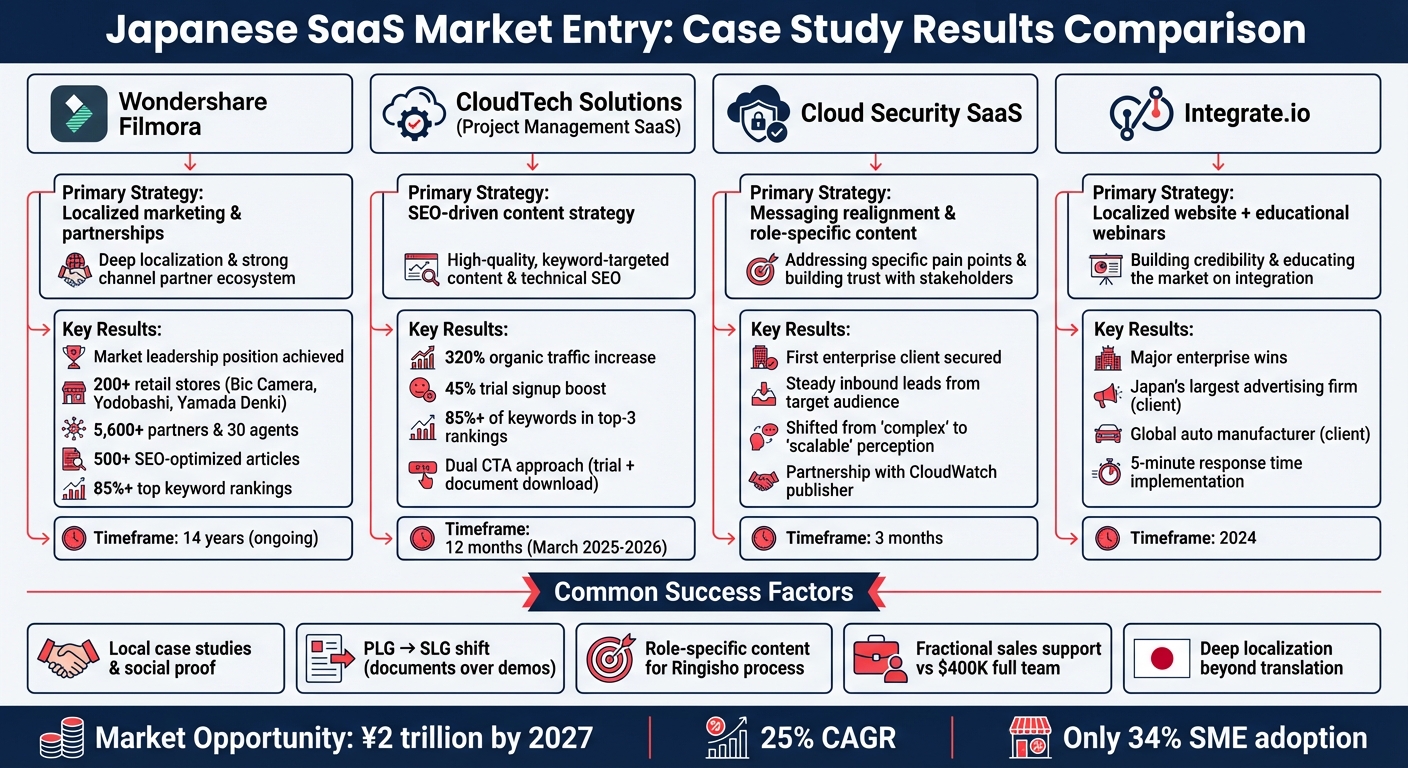
Japanese SaaS Market Entry: Case Study Results Comparison
Common Strategies Across Case Studies
The case studies highlight a clear takeaway: succeeding in Japan demands more than just translating your materials – it requires adapting to local business practices. Companies that thrived in Japan didn’t just tweak their messaging; they restructured their strategies to align with Japanese business norms. This goes beyond language, involving unique workflows and presentation styles tailored to the market’s expectations.
Building trust through social proof stands out as the most influential factor. Japanese buyers place a high value on local case studies to establish credibility. Interestingly, about 50% of SaaS companies offer discounts to Japanese clients in exchange for agreeing to participate in a case study. As Yuga Koda from Nihonium aptly states:
"If the case study didn’t happen in Japan, it didn’t happen at all"
.
Another recurring insight is the need to shift from Product-Led Growth (PLG) to Sales-Led Growth (SLG). While PLG works well in other markets, companies operating in Japan often transition to a sales-led or hybrid model to accommodate the Ringisho, a consensus-driven decision-making process. This shift involves offering downloadable documents instead of direct sign-up options, enabling internal advocates to secure approval from multiple stakeholders.
Additionally, fractional sales support has proven to be a cost-effective solution for managing Japan’s long sales cycles. Instead of incurring the hefty $400,000 upfront cost of establishing a full local sales team, companies rely on fractional experts. These professionals are skilled in navigating procurement processes and delivering the formal communication style expected by Japanese enterprise clients.
These combined strategies provide a clear framework for tackling the challenges of entering the Japanese market.
Results Comparison Table
| Company | Primary Strategy | Key Metric | Timeframe |
|---|---|---|---|
| Wondershare Filmora | Localized marketing & partnerships | Market leadership position | Ongoing |
| Project Management SaaS | SEO-driven content strategy | 320% organic traffic increase, 45% trial signup boost | Not specified |
| Cloud Security SaaS | Messaging realignment & role-specific content | First enterprise client secured | 3 months |
| Integrate.io | Localized website, sub-5-minute response times, educational webinars | Major enterprise wins (advertising firm, auto manufacturer) | 2024 |
Conclusion: Planning Your Japan Market Entry
The case studies highlight a key takeaway: succeeding in Japan requires long-term planning and deep localization. As Kiefer Szurszewski from Embed Workflow puts it, "It takes real budget, real execution, and a long-term mindset". The companies that thrived in this market didn’t just adapt – they committed fully to understanding and meeting local needs.
To craft your entry strategy, start by confirming the market’s potential. Look for organic Japanese traffic in your analytics or inbound leads from the region. If you’re not seeing any signals, it’s wise to pause and identify specific market needs before diving in. However, if the data supports it, take deliberate steps: focus on showcasing local case studies instead of relying on global logos, adjust your calls-to-action from "Book a Demo" to "Download Documents", and prepare for the consensus-driven Ringisho process, which is central to Japanese enterprise decision-making.
The opportunity is clear: Japan’s SaaS market is projected to hit ¥2 trillion by 2027, growing at a 25% CAGR. To tap into this potential, you’ll need more than just technical readiness – you’ll need patience and a genuine understanding of local business practices.
Start small. Instead of jumping into a $400,000 full-scale local operation, begin with fractional resources. Hire local sales experts who know the procurement landscape, localize your documentation if full product adaptation isn’t ready, and build trust by offering Japanese-speaking support and domestic data hosting.
The formula for success in Japan is straightforward but demanding. Companies that respect the market’s nuances – its emphasis on thorough research, reliance on local social proof, and focus on building long-term relationships – consistently outperform those that treat Japan as just another market on their expansion list.
If you’re serious about succeeding in Japan, lean on localized expertise. Partner with Nihonium for tailored go-to-market strategies, product localization, and fractional sales support to guide you through the complexities of this unique business environment.
FAQs
How do I know if Japan is worth prioritizing for my SaaS?
Japan’s SaaS market is currently valued at $10.6 billion (2023) and is expected to reach $15.8 billion by 2027. This growth presents a promising opportunity for companies willing to invest in localization and building strong relationships.
However, success in Japan requires a patient approach. Sales cycles in the region typically span 12 to 24 months, so businesses need to focus on earning trust, adapting to local preferences, and offering solutions tailored to the unique needs of Japanese customers.
For SaaS companies ready to make this commitment, Japan is a market that holds immense potential.
What should I localize first beyond translating my website?
After translating your website, the next step is localizing your products and services to align with Japanese workflows, regulations, and expectations. Japanese users often favor products that feel personalized and are presented in their native language. Beyond that, adapt your marketing content to resonate with local audiences. This approach not only helps you connect with potential customers but also builds trust, which can play a big role in the success of your market entry.
What’s the fastest way to build trust with Japanese buyers?
The quickest way to earn trust with Japanese buyers is by showing a solid local presence and a genuine commitment to the market. This means fully adapting your product – its interface, support, and documentation – to fit the Japanese language and align with local customs. Building personal connections, adhering to proper business etiquette, and collaborating with well-regarded local partners can also strengthen your credibility, making it easier to navigate the market and establish trust.
Related Blog Posts
- AI in Japan SaaS: Market Insights
- Why Long-Term Commitment Matters in Japan SaaS Sales
- 5 Ways Consensus Shapes SaaS Market Entry in Japan
- 5 Customer Acquisition Tips for SaaS in Japan
 English
  Japanese