

Silence in Japanese business meetings isn’t just the absence of words – it’s an active communication tool. It reflects deep thought, respect, and alignment among stakeholders. Misinterpreting these pauses as disinterest or hesitation can lead to tension, especially for those used to quick feedback. Instead, silence often signals internal reflection, risk assessment, or consensus-building.
Key points to know about silence in Japanese business settings:
- Respect and Harmony: Silence shows deference, especially to authority figures or elders.
- Decision-Making: Quiet moments allow for thorough consideration and internal discussions.
- Agreement or Disagreement: Silence can signal either, depending on context and follow-up actions.
- Non-Verbal Cues: Body language and context are critical for interpreting silence.
- Negotiation Strategy: Silence can break fixed thinking patterns and foster better outcomes.
For global professionals, understanding and respecting these pauses can improve collaboration and trust. To navigate this effectively, focus on clarifying processes, asking about next steps, and observing non-verbal signals. Patience and cultural awareness are key to building stronger partnerships in Japanese business environments.
Why Silence Matters in Japanese Culture
To grasp the role of silence in Japanese business meetings, it’s essential to delve into the cultural values that shape communication. Silence isn’t just the absence of words – it carries deep cultural significance rooted in history.
Silence as Harmony and Respect
In Japan, silence embodies wa (harmony) and serves as a sign of respect. Speaking sparingly reflects maturity and careful consideration, especially in interactions with authority figures or elders. In these contexts, silence often communicates deference and thoughtfulness.
"In traditional Japanese culture, silence is valued as a way to convey respect for others, especially those in positions of authority or seniority." – Martin Giles, Business Branding Specialist
Silence also plays a role in avoiding conflict. Instead of openly disagreeing, professionals often use silence as a way to gracefully exit a disagreement without confrontation. For instance, a silent bow in apology demonstrates humility while preserving the dignity of all parties involved. This approach shifts the responsibility to the listener to interpret the unspoken message, a practice deeply influenced by Japan’s spiritual traditions.
Zen Buddhism and Confucianism‘s Influence on Silence
The emphasis on silence in Japanese culture is heavily influenced by Zen Buddhism. In Zen, silence is central to practices like zazen (seated meditation) and is woven into traditional arts such as tea ceremonies, Noh theater, and martial arts. In Noh, for example, an actor might hold a silent pause for several seconds to heighten emotional intensity.
This cultural appreciation for silence is instilled early in life, with children learning its value at home, in school, and later in professional settings. These spiritual and artistic traditions continue to shape how silence is perceived and practiced in modern Japan.
sbb-itb-a752276
What Silence Means in Japanese Business Meetings
Silence plays a unique and nuanced role in Japanese business meetings. Unlike in many Western settings – where silence can suggest confusion or lack of interest – Japanese professionals use it deliberately as part of their communication style. Let’s explore how this quiet strategy is applied and what it often signifies.
Silence for Thinking and Consideration
When Japanese colleagues go quiet after hearing a proposal, it’s often a sign that they’re giving your ideas serious thought. In Japanese corporate culture, silence isn’t about indifference; it reflects a need for careful consideration. This pause often signals the beginning of an internal review process, which may involve informal discussions, consulting senior stakeholders, or aligning with other departments.
Rather than rushing to answer, Japanese professionals prioritize thorough consultation. For those used to fast-paced decision-making, this approach might seem slow, but it’s all about reducing risks and ensuring consensus.
Silence as Agreement or Disagreement
One of the trickiest parts of interpreting silence is determining whether it shows agreement or polite resistance. The key often lies in whether a specific process is mentioned.
- Healthy silence: Happens when a clear next step is outlined, such as consulting a department head.
- Avoidant silence: Occurs when responses remain vague and no process is defined.
"Healthy silence → process is named. Avoidant silence → process remains vague." – Shawn, Inside Japanese Work Culture
Instead of pushing for a direct "yes" or "no", try asking, "What internal process will move this forward?" This approach shifts the focus from seeking emotional affirmation to clarifying actionable steps, aligning better with Japanese communication norms.
Reading Body Language and Context
Silence in Japanese meetings is rarely just about the absence of words. Non-verbal cues and context help complete the picture. Pay attention to body language and follow-up actions to understand whether silence is constructive. For instance, if colleagues suggest scheduling a follow-up after internal discussions, it’s a good sign. On the other hand, if they consistently avoid questions and offer no timeline, it may indicate disagreement.
"If you misread it, you accelerate tension. If you understand it, you accelerate trust." – Shawn, Inside Japanese Work Culture
Hierarchy also plays a role. Participants might stay silent out of respect for senior colleagues or while waiting for their input. Understanding these dynamics is essential to building trust and fostering collaboration in Japanese business environments.
Research Findings on Silence in Japanese Business
Academic studies highlight that silence plays a purposeful role in Japanese business, challenging many Western assumptions. Recent findings build on earlier perspectives of silence as a deliberate communication strategy, particularly its influence on negotiations and the potential for miscommunication in international contexts. Research from institutions like MIT demonstrates that silence is not merely a cultural trait but a strategic tool with measurable effects on decision-making and negotiation outcomes. Let’s dive into how silence actively shapes negotiation dynamics.
Using Silence in Negotiations
Research led by Jared R. Curhan, a professor at MIT Sloan School of Management, reveals that silence can be a powerful asset in negotiations. His studies show that pauses lasting 3 seconds or more help negotiators break free from "fixed-pie" thinking – the belief that one party’s gain must come at the other’s expense. Instead, silence encourages a more thoughtful approach, allowing both sides to process information deeply and uncover solutions that benefit everyone involved.
"Extended silence increases value creation by interrupting default, fixed-pie thinking, and fostering a more deliberative mindset." – Jared R. Curhan, Professor at MIT Sloan School of Management
Interestingly, Curhan’s research also highlights the role of hierarchy. When individuals in higher-status positions use silence, it tends to lead to better outcomes. However, the same effect isn’t observed when silence comes from lower-status participants. This finding aligns with Japan’s hierarchical business culture, where senior executives often pause before speaking, while junior staff wait respectfully for their input. In contrast to Americans, who generally tolerate only 1- to 2-second pauses, Japanese negotiators have been observed remaining silent for up to 20 minutes before finalizing deal terms.
Curhan’s team also discovered that instructing negotiators to incorporate silence into their strategy was more effective at creating value than simply encouraging them to focus on problem-solving.
Common Misinterpretations of Silence
Despite its benefits, silence is often misunderstood in cross-cultural settings. Research by Mimi Murayama highlights that Japanese professionals view silence as an active signal, while U.S. participants often perceive it as passive.
"Japanese interpret silence as a communicative symbol that must be actively interpreted." – Mimi Murayama, Portland State University
This difference can lead to significant miscommunication. For example, a 2004 case study published in Corporate Communications: An International Journal examined a meeting between a U.S. manager, a Japanese manager, and a Japanese junior staff member. Researcher Misa Fujio documented how "pragmatic transfer" – when Japanese professionals apply their native communication norms to English-language interactions – caused direct misunderstandings and clashing politeness strategies.
Japanese professionals often use silence to signal respect or careful thought. However, Western counterparts frequently fail to interpret this correctly, leading to confusion or uncertainty that can disrupt negotiations. Adding to the complexity, U.S. participants in comparative studies tended to view silence more favorably than Japanese participants in most situations but still missed its active and symbolic nature.
How to Handle Silence in Japanese Business Meetings
Dealing with silence in Japanese business meetings requires a shift in perspective. For SaaS companies and global businesses collaborating with Japanese partners, the goal isn’t to eliminate silence but to interpret it and turn it into actionable steps. Instead of seeing silence as a communication breakdown, view it as an intentional phase for internal reflection and alignment.
Building Awareness of Japanese Communication Norms
The first step is to resist the urge to fill the silence. When a pause occurs in a meeting, let it be. Jumping in too quickly can signal unease and disrupt the reflective process that Japanese teams often rely on. Staying composed during these moments demonstrates respect for their approach to decision-making.
"The skill isn’t to eliminate silence. It’s to translate it." – Shawn, Inside Japanese Work Culture
If the silence stretches beyond what feels natural, focus on clarifying the process rather than pushing for immediate answers. Asking something like, "What internal process would help move this forward?" acknowledges the importance of informal discussions and cross-departmental alignment that often precede decisions in Japanese companies. To avoid confusion, establish clear timelines by scheduling follow-ups, ensuring everyone understands when internal alignment will transition to execution.
To further reduce ambiguity, you can ask, "Shall we define when alignment ends and execution begins?" This distinction helps both sides stay on the same page about what happens during these quiet periods. When reporting to Western stakeholders, reframing these pauses as part of an "internal alignment phase" can help them see the value in this deliberate approach, which often leads to more calculated and lower-risk actions.
Understanding silence also means paying attention to non-verbal signals, which often provide additional context.
Combining Verbal and Non-Verbal Signals
Silence doesn’t exist in a vacuum. Non-verbal cues like tone, facial expressions, and body language are essential for interpreting its meaning. For example, a slight nod during a pause might indicate agreement, while a lack of eye contact could suggest discomfort or disagreement.
It’s also important to distinguish between productive silence and avoidant silence. Productive silence occurs when the process is clear – stakeholders are consulting, weighing risks, or aligning internally. Avoidant silence, on the other hand, happens when the process remains unclear, questions are sidestepped, and follow-ups fail to provide clarity. If you sense avoidant silence, it may indicate resistance rather than thoughtful deliberation.
"If you misread it, you accelerate tension. If you understand it, you accelerate trust." – Shawn, Inside Japanese Work Culture
Combining verbal techniques with an acute awareness of these non-verbal cues allows for a more nuanced understanding of silence in meetings.
Working with Localization Experts
Successfully navigating these nuances often requires the help of localization experts. These professionals can help global teams understand that silence in Japanese business culture is often an "invisible phase" of internal alignment, involving private discussions, risk assessments, and stakeholder confirmations. Without this insight, teams might misinterpret silence, potentially disrupting the process and damaging trust.
Localization experts are also invaluable in identifying whether silence is productive or avoidant, offering guidance on when to proceed and when to address potential resistance.
For SaaS companies entering the Japanese market, services like Nihonium provide the support needed to bridge cultural gaps. Their expertise ensures that silence is seen as a strategic step in the process rather than a communication issue. By offering tailored localization and go-to-market strategies, they help global teams navigate Japanese business norms, fostering smoother collaboration and stronger partnerships.
Japanese vs. Western Attitudes Toward Silence
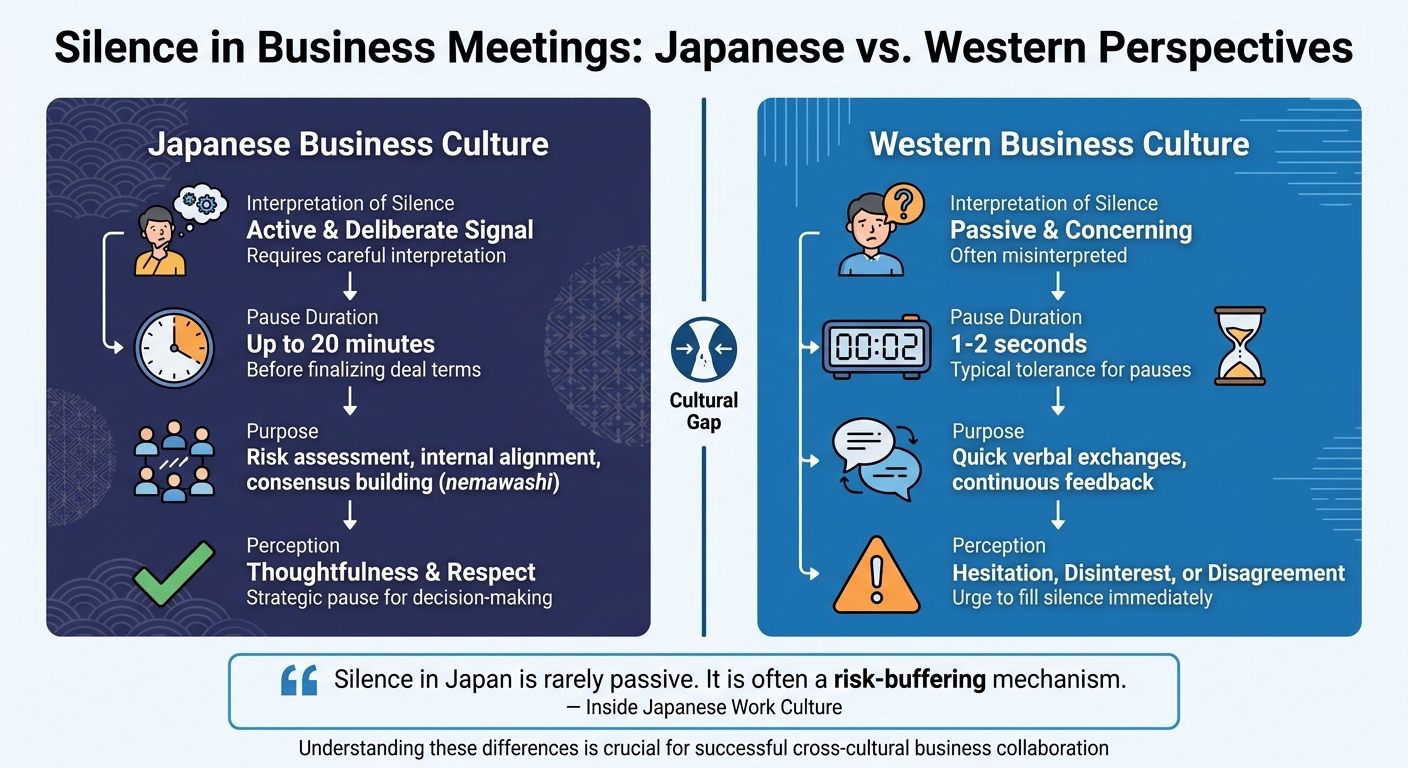
Japanese vs Western Business Meeting Silence: Cultural Differences in Communication
Silence in business meetings highlights a striking difference between Japanese and Western cultures. In Western settings – especially in the United States – silence often raises alarm bells. It can be perceived as a sign of hesitation, disinterest, or even disagreement. When discussions go quiet, Western participants usually feel an urge to jump in, filling the silence to keep the conversation flowing and to show they’re engaged. This cultural tendency contrasts sharply with Japanese norms, offering insight into the importance of localization and how silence shapes decision-making and meeting dynamics.
Silence as Thoughtfulness vs. Uncertainty
Studies comparing Japanese and American business professionals reveal that silence carries very different meanings. Japanese professionals tend to see silence as "active", interpreting it as a deliberate signal that requires careful understanding. When a Japanese team becomes silent during a meeting, they are often deep in thought – assessing risks, respecting hierarchical boundaries, and figuring out what internal alignment is needed before giving a response.
"Silence in Japan is rarely passive. It is often a risk-buffering mechanism." – Shawn, Inside Japanese Work Culture
In contrast, Western teams prioritize quick verbal exchanges, viewing rapid responses as a sign of decisiveness and efficiency. Silence, in this context, disrupts the flow of conversation and can create discomfort. Western participants may push for immediate answers, unintentionally clashing with the Japanese approach, where silence is seen as a crucial part of the decision-making process.
How Silence Affects Decisions and Meeting Flow
These cultural differences in interpreting silence have a direct impact on decision-making and how meetings progress. In Western meetings, continuous verbal feedback is expected. Silence often leads to what’s called the "illusion of agreement", where the speaker assumes everyone is on board simply because no one speaks up. On the other hand, in Japanese meetings, silence is an intentional part of the process. It allows for nemawashi – the practice of building consensus – and helps avoid direct conflict or abrupt refusals.
Japanese teams use these pauses to hold private discussions, consult senior leaders, and ensure alignment across departments. To Western observers, this might look like a lack of progress, but it’s actually a strategic pause. Misinterpreting these moments as inaction can lead to unnecessary escalation and damage trust. By understanding silence as a purposeful tool rather than a sign of disengagement, global teams can navigate these cultural differences more effectively and build stronger, more collaborative partnerships.
Key Takeaways for SaaS Companies Entering Japan
Adapting to Japanese Communication Patterns
When entering Japan, understanding the role of silence in decision-making is crucial for SaaS companies. Silence isn’t a sign of disinterest or indecision – it’s a structured part of the process. During these quiet moments, Japanese teams evaluate risks, consult stakeholders, and build consensus through the Ringisho method. While it might feel slow at first, this deliberate approach can lead to smoother execution later on.
In meetings or presentations, make room for these pauses. Allow time for participants to process information, form questions, and even translate their thoughts internally. Instead of pushing for an immediate "yes" or "no", ask about the steps needed to move forward. Set clear expectations for pauses and frequent alignment checks, and build time for behind-the-scenes consultations into your project timeline .
"If you misread it, you accelerate tension. If you understand it, you accelerate trust." – Shawn, Inside Japanese Work Culture
Recognizing the difference between productive silence (where internal discussions are happening) and avoidant silence (where there’s no clear progress) is key. When reporting delays to your global team, frame them as part of a risk-evaluation process that strengthens partnerships, helping everyone understand the long-term benefits of this approach.
These strategies are essential for navigating Japan’s business environment effectively.
Using Professional Localization Services
To put these insights into practice, professional localization services are invaluable. Adapting to Japanese communication norms goes beyond language translation – it requires a deep understanding of cultural nuances. For instance, knowing whether silence reflects thoughtful internal processing or resistance can make or break your approach. As Shawn from Inside Japanese Work Culture explains:
"The skill isn’t to eliminate silence. It’s to translate it." – Shawn, Inside Japanese Work Culture
Services like Nihonium specialize in helping SaaS companies tackle these challenges. They offer Japan-specific go-to-market expertise, including tailored marketing strategies, localized communication methods, and fractional sales support. Their team understands when to pause and when to push forward, turning cultural differences into opportunities to build trust and gain a competitive edge. Working with experts ensures your strategy aligns with Japanese business norms, paving the way for success in this unique market.
FAQs
How long should I wait in silence before I speak up?
In Japanese business meetings, a brief moment of silence before speaking is customary. This pause isn’t about uncertainty or hesitation – it often signals careful listening or a thoughtful approach to negotiation. Respecting this practice not only aligns with the local norm but also helps foster clearer and more respectful communication.
How can I tell if silence means “yes” or “no”?
In Japanese business culture, silence carries a different meaning than it might in other contexts. It often reflects thoughtfulness, politeness, or the need for more time to process information. Unlike in some cultures, silence shouldn’t be taken as a straightforward sign of agreement or disagreement.
Instead of assuming silence means a "yes" or "no", view it as an opportunity. It may indicate the need for further reflection or that additional context could help clarify the situation. Allowing this space can lead to better communication and mutual understanding.
What’s the best question to ask after a long pause?
In Japanese business meetings, a great way to re-engage the conversation after a long pause is by asking, "Do you have any thoughts or comments?" This question invites input while honoring the value placed on silence and careful listening in Japanese communication.
 English
  Japanese