

Japanese and Western meeting styles differ in formality, hierarchy, communication, and preparation. Japanese meetings emphasize respect, structure, and indirect communication, while Western meetings are more casual, egalitarian, and direct. Key distinctions include:
- Business Cards: In Japan, exchanging cards is formal and symbolic. In the West, it’s casual.
- Hierarchy: Japanese seating reflects rank, with senior members in the seat of honor. Western seating is flexible.
- Communication: Japan values indirectness and silence, while the West prefers directness and open discussion.
- Punctuality: Arriving 10–15 minutes early is expected in Japan; in the West, 5 minutes early suffices.
- Preparation: Japanese meetings often confirm decisions made earlier, while Western meetings focus on real-time problem-solving.
Quick Comparison:
| Aspect | Japan | West |
|---|---|---|
| Business Cards | Formal, symbolic exchange | Casual exchange |
| Hierarchy | Strict seating and speaking order | Flexible seating, open contributions |
| Communication | Indirect, silence shows thoughtfulness | Direct, open discussions |
| Punctuality | Arrive 10–15 minutes early | Arrive 5 minutes early |
| Preparation | Decisions made beforehand, formal approval | Real-time decision-making |
Understanding these differences is crucial for building trust and avoiding misunderstandings in cross-cultural business settings.
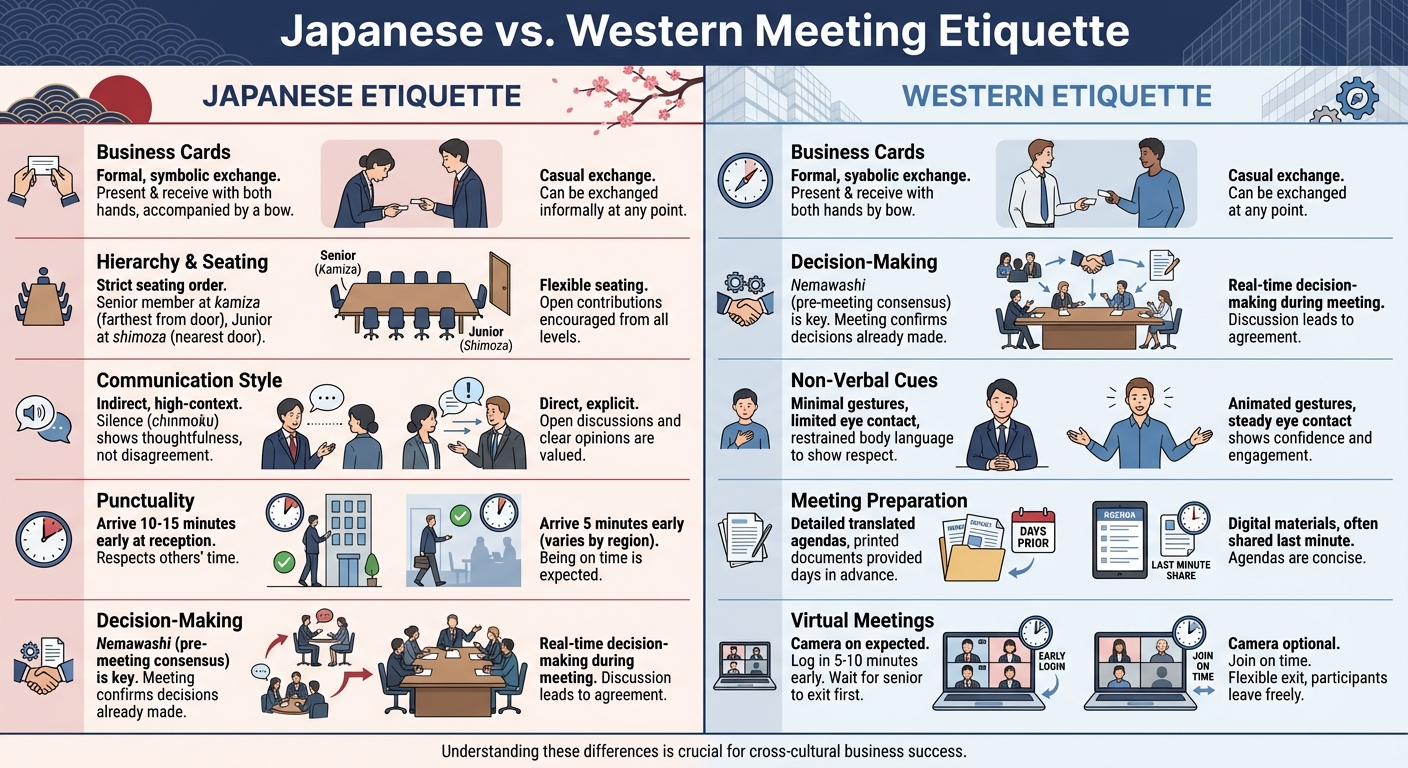
Japanese vs Western Meeting Etiquette: Key Differences Comparison Chart
Formality and Hierarchy in Meetings
Formality and Respect
Meetings in Japan carry a level of formality that often surprises those accustomed to Western business practices. The foundation of Japanese business culture rests on hierarchy (jouge kankei), harmony (wa), and an unspoken skill known as "reading the atmosphere" (kuuki wo yomu). Every detail, from the depth of a bow to the use of honorifics, plays a role in showing respect. For example, bows vary depending on the context – 15° for casual interactions, 30° for business situations, and a deep 45° for formal occasions. Addressing colleagues also follows strict rules: you always use the suffix "-san" for others, but never for yourself or your own team when speaking to external parties.
This emphasis on respect extends beyond words to physical arrangements, particularly in how seating is organized during meetings.
Hierarchy and Decision-Making
Seating in Japanese meetings is a visual representation of the company’s hierarchy. The most senior person occupies the kamiza – the seat of honor farthest from the door – a tradition rooted in Samurai-era practices, where leaders sat away from potential threats. Meanwhile, the junior-most team member takes the shimoza, the seat nearest the door, and is responsible for greeting guests and managing refreshments. As EJable highlights, this arrangement underscores the seniority of the person seated farthest from the entrance.
In Western settings, particularly in the U.S., seating tends to be more flexible. Arrangements are often based on convenience or informal power dynamics, like sitting at the head of the table or in a central position. Additionally, a hallmark of Western meetings is the encouragement for employees at all levels to contribute their opinions, even if they challenge those of their superiors.
The way decisions are made further highlights the contrast. In Japan, meetings often serve as ceremonial approvals. The actual decision-making happens beforehand through nemawashi, a process of behind-the-scenes consensus-building. In Western meetings, decisions are frequently made on the spot, driven by the person in charge or through majority voting. For SaaS companies looking to expand into Japan, this difference is critical to understand. What might take a single meeting in San Francisco could require weeks of careful relationship-building and preparation in Tokyo. These structured protocols reflect the broader contrasts in how Japanese and Western meeting cultures operate.
sbb-itb-a752276
Communication Styles and Expectations
Indirect Communication and Silence
The way people interact during meetings highlights one of the most striking differences between Japanese and Western business cultures. Japan is considered a high-context culture, where much of the meaning comes from shared understanding, non-verbal signals, and the ability to "read the atmosphere" (kuuki wo yomu). In contrast, countries like the U.S. and Germany lean on straightforward, explicit verbal communication.
In Japanese meetings, silence (chinmoku) plays an important role. It’s not just the absence of speech – it’s a tool for showing thoughtfulness and respect. As Commisceo Global puts it:
Silence is one of many non-verbal means the Japanese use to send and receive messages, intentions, feelings or information
.
For Western participants, however, silence can feel awkward or even counterproductive, often prompting them to fill the void with more conversation. What might seem like agreement in a Japanese meeting could simply be polite listening, as the word "yes" (hai) often signals understanding rather than actual agreement.
Japanese professionals also navigate between tatemae (public face) and honne (true feelings). To avoid disrupting harmony (wa), direct refusals are rare. Instead, phrases like "it is difficult" or a deliberate pause may be used to imply a negative response. Western communication, on the other hand, often values directness and assertiveness, interpreting them as signs of efficiency and honesty. These differences in verbal communication are further amplified by contrasting non-verbal cues.
Non-Verbal Gestures
Non-verbal communication plays a subtle but essential role in Japanese meetings. Body language tends to be restrained, with professionals maintaining a formal posture and limiting their gestures to small, controlled movements – usually within shoulder width – to avoid disrupting the room’s atmosphere. By contrast, Western meetings often feature animated gestures, lively expressions, and visible engagement as signs of active participation.
Eye contact is another area where conventions differ. In Japan, prolonged eye contact can feel confrontational, particularly in interactions between subordinates and superiors. Meanwhile, in Western cultures, steady eye contact is generally interpreted as a sign of confidence and sincerity. Even simple gestures carry different meanings: pointing to the nose in Japan means "me", while Westerners typically point to their chest.
Other subtle cues, like sucking in air through the teeth or rubbing the back of the head, can signal hesitation or disagreement in a Japanese context – messages that might not be explicitly stated but are just as meaningful. Recognizing these nuances can help bridge communication gaps and foster better understanding.
Meeting Preparation and Punctuality
Punctuality Standards
In Japan, being on time means more than just showing up when the clock strikes the meeting hour – it means arriving 10–15 minutes early at the reception. Gerhard Fasol, CEO of Eurotechnology Japan KK, puts it succinctly:
"The agreed time of the meeting is the time the discussions begin at the meeting table. You need to arrive at the reception at least 15 minutes before agreed meeting time."
This dedication to punctuality mirrors Japan’s broader emphasis on precision and reliability. A perfect example is the Shinkansen bullet trains, which are famous for their incredible punctuality, averaging just 1.3 seconds of delay. In Japan, timeliness isn’t just about keeping time – it’s a reflection of respect and professionalism.
In contrast, punctuality norms in Western countries vary. In the U.S., U.K., and Australia, arriving about 5 minutes early is seen as professional. Meanwhile, in parts of Southern Europe, like France, Spain, or Mexico, time is more flexible, and delays of 15 to 30 minutes may be acceptable. Additionally, while Japanese meetings start promptly, they may run longer to maintain group harmony. On the other hand, German and American professionals often view extended meetings as inefficient or poorly planned.
But punctuality is only part of the equation. In Japan, thorough preparation is equally vital.
Pre-Meeting Preparations
Once punctuality is assured, preparation takes center stage. Japanese professionals approach meetings with meticulous attention to detail, often sharing translated agendas and printed documents well in advance. Jason Shah, Founder of Do.com, highlights this practice:
"Japanese users… are more likely to create a detailed agenda and pass out supporting documents several days prior to a meeting than meeting goers in any other country."
This level of preparation ensures that informal consensus is reached before the meeting even begins. By the time participants gather, most key decisions have already been discussed, and the meeting itself serves as a formal confirmation rather than a brainstorming session.
In Western cultures, particularly in the U.S., meetings tend to be more dynamic. Agendas are often less formal, with materials shared digitally at the last minute. The focus leans toward real-time decision-making and discussion, rather than pre-approved outcomes. This difference in approach – confirmation versus exploration – affects everything from the meeting’s pace to the importance placed on written versus verbal communication.
Meeting Etiquette in Virtual Settings
Virtual meetings in Japan follow the same strict standards of formality and hierarchy as in-person gatherings. Participants are expected to log in 5–10 minutes early to test their equipment and ensure there are no delays. This practice stands in contrast to many Western meetings, where joining right at the scheduled time is common. This early preparation reflects Japan’s commitment to punctuality and sets the tone for a well-structured meeting.
Camera use is another area where cultural differences emerge. In Japanese virtual meetings, keeping your camera on is a standard expectation to foster a sense of connection. Kotaro Muramoto, Principal at Nihongo Online School, notes:
In web meetings, it’s generally expected that you keep your camera on to maintain a sense of personal connection
. Since subtle non-verbal cues are harder to pick up in online settings, Japanese participants often exaggerate nods and facial expressions to show engagement. On the other hand, many Western participants feel comfortable leaving their cameras off, reflecting a more casual approach.
Hierarchy remains a key element in Japanese virtual meetings. Junior team members typically speak first, sharing their input, while senior leaders wait until the end to deliver the final decision. In contrast, American business culture encourages contributions from all levels throughout the discussion. Additionally, Japanese etiquette dictates that participants wait for the most senior person or customer to exit the meeting before disconnecting themselves.
Even silence carries significant meaning in Japanese digital meetings. A pause from a Japanese participant often indicates thoughtful consideration or respect. This silence should not be mistaken for a technical issue. Western participants, however, may interpret such pauses as a sign of disinterest or a connection problem. The best approach is to allow at least one minute of silence before prompting for a response, respecting the time needed for reflection.
Adhering to these online protocols mirrors in-person expectations, emphasizing the importance of non-verbal communication. For example, looking directly into the camera lens instead of at the screen helps simulate eye contact. Meetings often begin with a formal opening, such as "Tadaima yori kaigi wo hajimesasete itadakimasu" (We will now begin the meeting), to set a professional tone. While muting oneself when not speaking is a universal practice to minimize background noise, staying muted for the entire meeting might be seen as disengaged or uninterested in maintaining group harmony.
Tips for SaaS Companies Entering the Japanese Market
Adapting to Formality and Hierarchy
In Japan, hierarchy and formality play a central role in business interactions. For SaaS companies, understanding these norms is essential. The concept of hierarchy, or jouge kankei, dictates everything from seating arrangements to speaking order during meetings. For instance, the most senior person sits in the kamiza (farthest seat from the door), while junior staff take the shimoza (closest to the door). It’s best to wait for direction instead of choosing a seat on your own. When addressing the group, always start with the senior executives and let them guide the discussion.
Business card exchanges are another key ritual. Present your card with both hands, text facing the recipient, and offer a slight bow. When receiving a card, handle it with care – never write on it or tuck it away casually. This tradition holds significant weight, with Japan’s digital business-card market projected to reach $6.8 billion by 2024, highlighting its continued importance.
Decision-making in Japan often follows the ringi system, which involves a process of consensus-building known as nemawashi before formal approval. As Yuga Koda from Nihonium explains:
Attempting to fast-track a decision or pressure for a quick response risks damaging your credibility
. Be prepared for longer sales cycles and prioritize building trust over time.
Building Cross-Cultural Communication Skills
Success in Japan goes beyond formal etiquette – it requires mastering nuanced communication. Japanese professionals often avoid direct refusals to preserve harmony (wa). Instead, they use indirect phrases like “it may be difficult” to signal a polite decline. Developing the ability to read unspoken cues (kuuki wo yomu), such as tone, facial expressions, and body language, is equally important.
In meetings, silence carries meaning. Pauses often reflect thoughtful consideration rather than disinterest. Resist the urge to fill these moments immediately and allow for natural pauses before continuing. Additionally, nodding typically means someone is following the conversation, not necessarily agreeing with your points. As Paul Smith, Director at Shinka Management, notes:
Japanese business etiquette is a topic that is difficult even for Japanese business professionals themselves!
.
When presenting, use the Ki-Sho-Ten-Ketsu structure (Introduction, Development, Turn, Resolution). Begin with a big-picture overview and emphasize how your SaaS solution aligns with long-term organizational goals and team collaboration. Visual aids can help bridge language barriers – stick to one idea per slide, use at least 24-point font, and keep designs clean and simple. These efforts help build stronger relationships, which are the foundation of business success in Japan.
Using Localization Services
Cultural adaptation alone isn’t enough – effective localization is equally critical. Avoid relying on automated tools or English-centric jargon if you want to establish trust. While Japan’s machine-translation market is expected to grow from $1.21 billion in 2024 to triple its size by 2032, native-level expertise remains indispensable for maintaining professionalism.
Nihonium offers tailored services to help global SaaS companies navigate Japan’s unique business landscape. Their offerings include product localization, SEO-driven marketing funnel creation, and fractional sales support for lead generation and closing deals. They also help companies adapt presentations, communication styles, and materials to meet Japanese expectations. For example, they prepare bilingual resources, refine slide designs for group viewing, and train teams to interpret indirect cues during meetings. Their go-to-market strategies account for the ringi process and the extended timelines required for consensus-building, ensuring a smoother entry into the Japanese market.
Conclusion
Japanese and Western meeting styles reflect fundamentally different approaches to business. Western meetings often focus on speed, direct communication, and individual decision-making. In contrast, Japanese meetings prioritize hierarchy, group consensus, and fostering long-term relationships. Recognizing these contrasts can greatly influence your ability to secure deals and establish meaningful partnerships in Japan.
These distinctions affect every part of a meeting. Japanese meetings typically involve arriving early, following formal protocols, and working through a consensus-driven process. This is a stark contrast to the more straightforward, fast-paced approach common in Western business settings.
For SaaS companies venturing into Japan, grasping these nuances can make or break their success. Yuga Koda from Nihonium highlights this point:
Success hinges on understanding and embracing the deep-rooted cultural, structural, and communication norms unique to Japanese business life
. Companies that rush decisions, rely on aggressive sales tactics, or dismiss formalities risk losing credibility. This underscores why adapting to these cultural differences is so important for thriving in the Japanese market.
Preparation is key. Share bilingual, detailed materials ahead of time, and design presentations to highlight team collaboration and organizational goals rather than individual achievements. Be patient with Japan’s layered approval process, avoiding the temptation to push for quick decisions.
FAQs
How do I show polite disagreement in a Japanese meeting?
In a Japanese meeting, expressing polite disagreement requires careful use of indirect and respectful language to uphold harmony. Rather than outright rejecting an idea, it’s better to propose alternatives in a subtle way. For example, you might say, "I see your point, but perhaps we could consider another approach," or "That’s an interesting perspective; might we also look at it from this angle?" This method helps avoid conflict while demonstrating respect for the group and its cultural norms.
What should I do if I’m unsure where to sit in Japan?
If you’re not sure where to sit in Japan, it’s best to wait for your host to guide you. Seating arrangements are often based on hierarchy and rank, so allowing them to indicate your seat shows respect and helps you avoid any potential missteps in etiquette.
How can U.S. SaaS teams adapt to Japan’s slower decision process?
U.S. SaaS teams aiming to succeed in Japan should align with the country’s emphasis on consensus-building, respect for hierarchy, and structured processes like nemawashi (informal groundwork) and the Ringi system (formal proposal circulation). Success often hinges on patience, crafting detailed proposals, and prioritizing regular relationship-building efforts – such as face-to-face meetings. Paying attention to indirect communication, understanding hierarchical dynamics, and picking up on subtle cues are crucial for building trust and forming the long-term partnerships that are so valued in Japan.
Related Blog Posts
- How to Present Effectively in Japan
- How to Build Trust in Japanese Business Negotiations
- Top Practices for Building Trust with Japanese Teams
- Japanese vs. Western Business Presentations
 English
  Japanese