

Silence in Japanese business isn’t just a pause – it’s a form of communication. While Western professionals often view silence as discomfort or indecision, in Japan, it reflects respect, contemplation, and group harmony. Misinterpreting this can derail negotiations, as Japanese professionals use silence to deliberate or subtly express disagreement.
Here’s what you need to know:
- Japanese communication is high-context: Meaning is conveyed through relationships, non-verbal cues, and silence, not just words.
- Silence has layers of meaning: It can indicate respect, reflection, or disagreement without confrontation.
- Cultural differences create challenges: Westerners may rush to fill silences, risking impatience or disrespect.
- Decision-making is consensus-driven: Processes like nemawashi (informal groundwork) and ringi (formal consensus) rely on pauses for alignment.
To succeed in Japan, resist the urge to interrupt silences. Instead, allow pauses, listen carefully, and interpret subtle cues. Silence isn’t a void – it’s a tool for building trust and understanding.
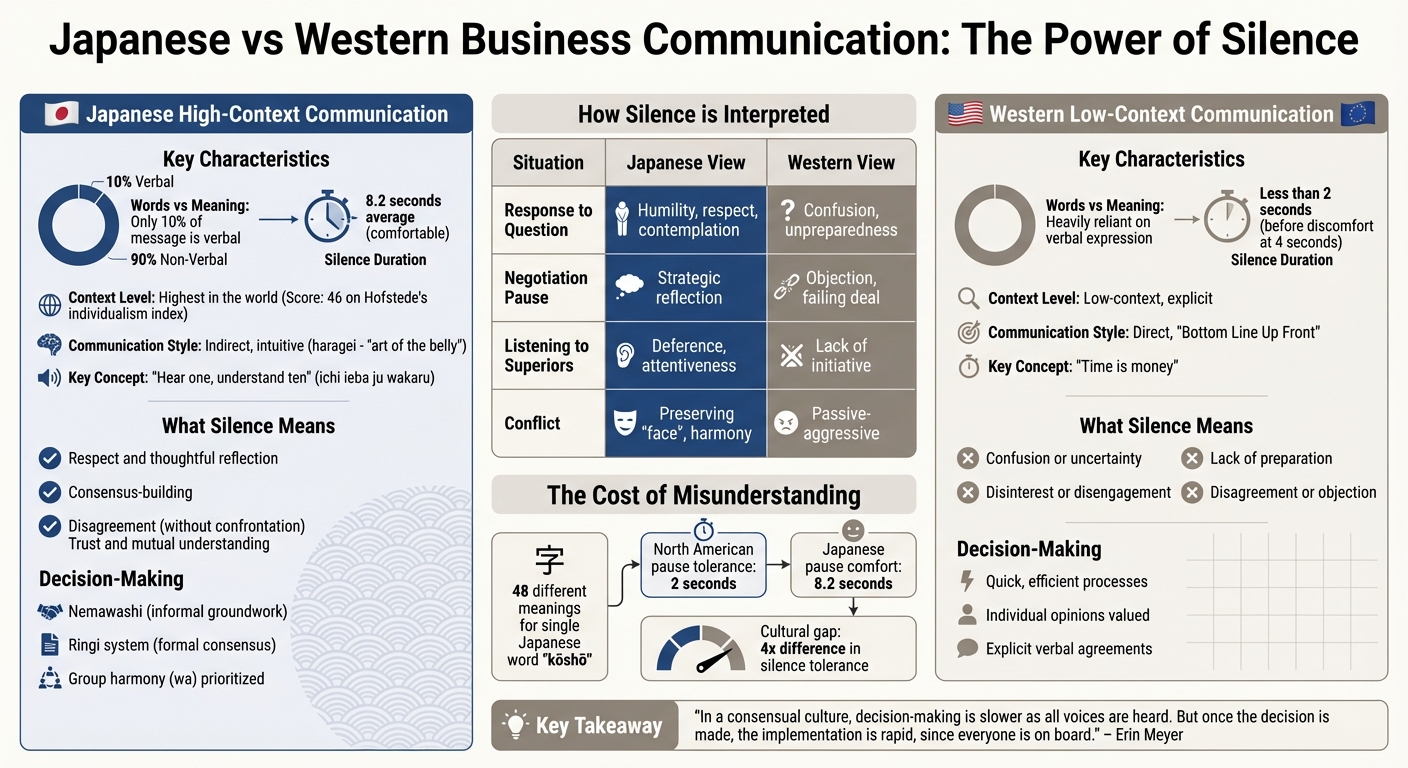
Japanese vs Western Business Communication: Understanding Silence Across Cultures
High-Context vs. Low-Context Communication
The core distinction between Japanese and Western business communication lies in how meaning is conveyed. In the United States and many other Western countries, communication is direct and relies heavily on words. This is known as low-context communication, where meaning is explicit, and there’s little room for ambiguity. Clear, straightforward articulation is crucial.
Japan, on the other hand, operates at the opposite end of the spectrum. As the most high-context culture in the world, Japanese communication relies on relationships, shared history, non-verbal cues, and situational awareness to convey meaning. Words often account for as little as 10% of the intended message, with the rest being understood intuitively – a principle encapsulated in the phrase ichi ieba ju wakaru (hear one, understand ten). While Americans often prioritize getting straight to the point – what’s sometimes called the "Bottom Line Up Front" approach – Japanese professionals focus on providing detailed context before drawing any conclusions. This difference highlights the unique role that silence plays in Japanese business settings.
These contrasting styles become apparent in everyday interactions. For instance, in Japan, saying "yes" (hai) doesn’t always mean agreement – it can simply indicate that the person is listening. Similarly, when a Japanese colleague describes something as muzukashii (difficult), it’s often a polite way of declining without outright refusal. Even the Japanese language itself reflects this need for context. The word "kōshō", for example, has 48 different meanings, making it nearly impossible to interpret correctly without understanding the surrounding situation.
At the heart of high-context Japanese communication is haragei, which translates to "art of the belly." This concept refers to a form of intuitive, non-verbal communication that relies on subtlety and an almost instinctive understanding. Kara Ronin, Founder of Executive Impressions, describes it as:
"a refined, intuitive exchange akin to a ‘sixth sense’…"
This intuitive style emphasizes the importance of silence, where thoughtful pauses convey respect and careful consideration. For Western professionals accustomed to verbalizing every thought, this implicit approach can be challenging. Silence or vague responses from a Japanese counterpart might be misinterpreted as confusion or disengagement, when in fact, they often signify deliberation and respect.
These differences in communication styles have tangible implications for business. Japan’s score of 46 on Hofstede‘s individualism index reflects its collectivist culture, where maintaining group harmony (wa) takes precedence over individual opinions. Decision-making processes in Japan are not typically top-down. Instead, they involve nemawashi (informal groundwork) and the ringi system, which ensures consensus before decisions are finalized. As Erin Meyer, author of The Culture Map, explains:
"In a consensual culture, decision-making is slower as all voices are heard. But once the decision is made, the implementation is rapid, since everyone is on board."
For Western companies looking to succeed in Japan, understanding these high-context communication norms is crucial. Misreading signals or failing to appreciate the subtleties of Japanese interaction can lead to misunderstandings and strained relationships. Recognizing the importance of implicit meaning and the role of silence is key to building trust and fostering successful business partnerships in Japan.
sbb-itb-a752276
What Silence Means in Japanese Business
In Japanese business settings, silence carries layers of meaning that are often misunderstood by Western professionals. A pause in conversation, for instance, is not just a gap in speech – it’s a moment of thoughtful reflection (kangaeru jikan). This silence often conveys respect for what has been said. However, in North America, where people tend to fill silences quickly (sometimes within two seconds), such pauses are frequently misinterpreted as disinterest or a lack of preparation.
The key lies in recognizing the type of silence you’re encountering. For example, a comfortable silence (kokochiyoi chinmoku) suggests trust and mutual understanding, where words are unnecessary. In contrast, a tense silence – often accompanied by hesitation or a sharp intake of breath – can indicate disagreement or reluctance. As Commisceo Global aptly puts it:
"Silence in Japanese culture is not just the absence of words or speech – it’s a skill."
This distinction becomes especially important during negotiations. Allan Halcrow from RW3 CultureWizard highlights that many deals have been lost because North Americans misinterpreted Japanese silence as an objection, reacting too quickly and losing their negotiating edge.
Here’s a quick comparison of how silence is interpreted differently across cultures:
| Situation | Japanese Interpretation | Western Interpretation |
|---|---|---|
| Response to a Question | A sign of humility, respect, and contemplation | Often seen as confusion, unpreparedness, or disinterest |
| Negotiation Pauses | A strategic moment for reflection or consensus-building | Interpreted as an objection or a failing deal |
| Listening to Superiors | Polite silence showing deference and attentiveness | May be viewed as a lack of initiative or engagement |
| Conflict/Disagreement | A way to preserve "face" and maintain group harmony | Often seen as passive-aggressive or unwillingness to communicate |
Understanding these nuances ties back to the high-context communication style prevalent in Japan. To navigate these subtleties effectively, developing sasshi – the ability to intuitively sense unspoken intentions – is essential.
1. Japanese Business Silence
Cultural Context
Japanese business culture places a high value on silence, a concept deeply influenced by Shinto and Zen Buddhism. Known as haragei, this practice prioritizes inner truth and unspoken understanding over direct verbal communication. This approach contrasts sharply with many Western business norms, where verbal expression is often linked to leadership and credibility.
A well-known Japanese proverb, "Deru kui wa utareru" (the nail that sticks out gets hammered down), illustrates why professionals often remain quiet in meetings. Speaking out too much can disrupt group harmony, a cornerstone of Japanese workplace interactions.
Understanding this cultural backdrop is as critical as localizing your business approach to appreciate how silence operates as a powerful tool in Japanese business communication.
Interpretation of Silence
In practice, silence in Japanese business settings is far from passive – it’s a deliberate and nuanced form of communication. The concept of chinmoku refers to pauses that convey respect, careful consideration, or a commitment to maintaining group harmony. During meetings, these silences ensure that only the most relevant points elicit a verbal response.
Jeff O’Dea, an expert in cross-cultural communication, highlighted this perspective with a quote from a senior Japanese executive:
"We are silent unless it impacts us"
This approach reflects a cultural norm where professionals speak only when a topic directly affects their role. Silence, in this context, becomes both efficient and considerate, especially when the matter at hand is not immediately relevant.
Business Impact
While this communication style works well in Japan, it can create challenges in international business settings. Hiroshi Kato, Vice President at Techno Pro Japan Inc., explained:
"A quiet response doesn’t necessarily mean ‘yes’ or ‘no.’ It often means ‘I’m thinking.’ Or ‘I disagree – but I don’t want to say it directly’"
This highlights how silence often prioritizes group consensus over individual opinions, a recurring theme in Japanese corporate culture.
In decision-making processes like nemawashi (informal consensus-building), silence can signal hesitation or subtle resistance. These pauses often require private follow-ups to address concerns before formal discussions take place. Misinterpreting silence – whether by rushing to fill it or assuming agreement – can lead to costly misunderstandings. Recognizing the function of silence in these contexts is crucial for navigating the risks and opportunities it presents in Japanese business interactions.
2. Western Business Communication
Cultural Context
In Western business settings, direct and clear verbal communication is highly valued. Silence, on the other hand, is often seen as a sign that something has gone wrong – whether it’s a lack of understanding or a failure to engage. This perspective aligns with the "time is money" mindset, where every moment of silence feels like a missed opportunity. Dr. Deborah Tannen, a linguistics professor at Georgetown University, puts it succinctly:
"As soon as you need words there’s already a failure to understand each other so you’re repairing that failure by using words."
English speakers, for example, tend to leave only a brief pause – typically less than two seconds – between conversational turns. Anything longer can feel awkward or disruptive, especially in a fast-paced business environment. This approach can create challenges when navigating cross-cultural communication, where silence might carry a different meaning.
Interpretation of Silence
In Western business interactions, silence lasting just four seconds can create discomfort, often interpreted as confusion, disagreement, or even disinterest. This contrasts sharply with cultures like Japan, where silences averaging 8.2 seconds are considered normal and respectful. In Southern European countries such as Italy and Spain, the discomfort with silence is even more pronounced. There, overlapping conversations are common, and a pause may imply uncertainty or a lack of preparedness.
Interestingly, some Western negotiators intentionally use silence as a tactic to unsettle their counterparts or gain control of the discussion. However, without cultural awareness, this strategy can backfire. For example, what might be seen as a power move in one culture could be misinterpreted as disengagement or rudeness in another. These differing views on silence can significantly shape negotiation dynamics and outcomes.
Business Impact
The discomfort with silence in Western cultures often influences B2B SaaS sales and negotiations in Japan. Matthew MacLachlan, a soft skills trainer at Learnlight, points out:
"Chinese negotiators are very, very aware that Americans like to fill silences and they are trained to stay silent and impassive because that will make the Americans uncomfortable and possibly make concessions without the Chinese having to do anything."
In contrast, Japanese business practices view silence as a moment for reflection and consensus-building. Western tendencies to interrupt or rush to fill silence can disrupt this process, potentially signaling impatience or disrespect. Jeff O’Dea, an expert in cross-cultural communication, highlights the potential pitfalls:
"In English, silence often signals uncertainty, a lack of alignment or disinterest. Put simply…your silence can make your English speaking colleagues feel you do not care or do not understand."
This cultural disconnect can have real consequences. For instance, Western teams may invest significant time and effort preparing for deals, only to discover later that their Japanese counterparts had silently declined the proposal weeks earlier. Understanding these nuances is crucial for fostering effective cross-cultural collaborations.
Business Impact: Risks and Opportunities
In the world of silent communication, the stakes for businesses can be surprisingly high. Misunderstanding these unspoken cues in Japanese business settings can lead to costly mistakes. For instance, North American sales teams often misinterpret Japanese silence as disagreement or objection. In their rush to fill the perceived void, they speak too soon, losing their negotiating leverage. This difference in how pauses are perceived highlights a major challenge in cross-cultural negotiations.
The financial risks don’t stop there. Misreading tatemae – the polite, outward-facing demeanor – can lead companies down expensive dead ends. When Japanese professionals use indirect language or remain silent, they are often signaling a polite refusal rather than leaving the door open. Yet, many companies misread this as tentative interest, wasting months – and significant resources – pursuing deals that were essentially declined in the first meeting.
Beyond financial losses, these missteps can harm reputations. Tom Roberts of Cranberry Leadership explains:
"The loud guy at any meeting in East Asia is considered the idiot."
This cultural perspective highlights how assertiveness, often valued in Western business settings, can be seen as overbearing or even foolish in Japan. Similarly, managers who assume employee silence means agreement may later face resistance when the team perceives the decision as already set in stone, leaving no room for discussion.
But for those who can navigate these subtleties, the rewards are immense. Businesses that grasp the "power of the pause" demonstrate respect and build trust by allowing their Japanese counterparts the necessary time for thoughtful reflection. Collaborating with local communication experts provides another advantage, offering insights into the unspoken dynamics that can make or break a deal. Katie Donovan, founder of Equal Pay Negotiations, puts it succinctly:
"Silence is the hardest technique to learn. It’s against our instincts. We want to fill in the blanks."
By mastering silence, companies can evolve into trusted, sophisticated partners who achieve ishin-denshin – a form of silent, mutual understanding.
Developing kuuki wo yomu – the ability to "read the air" or interpret subtle, non-verbal cues – further enhances high-context communication strategies. This skill helps businesses distinguish between silence used for reflection and silence wielded as a barrier to outsiders. For companies aiming to succeed in Japan, working with specialists like Nihonium (https://nihonium.io) can help decode these nuanced signals and turn them into actionable strategies.
Pros and Cons
Both communication styles play a significant role in shaping business interactions. Understanding their respective strengths and weaknesses sheds light on why cross-cultural negotiations can be so complex – and why mastering both approaches can provide a distinct advantage.
In Japan, silence is a tool for building trust and preserving relationships. During business meetings, Japanese professionals often use silence to demonstrate respect and allow for thoughtful decision-making. This approach minimizes impulsive reactions, avoids direct confrontation, and helps maintain wa (group harmony), protecting all parties from "losing face". However, this indirect style can sometimes lead to ambiguity, potentially masking resentment or leaving critical information unspoken.
In contrast, Western communication values directness, prioritizing clarity and speed. Discussions are designed to move quickly, ensuring that tasks and expectations are explicitly understood. While this style can resolve misunderstandings efficiently, it may come across as overly aggressive or confrontational. Additionally, many Western professionals find prolonged silences uncomfortable, which can prompt premature concessions during negotiations. These differences highlight the importance of finding a middle ground in cross-cultural business dealings.
| Feature | Japanese Silence (High-Context) | Western Directness (Low-Context) |
|---|---|---|
| Primary Strength | Encourages harmony, respect, and reflection | Ensures clarity, precision, and efficiency |
| Primary Weakness | Can lead to ambiguity or withheld details | May seem aggressive or overly blunt |
| View of Silence | A sign of wisdom, control, and subtlety | Often seen as confusion or lack of readiness |
| Conflict Style | Avoids confrontation to preserve "face" | Addresses issues head-on for quick resolution |
| Decision Speed | Focuses on consensus and deliberation | Prefers rapid decision-making and clarity |
This comparison highlights how silence can carry vastly different meanings depending on cultural context, making it a critical factor in international business negotiations. Companies that succeed globally often integrate these styles. This cultural adaptation is a core component of successful market entry strategies for Japan. For example, Western professionals who learn to embrace pauses during discussions can improve their negotiation tactics and demonstrate cultural awareness. Similarly, Japanese teams that adopt selective directness can minimize misunderstandings when working in multicultural environments.
Conclusion
Grasping the importance of silence in Japanese business culture is key for anyone aiming to build strong partnerships in Japan. The contrast between high-context and low-context communication styles influences everything from how negotiations unfold to how decisions are made. While Western professionals might see silence as a sign of confusion or lack of interest, Japanese counterparts often use it to show respect, process ideas, and foster agreement. This difference highlights the need for thoughtful adjustments during business interactions.
Studies reveal that Japanese professionals are comfortable with pauses lasting over 8 seconds, which Western teams might misread, potentially leading to missed opportunities. The answer isn’t to completely change your communication style but to adjust it thoughtfully when engaging across cultures.
Simple strategies can make a big difference. Try waiting five seconds before responding, use phrases like "Etto…" or "Sō desu ne…" to show you’re actively engaged, and discuss sensitive topics privately to build agreement ahead of time. Above all, resist the urge to fill every pause with unnecessary comments. As Tom Roberts from Cranberry Leadership wisely puts it:
"The Western urge to fill the silence is indeed not usually helpful. Learn to shut up…at the right time…in the right manner"
For businesses looking to apply these insights, the implications go far beyond just meetings. Everything from product messaging to marketing strategies and sales techniques needs to align with high-context communication norms. Nihonium offers comprehensive support to help Western companies navigate these complexities, from adapting products and documentation to creating culturally attuned sales strategies and establishing a strong local presence. These adjustments can shift your approach from misunderstandings to meaningful, effective negotiation.
Mastering the art of silence in Japanese business isn’t just about when to speak – it’s about knowing when to listen. This awareness can turn cultural differences into opportunities for stronger, more productive partnerships.
FAQs
How can I tell if silence means “thinking” or “no”?
In Japanese communication, silence carries a lot of meaning. It can signify respect, careful consideration, or a desire to steer clear of conflict. However, when silence stretches into something prolonged or uneasy, it might indicate disagreement or a subtle refusal. This is especially true in situations where direct responses are avoided to uphold harmony. To interpret silence accurately, it’s essential to focus on the context and pick up on non-verbal cues.
What should I do if a Japanese colleague says ‘hai’ but stays quiet?
In Japan, silence carries meanings that go beyond simple words. It often reflects respect, careful thought, or humility, rather than indifference or lack of interest. For example, a soft "hai" might signal deep consideration or acknowledgment, particularly in interactions with someone of higher rank or status. Instead of jumping to conclusions about disagreement, it’s important to appreciate the pause and give room for reflection. If you’re unsure, you can politely ask for clarification, but keep in mind that silence is an integral and respectful element of Japanese communication.
How long should I wait before speaking in a Japanese meeting?
In Japanese business meetings, silence holds a special place as a gesture of respect and careful consideration. Pausing for about 8 seconds or longer before responding gives others time to process information and aligns with established norms. Unlike in many Western settings, where silence might hint at discomfort or disagreement, in Japan, it often conveys understanding or deep reflection. Practicing patience and welcoming these moments of quiet can greatly enhance communication in professional interactions.
 English
  Japanese