

Looking to expand your SaaS business into Japan? Here’s what you need to know: Japan is the world’s second-largest enterprise software market, with SaaS spending projected to grow from $19.88 billion in 2024 to $62.84 billion by 2033 (13.7% CAGR). However, entering this market is challenging. Japan’s long sales cycles, consensus-driven decision-making, and demand for deep localization require a tailored approach.
Key Takeaways:
- Market Potential: Japan’s SaaS adoption is only 4% of total IT spend (vs. 14.9% in the U.S.), leaving significant room for growth.
- Cultural Nuances: Decision-making relies on Ringisho (formal approval processes) and Nemawashi (informal consensus-building), stretching sales cycles to 12–24 months.
- Localization: Success requires more than translation – think native-language support, local payment systems, and compliance with APPI privacy laws.
- Challenges: High costs for entry (est. $400,000 minimum), complex buyer expectations, and reliance on system integrators (72% of IT professionals work for SIs).
- Phased Strategy: Start with market research, validate demand, localize your product and marketing, and then establish a sales team.
Quick Breakdown:
-
Phase 1: Research & Entry Planning
Focus on identifying demand, understanding decision-making, and testing the market with pilot programs before committing to a full local presence. -
Phase 2: Product & Marketing Localization
Ensure high-quality translations, native payment options, and culturally aligned marketing materials. -
Phase 3: Build Sales Teams
Use fractional sales teams, partner with system integrators, and invest in relationship-driven marketing like Account-Based Marketing (ABM).
Japan’s SaaS market offers immense opportunities, but success requires patience, detailed preparation, and a commitment to long-term relationship building.
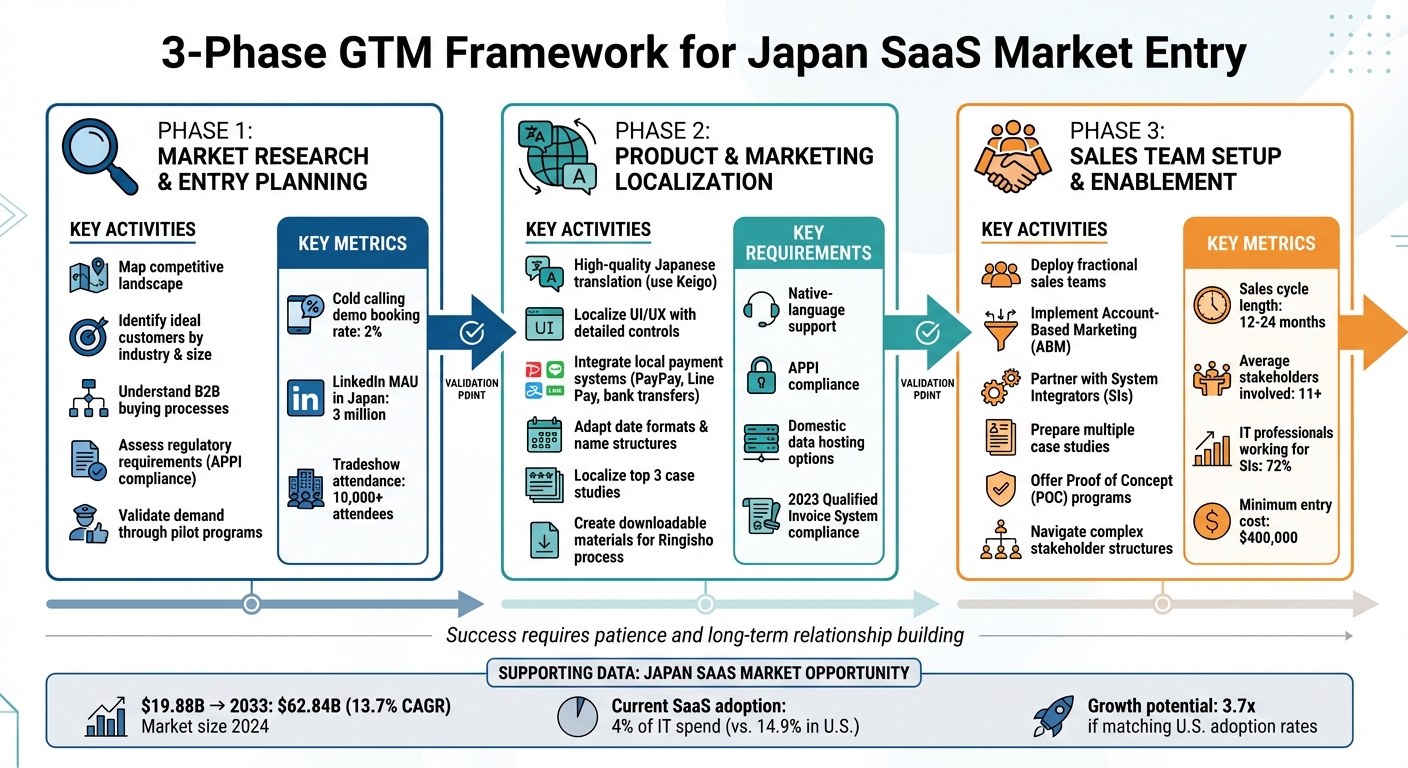
3-Phase GTM Framework for Entering the Japanese SaaS Market
The Japanese SaaS Market: Size, Trends, and Barriers
Market Size and Growth Factors
Japan’s SaaS market is on a steady growth trajectory. By 2024, it reached $19.88 billion, with projections estimating it will climb to $62.84 billion by 2033, reflecting a 13.7% CAGR. Despite this growth, SaaS spending in Japan makes up just 4% of total IT spending, compared to 14.9% in the U.S.. This significant disparity highlights untapped opportunities – if Japan’s adoption rates aligned with U.S. levels, the market could grow nearly 3.7 times its current size.
The shift toward SaaS has been notable. In 2020, SaaS spending edged out packaged software (50.5% vs. 49.5%), and by 2025, SaaS is expected to dominate 63% of the software market. This momentum is partly driven by the "2030 Problem", where a looming labor shortage pushes companies to embrace automation and software solutions. Another trend involves the evolution from general-purpose horizontal SaaS tools (like HR or back-office systems) to more specialized vertical solutions and AI-powered analytics.
A prime example of successful horizontal SaaS scaling in Japan is SmartHR, which achieved $100 million in Annual Recurring Revenue in 2024. This success underscores the market’s potential, but it also reveals the unique challenges businesses face in this space.
Common Obstacles for Foreign SaaS Companies
Japan’s IT workforce structure is a key hurdle. Only 28% of IT professionals work in-house at corporations, while the remaining 72% are employed by system integrators or vendors. This outsourcing culture means foreign SaaS companies must establish partnerships with system integrators to effectively enter the market. The venture capital scene also reflects this complexity – Japan had only 156 SaaS companies receiving VC funding, compared to 3,407 in the U.S., a stark contrast that highlights the slower pace of activity.
Sales cycles in Japan are notoriously long, often stretching 12 to 24 months. This is due to traditional decision-making processes like Nemawashi (informal consensus-building) and Ringi (formal approval circulation), which require buy-in from multiple layers of management.
Marcus Otsuji of Geodesic Capital explains, "Scaling fast requires initial investment in early adopter engagement, product localization, customer success, and relationship building before aggressive expansion".
The financial commitment is also substantial. Setting up a minimal local presence, such as hiring a Country Manager and one sales representative, costs around $400,000, and that’s before factoring in go-to-market expenses. Additionally, companies must comply with regulations like APPI, ISMAP, and the 2023 Qualified Invoice System.
Japanese buyers also have specific expectations, such as yen-based pricing, bank transfer payment options, and native-language support. This goes beyond simple translation – companies need to use proper keigo (formal language) and adapt workflows to align with local business culture. Successfully navigating these barriers is critical for any SaaS company looking to establish a foothold in Japan.
3-Phase GTM Framework for Japan
This three-phase framework provides a structured approach to entering the Japanese market. By validating assumptions at each step, companies can avoid costly missteps, like scaling too quickly without the right foundation.
Phase 1: Market Research and Entry Planning
Start by mapping out the competitive landscape and identifying your ideal customers. Focus on specific industries and company sizes where your solution solves real problems. In Japan, understanding customer needs is only half the equation – you also need to grasp how purchasing decisions are made.
Your research should address four key questions:
- Who are your competitors, and how do they position themselves?
- Which industries, company sizes, and regions show the strongest demand?
- What does the B2B buying process look like for your target accounts?
- What regulatory requirements, like APPI compliance, must you meet to sell?
In Japan, decisions often involve committees, so your website needs a "Download Documents" CTA alongside "Free Trial" options. This ensures stakeholders who aren’t end users have the materials they need for internal evaluations. Cold calling is less effective here, with only a 2% demo booking rate, and LinkedIn’s 3 million monthly active users make it less impactful than in Western markets. Instead, prioritize tradeshows (which can draw 10,000+ attendees) and introductions through trusted third parties.
To minimize risk, validate demand through pilot programs or fractional sales support before establishing a full legal entity. These early efforts will confirm product-market fit and set the stage for the localization work in Phase 2.
Phase 2: Product and Marketing Localization
Once demand is validated, it’s time to localize. This step goes beyond just translating text – Japanese buyers expect exceptional quality in every detail. Poorly translated materials can erode trust and signal a lack of commitment to the market.
"Everything should be in high-quality, idiomatic Japanese. There’s nothing worse than bad translation. It’s easy to tell which vendors know what they are doing and are really committed to the market just through the quality of their materials and programs." – Naoki Togawa, Manager, Nikkei Business Publications
Your product’s UI and UX should be clear, detailed, and tailored to Japanese preferences. This includes integrating local payment options like PayPay, Line Pay, and convenience store payments. Technical documentation should use formal keigo and align with Japanese business practices, such as proper date formats and name structures.
Marketing materials also need cultural adaptation. Focus on localizing your top three case studies, as Japanese companies often look for proof from businesses similar to their own. If full product localization isn’t feasible immediately, prioritize onboarding instructions and technical documentation – these can often suffice for technical users to adopt your product.
Phase 3: Sales Team Setup and Enablement
The final phase involves building a local sales presence. Instead of diving straight into hiring full-time staff, consider fractional sales teams. These teams offer native expertise without the heavy fixed costs and can help you navigate Japan’s 12 to 24-month sales cycles.
Adopt Account-Based Marketing (ABM) to align with the relationship-driven approach Japanese buyers expect. Equip your sales team with tools like GenAI-driven organizational charts to navigate complex corporate structures and identify key decision-makers. Keep in mind that Japanese enterprises typically involve 11+ core stakeholders, including IT, security, business unit heads, procurement, and executives.
Strategic partnerships with System Integrators (SIs) are essential, as 72% of IT professionals in Japan work for SIs or vendors. Co-selling with SIs that align with your target accounts can accelerate your market entry. Be prepared with multiple case studies and offer Proof of Concept (POC) programs, as Japanese companies require more evidence than Western buyers before committing.
To succeed, balance Japanese operational standards with your global strategy. Establish clear KPIs and prioritize talent development. The groundwork laid in Phases 1 and 2 – research and localization – directly supports the sales process, ensuring you have the materials and strategies needed for Japan’s committee-based decision-making processes.
Localization and Marketing Tactics for Japan
To effectively engage with the Japanese market, it’s crucial to tailor your strategies to align with local expectations, cultural norms, and business practices. Here’s how to approach product localization and marketing in Japan.
Product and Content Localization Requirements
Localization in Japan involves more than just translating text – it’s about adapting your product to fit local standards and expectations. Japanese users often favor interfaces loaded with detailed options and controls, as these provide a sense of reliability and thoroughness. However, clarity must still be maintained to avoid overwhelming users.
Language is a critical element. Accurate use of honorifics (keigo) and the distinction between formal and casual tones are essential for building trust. Errors in translation or reliance on AI-generated content can quickly damage your credibility. Additionally, forms and workflows should reflect local conventions, such as surname-first order, Japanese date formats, and gender-specific titles. Payment systems should include options like bank transfers (furikomi), monthly invoicing, and compliance with the 2023 Qualified Invoice System. Furthermore, many enterprise clients will demand domestic data hosting through AWS or Azure Japan regions to meet internal security requirements.
If full localization is not immediately possible, prioritize translating documentation and onboarding materials into Japanese. For developer tools and technical products, this step alone can help establish a foothold while broader localization efforts are underway. Customer support must also reflect Japan’s Omotenashi philosophy – this means offering polite, attentive, and prompt service at a native level.
Once your product is tailored to Japanese preferences, the next step is to build marketing funnels that align with local buyer behaviors.
Building Marketing Funnels for Japanese Customers
In Japan, the B2B decision-making process often revolves around the Ringisho consensus system, where middle managers compile materials to secure internal approval. To support this, prioritize a "Download Documents" call-to-action over options like "Start Free Trial." Whitepapers, case studies, and detailed service decks are indispensable for aiding internal discussions.
Search engine optimization (SEO) requires attention to both Google and Yahoo! Japan, which still accounts for 20–25% of search traffic. Effective keyword research must consider Kanji, Hiragana, and Katakana, the three primary character sets used in Japanese. Building trust also involves obtaining .jp backlinks from respected domestic websites and industry platforms.
For messaging, LINE is the go-to platform for B2B communication, with 92 million users, far surpassing LinkedIn’s 3 million monthly active users in Japan. It’s an essential tool for nurturing leads and maintaining engagement.
Webinars have gained significant traction, with participation among Japanese professionals doubling between 2020 and 2022. High production quality is a must, as Japanese audiences often associate polished presentations with professionalism and credibility. Content should focus on education and problem-solving rather than direct sales, as 72% of business professionals prefer information in their native language. Highlighting practical solutions and compliance with local regulations resonates far better than aggressive marketing tactics.
These tailored funnels should be complemented by sales materials that address Japan’s unique decision-making processes.
Creating Japan-Specific Sales Materials
Western-style sales materials often fall flat in Japan. Instead, emphasize case studies, which are the most requested type of collateral in the Japanese market.
"Case studies are the most important sales collateral in Japan. There was a survey a little while back and it was the most requested document. Even above the company deck itself." – Yuga Koda, Nihonium
Sales materials should provide detailed documentation to support the Ringi approval process. Avoid hard-sell approaches and instead focus on storytelling, building emotional connections, and demonstrating long-term reliability. Japanese buyers are particularly interested in how a product minimizes risks and integrates seamlessly with existing systems. This is especially relevant given that over 60% of IT budgets in Japan are still allocated to maintaining legacy infrastructure.
Professional native speakers should handle all translations to ensure proper use of Keigo (honorific language) and adherence to business etiquette. Additionally, explicitly address compliance with local laws, such as the Act on the Protection of Personal Information (APPI), to reassure risk-averse clients. Presentations and brochures should cater to Japanese preferences for dense, information-rich formats.
sbb-itb-a752276
Building Credibility Through Thought Leadership and Partnerships
In Japan, business is all about relationships. Before you can even start talking sales, you need to build trust. As mentioned earlier, localized strategies are key to gaining this trust. Foreign SaaS companies often face hesitation from Japanese buyers, who prefer established brands and worry that new vendors might leave the market if revenue goals aren’t met. So, how do you overcome this? By showcasing your expertise and commitment through thought leadership and strategic partnerships.
Developing Thought Leadership in Japan
Establishing yourself as an industry authority in Japan means focusing on educational content that solves real business problems. Forget the hard sell – Japanese audiences respond better to practical insights. Webinars in Japanese are a powerful tool for this, especially when tackling industry-specific challenges like integrating legacy systems or complying with the Act on the Protection of Personal Information (APPI). Between 2020 and 2022, webinar participation among Japanese professionals doubled, making this format a smart choice.
Publishing detailed whitepapers and technical guides on platforms like ITmedia or Nikkei BP can further cement your authority. To add a layer of credibility, use PR TIMES for formal announcements. And here’s a crucial tip: Always deliver content in polished, idiomatic Japanese.
"Everything should be in high-quality, idiomatic Japanese. There’s nothing worse than bad translation. It’s easy to tell which vendors know what they are doing and are really committed to the market just through the quality of their materials and programs."
- Naoki Togawa, Manager, Nikkei Business Publications
Want to amplify your reach? Partner with local system integrators, consultants, or even early customers to co-host webinars and seminars. Their established reputation can help you access enterprise stakeholders who are otherwise hard to reach. Collaborating with respected industry analysts or key opinion leaders for co-branded content is another way to shape perceptions and build trust.
Don’t forget about social platforms. While LinkedIn has only 3 million monthly active users in Japan, LINE, with its 92 million users, is a must for B2B engagement. Platforms like X (formerly Twitter) are great for sharing industry updates and hosting live Q&A sessions through Twitter Spaces. These efforts not only position your company as a thought leader but also pave the way for forming strategic local partnerships.
Creating and Growing User Communities
Once you’ve established your thought leadership, the next step is building engaged user communities. In Japan, personal introductions carry far more weight than cold outreach – demo bookings from cold calls have only a 2% success rate. Tapping into existing tech groups like JSSA or TechCrunch Japan can help you connect with key players.
Online platforms like Connpass or Zenn are excellent for hosting meetups and developer forums. LINE groups are also popular for industry discussions and customer support. When creating community content, focus on themes of teamwork and collective success (wa), as these resonate more with Japanese professionals than aggressive individual ROI claims.
In-person events are still vital in Japan. Hosting meetups in cities like Tokyo and Osaka can deepen relationships. Tradeshows are another great opportunity – some events draw over 400 booths and more than 10,000 attendees. These gatherings are perfect for networking and exchanging business cards (meishi), which remain an important tradition. Sharing customer success stories that highlight reliability and risk reduction can further reassure potential buyers. Additionally, establishing a presence on local review platforms like Boxil and ITReview can help build trust.
Keep in mind that 72% of Japanese business professionals prefer consuming content in their native language, and 66% favor video content when researching software options.
If your company lacks in-house expertise on the Japanese market, you can turn to services like Nihonium. They offer fractional thought leadership and evangelism services, helping with event planning, partnerships, and localized content. This approach allows you to build credibility without the need to establish a full local entity right away.
Case Studies: How Western SaaS Companies Succeeded in Japan
Using the three-phase GTM framework as a guide, these case studies highlight how adapting strategies to Japan’s unique business environment can lead to success. Salesforce, Slack, and HubSpot each took different approaches, but they all share one key trait: they tailored their strategies to align with Japan’s distinct business culture. Here’s a closer look at what worked for them.
Salesforce: Empowering Local Teams and Investing in Infrastructure
Salesforce’s success in Japan hinged on its ability to empower local operations and make targeted investments. By giving its Japanese team autonomy to make market-specific decisions, Salesforce ensured its strategies were directly aligned with local needs. This wasn’t just about hiring Japanese employees – it was about trusting them to shape the company’s product and market approach.
To address Japan’s data sovereignty concerns, Salesforce established local data centers and acquired Japanese companies to deepen its understanding of the market and accelerate its growth. These steps signaled a long-term commitment, which is something Japanese enterprises value highly.
Another standout move was Salesforce’s AppExchange marketplace, which required vendors to meet rigorous localization standards. Vendors had to provide fluent Japanese documentation, localized user agreements, and adhere to strict local data protection rules. This level of localization reassured Japanese customers of Salesforce’s dedication to their market.
Slack: Adjusting Product-Led Growth for Japan

Slack is known worldwide for its Product-Led Growth (PLG) model, where users organically adopt the tool. However, in Japan, this approach needed fine-tuning. Unlike other markets, Japanese companies rarely allow individual employees to sign up for software without managerial approval. Instead, decisions are made through multi-stakeholder consensus.
To address this, Slack introduced downloadable materials alongside its free trial options. These resources provided employees with the tools to pitch Slack to their managers, respecting Japan’s decision-making process. This small adjustment made it easier for companies to adopt the platform.
Slack also prioritized brand awareness campaigns that balanced its global identity with local sensibilities. By acknowledging cultural differences while staying true to its core mission, Slack built trust and credibility in the Japanese market without compromising its brand.
HubSpot: Deep Product Localization and Partner Networks
HubSpot’s strategy showcased the importance of thorough localization during Phase 2 of the GTM framework. The company heavily localized its product, adapting its marketing software to meet Japanese preferences for detailed menus, granular controls, and comprehensive support materials.
HubSpot also created a strong partner network through HubSpot Partners Japan, offering technical training and localized GTM strategies to help partners close deals faster. This approach leveraged the existing relationships of partners, vital in a market where only 10% of foreign products gain approval from Japanese distributors.
Additionally, HubSpot focused on inbound marketing and thought leadership, producing educational content that addressed real-world business challenges. This positioned HubSpot as a trusted advisor, which is critical in Japan, where trust ("shinrai") and social proof are essential for business success.
These examples demonstrate how adapting foundational GTM tactics – local infrastructure, cultural alignment, and a strong commitment to the market – can pave the way for success in Japan.
Conclusion: Core Principles for Japan Market Entry
Success in Japan hinges on three key principles: deep localization, trust, and a phased strategy. These elements, when combined, can help businesses navigate the complexities of this market.
Deep localization means tailoring every aspect of your product to meet local expectations. This isn’t just about translating text – it involves adjusting UI workflows, date formats, customer support, and aligning with cultural norms. The goal is to make Japanese customers feel like the product was crafted specifically for them.
Trust (shinrai) holds immense value in Japan’s cautious business environment. For instance, AWS Japan achieved $1.8 billion in annual revenue (¥245 billion) with 16% year-over-year growth by investing in local data centers and showcasing their long-term commitment. Japanese companies favor vendors who demonstrate reliability through a tangible local presence, dedicated teams, and partnerships with established system integrators.
A phased approach minimizes risks by validating product-market fit and building credibility step by step. This strategy allows businesses to test the waters before making significant investments in local infrastructure, turning what might seem like a gamble into a well-calculated expansion.
For those aiming to streamline this process, services like Nihonium offer fractional sales teams, expert localization, and marketing funnel creation tailored to Japan’s specific needs. These services help companies validate the market and drive revenue before committing to the fixed costs of setting up a local entity. By embracing these principles, businesses can turn Japan’s challenges into a pathway for steady, long-term growth.
FAQs
What cultural nuances should SaaS companies understand when entering the Japanese market?
When stepping into the Japanese market, SaaS companies need to pay close attention to specific cultural elements that can make or break their success. One of the most important factors? Building trust through long-term relationships. In Japan, trust isn’t established overnight – it grows through consistent communication and regular in-person meetings. Patience is also crucial, as decision-making is often a consensus-driven process. This means proposals need to be thorough, and all stakeholders must be on the same page before moving forward.
Another important aspect is indirect communication. In Japanese business culture, subtle cues, body language, and even silences carry significant meaning. Direct criticism is generally avoided to maintain harmony, so reading between the lines is a must. On top of that, formalities matter – a lot. For instance, business card etiquette is more than just a formality; it’s a reflection of respect and professionalism.
By understanding and respecting these cultural nuances, SaaS companies can navigate the Japanese market with greater ease and build meaningful, lasting partnerships.
Why is product localization crucial for SaaS companies entering the Japanese market, and what should they focus on?
For SaaS companies aiming to thrive in Japan, product localization isn’t just helpful – it’s a must. This process ensures your product meets the unique expectations of Japanese users, including their cultural, linguistic, and regulatory preferences. In Japan, trust and precision are highly valued, and a well-localized product can help establish both credibility and user loyalty.
Key Areas to Focus On
- Language and Cultural Adaptation: Japanese users expect communication that aligns with their norms. This means using the right level of formality, incorporating keigo (honorific language), and maintaining an appropriate tone. These adjustments can significantly improve user engagement.
- Technical Localization: Beyond language, your product’s technical aspects need to align with local standards. This includes adapting the user interface, ensuring support systems are accessible, and meeting Japan’s strict compliance requirements.
By tailoring your product to the specific needs of the Japanese market, you not only enhance the user experience but also position your SaaS offering as a trustworthy and competitive choice in a market that values relationships and precision.
How can SaaS companies effectively manage Japan’s lengthy sales cycles?
To thrive in Japan’s extended sales cycles, SaaS companies need to prioritize earning trust and cultivating meaningful relationships with prospective clients. This means committing to regular communication and recognizing the value of in-person meetings, which are a cornerstone of Japanese business practices.
Equally important is tailoring your product and strategy to fit Japanese norms and expectations. This involves adjusting your software, marketing content, and customer support to align with local language and cultural preferences. Such efforts not only show respect but also reinforce your reliability and professionalism in the eyes of Japanese clients.
 English
  Japanese