

To succeed in Japan’s SaaS market, trust is non-negotiable. Japanese enterprise buyers are cautious, prioritizing reliability, privacy, and long-term relationships over product features. Testimonials from local, respected companies showcasing measurable results are essential for building credibility. Here’s how to make them work:
- Focus on measurable outcomes: Highlight specific results like cost savings, efficiency gains, or improved customer satisfaction.
- Localize testimonials: Use formal Japanese (keigo), adapt to cultural norms, and emphasize group benefits over individual success.
- Gain consent properly: Follow Japan’s strict privacy laws (APPI) and allow for formal approval processes.
- Strategic placement: Display testimonials prominently on websites, sales materials, and trusted platforms like LINE or Kakaku.com.
- Collaborate with local partners: Co-branded case studies with Japanese firms can boost trust and open doors.
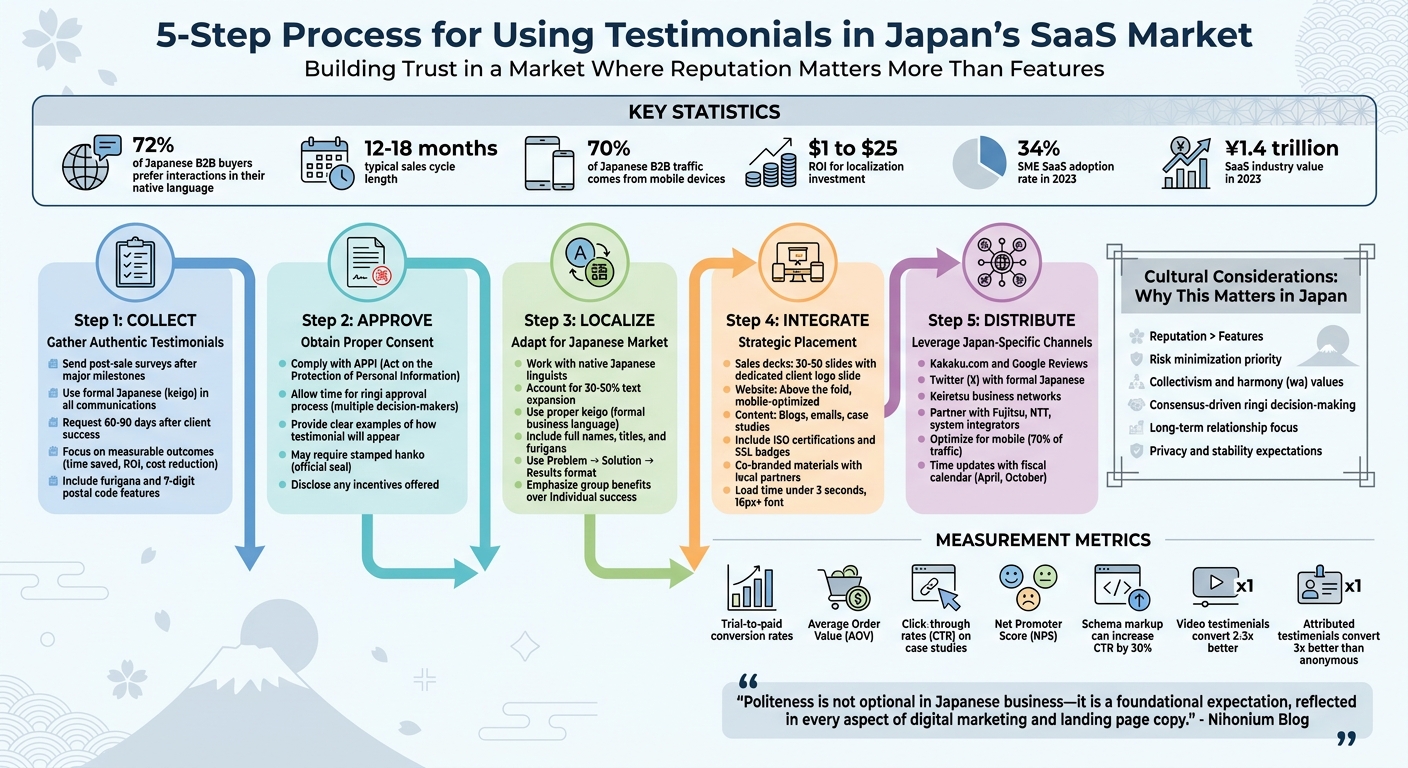
5-Step Process for Using Testimonials in Japan’s SaaS Market
How Trust and Social Proof Work in Japan
Why Reputation Matters More Than Features
In Japan, enterprise buyers place a higher value on a provider’s reputation and long-term commitment than on product features. This stems from a strong focus on minimizing risks – Japanese companies prefer to work with partners who have a proven track record of reliability. Before formal discussions even begin, a solid reputation is often expected. The ringi process, where proposals are reviewed across several departments, makes trust even more critical. Without a referral from a trusted partner or a shared client, foreign SaaS companies can face extended evaluation periods. However, introductions from respected business partners or industry organizations can significantly boost credibility. Demonstrating commitment to the Japanese market, such as by setting up a local legal entity or hiring local staff, also signals a willingness to establish a lasting presence. This focus on reputation naturally ties into the importance of social proof.
How Social Proof Influences Enterprise Decisions
In Japan’s SaaS market, testimonials from well-known local companies are incredibly valuable in building trust. With sales cycles often stretching 12–18 months due to the multiple layers of approval required, social proof can help internal advocates gain buy-in across departments. Endorsements that align with Japan’s cultural values of collectivism and harmony (wa) are particularly persuasive. Highlighting individual success stories alone won’t be enough – these endorsements must demonstrate benefits for the entire organization to resonate effectively.
sbb-itb-a752276
How to Collect Testimonials from Japanese Clients
Gathering genuine testimonials is a key step in earning the trust of Japanese businesses, where reputational credibility carries significant weight.
Use Post-Sale Surveys to Collect Feedback
Send a follow-up survey shortly after a major milestone while the experience is still fresh. Make sure the survey is in Japanese and focuses on specific results, such as time savings, cost reductions, or compliance achievements. Instead of general compliments, ask for measurable outcomes – like how many hours were saved or the ROI achieved. This kind of data-driven feedback resonates with Japanese companies, which often prioritize detailed analysis in their internal processes.
To make the survey user-friendly, include features tailored to Japanese preferences, like furigana (phonetic guides for names) and automatic 7-digit postal code entry. Finally, maintain a tone that reflects Japan’s formal business culture, as this helps cement your professionalism and credibility.
Use Formal Communication Styles
When requesting testimonials, always use keigo, the most formal and respectful form of Japanese. Politeness is a non-negotiable aspect of Japanese business etiquette and should be reflected in all your communications, from emails to landing pages. Personalize your request by mentioning the client’s name and referencing their specific project.
Avoid tactics that could come across as overly aggressive or sales-driven, as these may alienate Japanese clients. Instead, frame the testimonial as a way to contribute to the broader industry or community, which aligns with the collectivist mindset prevalent in Japan. Since 72% of Japanese B2B buyers prefer interactions in their native language before seriously considering a SaaS product, it’s crucial to have your messaging reviewed by a native-speaking professional.
Get Permission for Public Use
After collecting testimonials, obtaining explicit consent for publication is a must. This process must comply with Japan’s Act on the Protection of Personal Information (APPI), which regulates the use of personal details, photos, and company logos. Keep in mind that many companies will require internal discussions and formal approvals involving multiple decision-makers.
To streamline this process, provide a clear example of how the testimonial will appear and specify where it will be published, whether on your website, social media, or in print. Some clients may even require a stamped hanko (official seal) on documentation to finalize their approval. Be sure to allow enough time for these steps, and if you’ve offered any incentives for the testimonial, disclose this upfront to comply with consumer protection laws. The best time to request a testimonial is typically 60 to 90 days after the client achieves a major success.
How to Localize Testimonials for the Japanese Market
Tailoring testimonials to appeal to Japanese enterprise buyers involves more than just translation – it requires a thoughtful reworking of the message to connect with local audiences.
Translate and Review with Native Experts
Avoid literal translations. Japanese text often takes up 30–50% more space than English, so your layouts and sales materials need to accommodate this expansion. Work with native Japanese linguists who understand SaaS terminology to ensure technical terms are accurately adapted. This might mean using the correct katakana or industry-specific loanwords. As Naoki Togawa from Nikkei Business Publications explains:
It’s easy to tell which vendors know what they are doing and are really committed to the market just through the quality of their materials.
Well-crafted translations do more than convey your message – they build trust and reinforce your brand’s credibility. Testimonials should be written in polished, formal business Japanese, as improper use of Japan’s three writing systems – hiragana, katakana, and kanji – can make your product seem unprofessional or unreliable. And here’s a compelling statistic: for every $1 you invest in localizing for the Japanese market, the return is estimated at $25. Beyond translation, incorporating business etiquette into your materials strengthens your appeal.
Include Business Etiquette and Metrics
Japanese testimonials should reflect the country’s business culture. Include full client names, titles (with furigana for pronunciation), and measurable outcomes that demonstrate benefits on an organizational level. While Western markets often celebrate "disruption", Japanese buyers value stability, privacy, and reliability.
Frame testimonials in a way that highlights how your solution benefits the entire team or company, aligning with Japan’s collectivist culture. Use specific metrics – like percentage improvements, cost reductions, or time savings – to appeal to Japanese decision-makers’ preference for detailed and quantifiable results. A structured "Problem → Solution → Results" format works well, as it provides the logical flow that corporate buyers expect. Pair these detailed testimonials with endorsements from well-known local brands to build instant trust.
Feature Well-Known Local Companies
Testimonials from respected Japanese companies can significantly boost your credibility. Japanese buyers tend to be cautious and risk-averse, so endorsements from familiar local brands help address concerns about privacy and reliability. Display these logos and endorsements prominently in your materials to make an immediate impact and support the approval process.
In Japan, enterprise buying decisions often require hierarchical approval and group consensus through the ringi process. Testimonials from trusted local peers provide the social proof needed to gain internal buy-in. Additionally, working with local partners such as value-added resellers or consultants can open doors to decision-makers, as referrals and established relationships are highly valued in Japanese business culture.
How to Integrate Testimonials into Your Japan SaaS Strategy
In Japan, social proof plays a crucial role in the decision-making process. To make the most of this, strategically place localized testimonials where they’ll have the greatest impact. Japanese enterprise buyers often seek confirmation from multiple sources before committing, so testimonials should be present across various marketing touchpoints. This behavior is reflected in how buyers compare global and local review sites to validate software claims.
Place Testimonials in Sales Materials
For Japanese enterprises, the sales deck is a critical resource during the decision-making process. These decks are typically extensive, ranging from 30 to 50 slides, to ensure all stakeholders have the information they need. As Yuga Koda, Co-Founder of Nihonium, puts it:
The company introduction deck will likely be the first substantial information for the stakeholders and decision-makers and will be the foundation of their decision.
Dedicate an entire slide to showcasing client logos – Japanese buyers value quantity here, so aim for a robust display of recognizable brands. Include your founding date to convey a sense of stability, which is highly valued in Japanese business culture.
When incorporating testimonials, pair them with measurable results and visuals to strengthen their impact. Each testimonial should emphasize how your product benefits the organization as a whole, reflecting Japan’s collectivist values.
On your Japanese-language website and landing pages, position testimonials and client logos prominently – ideally above the fold. This is especially critical since more than 70% of Japanese B2B web traffic comes from mobile devices. Additionally, place trust indicators like ISO certifications or SSL badges near testimonials and lead capture forms. These reassure potential customers at the exact moment they’re deciding whether to convert, which is vital given that SaaS landing page conversion rates typically range from 2% to 7%.
Once testimonials are integrated into your sales materials, extend their reach through your content strategy.
Use Testimonials in Content Marketing
Incorporate testimonials into blogs, emails, and case studies to highlight proven results. Use a clear structure – “Problem → Solution → Results” – to align with what corporate buyers expect. Ensure all copy uses formal and respectful business Japanese, known as keigo, to meet cultural norms.
Go beyond simple quotes by creating co-branded case studies with your clients. These documents should address key concerns like privacy, operational stability, and reliability, which are common objections among Japanese enterprise buyers. Include specific metrics and, where possible, endorsements from local channel partners such as system integrators or value-added resellers. These partnerships signal that your product is ready for the Japanese market.
How to Distribute Testimonials Across Japan-Specific Channels
Reaching Japanese enterprise buyers with testimonials requires a strategic approach that aligns with local preferences. This means optimizing for Japan’s search habits and leveraging its distinct business ecosystems.
Focus on Local SEO and Business Networks
Start by tailoring your testimonial pages for Japanese search engines. Use native keyword research to identify relevant industry terms. Since 70% of Japanese B2B traffic comes from mobile devices, ensure your pages load quickly (under three seconds) and use at least a 16px font size for readability.
Beyond SEO, distribute testimonials on platforms trusted by Japanese professionals. For example, Kakaku.com and Google Reviews are popular for sourcing social proof. Additionally, tap into keiretsu networks – Japan’s traditional business alliances. These networks are key to building credibility in a market where the SaaS industry reached ¥1.4 trillion in 2023. Social media also plays a role: Twitter (X) is widely used for professional networking. When sharing testimonials there, write in formal Japanese and emphasize how your solution benefits the entire organization, reflecting Japan’s collectivist values and cultural focus on harmony. By combining online visibility with trusted local platforms and networks, you can foster greater trust in your brand.
Create Co-Branded Case Studies
Collaborate with local system integrators or value-added resellers to produce co-branded testimonials and case studies. These partnerships help you tap into established networks and build trust more quickly. This is especially critical since only 34% of SMEs in Japan adopted SaaS in 2023. Partnering with well-known companies like Fujitsu or NTT can lend your brand a layer of credibility.
When crafting co-branded materials, keep Japan’s consensus-driven ringi decision-making process in mind. Include detailed technical specs and quantitative metrics to highlight measurable results. Also, ensure compliance with the Act Against Unjustifiable Premiums and Misleading Representations, which requires transparency for incentivized reviews and prohibits exaggerated claims. By following these guidelines, your testimonials will resonate more effectively with Japanese enterprise buyers.
How to Measure and Improve Testimonial Performance
Tracking the right metrics can help you understand how testimonials impact conversions, especially when targeting Japanese enterprise buyers. Focus on key indicators like trial-to-paid rates and average order value (AOV) to determine how testimonials influence purchasing decisions. For engagement, measure how much time visitors spend on testimonial sections and the click-through rates (CTR) on case study links to gauge interest in detailed success stories. Additionally, use the Net Promoter Score (NPS) to link customer satisfaction with the effectiveness of your social proof. If you’re leveraging schema markup, monitor CTR from search engine results pages (SERPs), as this can increase organic clicks by up to 30%. These metrics provide a solid starting point for refining your testimonial strategy.
Track Conversion Rates and Engagement
Conversion data offers valuable insights to improve your approach. Combine testimonial engagement metrics with your CRM tools to pinpoint their impact on lead generation and sales velocity. For the Japanese market, analyze performance by industry, company size (enterprise vs. SMB), and user roles to ensure your testimonials align with both cultural and professional expectations. For example, testimonials that emphasize security and compliance may resonate more with IT stakeholders, while those highlighting ROI are likely to appeal to financial decision-makers.
As Hanna Barabakh, Language and Content Specialist at PayPro Global, explains:
Social proof is transformed from subjective content into a quantifiable, continuously improved conversion asset through data-driven testimonial enhancement.
Test Different Formats and Placement
A/B testing is an effective way to identify which testimonial formats resonate most with Japanese enterprise buyers. Compare short quotes with detailed, data-driven case studies, as decision-makers often prefer in-depth analysis. Experiment with placement – position testimonials near Call-to-Action (CTA) buttons or in separate sections to determine which drives better results.
Here are some format insights to consider:
- Video testimonials can convert 2–3x better than text-based ones.
- Testimonials with client photos see 3x more engagement than text-only versions.
- Attributed testimonials (including name, title, and company) convert 3x better than anonymous ones.
You can also map testimonials to common objections like "too expensive" or "too complex" to reduce bounce rates on pricing pages.
Tailor Testimonials for Target Segments
Use Google Analytics 4 to track how different enterprise segments engage with specific testimonial blocks. Break down the data by channel to determine what resonates with each audience tier. Tailor your testimonials to meet industry-specific needs – technology buyers may prefer detailed technical specs and performance metrics, while the hospitality sector might value stories that focus on customer experience.
Keep testimonials fresh by updating them regularly to maintain credibility with Japanese prospects. Timing updates around Japan’s fiscal calendar – April (start of the business year) and October (mid-term) – can help you align with key decision-making periods.
Conclusion
Testimonials play a crucial role in earning the trust of Japanese enterprise buyers. These buyers value reliability, privacy, and stability above all else, and your testimonials need to reflect these priorities to address the cautious nature of Japanese decision-making.
To strengthen this trust, localization is key. As mentioned earlier, using keigo (formal and respectful language) and embracing collectivist values – focusing on group success rather than individual achievements – are essential strategies. The Nihonium Blog emphasizes this point:
Politeness is not optional in Japanese business – it is a foundational expectation, reflected in every aspect of digital marketing and landing page copy.
Including testimonials from recognizable local companies can instantly boost credibility. Pair these with quantitative data – like percentage improvements or cost savings – to make your claims more compelling and grounded in measurable results.
It’s also important to strategically place testimonials across various touchpoints – sales materials, landing pages, and platforms like LINE, which is widely used in Japan. This creates multiple opportunities to build trust during the often-lengthy approval processes typical in Japanese enterprises. And don’t forget: over 70% of Japanese B2B traffic comes from mobile devices, so ensure testimonials are mobile-friendly and load quickly (under three seconds).
Lastly, navigating Japan’s business etiquette, APPI regulations, and cultural nuances requires local expertise. Nihonium provides the networks and insights needed to adapt testimonials authentically for the Japanese market. When done right, testimonials evolve from simple marketing tools into powerful trust-builders that deeply resonate with Japanese enterprise buyers.
FAQs
What should I include in a Japan-ready SaaS testimonial?
When creating a SaaS testimonial for the Japanese market, it’s essential to tailor every aspect to meet local expectations and business norms. Here’s how you can make it resonate:
- Language Matters: Testimonials should be written in Japanese to ensure accessibility and relatability. Accurate translations are critical, preserving both the tone and intent of the original message.
- Cultural Sensitivity: Japanese business culture values formality and respect. Use polite, professional language and avoid overly casual expressions to align with these norms.
- Authenticity Over Hype: Japanese enterprise buyers appreciate sincerity. Include real customer feedback and avoid exaggerated claims. This builds trust and credibility.
- Focus on Measurable Results: Highlight specific, quantifiable outcomes achieved through your SaaS solution. For example, mention metrics like increased efficiency, cost savings, or improved ROI.
- Real-World Applications: Share practical examples of how your product is used in everyday business scenarios. This helps potential clients visualize the benefits in their own operations.
By combining these elements, you can create a testimonial that not only informs but also connects with Japanese enterprise buyers in a meaningful way.
How do I get approval to publish a Japanese client’s logo and quote?
When working with a Japanese client to publish their logo and quote, it’s crucial to get explicit consent. Make sure they approve the specific way their branding and testimonial will be used. This step is essential to ensure they are comfortable with the presentation and that it aligns with Japan’s emphasis on professionalism and respect for business etiquette.
To avoid any misunderstandings, always secure written approval, such as via email or a formal agreement. This approach not only ensures clarity but also respects Japan’s strong focus on authenticity and credibility in testimonials.
Where should I place testimonials to speed up Japan enterprise sales?
To drive enterprise sales in Japan, strategically placing testimonials on landing pages and marketing materials is key. Spotlighting these testimonials on Japanese-language pages helps establish trust and provides strong social proof, which resonates deeply with local preferences.
Using authentic testimonials written in Japanese not only enhances credibility but also demonstrates respect for the audience. This approach makes potential customers feel understood and valued, increasing the likelihood of engagement and conversions.
Related Blog Posts
- Why Long-Term Commitment Matters in Japan SaaS Sales
- Japanese SaaS Market: Positioning Case Studies
- How Japan SaaS Case Studies Build Trust
- 5 Customer Review Trends in Japan’s SaaS Market
 Japanese
  English