

In Japan’s growing SaaS market, trust is everything. Companies are cautious and deliberate, preferring well-documented proof before making decisions. Case studies stand out as the most effective tool to build trust, even more than company presentations or flashy marketing. Why?
- Japanese buyers rely on peer validation: They need examples of success from similar businesses to reduce risk. This aligns with broader B2B buying patterns in Japan where consensus is paramount.
- Data and measurable results matter: ROI, cost savings, and retention metrics are key to convincing decision-makers.
- Localization is critical: Case studies must address specific Japanese business challenges, use formal language, and include testimonials from local customers.
For global SaaS companies, creating localized, data-driven case studies with real customer success stories is the best way to break into the market and establish credibility.
Why Case Studies Work Better Than Other Marketing Tools in Japan
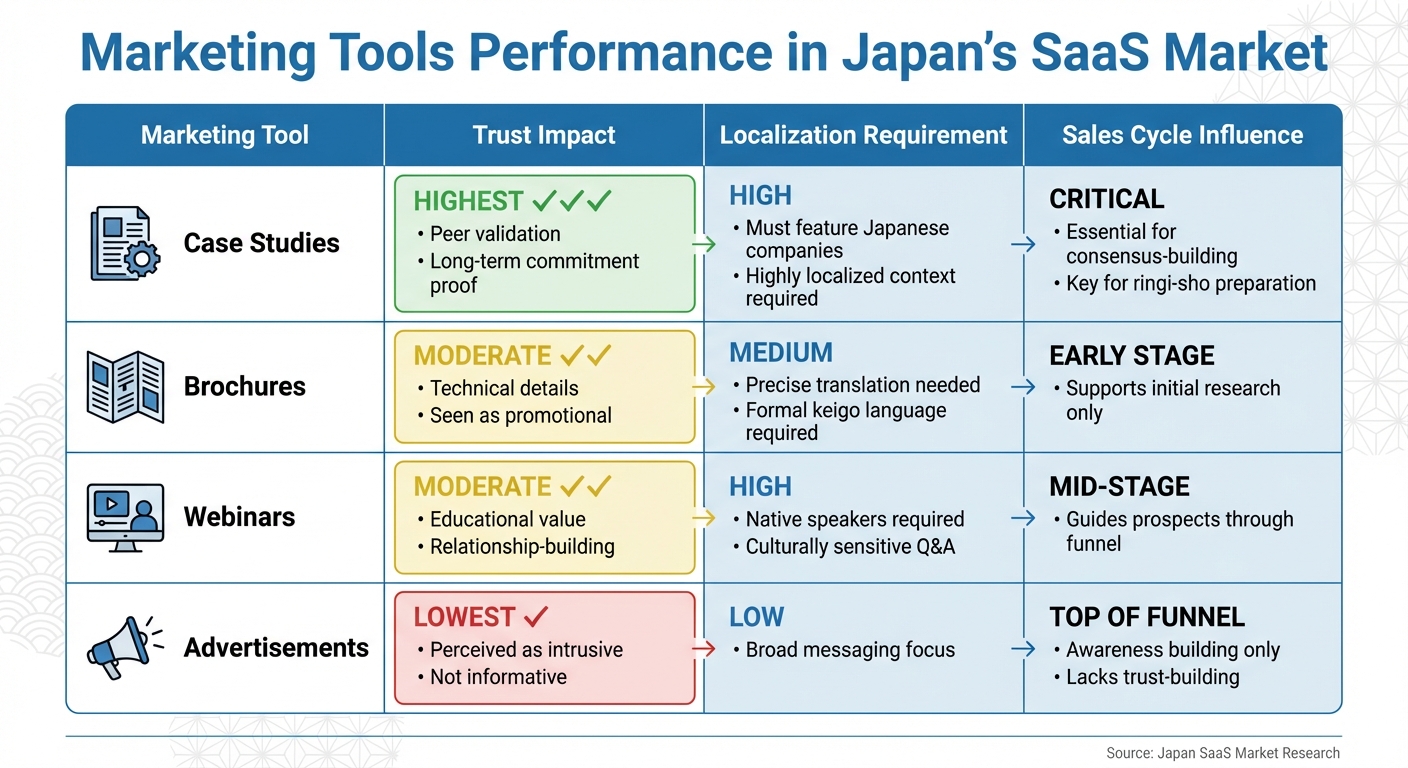
Marketing Tools Trust Impact Comparison for Japan SaaS Market
Peer Validation in Japanese Business Culture
In Japan, business decisions often revolve around group consensus. This approach, known as nemawashi, requires internal advocates to address the concerns and criteria of various stakeholders. For these advocates, case studies are invaluable because they offer data-backed stories paired with peer feedback and measurable ROI.
When a Japanese buyer reviews a case study, they’re not just gathering information for themselves. They’re preparing to share it as part of a ringi-sho, a formal approval document that circulates within the organization. If the case study highlights a similar Japanese company, it reduces the perceived risk for the final decision-maker. This is why case studies featuring local businesses are in high demand, often requested more than even the company’s main sales deck.
This preference for peer validation is deeply ingrained. Japanese buyers independently collect documents and compare SaaS reviews to present a thorough internal case before reaching out to a vendor. They’re not swayed by flashy marketing – they want evidence of reliability and ongoing improvement (kaizen) from companies with similar profiles. By aligning with traditional consensus-building practices, localized case studies establish trust and credibility with Japanese decision-makers. This need for peer-based proof highlights why case studies outperform other marketing tools.
Case Studies vs. Other Marketing Tools
Given the cultural emphasis on peer validation, case studies stand out when compared to other marketing tools. The trust gap is clear – while tools like advertisements and brochures might create awareness, they lack the depth Japanese buyers require to justify their decisions. Here’s a breakdown of how different tools perform in Japan:
| Marketing Tool | Trust Impact | Localization Requirement | Sales Cycle Influence |
|---|---|---|---|
| Case Studies | Highest: Offers peer validation and demonstrates long-term commitment | High: Must feature Japanese companies or include highly localized context | Critical: Integral for consensus-building and ringi-sho preparation |
| Brochures | Moderate: Useful for technical details but seen as promotional | Medium: Requires precise translation and formal keigo language | Early Stage: Supports initial research only |
| Webinars | Moderate: Effective for education and relationship-building | High: Needs native speakers and culturally sensitive Q&A | Mid-Stage: Helps guide prospects further along the funnel |
| Advertisements | Lowest: Often perceived as intrusive rather than informative | Low: Focuses on broad messaging | Top of Funnel: Builds awareness but lacks trust-building |
This comparison highlights the Japanese market’s preference for localized, evidence-driven materials over immediate product demonstrations. Buyers in Japan typically prefer to gather thorough documentation first, using it to build their internal case before directly engaging with sales teams.
sbb-itb-a752276
What Makes a Good Japan SaaS Case Study
Strong case studies for Japan combine local relevance, clear metrics, and peer testimonials to address the trust gap that foreign SaaS vendors often face in the market.
Japan-Specific Problems and Solutions
A successful case study highlights the unique challenges faced by Japanese companies and demonstrates how your solution directly addresses them. For example, integration with local platforms like kintone, Sansan, LINE, or Chatwork is often a key concern, and showing how your product seamlessly works with these systems can make a big difference.
If a company has struggled with outdated, paper-based processes due to regulations like the Electronic Bookkeeping Preservation Act, your case study should detail how your solution ensured compliance while maintaining operational efficiency. Pairing these examples with concrete data adds credibility and reassures potential customers that your solution is tailored to their needs.
Measurable Results and Data
Japanese buyers value clear, quantifiable evidence to justify the costs of switching to a new service. Metrics like ROI, labor hours saved, or cost reductions (in yen) are particularly persuasive.
"Marketing and customer success communications should focus on measurable results and defensible metrics rather than generic claims. Providing structured proof – such as peer feedback, usage analytics, or industry benchmarks – offers persuasive evidence of value."
– Yuga Koda, Nihonium
Additionally, many SaaS companies in Japan rely on retention metrics to demonstrate stability. Metrics such as a Net Revenue Retention (NRR) of 120 or higher, a Gross Revenue Retention (GRR) above 95, and annual logo retention rates exceeding 90% are benchmarks that resonate with Japanese buyers. Including these figures in your case study can help alleviate concerns about the long-term viability of a foreign vendor. Whenever possible, align your results with Japan’s fiscal year-end in March, as this is a critical time for corporate decision-making.
Testimonials from Japanese Customers
While data is crucial, testimonials from local customers carry significant weight. Japanese buyers place a high value on peer recommendations, with 73% preferring product reviews in their native language and 90% more likely to purchase when information is available in Japanese.
To maximize credibility, testimonials should use formal keigo language and address specific concerns, such as data security, compliance with the Act on the Protection of Personal Information (APPI), and long-term support. When a Japanese customer vouches for your product’s reliability and stability, it provides the social proof that internal advocates need to persuade decision-makers.
"Retaining SaaS clients in Japan is as much about trust, adaptability, and cultural awareness as it is about superior product features or competitive pricing."
– Yuga Koda, Nihonium
Examples of Japan SaaS Case Studies
The following examples highlight how tailored case studies help build trust in Japan. Each one showcases how addressing specific local challenges and aligning with Japanese systems can earn credibility.
Real-world examples show how foreign SaaS companies have gained trust in Japan by tackling local concerns and delivering clear, measurable results.
Kotaeru Holdings provides a great example of how localization combined with advisory services can produce tangible outcomes. Their case study struck a chord with Japanese prospects by focusing on a customized approach that directly addressed unique local issues.
SivanS Lab‘s Tokyo launch highlights the importance of forming local partnerships to establish credibility. By adapting its products to integrate with local business tools and collaborating with key technology partners, SivanS Lab overcame initial buyer skepticism. This case study also gave internal advocates the proof they needed to support consensus-based decisions.
Japan Cloud partner stories illustrate how working with established Japanese cloud providers can fast-track trust-building. These case studies emphasize technical integrations and joint customer success, sending a strong message of long-term commitment to the Japanese market. When a respected Japanese cloud provider endorses a foreign SaaS solution, it acts as a powerful signal of reliability. This collaboration not only validates the technology but also reinforces the company’s dedication to the market, helping to bridge the trust gap further.
How to Localize Case Studies for Japan
Language and Cultural Adaptation
A direct translation approach often falls short of meeting the expectations of the Japanese market. Instead, transcreation – a process that adapts content to align with Japanese business norms – is essential. This involves replacing Western idioms with culturally relevant expressions, using proper keigo (honorific language), and reformatting dense data to match local preferences.
In Japanese business culture, the use of formal language is critical. Mistakes in honorifics or addressing someone incorrectly can erode trust with corporate buyers. The language must reflect the relationship and context accurately to demonstrate a deep understanding of local norms.
Another factor to consider is text length. Japanese text tends to be 30–50% longer than its English counterpart, which necessitates adjustments to layouts and designs.
"It’s easy to tell which vendors know what they are doing and are really committed to the market just through the quality of their materials." – Naoki Togawa, Nikkei Business Publications
The numbers highlight the importance of localization: 90% of Japanese consumers prefer products with information in their own language. Companies that fully localize their materials often see adoption rates increase by 25–30% and revenue growth of 15–20%. For every $1 invested in localization for Japan, the average ROI is $25. These statistics are especially relevant for case studies, where culturally adapted content can directly influence purchasing decisions.
This meticulous adaptation process lays the groundwork for leveraging specialized services like those provided by Nihonium, which help global SaaS companies localize effectively for Japan.
Using Nihonium for Localization
Nihonium takes localization a step further by offering a comprehensive suite of services tailored to Japanese audiences. Their approach goes beyond translation, incorporating Japanese-specific keyword research for SEO and creating custom collateral that matches the high production standards expected by Japanese enterprise clients.
A prime example is the partnership between Integrate.io and Nihonium from September 2023 to August 2024. During this time, Nihonium localized Integrate.io’s marketing website, using Japanese-specific keyword research and implementing a "Download Documents" call-to-action – a proven lead generation strategy in Japan. They also provided support with response times under 5 minutes and hosted educational webinars. These efforts led to contracts with one of Japan’s largest advertising companies and a globally recognized auto manufacturer.
Additionally, Nihonium’s fractional sales support proved invaluable in navigating the nemawashi process – an essential consensus-building step in Japanese enterprise sales. This approach builds trust in a market where only 50% of buyers will choose a well-known brand over one that provides local-language information.
Conclusion
Key Lessons for Global SaaS Companies
Succeeding in Japan’s SaaS market demands a tailored approach that respects its unique business culture. Japanese buyers often approach decisions with caution, requiring clear, measurable proof of value. This is where case studies play a critical role – they provide concrete evidence that helps overcome skepticism and address concerns about risk. Similarly, showcasing strong retention metrics reassures buyers about the stability and reliability of your service.
Peer validation holds significant weight in Japan. Decision-makers rely heavily on testimonials from trusted local partners and industry benchmarks to guide the nemawashi process – a method of building consensus within organizations. To be effective, your case studies must not only highlight your product’s value but also align with the priorities of various stakeholders, ensuring they collectively support the decision.
Localization isn’t just about language – it’s about demonstrating a deep understanding of the market. This means using proper keigo (business etiquette), integrating with popular domestic platforms like Sansan and kintone, and aligning your messaging with Japan’s fiscal calendar, especially around the March year-end when budget approvals peak. With Japan’s SaaS market valued at ¥1.4 trillion in 2024 and projected to grow to ¥2 trillion by 2028, the opportunities are immense.
By applying these lessons, global SaaS companies can position themselves to successfully navigate and thrive in Japan’s competitive market.
Next Steps for Entering the Japanese Market
These insights translate into actionable strategies for breaking into Japan’s SaaS space. First, ensure your SaaS landing pages include a "Download Documents" option. In Japan, this isn’t just a nice-to-have – it’s a standard feature, as B2B buyers often need detailed materials to facilitate internal discussions and build consensus. Hosting benkyoukai (educational webinars) is another key tactic. These sessions help establish trust while educating potential clients about your product’s benefits.
Collaborating with localization experts can also make a significant difference. For instance, Integrate.io’s partnership with Nihonium showcases how working with specialists who understand Japan’s nuances can lead to success.
Ultimately, companies that invest in high-quality localized content, cultivate a local presence, and nurture relationships with patience will find themselves well-positioned for success. Case studies are your entry point – they lay the groundwork for building trust and credibility in this growing market.
FAQs
What should a Japan SaaS case study include?
When crafting a SaaS case study for the Japanese market, it’s essential to focus on elements that resonate with local customers. Trust is a cornerstone of business in Japan, and these factors can help establish it:
- Partnerships with Local Experts: Collaborating with trusted Japanese professionals or organizations signals a commitment to understanding and respecting the local market.
- Thorough Localization: Go beyond simple translation. Adapt the product and content to align with Japanese cultural nuances, preferences, and workflows.
- Regulatory Compliance: Japan has strict regulations, and showcasing adherence to these standards demonstrates reliability and professionalism.
- Product Adaptations: Highlight any modifications made specifically for Japanese workflows or business practices. This shows an effort to meet unique local needs.
- Local Customer Support: Providing support in Japanese, with an understanding of local expectations, can make a significant difference in customer satisfaction.
- Integration of Business Norms: Reflecting Japanese business etiquette and norms in your approach helps build stronger relationships.
Finally, include measurable outcomes, such as revenue growth or successful market entry, to validate your understanding of the Japanese market and reinforce your credibility. These results make a compelling case for your SaaS solution’s effectiveness in Japan.
Which metrics matter most to Japanese buyers?
Japanese buyers place a high value on trust-building factors such as thorough localization, adherence to regulations, and reliable customer support. It’s also essential to grasp the nuances of local market behaviors and buyer psychology, as these elements play a key role in fostering loyalty and long-term customer relationships.
How localized does a case study need to be for Japan?
To succeed in Japan, a case study needs more than just a simple translation. It must be tailored to fit local workflows, meet regulatory standards, and reflect customer preferences. This kind of deep localization is crucial for earning trust in the Japanese SaaS market.
Related Blog Posts
- Why Long-Term Commitment Matters in Japan SaaS Sales
- 5 Customer Acquisition Tips for SaaS in Japan
- Japanese SaaS Market: Positioning Case Studies
- Trust vs. Speed: Priorities in Japan SaaS Sales
 Japanese
  English