

Customer reviews heavily influence SaaS purchasing decisions in Japan, where trust and local validation are critical. Platforms like ITreview and BOXiL drive nearly 43% of SME decisions, with ITreview hosting over 100,000 verified reviews. Here’s what you need to know:
- Detailed Reviews: Japanese buyers prefer thorough, anonymous reviews that focus on features, localization quality, and customer support.
- Security Focus: Compliance with Japan’s APPI law and mentions of data security in reviews are crucial for enterprise buyers.
- Video Testimonials: Short, industry-specific video testimonials help sway decisions during internal approval processes.
- AI Review Analysis: AI tools identify localization gaps and preferences, improving relevance and customer satisfaction.
- Long-Term Value: Japanese buyers prioritize reliability, leading to low churn rates and high retention.
To succeed, SaaS providers must localize their offerings, comply with regulations, and build trust through native-language reviews and tailored support.
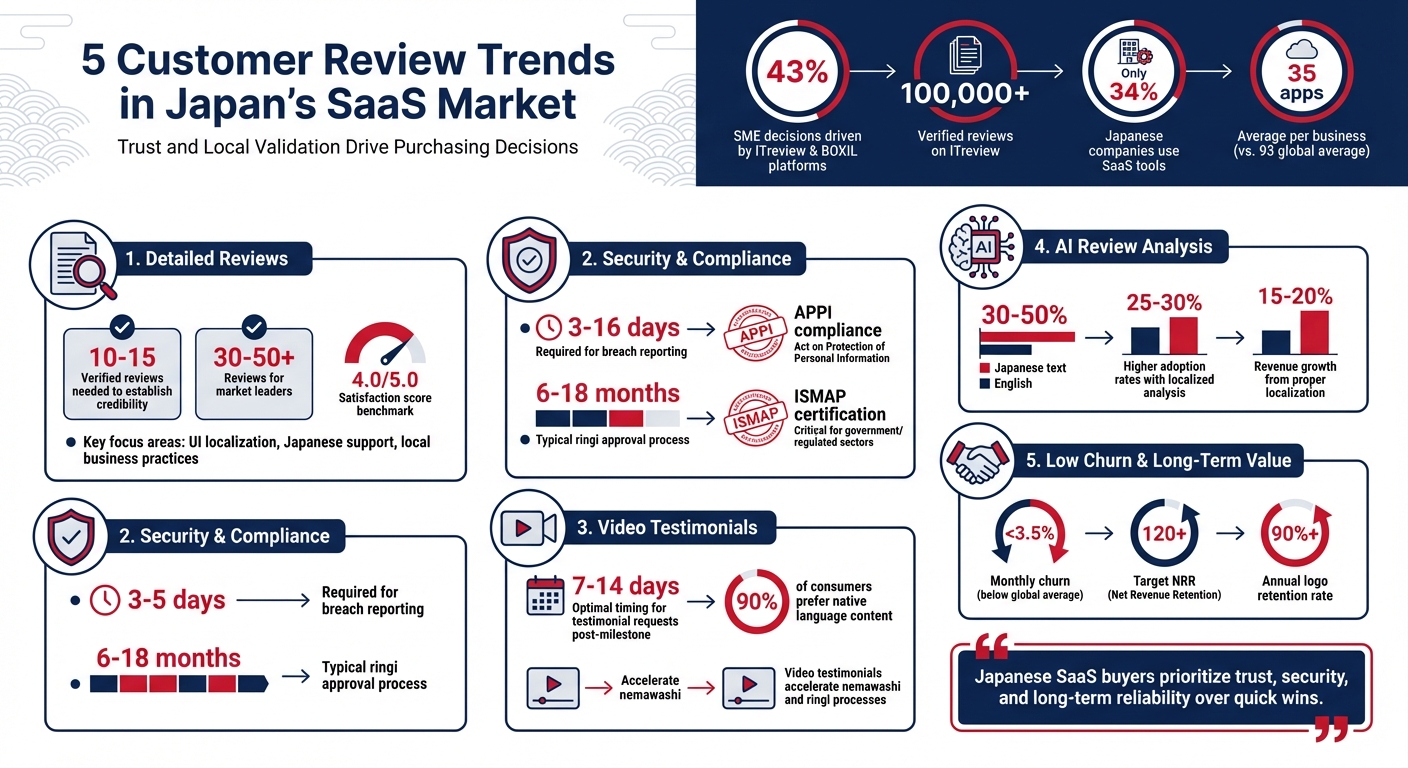
Japan SaaS Market Review Statistics and Key Trends
1. Detailed, Anonymous Reviews on Local Platforms
In Japan, SaaS buyers are known for writing thorough reviews while staying anonymous – a practice rooted in cultural norms that prioritize trust and respect in communication. Unlike the often short and emotionally charged reviews seen in Western markets (think "Amazing!" or "Awful!"), Japanese reviews tend to dive deep into specifics. They cover details like product features, implementation processes, and how well the software aligns with local needs.
Anonymity plays a key role here. It allows users to provide honest feedback without disrupting the cultural value of harmony, or wa. Instead of blunt criticism, reviewers might offer suggestions in a more indirect way, such as saying, "It would be better if…" This subtle approach ensures feedback remains constructive and polite.
These reviews often highlight critical factors for success in Japan, such as:
- The quality of UI localization.
- The responsiveness of Japanese-language customer support.
- Compatibility with local business practices, like yen-based billing and native address formats.
Interestingly, in Japan, describing a product as "normal" is actually a compliment, signaling dependability rather than mediocrity.
For SaaS companies aiming to break into the Japanese market, having 10–15 verified reviews on local platforms like ITreview is essential to establish credibility. Leading players in the market often have 30–50+ reviews with satisfaction scores above 4.0 out of 5.0. Without this baseline of locally-authored feedback, even top-tier global products may struggle to overcome initial trust barriers and demonstrate their commitment to meeting Japanese business needs.
sbb-itb-a752276
2. Focus on Data Security and Compliance in Reviews
When it comes to SaaS, Japanese customers pay close attention to security. Reviews on platforms like ITreview often emphasize whether a product complies with the Act on the Protection of Personal Information (APPI), Japan’s central data privacy law. For enterprise buyers, this isn’t just a preference – it’s an absolute must. As Yuga Koda, CEO of Nihonium, explains: "Failing to understand and correctly apply APPI’s reporting mandates can disrupt business, damage reputation, and result in regulatory penalties".
Security concerns are just as important as the detailed feedback discussed earlier. Reviews play a key role in enterprise risk assessments and often serve as vital evidence during the ringi process – the formal approval system used by Japanese companies. Positive mentions of security and compliance in reviews can help internal advocates persuade stakeholders who may never directly interact with the software.
For SaaS providers aiming to work with government agencies or operate in heavily regulated sectors like healthcare or finance, reviews referencing ISMAP certification (Information System Security Management and Assessment Program) carry significant weight. Additionally, buyers expect providers to comply with APPI by appointing a domestic representative to handle Japanese user data, as required by law.
The stakes are high. Under the 2022 amendments to APPI, companies must report data breaches to the Personal Information Protection Commission within three to five days. Reviews that highlight transparency, domestic data hosting (using platforms like AWS Japan or Azure Japan), and detailed Japanese-language security documentation (often highlighted on SaaS landing pages in Japan) can dramatically speed up the ringi process, which might otherwise take anywhere from 6 to 18 months.
3. Growth of Video Testimonials and Community Advocacy
In Japan’s SaaS market, video testimonials are becoming a game-changer. These dynamic, visual endorsements offer a level of credibility that traditional sales pitches just can’t match. Why? Because Japanese buyers tend to mistrust sales-driven messaging, preferring authentic, user-driven insights instead. This is especially crucial in a market where only 34% of companies use SaaS tools, and the average business operates just 35 apps – far below the global average of 93.
Video testimonials are particularly effective during key decision-making phases like nemawashi (informal consensus-building) and the formal ringi approval process. A short, impactful video showcasing a peer company’s success can often sway internal champions faster than a written review. Placing these videos strategically – on pricing pages or near checkout forms – can help address last-minute concerns, from security to performance, and push decisions across the finish line.
"Japanese business buyers are significantly more risk-averse than their Western counterparts. They place exceptional value on peer validation and third-party endorsement before committing to a software purchase."
- ITreview & BOXiL
Timing is everything when it comes to collecting these testimonials. Aim to request feedback 7–14 days after a milestone or onboarding, when the experience is still fresh. Segmenting videos by industry, company size, or user role ensures that prospective buyers see relatable scenarios tailored to their own challenges.
In addition to video content, community advocacy on local platforms further strengthens trust. Peer-driven validation is so influential in Japan that without it, many products might not even make it onto a buyer’s radar.
4. AI Tools in Review Analysis
AI-powered review analysis is changing the way Japanese SaaS companies and global competitors connect with their customers. Platforms like ITreview now provide advanced analytics tools that go far beyond basic sentiment tracking. These tools help vendors uncover Japan-specific needs, such as preferences for yen-based billing, Japanese calendar formats, and properly structured address fields.
By processing thousands of reviews in a flash, AI identifies both sentiment and critical feature requirements. It also picks up on subtle usage patterns – like how often documents are accessed or how groups interact with a product. This is especially valuable in Japan, where users may not voice feedback openly but still expect exceptional precision.
One of the standout benefits of AI analysis is its ability to pinpoint localization gaps that can undermine customer trust. For example, it evaluates sentiment around issues like compliance with APPI regulations or the quality of Japanese-language support. Since Japanese text tends to be 30–50% longer than English, automated summarization becomes a must-have for extracting actionable insights quickly.
The best results come when AI review analysis is integrated directly into product pages through APIs. This setup creates a real-time feedback loop, allowing companies to present concise, reliable user experiences. This is crucial in Japan, where 90% of consumers prefer products that offer information in their native language. AI tools that handle Japan’s multiple writing systems and adapt to different levels of formality give companies a clear advantage in this market. Understanding the state of SaaS in Japan is essential for navigating these localized requirements.
Businesses that invest in localized review analysis often see measurable outcomes, such as 25–30% higher adoption rates and 15–20% revenue growth compared to those relying on generic translations. This real-time insight empowers vendors to adjust their strategies quickly to meet evolving customer needs.
5. Long-Term Value and Low Churn Expectations
In Japan, SaaS buyers prioritize solutions that promise reliability and stability over the long haul. Reviews on platforms like ITreview and G2 consistently highlight the importance of these qualities, reflecting a business culture that views switching vendors as both risky and disruptive.
Japan’s B2B SaaS market stands out with churn rates significantly below the global average of 3.5% per month. Top-performing SaaS companies in the region aim for Net Revenue Retention (NRR) rates of 120 or higher, and annual logo retention rates exceeding 90% are considered a gold standard. These figures underscore the high value placed on dependable, long-term partnerships.
"Once relationships are established, Japanese clients demonstrate exceptional loyalty and a low risk of churn." – Yuga Koda, Nihonium
Japanese businesses also value localized support, such as dedicated account management, Yen-based billing, and adherence to strict APPI compliance standards. These elements signal a vendor’s deep commitment to the Japanese market.
Real-world examples further highlight these expectations. For instance, in December 2025, Nippon Yusen Kabushiki Kaisha transitioned to SAP S/4HANA Cloud Public Edition to implement AI-driven financial management across more than 350 companies. Reviews of such projects often emphasize the solution’s reliability and minimal disruption – qualities that align with the needs of Japanese enterprises. This focus on operational continuity, driven by challenges like labor shortages and an aging workforce, reinforces the preference for vendors who can demonstrate unwavering dedication.
Conclusion
Japan’s SaaS market thrives on trust, meticulous attention to detail, and long-term relationships. At its core, customer reviews significantly influence purchasing decisions. The trends discussed in this article highlight key factors shaping this landscape: anonymous feedback on local platforms validates buyer confidence, data security remains a top priority, video testimonials and community advocacy build genuine connections, AI tools refine review analysis, and low churn rates reflect a cultural preference for stability. Together, these elements provide a roadmap for success.
For SaaS providers, establishing credibility is non-negotiable. Platforms like ITreview, which impacts nearly 43% of SME purchasing decisions, are critical. Companies must also ensure strict data compliance, offer localized support, and adopt Yen-based billing to resonate with Japanese customers. The rewards are clear: churn rates in Japan are often much lower than the global average of 3.5%, and once trust is earned, customer loyalty tends to last for years.
However, navigating Japan’s unique cultural landscape requires more than standard global strategies. Tailored approaches are essential, relying on native Japanese communication and a deep understanding of consensus-driven decision-making.
This is where Nihonium steps in. Their comprehensive market entry services are designed to address Japan’s distinct review ecosystem. From product localization and marketing funnel development to fractional sales teams, Nihonium helps global SaaS companies establish a strong local presence. By refining ITreview profiles with professional Japanese (keigo), integrating domestic tools like kintone and Sansan, and crafting a value story that resonates with local audiences, Nihonium turns these trends into actionable advantages.
FAQs
How do I get my first verified reviews in Japan?
To kickstart gathering verified reviews in Japan, start by listing your SaaS product on well-known local review platforms such as ITreview and BOXIL. These platforms are widely trusted by Japanese users and can help you establish credibility while collecting your first wave of feedback.
If you need additional guidance, look into services that focus on Japan-specific localization and market entry strategies. These experts can help you navigate the unique review landscape and build trust with local users more effectively.
What APPI steps do Japanese buyers expect from SaaS vendors?
Japanese buyers expect SaaS vendors to adhere to the APPI guidelines, which stress the importance of understanding local decision-making practices, offering comprehensive documentation, and maintaining clear, structured communication. These steps reflect Japan’s emphasis on detailed, consensus-based processes and a methodical approach to onboarding.
When should I ask Japanese customers for video testimonials?
When seeking video testimonials from Japanese customers, timing is everything. Reach out after they’ve had ample time to use your product and experience success or satisfaction. This approach ensures their feedback is not only thoughtful but also valuable.
Why does timing matter? Japanese customers often place high importance on structured communication and genuine expressions of experience. By allowing them enough time, they can provide well-organized and detailed insights that resonate with others.
Focus on gathering testimonials when they can share specific, positive aspects of their journey with your product. This will help build trust and highlight authentic customer voices – something that holds significant weight in Japan.
Related Blog Posts
- AI in Japan SaaS: Market Insights
- Checklist for Analyzing Japanese SaaS Competitors
- Japan SaaS Market: Data Privacy as a Selling Point
- How Japan SaaS Case Studies Build Trust
 Japanese
  English