

If I misread who holds approval power in a Japanese buyer meeting, I can mistake interest for a real path to a signed deal.
Here’s the short version: in many Japanese companies, age, title, and years at the company often shape who leads, who stays quiet, and who can approve. The loudest person in the room may not be the one who decides. In many cases, junior evaluators ask product questions, while older senior leaders judge risk, fit, and whether to approve. Some teams also work through nemawashi before the meeting, and one estimate in the article puts 70%–90% of the meeting outcome in place ahead of time.
If I want to improve B2B SaaS sales in Japan, I should remember this:
- Don’t assume the most vocal buyer is the decision-maker
- Watch seating, introductions, and speaking order for clues
- Treat silence and soft wording as possible pushback
- Plan for senior approval, not just junior interest
- Shape senior-facing materials around risk, local support, and business fit
- Ask early who approves the ringisho and at what level
A simple way to think about it: junior buyers often evaluate; senior buyers often approve. That one point changes how I should read questions, follow-up, and deal health.
| Area | What I should expect |
|---|---|
| Who asks most questions | Often junior or mid-level staff |
| Who may hold final say | Often older, higher-ranking leaders |
| What seniors care about | Risk, support, fit, internal approval |
| What juniors care about | Product details, setup, day-to-day use |
| What can go wrong | I build with a junior champion but miss senior objections |
If I keep that hierarchy in view from the start, I’m less likely to get late-stage surprises on the path to your first customer in Japan.
How age and seniority define buyer-side hierarchy
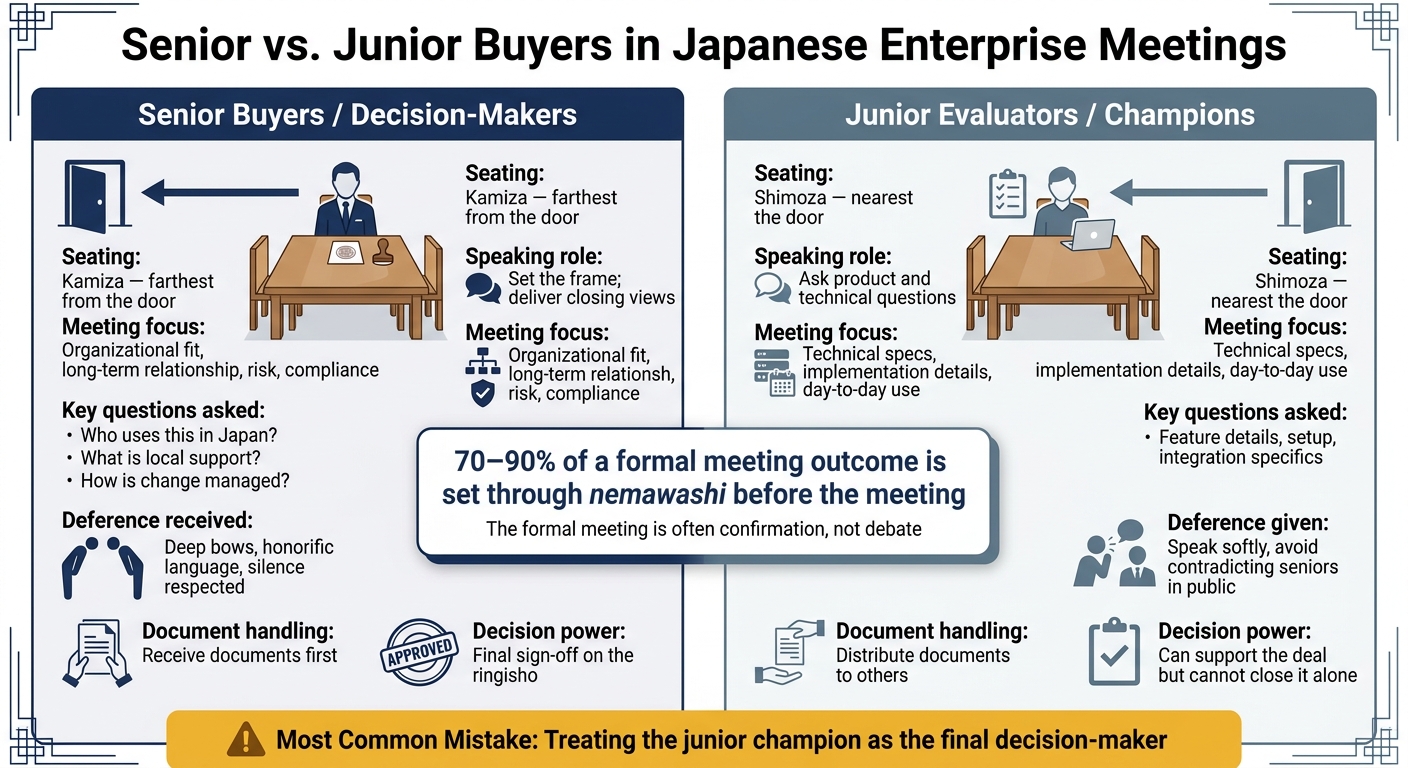
Senior vs. Junior Buyers in Japanese Enterprise Meetings
Age, title, and tenure as markers of authority
In many Japanese firms, authority is often signaled through title, age, and tenure. Nenkō joretsu ties pay and promotion to years of service, so long tenure often comes with status. For sellers, title is usually the clearest signal, followed by age, then tenure. If titles aren’t obvious right away, age can give you an early read on who may carry the most weight in the room. You’ll often see that pecking order play out in how people act during the meeting.
Senpai–kohai adds another layer. Seniors hold authority over juniors based on entry year, and juniors often show visible deference in how they speak and behave. That means even coworkers with the same formal rank may still have a clear senior-junior dynamic if one joined earlier. In vendor meetings, this can shape who jumps in first and who hangs back.
Use age as a starting clue, then confirm it through introductions and business cards. When handing over documents or business cards, go from the most senior person down.
How hierarchy shows up in vendor meetings
You can often spot hierarchy by watching the flow of the meeting. Who speaks first? Who stays quiet? Juniors tend to handle product-level questions, while seniors focus more on business fit, risk, and the seller’s credibility. Put simply, younger team members may dig into the details, while seniors hold back and weigh whether the vendor feels like a safe choice.
That pattern doesn’t always hold. In tech-forward or global firms, younger managers may have real decision power, so it’s smart to confirm hierarchy through titles and introductions instead of guessing from age alone. Even then, the tone often follows a familiar split: younger participants ask questions, and seniors judge.
sbb-itb-a752276
Speaking order, seating, and deference in the meeting room
Kamiza, shimoza, and the order of introductions
You can spot the hierarchy as soon as the meeting starts.
Japanese meeting rooms make rank clear right away: the most senior person sits farthest from the door, while the most junior person usually sits closest to it.
If you’re the vendor, you’ll usually take the seat on the door side of the table. That leaves the honor seat for the client’s senior stakeholder. After everyone sits down, the business card exchange (meishi) helps set the pecking order from the start. Cards are given and received with both hands, along with a bow whose depth and length reflect seniority. Don’t rush past this moment. Look at each card for a second before placing it on the table in front of you. It shows that you’ve noticed the person’s title and role.
When senior buyers speak first or wait until the end
Senior buyers may start the meeting. Or they may stay quiet while junior team members handle product questions and then speak at the end. That last comment often tells you more about the internal decision than the full discussion does.
In practice, junior staff may carry most of the conversation. But senior buyers still tend to signal approval or rejection, sometimes in only a few closing words.
How junior participants show deference in front of external vendors
Junior participants rarely push back on a senior colleague in front of an outside vendor. When a senior buyer is in the room, junior team members often speak more softly, ask fewer direct questions, and avoid open disagreement.
The table below sums up the main differences between senior and junior buyers.
| Senior Buyers | Junior Evaluators | |
|---|---|---|
| Seating | Kamiza – farthest from the door | Shimoza – nearest the door |
| Speaking role | Set the frame; deliver closing views | Ask product and technical questions |
| Meeting focus | Organizational fit, long-term relationship | Technical specs, implementation details |
| Deference received | Bows, honorific language, silence respected | Expected to defer; avoid contradicting seniors |
| Document handling | Receive documents first | Distribute documents to others |
So if junior attendees seem quiet, don’t read that as lack of interest. In many cases, it’s a sign of deference. That same hierarchy also shapes the tone of the meeting, especially when older buyers are present.
How meeting tone changes when older buyers are in the room
That hierarchy doesn’t just change who talks. It also changes how safe people feel when they talk.
Indirect communication, silence, and careful phrasing
When a senior stakeholder is in the room, meetings usually get more formal, slower, and more careful.
Silence often signals reflection or internal consultation. Phrases like "we need to think about this" or "it might be difficult" often mean no, or at least not yet. A senior buyer may sit quietly for a long stretch, pause to check with a colleague, and then reply with one of those phrases. In practice, those lines work as soft refusals. They often point to risk, lack of fit, or internal resistance.
Push too hard in the room – especially in front of a senior buyer – and trust can drop fast.
Face-saving shapes how concerns come up, too. Instead of saying the system is too complex, a senior buyer may frame the issue as an internal constraint and say the organization’s internal processes may find this difficult. That’s face-saving. It keeps disagreement contained and helps preserve harmony. So if you hear vague resistance, treat it like a real objection and follow up later in writing or in a private conversation.
Why younger evaluators ask product questions while seniors focus on fit
That same caution affects the kinds of questions younger and older buyers feel comfortable asking.
When senior buyers are present, juniors tend to probe details carefully, while seniors focus on risk and alignment.
Senior buyers usually ask about compliance, stability, and organizational fit. They are more likely to ask which major companies in the industry use the product in Japan, how change management is handled, and what the local support structure looks like. These are accountability questions. They reflect what senior stakeholders are there to protect: the organization from operational or reputational risk, not the feature set.
For global SaaS sellers, the shift is simple: lead with risk, proof, and local fit – not product enthusiasm.
Those cues often decide whether the deal moves forward after the meeting.
How age hierarchy affects SaaS sales outcomes
Where final decisions sit in Japanese enterprise buying
Those meeting-room signals matter because the actual decision often happens before the formal meeting starts. In Japanese enterprise buying, evaluation and approval are usually split. Junior evaluators handle demos and collect requirements, while older executives often give the final sign-off on the ringisho.
One estimate suggests 70–90% of a formal meeting’s outcome is set through nemawashi before the meeting. So the formal meeting often works more like confirmation than debate.
A junior champion can still be a big help. They may move fast, answer questions, and help shape the internal case. But their authority usually stops at internal approval. They can support the deal, but they usually can’t close it on their own.
What global SaaS teams need to adjust in meeting approach
The most common mistake is assuming the junior champion is the final decision-maker. Later, when senior executives review the proposal during the ringisho approval process, objections can show up at the last minute. And one senior objection can stall the deal late.
Start by addressing the most senior buyer first during introductions. Keep senior-level presentations structured and calm, and save deep feature discussions for sessions with junior and mid-level evaluators. Ask your junior contact directly who needs to approve the ringisho and at what level – department head, division head, or C-suite – so you can plan nemawashi conversations the right way. Senior-facing collateral should focus on approval risk and business impact.
You can see the gap in outcomes pretty clearly:
| Aspect | Handled Age Hierarchy Well | Misread Age Hierarchy |
|---|---|---|
| Stakeholder mapping | Senior decision-makers are identified early and consulted privately. | Focus stays on the junior champion; seniors are not systematically engaged. |
| Meeting etiquette | Seating and introductions prioritize seniors; respectful tone is maintained. | Juniors are addressed first, and seniors may be sidelined or treated too casually. |
| Decision visibility | There is a clear understanding of who approves the ringisho and what matters to them. | Veto power stays hidden at upper levels, and objections appear only at the final stage. |
| Deal outcome | The solution is adopted with broader buy-in and steadier retention. | The pilot stalls, the contract shrinks, or the deal dies because senior concerns were not addressed. |
Conclusion: Key patterns global sellers should keep in mind
The room may look collaborative, but approval still follows hierarchy. Age and seniority shape who approves, who speaks, and how deals move. Sellers do better when they line up senior stakeholders before the formal meeting.
FAQs
How can I identify the real decision-maker early?
In Japan, decision-making usually happens through the group and follows a clear chain of seniority. So don’t treat one executive like the only person who matters. Instead, figure out who’s part of the ringi approval chain, including department heads and technical experts.
It also helps to build support from an internal champion, often someone in IT. Then use nemawashi – informal one-on-one conversations – to sort through concerns, answer questions, and build agreement before the formal meeting even starts.
What does silence usually mean in Japanese buyer meetings?
In Japanese buyer meetings, silence is usually a deliberate nonverbal cue, not awkwardness or disinterest. More often, it signals careful thought, respect for the speaker, or time to process what was said and work toward group agreement.
That same silence can also hint at hesitation or disagreement, especially because direct refusals are often avoided to keep harmony intact. Don’t rush to fill the pause.
How should I prepare for senior buyer approval?
Prepare for senior buyer approval by working through Japan’s formal, consensus-driven hierarchy. Before executives sign off, build internal alignment through nemawashi – private, one-on-one conversations that bring concerns to the surface early, when they’re easier to address.
At the formal approval stage, or ringi, present a thorough, localized ringisho that uses the 5W2H framework. It should clearly explain the problem, the proposed solution, the financial case, and the risks.
Related Blog Posts
- Why Patience Matters in Japanese Business Decisions
- Japanese vs. Western Meeting Etiquette
- Checklist for Navigating Japanese Decision-Making
- Reading Silence in Japanese Business Culture
 Japanese
  English