

Doing business in Japan requires understanding its unique decision-making process. Unlike Western markets, where decisions are often made quickly by a single person, Japanese organizations prioritize consensus-building. This means decisions take longer but are supported by all stakeholders once finalized. Here’s what you need to know:
- Nemawashi: Informal, behind-the-scenes discussions to align stakeholders before formal meetings.
- Ringi-sho: A formal proposal document that collects approvals via personal seals (hanko) from all relevant parties.
- Tatemae vs. Honne: The public stance (tatemae) often differs from the true reason (honne) behind decisions, requiring careful interpretation.
Key Impacts on SaaS Sales
- Japanese deals involve 8–12 stakeholders (vs. 3–5 in the West) and take 6–18 months to close.
- A verbal "yes" signals the start of the process, not the end.
- Fiscal year alignment (April–March) is crucial – most buying happens between January and March.
How to Succeed
- Map Stakeholders: Identify decision-makers and hidden influencers early.
- Prepare Localized Proposals: Use native-level Japanese, include detailed cost breakdowns, and tailor materials for each stakeholder group (e.g., IT, Finance).
- Support Consensus: Provide case studies, pilot programs, and clear documentation to reduce perceived risks.
- Timing Matters: Avoid holidays like Golden Week (May) and Obon (August) and align proposals with fiscal deadlines.
By respecting Japan’s structured, consensus-driven process, you can build trust, reduce risks, and improve your chances of success.
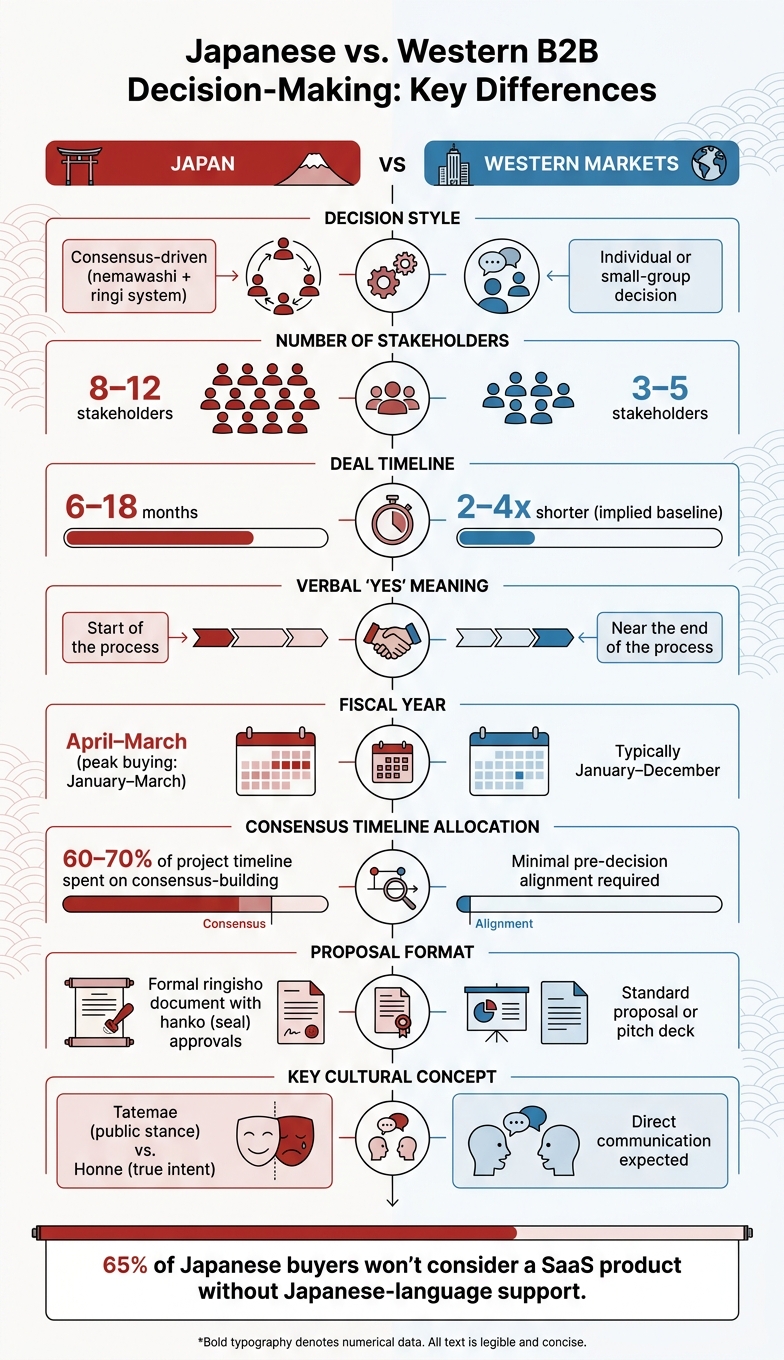
Japanese vs. Western B2B Decision-Making: Key Differences
Mapping Stakeholders and Approval Flows
Once you grasp the reasoning behind Japanese decision-making, the next step is identifying all the parties involved and understanding how decisions flow. This mapping process helps align your internal processes with the structured approach of Japanese organizations.
Key Roles in Japanese Organizations
Each decision-maker in a Japanese organization has distinct priorities. Your internal champion – often a buchō (department manager) or kachō (section manager) – initiates the process and steers the proposal forward, with support from other stakeholders.
| Stakeholder | Key Concerns |
|---|---|
| IT Leaders | Integration, security, regulatory compliance, and system stability |
| Finance Executives | ROI, Total Cost of Ownership (TCO), and budget impact |
| Executive Sponsors | Strategic alignment and competitive positioning |
| End Users | Ease of adoption and Japanese-language UI |
In addition to these main players, keep an eye out for hidden influencers. These could be administrative staff, department heads from adjacent teams, or senior advisors. While they may lack formal authority, they can quietly influence or even stall a proposal’s progress.
How Approval Processes Work
After laying the groundwork with nemawashi, the proposal moves into the ringi system, a structured, document-based approval process. The internal champion drafts a ringisho (proposal document), which then travels up the hierarchy. Each stakeholder provides their approval by adding their hanko (personal seal) in sequence, following the formal ringi protocol.
"The ringi process ensures that all relevant parties are on board before making a decision… reducing the risk of poor decision-making." – Yuga Koda, Co-Founder, Nihonium
Timing is a critical factor here. Most Japanese organizations operate on an April–March fiscal year, with purchasing activity peaking between January and March as teams aim to use remaining budgets. Aligning your outreach and proposals to land before March 31st increases your chances of securing approvals within the fiscal year.
Mapping Stakeholders
To uncover the full scope of stakeholders, ask your champion questions like, "Who else should I speak with?" and "Who has been consulted so far?" This helps you identify both the formal approval chain and the hidden influencers who might otherwise go unnoticed.
Once you’ve identified the stakeholders, apply the "3×5 Rule": allow three weeks for every five decision-makers involved, and include an additional 15–20% buffer for unexpected consultations. Be sure to document the entire hanko chain – the sequence of managers whose approval is required – to keep track of the proposal’s progress. A well-documented stakeholder map is the foundation for a successful, consensus-driven proposal.
sbb-itb-a752276
Building Proposals That Support Consensus and Reduce Risk
Creating a proposal that earns unanimous approval is crucial in Japan. A poorly prepared proposal doesn’t just get turned down – it reflects negatively on the internal champion advocating for it. As Yuga Koda, Co-Founder of Nihonium, explains:
"A ringisho that encounters objections during its formal circulation is considered a failure of preparation."
Because objections can harm your internal champion’s credibility, careful groundwork is essential before submission.
What to Prepare Before Writing a Proposal
Before drafting your proposal, gather reliable and relevant materials. In Japan, case studies from similar Japanese companies are especially valued. Alongside these, provide a localized ROI analysis, security certifications, and data residency documentation. Importantly, all materials should be in localized for the Japanese market. Using machine translations can instantly damage trust with key stakeholders, particularly in IT and Legal.
Additionally, create one-page briefs tailored to specific stakeholders before diving into the full proposal. Each department has unique priorities:
| Stakeholder Group | Primary Concerns |
|---|---|
| IT / InfoSec | Security certifications, technical architecture, data residency, integration |
| Finance | Total cost of ownership (TCO), ROI timeline, billing flexibility |
| End Users | Japanese-language UI, ease of adoption, training as part of a broader B2B SaaS sales strategy |
| Legal / Compliance | APPI compliance, SLAs, liability |
| Executives | Strategic alignment, long-term stability |
These briefs help your internal champion address concerns early, smoothing the path for formal approvals.
How to Structure a Proposal for Japanese Buyers
Once your materials are ready, structure your proposal to align with Japanese expectations. A well-crafted ringisho follows a consistent format. Start with a title and executive summary, then provide background and purpose, supported by data and industry context. Follow this with a detailed implementation plan that includes timelines and ownership, an honest assessment of benefits and risks, and a comprehensive financial breakdown covering TCO, ROI projections, and implementation fees.
One common mistake: pricing transparency. Japanese buyers expect a full cost breakdown upfront. This includes not just subscription fees but also implementation costs, ongoing support, and future expenses for seat additions or upgrades. Pricing models that obscure future costs can quickly erode trust.
In addition to the main proposal, include a one-page internal summary. This document is for stakeholders who may not have attended meetings, making it easier for your internal champion to defend the proposal at every organizational level. Transparency in pricing and upfront disclosure of all costs help minimize perceived risks.
Offering Low-Risk Entry Points
To ease concerns and build trust, propose a pilot or proof-of-concept (PoC) before initiating the full procurement process. This allows stakeholders to gather concrete data for the formal approval process and builds confidence in your solution.
A successful pilot in Japan isn’t just about technical validation – it’s a cross-functional effort. Engage IT, compliance, and business teams from the start so each group can evaluate the solution against their own requirements. Define clear success criteria that reflect Japanese priorities, such as system reliability and risk reduction, and provide regular progress updates. When the pilot succeeds, its results become a key part of your ringisho and pave the way for a "re-ringi" to expand the solution across more departments or users.
"The consensus achieved through nemawashi means the entire organization has already bought into the solution before the contract is signed, reducing churn risk and accelerating adoption." – Yuga Koda, Co-Founder, Nihonium
This upfront effort pays off: customer retention rates in Japan consistently surpass global averages by 10 to 15 percentage points, thanks to the extensive buy-in established during this process.
Running Meetings and Nemawashi Effectively
How to Prepare for a Meeting
In Japanese business culture, formal meetings are rarely where decisions are made. Instead, the groundwork is laid well before anyone gathers in the room. Patric Sawada, Founder of Silkdrive, explains it best:
"The decision was not supposed to happen in the room. It already happened, in hallways, over coffee, in a series of quiet one-on-one conversations."
This process, rooted in the concept of nemawashi, emphasizes meticulous preparation to ensure consensus is already in place. Start by sharing all presentation materials and agendas 3 to 5 days ahead of the meeting. This gives stakeholders time to review and begin internal discussions. To avoid missteps, ensure all materials are bilingual – Japanese and English side by side – and use professional, native-level translations. A poorly translated document can undo months of effort in building trust.
Before the meeting, apply the "Three-Touch Rule": engage stakeholders through three brief, informal conversations. These aren’t high-pressure pitches but opportunities to check in, gather feedback, and quietly secure agreement.
Once this groundwork is complete, you can shift your focus to securing your first customer by running the meeting effectively.
Best Practices During the Meeting
During the meeting, your goal is to confirm alignment – not to create it. Pushing for immediate decisions, such as asking, "Can we decide today?" could backfire and damage the relationship.
Instead, embrace the silence. Pauses after questions often signal thoughtful consideration, not discomfort. Present clear options with balanced advantages and disadvantages to reinforce the consensus already built. As Yuga Koda, Co-Founder of Nihonium, points out:
"Presenters who demonstrate patience and a genuine grasp of the ringi process earn deeper respect."
Keep your presentation simple and visually clear. Use slides with a minimum 24-point font and focus on one idea per slide. Structure your presentation logically, starting with the overarching business context before diving into technical details. This approach ensures every stakeholder can follow and engage with the discussion.
Once alignment is confirmed, timely and thorough follow-up becomes the next critical step.
Follow-Up and Nemawashi After the Meeting
The end of a meeting is just the beginning of the follow-up process. Within 24 hours, send a concise recap to all participants. Within a week, share a polished proposal summary that’s ready for internal circulation. These steps extend the nemawashi process, keeping everyone on the same page.
If progress slows, don’t interpret it as disinterest. Often, it’s a sign that additional information is needed. Stakeholders may require specific details – like security documentation, timelines, or support plans – to address internal concerns from departments like IT, Legal, or Finance. Be proactive and offer to create tailored one-pagers for different roles. To check in without being pushy, try asking, "Which stakeholders have you been able to speak with so far?" instead of "When will you make a decision?" .
When a Japanese counterpart says, "We will study this carefully," it’s not a polite dismissal. It’s an indication that internal alignment is underway. Your job is to support this process by providing precise, well-translated materials when needed.
Getting Your Organization Ready for Japanese Decision-Making
Navigating Japan’s decision-making landscape requires more than just a tailored approach to stakeholders and proposals. Your organization needs to fine-tune its internal processes and prepare its teams to align with Japan’s unique business practices.
Adjusting Internal Processes
Prepare for Japan’s lengthier sales cycles by adapting your internal timelines. Mid-market deals typically take 6–9 months, while enterprise deals can stretch to 9–18 months – two to four times longer than Western sales cycles.
"Nemawashi (根回し) is Japan’s informal consensus-building process where stakeholders align behind the scenes before any formal proposal, extending B2B SaaS deal cycles by 2-4x compared to Western markets."
To manage expectations, adjust your CRM forecasting with the "3×5 Rule" – plan for three weeks per five decision-makers, adding a 15–20% buffer. This helps you reflect the extended timelines for mid-market and enterprise deals. Consistency across your teams is also critical. If sales, product, and operations deliver conflicting messages about pricing or timelines, Japanese buyers will notice – and it can quietly undermine their trust.
Once your internal processes are aligned, the next step is to ensure your product and team are ready for these consensus-driven cycles.
Product Localization Checklist
Localization is essential when entering Japan’s market. A staggering 65% of Japanese buyers won’t consider a SaaS product without Japanese-language support. Before initiating any sales efforts, make sure your product meets these baseline localization standards:
| Checklist Area | What’s Required |
|---|---|
| Language & UI | Full Japanese UI, documentation, and help content; UI layouts adjusted for 30–50% text expansion |
| Billing & Payments | JPY pricing, support for bank transfers (furikomi), and fiscal year alignment (April–March) |
| Approvals & Workflows | Multi-step hanko (stamp-based) approval flows and hierarchical permission controls |
| Compliance | APPI data privacy compliance and Japan-based data residency options for regulated industries |
| Integrations | Compatibility with tools like Cybozu kintone, ChatWork, Sansan, and local ERP systems |
Start with a "Minimum Viable Localization" strategy. This might include creating Japanese landing pages, localized marketing materials, and a demo environment, which can cost between $15,000–$30,000. Full localization, covering core features, typically costs $20,000–$50,000, while comprehensive coverage can climb to $250,000.
Preparing Your Team
Every document you produce needs to stand on its own. As J2G explains:
"Your real audience is not only the person you met. It is also the people they need to persuade after the meeting."
This means your proposals, one-pagers, and follow-ups should be designed to communicate value without your presence. Build role-specific, native-level Japanese briefs. For example:
- IT: Security and integration details
- Finance: Total cost of ownership (TCO) and ROI breakdowns
- End Users: Ease-of-use summaries
These documents equip your internal champion with the tools they need to advocate for your product.
Additionally, rethink your website’s call-to-action. Japanese buyers often need detailed materials to share internally. Adding a "Download Documents" option alongside "Book a Demo" allows your champion to circulate a comprehensive deck during nemawashi. This simple tweak shows that your company understands Japan’s decision-making process.
Conclusion: Steps to Navigate Japanese Decision-Making
Success in the SaaS market in Japan hinges on moving thoughtfully rather than rushing. Japanese organizations typically allocate 60–70% of a project timeline to building consensus, and this is intentional. As Patric Sawada, Founder of Silkdrive, explains:
"The slow cycle is the feature, not the bug; the consensus expectation is the design, not the side effect."
Periods of silence often mean active coordination is happening behind the scenes. Your role is to support this process. Equip your internal advocate with tools like one-page summaries, FAQs, and rollout plans to simplify their efforts in navigating the ringi-sho process. Providing stakeholder-specific materials – such as security details for IT or total cost breakdowns for Finance – helps reduce the friction they may encounter in internal discussions. By carefully following steps like stakeholder mapping and creating tailored proposals, you ensure that every action strengthens consensus.
Timing is also critical. Align your efforts with Japan’s fiscal calendar and business practices by initiating outreach before March, presenting pricing in JPY (including Japanese Consumption Tax), and avoiding major holiday periods like Golden Week in May or Obon in August. These adjustments not only simplify internal workflows but also reinforce your approach.
For additional support, Nihonium offers services tailored to global SaaS companies entering Japan. From product localization and ringi-ready sales materials to fractional sales support, they specialize in navigating Japan’s consensus-driven buying processes. By following these strategies, you can approach Japanese decision-making with confidence.
FAQs
How can I identify the real decision-makers in Japan?
In Japan, decision-making typically relies on a consensus-driven approach that involves input from various stakeholders. These stakeholders often include department leaders, IT architects, and finance controllers, ensuring that multiple perspectives are considered. Final approvals are usually granted by executives or committees, reflecting the collective agreement.
A critical part of this process is nemawashi, an informal yet essential practice. It involves having one-on-one discussions to build consensus and address concerns before formal meetings take place. This groundwork helps smooth the approval process and ensures alignment among all parties.
To navigate this structured system, it’s helpful to identify high-level sponsors or advocates within the organization. These individuals can lend their support and help guide proposals through the often-layered approval process.
What should a ringi-sho include to avoid objections later?
To avoid objections during the circulation of a ringi-sho, make sure the document is thorough and covers all critical aspects. Include the following:
- The problem: Clearly define the issue being addressed.
- Proposed solution: Outline the recommended course of action.
- Implementation plan: Detail responsibilities, timelines, and steps for execution.
- Financial details: Provide a breakdown of the budget, costs, and expected ROI.
- Risk assessments: Highlight potential risks and how they will be managed.
- Supporting documentation: Attach relevant materials like market research or legal reviews.
It’s crucial to address potential objections during the nemawashi phase, where informal discussions help align stakeholders. By the time the ringi-sho is circulated, it should already reflect a consensus.
How can I speed up consensus without seeming pushy?
To help move toward consensus without coming across as too assertive, assist your internal champion through the nemawashi and Ringi processes. Incorporate the catchball technique, which involves refining proposals collaboratively by treating your solution as a draft open to feedback. Offer comprehensive, data-backed materials in Japanese – such as ROI analyses and risk assessments – that your champion can present internally. Be patient with follow-ups, as silence often signals that the proposal is being reviewed within their organization.
Related Blog Posts
- Nemawashi: Building Consensus in Japan
- Why Patience Matters in Japanese Business Decisions
- Nemawashi vs. Ringi: Decision-Making Tools in Japan
- Aligning SaaS Teams with Japanese Decision-Making Styles
 Japanese
  English