
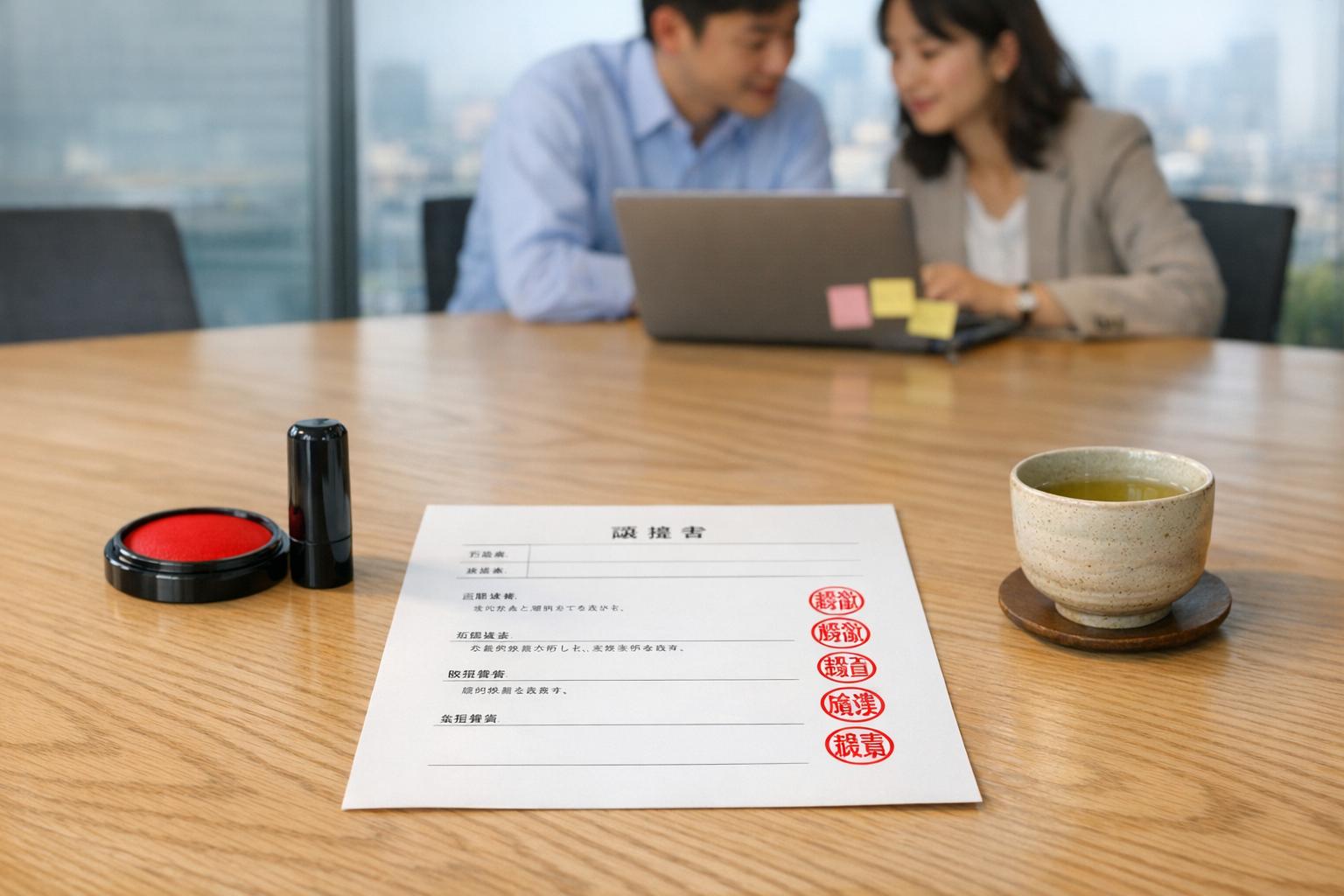
Japanese decision-making thrives on two key processes: Nemawashi and Ringi. These approaches prioritize consensus over speed, ensuring smoother execution once decisions are finalized.
- Nemawashi: Informal groundwork where stakeholders are consulted individually before formal discussions. Think casual meetings, private chats, or one-on-one sessions to address concerns and refine proposals.
- Ringi: A formal process involving a document (ringisho) circulated through organizational layers for approval, with each stakeholder adding their seal (hanko) to signify agreement.
Key Differences:
- Nemawashi focuses on private consensus-building, while Ringi formalizes decisions with documented accountability.
- Nemawashi happens before formal proposals; Ringi occurs after proposals are ready for review.
For businesses, especially SaaS companies entering Japan, understanding these systems is crucial. Nemawashi reduces resistance, while Ringi ensures thorough evaluation and shared responsibility. Together, they create a methodical path to successful collaboration in Japan.
What is Nemawashi?
Nemawashi (根回し) refers to an informal process used to build consensus before formal decisions are made. The term translates to "turning the roots", symbolizing the careful groundwork required before introducing significant changes.
In a business context, nemawashi acts as a kind of preliminary quality check. It involves engaging key decision-makers individually to identify and address potential issues ahead of formal discussions.
This approach is deeply rooted in Japanese business culture, where high-ranking officials expect to be briefed privately about new proposals. As Rochelle Kopp of Japan Intercultural Consulting explains:
"If they find out about something for the first time during the meeting, they will feel that they have been ignored, and they may reject it for that reason alone."
Nemawashi complements the formal Ringi system, which handles official approvals. While Ringi provides the structure, nemawashi ensures the groundwork is laid to make the approval process smoother.
How Nemawashi Works
The process begins with identifying the right stakeholders. This includes not only formal decision-makers but also informal influencers and technical experts who may impact the decision. Stakeholder mapping often extends beyond the organizational chart to uncover hidden power dynamics.
Next, informal one-on-one consultations are held. These meetings are used to explain the proposal, gauge reactions, and collect feedback. These discussions often take place in relaxed settings, making it easier for participants to share their honest opinions.
The most critical phase of nemawashi involves addressing concerns. Feedback gathered during these consultations is used to refine the proposal or prepare solutions to anticipated objections. As N.K., a Technical Logic Strategist, describes it:
"Think of it as Preliminary QA (Quality Assurance). It is the act of talking to key stakeholders individually before the meeting to fix ‘bugs’ in your proposal."
For example, if someone responds with "kento-shimasu" (indicating they will consider it), follow up with specific data or clarifications to address their concerns.
By the time the formal meeting occurs, the proposal is often primed for a smoother approval process.
Benefits of Nemawashi
Nemawashi provides several advantages in business settings. It helps identify potential issues early, minimizing risks before significant resources are invested. The process also fosters collaboration by giving stakeholders a chance to voice concerns in a non-confrontational environment, preserving harmony (wa). This cultural alignment is as critical as SaaS localization when entering the market.
This method ensures alignment among all parties, so by the time a formal meeting takes place, key stakeholders have already been heard. For instance, in 2024, TechInnovate Solutions, a U.S.-based software company, adopted nemawashi for a major project under the guidance of a Japanese manager. Informal discussions across departments shortened the approval process by 30%, achieving full team buy-in.
While the process requires careful preparation, it ultimately speeds up execution once consensus is achieved.
sbb-itb-a752276
What is the Ringi System?
The Ringi system is a structured, bottom-up approach to decision-making where a written proposal, known as a ringi-sho, moves through various levels of an organization for approval. Unlike the more hierarchical, top-down methods common in Western companies, this process begins with frontline employees or lower management drafting a detailed proposal.
A ringi-sho includes all the essential elements for a thorough review: the project title, background, implementation plan, financial details like ROI, risk analysis, and a section for approvals. As the document circulates through the organization – from lower-level employees to middle management and finally to top executives – each stakeholder stamps it with their hanko (personal seal) to indicate agreement. This hanko serves as a symbol of shared accountability across departments.
The Ringi process values consensus over speed. Approvals can take up to a month due to the number of stakeholders involved. However, this deliberate approach allows teams to identify potential issues early. As Yuga Koda, CEO of Nihonium, puts it:
"The ringisho serves as a formal document that enables proposals to gain approval through the consensual decision-making process."
By involving multiple layers of review, the system ensures that all departments are aligned before final approval. This shared responsibility means that if problems arise during implementation, accountability isn’t placed on a single individual but distributed across the organization.
How the Ringi Process Works
The Ringi process follows a structured sequence of steps. It starts with the initiation phase, where lower or middle management drafts the ringi-sho. This document typically includes detailed data, ROI projections, and often case studies from similar companies to strengthen the proposal. These case studies are especially valued in Japan as they serve as practical examples.
Before the document is formally circulated, proponents often lay the groundwork by gathering informal feedback. Once in the review phase, the ringi-sho moves through various departments for input and revisions. This iterative process may involve multiple adjustments to address concerns or refine the proposal.
Next comes the approval phase, where managers affix their hanko, signaling formal agreement. Finally, top executives conduct a final review and provide the ultimate sign-off. In 2024, GlobalManufacture Corp demonstrated how digitizing this process can save time, reducing decision-making timelines by 40%. Increasingly, companies are adopting electronic formats for ringi-sho to streamline this traditionally paper-based process.
This methodical approach not only ensures thorough evaluation but also reinforces the collective accountability that is central to Japanese business practices.
Why Ringi Matters in Japanese Business
The Ringi system is crucial for Japanese organizations because it emphasizes transparency, detailed documentation, and shared responsibility. Every stakeholder involved can track the proposal’s progress and understand the reasoning behind decisions. The detailed ringi-sho also serves as a permanent record, capturing cost-benefit analyses and stakeholder feedback. This documentation proves invaluable if questions or disputes arise later. As Saori Tamaki from Inventure Japan explains:
"Since it is basically the employees on the frontline who write the Ringi-sho, the Ringi strongly reflects the voice of the people on the frontline."
One of the system’s most important features is its distribution of responsibility. Instead of placing the weight of a major decision on a single executive, the hanko stamps from each department ensure that accountability is shared. This approach aligns with Japan’s cultural focus on harmony (wa) and guarantees smoother implementation once a proposal is approved, as all potential dependencies have been addressed.
For SaaS companies looking to break into the Japanese market, understanding the Ringi system is a must. Japanese buyers prioritize ROI and require extensive supporting documentation. That’s why SaaS landing pages in Japan targeting this audience often feature "Download Document" buttons instead of "Book a Demo" calls-to-action. These materials are critical for potential customers to draft their internal ringi-sho, ensuring their proposals meet the rigorous approval process.
Nemawashi vs. Ringi: Key Differences
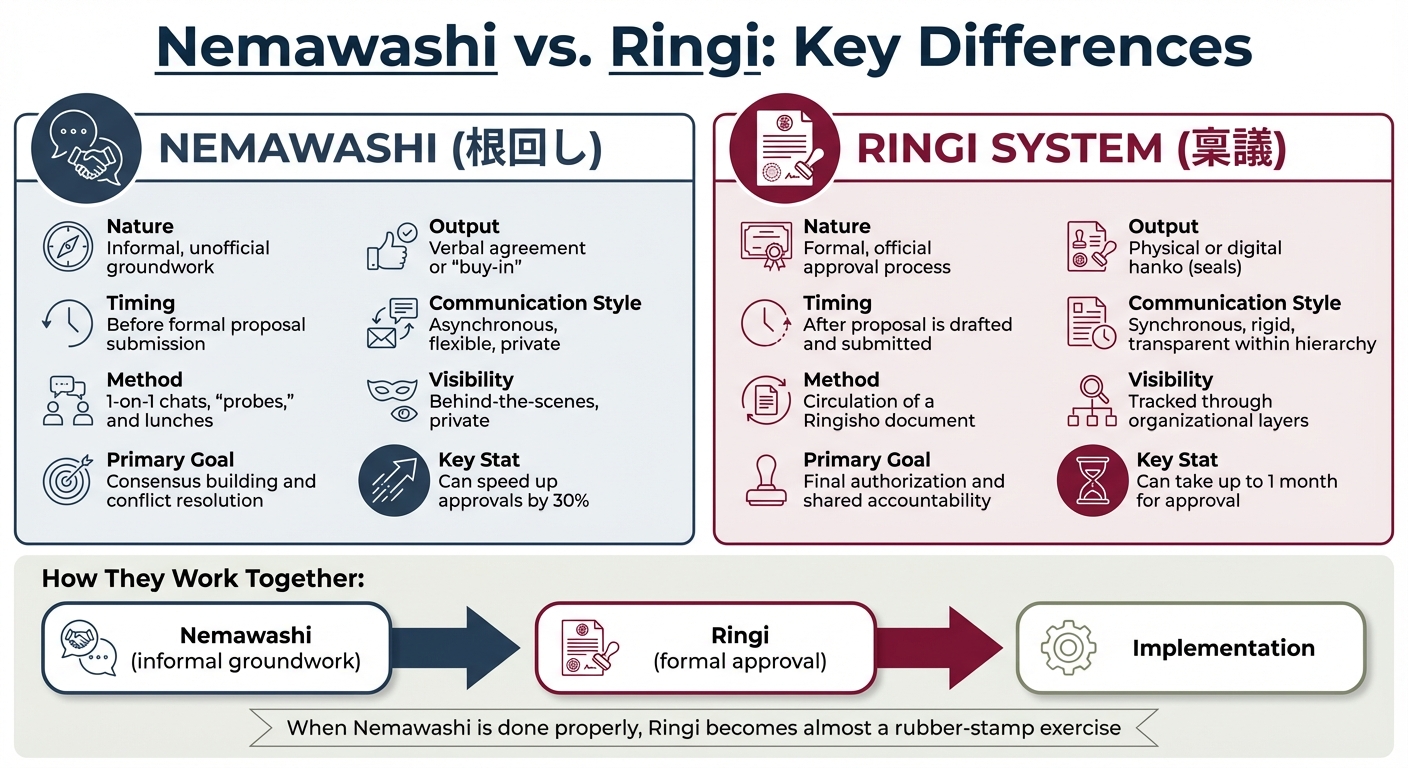
Nemawashi vs Ringi: Key Differences in Japanese Decision-Making
Nemawashi and Ringi are both integral to Japanese decision-making, but they serve very different purposes within the process. Think of Nemawashi as the behind-the-scenes preparation, while Ringi is the formal step that makes decisions official. Knowing how to navigate both is essential for anyone working in Japan, especially in the SaaS industry. These distinctions are particularly important when evaluating how these systems can be applied in SaaS market strategies for entering Japan.
Nemawashi lays the groundwork through informal conversations – think hallway chats, casual lunches, or one-on-one meetings. It’s during this phase that potential objections are addressed, interdepartmental dependencies are sorted out, and early buy-in is secured. By the time a formal meeting happens, the heavy lifting is already done. Skipping Nemawashi and going straight to formal discussions can lead to rejection or delays.
Ringi, on the other hand, is the formal approval process. It involves circulating a document (ringi-sho) for signatures, with each manager stamping their hanko as a sign of approval. This creates a clear trail of accountability. However, if even one person in the approval chain is unavailable or hesitant, the entire process can grind to a halt. Ringi is not the place for brainstorming or negotiating – it relies on the groundwork laid during Nemawashi to move smoothly.
The two systems complement each other. Nemawashi handles sensitive issues privately, giving stakeholders a chance to voice concerns without fear of public embarrassment. Ringi then formalizes the consensus reached during Nemawashi, ensuring that responsibility is shared across the organization. When Nemawashi is done properly, Ringi becomes almost a rubber-stamp exercise, as all parties have already agreed to the proposal. In fact, one study found that effective Nemawashi can speed up approvals by as much as 30%. For SaaS companies, understanding these dynamics is key to leveraging both systems effectively, as discussed further in the analysis.
Comparison Table: Nemawashi vs. Ringi
| Feature | Nemawashi | Ringi System |
|---|---|---|
| Nature | Informal, unofficial groundwork | Formal, official approval process |
| Timing | Before the formal proposal is submitted | After the proposal is drafted and submitted |
| Method | 1-on-1 chats, "probes", and lunches | Circulation of a Ringisho document |
| Primary Goal | Consensus building and conflict resolution | Final authorization and shared accountability |
| Output | Verbal agreement or "buy-in" | Physical or digital hanko (seals) |
| Communication Style | Asynchronous, flexible, private | Synchronous, rigid, transparent within hierarchy |
| Visibility | Behind-the-scenes, private | Tracked through organizational layers |
Pros and Cons of Nemawashi and Ringi
Nemawashi and Ringi are two key approaches in Japanese decision-making, each with its own strengths and challenges. Nemawashi focuses on reducing resistance and fostering trust by addressing objections and refining proposals in private discussions. While this approach can smooth the path for implementation, it requires significant time and depends heavily on strong relationship-building skills. To outsiders unfamiliar with Japanese business practices, it might even appear as covert or behind-the-scenes negotiations.
Ringi, on the other hand, provides a structured and transparent process that ensures accountability and resolves potential issues early. This method distributes responsibility across multiple stakeholders, minimizing the risk of failure stemming from a single individual. However, the process is notoriously slow – sometimes taking up to a month due to its many layers of approval. Even worse, a single objection at the executive level can send the entire proposal back to square one.
Both approaches share a common pitfall: the risk of groupthink. The strong emphasis on consensus can stifle dissenting opinions and reduce the organization’s ability to adapt quickly. Understanding these dynamics is crucial for applying Nemawashi and Ringi effectively, particularly for SaaS companies operating in Japan.
Comparison Table: Advantages and Disadvantages
| Method | Advantages | Disadvantages |
|---|---|---|
| Nemawashi | Reduces resistance; fosters trust; allows private feedback; smooths implementation | Time-intensive; demands high interpersonal skills; may seem like covert maneuvering |
| Ringi | Ensures a clear paper trail; shares accountability; promotes harmony; values frontline input | Extremely slow (up to a month); bureaucratic; risks groupthink; discourages individual initiative |
For SaaS companies, balancing these trade-offs is essential to decide when and how to apply each method effectively.
How SaaS Companies Can Use These Methods in Japan
Using Nemawashi Before Formal Pitches
Nemawashi is all about laying the groundwork informally to ensure your formal proposal gets the green light. For SaaS companies entering Japan, this means connecting with key stakeholders individually before presenting anything officially. As Yuga Koda, CEO of Nihonium, puts it:
"By minimizing surprises and resistance, nemawashi is a vital precursor to formal advancement."
Start by mapping out the key players who influence decisions in your target market. Then, focus on informal interactions – think coffee chats, lunch meetings, or casual conversations – to gather feedback and address concerns early. Share draft proposals with these stakeholders beforehand, giving them a chance to flag risks or contribute ideas. Use data-backed messaging that highlights ROI and operational efficiency, and include case studies to demonstrate successful outcomes. These steps build trust and ensure smoother discussions during the formal pitch.
Once this groundwork is in place, the formal Ringi process becomes much easier to navigate.
Using Ringi for Formal Approvals
After completing Nemawashi, the Ringi process formalizes approvals through a structured proposal document, or ringisho. This document typically includes technical details, ROI estimates, timelines, and training plans for post-implementation. The ringisho is reviewed sequentially by department managers, each providing approval with their hanko (seal), before reaching final executive sign-off (kessai).
To support this process, make sure your website offers clear, accessible "Download Document" options. Japanese buyers often rely on these materials to draft their internal ringisho. Timing is also critical – most Japanese companies align their procurement and budgeting cycles with the April–March fiscal year. Submitting your Ringi proposals in sync with these cycles can give you a competitive edge.
Working with Nihonium for Market Entry
Navigating Nemawashi and Ringi successfully requires deep local knowledge and cultural insight. Nihonium specializes in helping global SaaS companies localize their products and strategies for the Japanese market. Their services include product localization, SEO-driven marketing funnels, and fractional sales support for lead generation and deal closures.
Nihonium can also assist with creating "Ringi-ready" documentation packs tailored to Japanese decision-making processes. These packs include localized business cases, detailed ROI projections, and implementation timelines, reducing the workload for your internal champion. Additionally, Nihonium connects clients with Systems Integrators (SIers) and Global Systems Integrators (GSIs) experienced in Japanese procurement practices. By partnering with experts who understand both the relationship-driven Nemawashi approach and the structured Ringi process, you can approach Japan’s consensual decision-making with confidence and clarity.
Conclusion
Nemawashi and Ringi work hand-in-hand in Japanese decision-making. Nemawashi focuses on building consensus informally through personal discussions, while Ringi formalizes that consensus via a structured approval process. Together, they create a thorough system that minimizes risk by ensuring all voices are heard before moving forward.
For SaaS companies entering Japan, these methods are crucial. Global providers need to embrace this layered, bottom-up approach to succeed in the market. As Yuga Koda, CEO of Nihonium, explains:
"The ringi process and ringisho epitomize Japan’s business culture of consensual decision-making, significantly impacting how businesses operate and how sales are conducted".
This process may take more time than Western-style sales cycles, but it pays off. Once a proposal clears both Nemawashi and Ringi, implementation flows seamlessly. Every stakeholder has given their approval, concerns have been addressed, and accountability is shared across the organization.
Skipping Nemawashi and jumping straight to formal presentations often leads to setbacks, like receiving a "Kento-shimasu" response – a polite way of saying, "We’ll consider it". Think of Nemawashi as the groundwork that ensures quality, while Ringi serves as the final stage for execution.
To succeed, start by identifying key stakeholders early. Prepare documentation that includes detailed ROI projections tailored for Ringi, and align your sales strategy with Japan’s fiscal year (April–March). By mastering these practices, you move from being seen as an outsider to becoming a trusted partner in the Japanese market.
FAQs
How do I know who to include in nemawashi?
When making decisions, it’s important to involve the right people. This means including stakeholders, key decision-makers, and those directly impacted by the outcome. Prioritize individuals whose input or backing is essential – this could be team members, managers, or influential colleagues within the organization.
The idea is to engage these individuals early by gathering their feedback in an informal, low-pressure way. This approach helps you build alignment, address potential concerns, and create a sense of shared ownership before any formal decisions are made. By doing so, you set the stage for smoother implementation and stronger support down the line.
What should a ringi-sho include for SaaS buying decisions?
A ringi-sho is a formal document used in Japan to propose and approve decisions within a company. It should clearly explain the proposal’s purpose, outline its benefits, and detail any associated costs. To ensure smooth decision-making, it’s crucial to include supporting documentation and obtain approvals from relevant departments. This approach aligns with the consensus-driven process often seen in SaaS purchasing in Japan.
How can we shorten ringi timelines without breaking etiquette?
To streamline ringi timelines without compromising etiquette, consider using Nemawashi. This method involves having informal, pre-approval conversations to establish consensus before initiating the formal ringi process. By tackling potential concerns upfront, you can minimize the need for multiple revisions and accelerate approvals. It’s a way to honor traditional practices while making the decision-making process more efficient.
Related Blog Posts
- Nemawashi: Building Consensus in Japan
- Hierarchy vs. Consensus in Japan
- Why Patience Matters in Japanese Business Decisions
- How Japanese Middle Managers Make Decisions
 Japanese
  English