

Japanese middle managers, known as kachō and buchō, play a pivotal role in decision-making, especially for SaaS companies entering Japan. Unlike Western organizations with top-down authority, Japan relies on consensus-driven methods like nemawashi (informal groundwork) and ringi (formal approval). Here’s what you need to know:
- Key Practices: Decisions are built through informal discussions (nemawashi) to address concerns privately, followed by formal proposals and ringisho, which circulate for approval stamps (hanko).
- Decision Flow: A six-step process ensures alignment – initiation, informal consensus, formal documentation, circulation, final approval, and implementation.
- Cultural Norms: Harmony (wa), risk-sharing, and long-term relationships are priorities, influencing cautious, incremental changes over disruptive solutions.
-
Tips for SaaS Companies:
- Build trust through long-term engagement.
- Provide detailed, data-backed proposals.
- Involve all stakeholders early to avoid objections.
- Tailor communication for clarity and respect.
Understanding these practices can help foreign companies navigate Japan’s structured, collaborative decision-making process and establish strong partnerships.
How Japanese Middle Managers Make Decisions
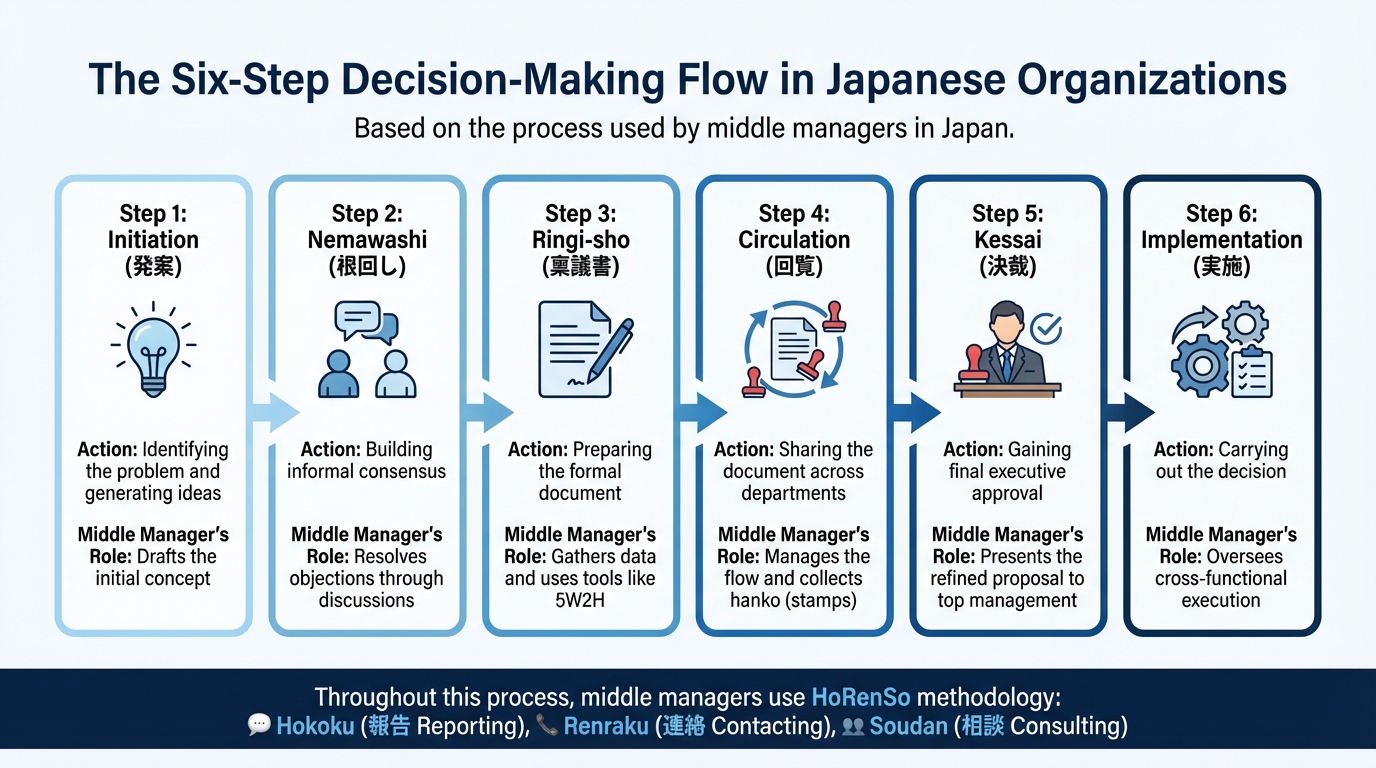
Six-Step Japanese Decision-Making Process for Middle Managers
Japanese middle managers operate within a structured system that carefully balances hierarchy and consensus. Unlike many Western organizations, where decisions often come from the top-down, Japanese middle managers rely on a bottom-up approach. This method emphasizes group alignment and shared responsibility, making it a key aspect of doing business in Japan.
The Role of Ringi and Nemawashi
At the heart of decision-making in Japan are two key practices: ringi (a formal approval process) and nemawashi (preliminary discussions). Middle managers are typically the ones who initiate proposals, as they are closely involved in addressing day-to-day challenges.
Nemawashi starts with informal, one-on-one discussions with stakeholders across various departments. As Tokhimo explains:
"Nemawashi involves informal discussions, meetings, and consultations with relevant stakeholders to gather input, address concerns, and build support for a proposed idea."
This method allows objections to be addressed privately, ensuring harmony is preserved. By the time the proposal enters the formal ringi process, most concerns have already been resolved.
The next step is drafting a ringi-sho, a formal proposal document. Middle managers prepare this concise document, which includes the rationale, data, budget, and expected outcomes. In some companies, all the details must fit on a single A3-sized sheet of paper. Rochelle Kopp, Founder of Japan Intercultural Consulting, explains:
"The person who writes the ringi is the person who frames the question, and who gathers all the data to support the decision."
This preparation sets the stage for a structured six-step decision-making process.
Steps in the Decision-Making Flow
The decision-making process typically follows six stages:
| Stage | Action | Middle Manager’s Role |
|---|---|---|
| Initiation | Identifying the problem and generating ideas | Drafts the initial concept |
| Nemawashi | Building informal consensus | Resolves objections through discussions |
| Ringi-sho | Preparing the formal document | Gathers data and uses tools like 5W2H |
| Circulation | Sharing the document across departments | Manages the flow and collects hanko (stamps) |
| Kessai | Gaining final executive approval | Presents the refined proposal to top management |
| Implementation | Carrying out the decision | Oversees cross-functional execution |
Throughout this process, middle managers rely on the HoRenSo methodology – reporting (Hokoku), contacting (Renraku), and consulting (Soudan) – to keep everyone informed and aligned.
For example, a U.S.-based software company was able to speed up approvals by 30% using localized bilingual documents and extensive nemawashi, achieving full departmental buy-in.
These steps highlight the importance of harmony and shared responsibility in Japanese organizations.
Consensus Culture and Risk Minimization
The focus on harmony (wa) and risk aversion shapes every part of the decision-making process in Japan. The ringi system ensures that responsibility is shared among multiple stakeholders, so no single individual is solely accountable if something goes wrong. As Career Management English notes:
"The role of the president of the company is solely to approve what has already been decided upon through the whole decision-making process."
By the time a proposal reaches the executive level, consensus has already been achieved, making the final approval more of a formality. For SaaS companies, this means that while the initial approval process may take longer, deployment across the organization is often smooth once the decision is finalized.
Many Japanese companies are now modernizing these traditional practices. Digital tools that streamline ringi circulation can cut decision-making time by up to 40%. Some organizations are even experimenting with hybrid models that combine consensus-building with agile practices, allowing them to respond more effectively to global market demands.
Common Decision Patterns Among Japanese Middle Managers
Understanding how Japanese middle managers typically approach decisions can help SaaS companies navigate the approval process more effectively. Three key patterns stand out: a focus on maintaining harmony, a preference for gradual changes over major disruptions, and a strong emphasis on cross-department collaboration. These patterns align with the structured decision-making processes often seen in Japanese organizations, reinforcing earlier discussions on consensus-building and risk reduction.
Prioritizing Harmony and Long-Term Relationships
In Japan, the concept of wa – harmony – takes precedence over individual accomplishments. This value is deeply ingrained in workplace culture, where long-term career commitments are the norm. Many professionals expect to work with the same colleagues for decades, making the preservation of relationships a practical and strategic priority.
This emphasis on harmony influences how decisions are made. Responsibility is often distributed across multiple stakeholders, ensuring no single individual bears the full weight of accountability if something goes wrong. As Commisceo Global explains:
"Japanese management culture is deeply influenced by the concept of harmony (wa), hierarchy, and collective responsibility."
The practice of nemawashi, or informal, behind-the-scenes discussions, plays a critical role in this process. It’s not just about building consensus – it’s also a way to strengthen collaborative relationships, which are essential for day-to-day operations.
Incremental Changes Over Radical Shifts
Aligned with their focus on harmony, Japanese middle managers tend to favor small, incremental changes over sweeping transformations. This cautious approach stems from a decision-making system that requires thorough consultation and agreement from all relevant parties. As a result, radical changes are rare and often impractical without unanimous stakeholder support.
Research from Stanford Graduate School of Business highlights this tendency:
"Managers at Japanese managed firms were found, as a group, to rely more extensively on consultative type decision making and to achieve higher perceived quality of implementation."
For SaaS companies, this means positioning your product as a tool that enhances existing workflows rather than one that disrupts or replaces them entirely. While this incremental approach may extend the B2B SaaS sales cycle, it often results in smoother implementation and higher-quality outcomes once approval is secured.
Cross-Functional Coordination
Japanese middle managers excel at bringing together input from various departments before finalizing decisions. This coordination is achieved through both nemawashi (informal discussions) and the formal ringi system, where proposals are circulated for approval among departments like IT, Finance, and Operations.
This collaborative approach reduces risk by incorporating diverse perspectives and ensures that all stakeholders are aligned before moving forward. Middle managers act as facilitators, gathering feedback from team members and building consensus horizontally before presenting proposals to higher-ups.
For SaaS providers, this highlights the importance of engaging all relevant stakeholders early in the process. An objection from even one department can derail a proposal. Companies that proactively organize "listening sessions" with middle managers from different functions and prepare detailed, data-driven proposals addressing each department’s concerns have seen approval times improve by 30% on average. With alignment achieved during the decision phase, implementation tends to proceed with minimal friction – a stark contrast to the more top-down decision-making approaches common in Western organizations.
sbb-itb-a752276
How to Work with Japanese Middle Managers
Collaborating effectively with Japanese middle managers calls for a thoughtful approach to relationship-building and proposal strategies. By tailoring your methods to fit the decision-making framework discussed earlier, you can foster smoother communication, quicker approvals, and more seamless implementations. A one-size-fits-all strategy simply doesn’t work in this context.
Building Relationships and Trust
In Japan, business relationships are built on a foundation of long-term reliability rather than quick wins. Sales cycles can stretch from six months to a year and a half, reflecting the importance of trust and consistency in interactions. Unlike markets where a strong pitch might seal the deal, middle managers in Japan need to see evidence of your product’s reliability, your commitment to follow-up service, and your professionalism before they’ll advocate for your solution within their organization.
Personal connections often outweigh formal exchanges. As a supervisor from Japan Intercultural Consulting put it:
"The answer to what we should do in international PR is not going to come to us from above. We are the ones who are the experts in this area… We need to understand the general direction that the company is going, and then decide what we think the company should do."
This highlights how middle managers see their role: translating company goals into actionable strategies. Trust is an essential prerequisite for this process.
Earning that trust takes time and cultural sensitivity. Small gestures, like using both hands when exchanging business cards (meishi), addressing people by their titles, and respecting seating arrangements based on seniority, go a long way toward building credibility. Thoughtful gestures, such as giving small symbolic gifts (a bottle of whiskey, for example), can also strengthen relationships – though remember that these gifts often come with the expectation of reciprocation, known as okaeshi. Providing bilingual materials and localized support further demonstrates respect and understanding.
Adapting to Japanese Decision-Making Processes
The concept of nemawashi – informal groundwork – is central to navigating Japanese decision-making. By addressing concerns privately with stakeholders before seeking formal approval, you can resolve objections and gain support ahead of the formal ringi process.
For example, in 2024, TechInnovate Solutions, a U.S.-based software company, successfully streamlined their approval process by assigning a local manager to lead their ringi efforts. They conducted extensive nemawashi discussions across departments before submitting their proposal, achieving complete departmental buy-in and cutting approval times by 30% compared to similar projects. Similarly, GlobalManufacture Corp, a European firm, shortened their decision timeline by 40% through listening sessions during the nemawashi phase and by implementing a staged approval process.
When preparing a formal ringisho (proposal document), follow the 5W2H framework – Who, What, When, Where, Why, How, and How Much – and include clear data and cost-benefit analyses. While some companies are moving toward digital processes, many still rely on traditional practices like using personal seals (hanko) to signify approvals. Rushing the process is likely to backfire, as patience is highly valued.
Tailoring Communication and Proposals
Japanese business culture prioritizes practical application over abstract theory. When presenting your solution, focus on how it works in real-world scenarios rather than diving into its technical foundations. Middle managers need detailed, actionable information to share with other stakeholders, so providing comprehensive upfront details is crucial.
Your proposals should highlight measurable impacts, such as ROI and efficiency improvements, as these resonate strongly with Japanese decision-makers. Use visual aids like charts and graphs to enhance credibility and clarity.
Equally important is your communication style. Japanese communication is high-context, relying heavily on indirect language and subtle cues. A phrase like "it is difficult" often signals reluctance, even if it’s not explicitly stated. Polite language and honorifics (keigo) are essential in written proposals, especially since these documents are often reviewed by senior management. Avoid overly technical jargon and aim for clear, straightforward language.
Social proof can also be a powerful tool. Include detailed case studies that draw clear parallels with your prospect’s business. This helps middle managers visualize how your solution could work for them and builds confidence in your offering. Finally, frame your proposals in a way that preserves harmony (wa) and avoids direct confrontation, as decisions are typically made with an eye toward minimizing friction and fostering long-term relationships.
Conclusion
Key Strategies for Success
Achieving success with Japanese middle managers requires a mix of patience, cultural understanding, and trust. Japan’s consensus-driven decision-making process is designed to minimize individual risk while maintaining long-term harmony within organizations.
Focus your efforts on building trust, tailoring communication to local norms, and aligning with established processes. This includes providing detailed, data-backed documentation to support internal discussions, highlighting practical metrics like ROI and efficiency instead of abstract benefits, and respecting the time it takes to reach consensus.
Working with Nihonium
Effectively implementing these strategies often calls for specialized local expertise. For foreign SaaS companies unfamiliar with Japan’s unique approach to decision-making, navigating these waters can be challenging.
Nihonium is dedicated to helping global SaaS companies adapt their go-to-market strategies to fit the Japanese business environment. They specialize in creating detailed marketing materials and sales collateral that align with the ringi process – a key component of decision-making in Japan.
As Yuga Koda from Nihonium puts it:
"Context-building is an important and necessary first step in consensual decision-making"
Nihonium supports companies by developing localized case studies, incorporating "Download Document" CTAs for internal sharing, and guiding them through the nemawashi process to build consensus before formal proposals. With Nihonium’s expertise, SaaS companies can establish meaningful, long-lasting relationships in Japan.
FAQs
What is nemawashi, and why is it key to decision-making in Japanese businesses?
Nemawashi, meaning "laying the groundwork", is an essential informal process in Japanese decision-making. It involves engaging with stakeholders one-on-one or in small groups to discuss ideas or proposals before they are formally presented. This approach ensures that feedback is gathered, concerns are addressed, and consensus is built well in advance.
This practice holds a crucial place in Japanese business culture for several reasons:
- Promotes consensus and harmony: By securing agreement beforehand, formal meetings become smoother, with minimal conflicts.
- Streamlines decision-making: While it might seem time-intensive upfront, resolving issues early prevents delays and revisions later.
- Respects hierarchy: It provides opportunities for leaders to contribute and ensures decisions align with the organization’s structure.
- Reduces risks: Gathering input from multiple stakeholders lowers the chances of opposition or failure.
Nemawashi is a fundamental part of Japan’s collaborative approach to decision-making, helping to build trust and alignment across teams and organizations.
What are the best ways for foreign SaaS companies to build trust with Japanese middle managers?
To gain the trust of Japanese middle managers, foreign SaaS companies need to align with Japan’s unique decision-making culture. Start by respecting the country’s hierarchical structure. This means addressing senior staff formally, following the established chain of approval, and recognizing seniority in all interactions. Incorporate nemawashi – informal discussions to lay the groundwork – and the Ringi system, which involves circulating formal proposals to gather consensus from multiple stakeholders before presenting them to top executives. Keep in mind, patience and consistent follow-ups are critical. Rushing decisions can backfire and damage trust.
Localization plays a big role, too. Make sure to provide materials, demos, and customer support in Japanese. Use indirect yet clear communication to align with local preferences. Sharing localized case studies can help alleviate risk concerns. For example, highlight a specific success story, like a $5 million ROI achieved by a similar company, to demonstrate low-risk, proven results. Offering additional localized resources, such as whitepapers and webinars, shows your commitment to understanding and supporting the market.
Building relationships beyond business transactions is equally important. Schedule regular face-to-face meetings or video calls, attend industry events, and consider offering a dedicated Japanese liaison or sales support. By respecting hierarchy, embracing consensus-driven processes, and tailoring your approach to match cultural norms, you can create strong, lasting relationships that lead to smoother collaboration with Japanese middle managers.
What challenges might arise when adapting to Japanese decision-making processes?
Adapting to how decisions are made in Japan can be tricky, especially for those unfamiliar with the emphasis on consensus-building and hierarchical approval structures. Key practices like nemawashi – an informal process of laying the groundwork – and ringi, where proposals are circulated for approval, often involve lengthy discussions and multiple rounds of review. For businesses used to quicker, more straightforward decision-making, this slower pace can feel frustrating.
Hierarchy is another critical element. Decisions typically need the green light from senior leaders, and junior employees may hesitate to share their opinions openly. Add in a preference for indirect communication and a cautious stance on risk, and it can become challenging to interpret feedback or gauge how firmly a decision is supported.
To navigate these differences, building trust and understanding these cultural practices is crucial. Adjusting your approach to fit these norms can lead to smoother collaboration and stronger, long-term partnerships in the Japanese market.
Related Blog Posts
- Nemawashi: Building Consensus in Japan
- Hierarchy vs. Consensus in Japan
- Why Patience Matters in Japanese Business Decisions
- How to Navigate Group Decision-Making with Japanese Managers
 Japanese
  English