

If you are navigating B2B SaaS sales in Japan, silence is part of the message. In many meetings, a pause does not mean confusion or lack of interest. It often means the buyer is thinking, checking internal views, or avoiding a direct no.
Here’s the short version:
- Don’t fill silence too fast. In Japan, pauses of 8–15 seconds can be normal in business talks.
- Don’t treat “hai” as agreement. It often means “I’m listening,” not “yes, approved.”
- Don’t assume “we’ll consider it” means progress. Phrases like kentou shimasu can be a polite decline.
- Watch hierarchy. Junior staff may wait for senior leaders to speak first.
- Expect slow group review. In Japan, 70%+ of enterprise software purchases involve five or more stakeholders, and buying cycles often run 3–6 months.
- Use written follow-up. Clear notes, summaries, and agendas help buyers review your offer inside the company.
- Don’t cut price during a quiet moment. One 2026 case cited in the article says a foreign tech firm did that and lost a ¥200 million partnership.
What I take from this is simple: silence is often part of the decision process, not a gap to fix. If I rush, push, or over-explain, I can make the meeting worse. If I slow down, read the room, and give buyers space plus written material, I’m much less likely to misread what’s happening.
The article below explains what silence can mean, how hierarchy and group approval shape it, and what U.S. teams should do in meetings and follow-up.
How Silence Works in Japanese Business Culture
High-Context Communication, Wa, and Enryo
In Japanese business settings, silence means something because communication depends heavily on context. Japan is one of the world’s highest-context business cultures, so meaning often comes from shared understanding, tone, and the situation itself—a key reason why localization for SaaS products in Japan goes far beyond simple translation.
Two ideas help explain this. Wa – group harmony – pushes people away from direct confrontation. Enryo, or restraint, pushes people away from saying too much. Put those together, and silence can feel like the safer move than open disagreement. Talking too much or pressing your case too hard can come across as arrogant or rude. Listening with care and speaking with restraint shows self-control and respect.
What Silence Can Mean in Meetings and Negotiations
Once you see why silence matters, the next part is reading what it means in the moment. In enterprise meetings, silence after questions about pricing, security, or implementation often means the buyer is weighing several issues at once. This deliberate pace is a hallmark of the current state of SaaS in Japan, where consensus-driven decision-making remains the norm. Silence after a proposal can point to different things, and the context is what tells you which one.
Some common silence patterns in Japanese meetings include:
- Processing Ma – looking at notes, eyes briefly closed, calm room: serious evaluation of the proposal
- Hesitation / indirect no – sharp intake of breath, head tilted, broken eye contact: discomfort or polite refusal
- Hierarchical wait – junior members glancing toward the senior leader: waiting for the most senior person to speak first
- Trust-building pause – brief pause before "yes": showing respect for the weight of a commitment
- Disengagement – no aizuchi, no nodding, no verbal cues: confusion, low interest, or quiet disagreement
It also helps to watch for phrases that show up around silence. "Kentou shimasu" ("we will consider it") and "Kangaete okimasu" ("I will think about it") are often polite ways to decline, not firm promises to follow up.
Aizuchi and Other Small Signals Around Silence
Silence in Japan usually isn’t total. Small verbal cues often sit around it and change its meaning. Japanese business conversations often include short responses called aizuchi – sounds like "hai", "ee," or "sou desu ne" – that mean "I’m following you", not "I agree".
"A lack of aizuchi (active listening sounds like ‘uh-huh,’ ‘I see’) might signal disengagement or polite disagreement, while appropriate aizuchi confirms active listening." – Osaka Language Solutions
A steady flow of aizuchi usually shows engagement. When those cues stop, it’s smart to slow down and read the room before jumping back in. That change can tell you more than any spoken objection.
Who stays silent matters too, because hierarchy shapes when people speak.
sbb-itb-a752276
How Hierarchy and Consensus Shape Silent Responses
Who Speaks, Who Waits, and Why Senior Silence Matters
Once hierarchy enters the room, silence becomes part of the decision process. In many Japanese enterprise meetings, junior staff wait for the most senior person to speak first so they don’t overstep. And that senior person may say very little. In this setting, silence can signal listening, cross-department review, and careful reflection rather than disengagement.
Small physical cues matter. A senior member closing their notebook or taking a sharp breath can say more than a comment out loud.
Junior staff may also stay quiet until someone invites them in. In many Japanese organizations, the person who puts forward an idea is often expected to own its execution. So staying silent can be a way to avoid taking ownership too early, before group agreement is clear.
Hierarchy helps explain who stays quiet. Nemawashi helps explain why the room stays quiet.
Nemawashi and Decisions Made Before the Formal Meeting
At the group level, that same restraint turns into consensus-building. If a formal meeting in Japan feels quiet or light on debate, that isn’t automatically a bad sign. These meetings often serve as moments of alignment, not arenas for open debate.
Nemawashi is the informal process of building consensus through one-on-one conversations before the group meeting happens. Stakeholders are consulted in private, concerns are handled quietly, and by the time everyone gathers, the decision is often close to settled. The formal meeting then confirms what has already been shaped behind the scenes.
That silence points to internal alignment work already in motion – private one-on-one conversations, cross-department reviews, and risk checks happening out of sight. More than 70% of enterprise software purchases in Japan involve five or more stakeholders, so this alignment phase takes time.
Once nemawashi is done, the formal ringi approval process begins. This is a document-based sign-off process that usually involves 3 to 7 approvers and takes 2 to 4 weeks. The B2B buying patterns in Japan show that the SaaS cycle averages 3 to 6 months overall, which is two to three times longer than similar cycles in the U.S. or Europe. That timeline reflects consensus-building, and once approval is in place, execution often moves fast because the alignment work is already done. For sellers, that timing is a clue: if things are quiet, alignment may still be taking shape.
How U.S. SaaS Teams Should Read and Respond to Silence
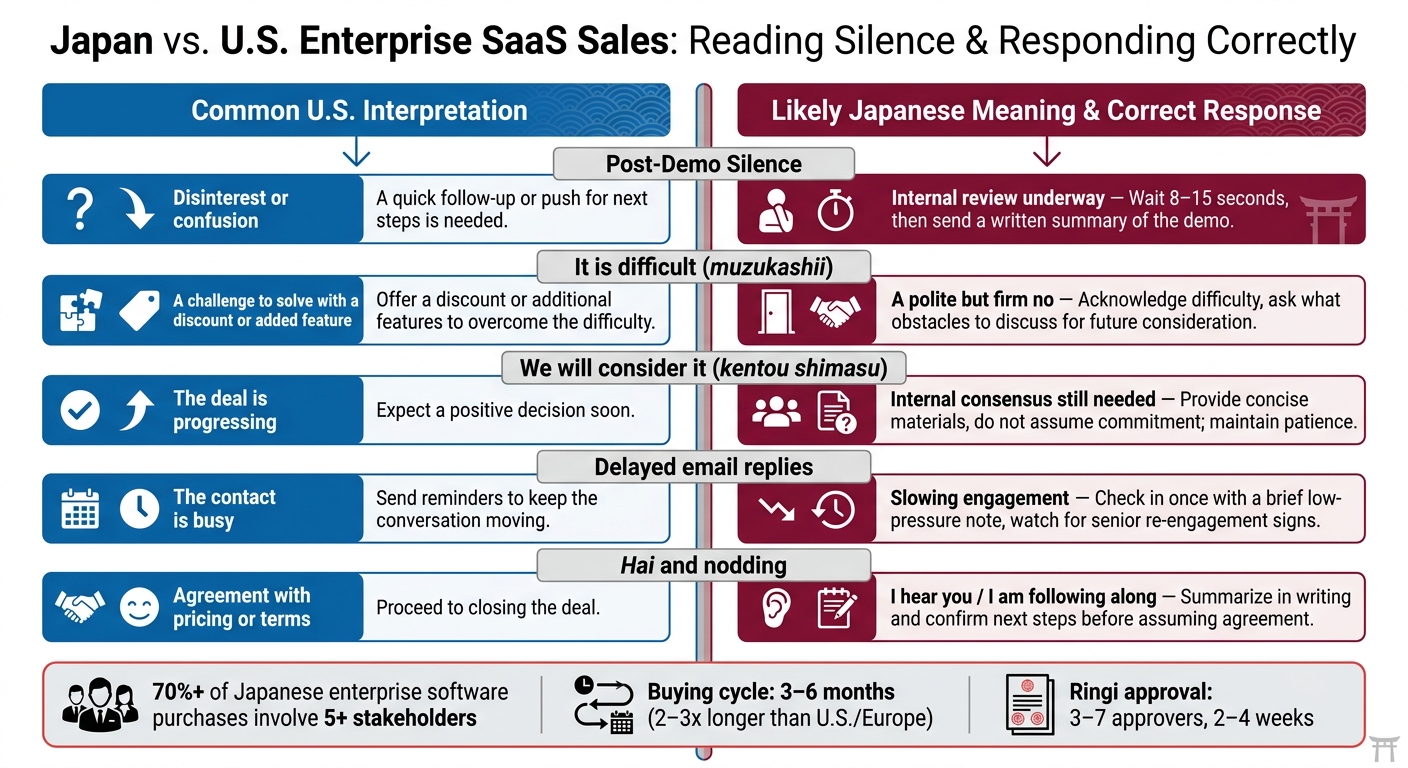
Japan vs. U.S. Enterprise SaaS Sales: How to Read Silence & Respond
Silence often points to internal alignment. So the skill isn’t forcing an answer. It’s reading the pause well and choosing the right next step.
Common Japan-U.S. Misreads in Enterprise SaaS Sales
What works in U.S. enterprise sales can miss the mark in Japan. Fast pacing, treating hesitation like an objection to handle, and reading quiet as a prompt to push can all backfire. The table below shows the misreads teams make most often and what to do instead.
| Scenario | Common U.S. Interpretation | Likely Japanese Meaning | Recommended Response |
|---|---|---|---|
| Post-demo silence | Disinterest or confusion | Internal review underway | Wait 8–15 seconds; then follow up with a written summary of the key points |
| "It is difficult" (muzukashii) | A challenge to solve with a discount or added feature | A polite but firm "no" | Acknowledge the difficulty; ask, "What specific obstacles should we discuss?" |
| "We will consider it" (kentou shimasu) | The deal is progressing | The team still needs internal consensus | Provide concise materials for internal stakeholders; don’t assume commitment |
| Delayed email replies | The contact is busy | Slowing engagement; hoping you’ll read the room | Check in once with a brief, low-pressure note; watch whether senior contacts re-engage |
| "Hai" and nodding | Agreement with pricing or terms | "I hear you" or "I’m following along" | Summarize key points in writing and ask for confirmation of next steps |
A quiet beat after a demo or pricing discussion can change the meaning of your move. What feels flexible on the U.S. side can feel like pressure on the Japanese side.
What to Do During Quiet Moments in Meetings
Don’t rush to fill the gap. In Japanese meetings, a pause after a proposal often runs 8–15 seconds. That’s part of ma – the space that lets an idea settle.
One simple habit helps: after your Japanese counterpart finishes speaking, count to five before you answer. It shows you’re taking in what they said instead of lining up your next point. If silence comes after a question, resist the urge to restate it or answer it for them. That usually breaks their train of thought and signals impatience.
Pay attention to small cues: nods, short verbal responses, note-taking, or broken eye contact. A sharp intake of breath, a head tilt, or looking away often points to hesitation or a soft refusal. When you see that, don’t press for a yes. Acknowledge the pause, stay still, and let the buyer speak next.
How to Follow Up Without Sounding Pushy
After the meeting, give the team time to review things inside the company. Japanese enterprise teams often need that space, and repeated nudges can suggest that you don’t get how their process works.
One clear follow-up usually works better than a string of check-ins. Send a short written recap covering what was discussed, what was agreed, and the proposed next steps. That kind of summary gives people something they can pass around internally without having to rewrite it. If you follow up again, keep it brief and low-pressure.
If replies get shorter and slower, first read that as a sign that internal review may still be happening. But if senior contacts stop replying and you get pushed down to lower-level staff (tantousha), that’s a stronger sign that interest is fading.
Building a Japan-Ready Communication Approach
Adjusting Product, Messaging, and Sales Process for Japan
Once you can read silence, the next move is to build a sales process that doesn’t push for answers too early.
Japanese enterprise buyers often lean more on written materials than live discussion. That gives proposals, agendas, and summaries extra weight. Buyers may review materials internally before they speak, so written documents tend to matter more here than in a typical U.S. sales cycle. Sending a written agenda before a meeting gives your counterpart time to prepare internal questions and start nemawashi before you’re in the room. It also makes it easier for stakeholders to pass information around internally.
The same idea applies to demos. Slow the pace a bit, and follow up with written summaries. That gives buyers space to review the material internally and assess the offer on their own terms.
A Japan-ready message should focus less on what you want to say and more on what the buyer can review, share, and discuss internally. In plain English, that means giving buyers the written detail and process clarity they need for internal consultation instead of pressing for an immediate yes-or-no answer.
These changes are much easier to carry out when they’re built into localization and market-entry work from the start, not handled ad hoc.
Where Nihonium Can Support SaaS Market Entry
For global SaaS teams, the gap between understanding these ideas and applying them day after day is often where deals stall. Nihonium supports product localization, localized demand generation, fractional sales support, and Japan-specific go-to-market strategy. For teams without an in-country presence, that support can make Japan entry more repeatable.
Conclusion: Read Silence as Part of the Decision Process
Taken together, these shifts make silence easier to read and easier to respect.
In Japanese business, silence often signals review, caution, or internal alignment. Design your process to leave room for it.
FAQs
How can I tell silence from a polite no?
In Japanese business culture, the difference often comes down to context and nonverbal cues. A polite no might show up as a sharp intake of breath, a slight tilt of the head, broken eye contact, or a stretch of silence followed by an abrupt shift in the conversation.
Phrases like it is difficult or we will consider it carefully usually mean no. They’re polite refusals, not a green light to keep pushing the negotiation.
When should I follow up after a quiet meeting?
If a meeting ends with a vague agreement, don’t assume the matter is settled. In Japanese business culture, formal meetings often serve to confirm consensus that has already been built through nemawashi.
That’s why follow-up matters so much. Send detailed written documentation after the meeting so people can review it internally and discuss it with the right stakeholders.
And if something feels unresolved, handle it with care. Instead of pushing for an immediate answer in front of the group, address unspoken concerns privately. That approach is often more effective and more in line with how decisions get made.
How should I adapt my sales process for Japan?
Move away from a purely transactional style and focus on long-term relationships, patience, and building consensus over time. Put nemawashi first by gathering input informally before you bring a proposal forward, and back that process up with detailed documentation that helps internal review move along.
In meetings, treat silence as part of the conversation. Don’t rush the discussion, push for blunt answers, or assume a vague response means clear agreement. Instead, pay attention to indirect signals and the chance that you’re hearing a soft no.
Related Blog Posts
- Why Silence Matters in Japanese Business
- Japanese vs. Western Meeting Etiquette
- Understanding Silence in Japanese Business Meetings
- Japan vs West: Client Relationship Style in SaaS
 Japanese
 English