

Building trust in Japan’s SaaS market requires more than offering a great product. Japanese customers prioritize long-term relationships, reliability, and high-quality service. Here’s a quick overview of the key strategies covered in this guide:
- Japanese-Language Support: Offer precise, responsive local support.
- Localized Materials: High-quality translations and culturally appropriate content are essential.
- Long-Term Commitment: Demonstrate stability and dedication to the market.
- Local Partnerships: Collaborate with trusted resellers, distributors, and partners.
- Data Compliance: Obtain certifications like PrivacyMark and ISO/IEC 27001.
- Dedicated Account Managers: Build relationships through personalized service.
- Referral Programs: Leverage word-of-mouth and local networks.
- Showcase Credibility: Highlight case studies with Japanese brands.
- Legacy System Integration: Ensure compatibility with older IT systems.
- Expert Guidance: Work with firms like Nihonium for market entry.
Japan’s enterprise software market is the second-largest globally, but success demands a tailored, relationship-first approach. By addressing local needs and concerns, you can build trust and achieve sustainable growth.
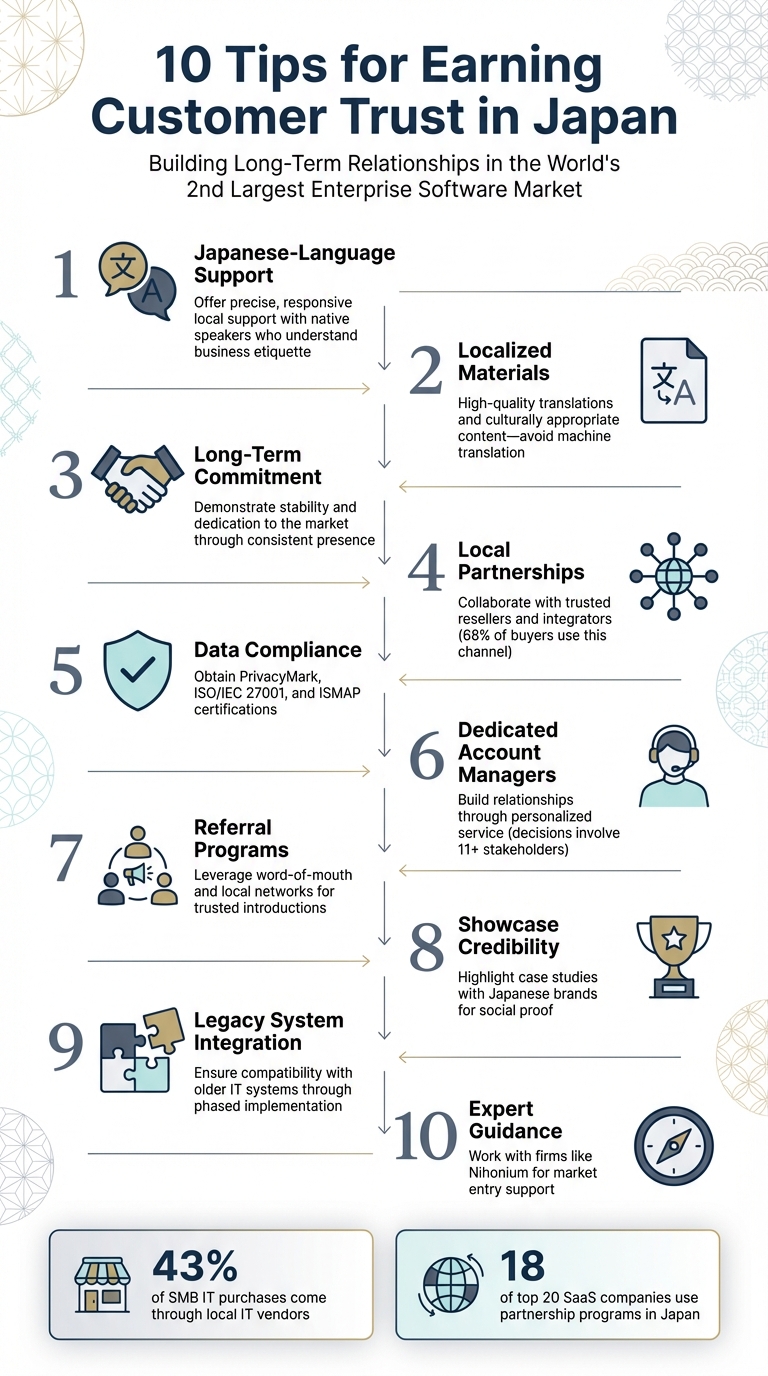
10 Essential Strategies for Building Customer Trust in Japan’s SaaS Market
1. Offer Customer Support in Japanese
The Importance of Local Language and Precision
Providing customer support in Japanese is non-negotiable if you want to succeed in the Japanese market. Japanese customers expect immediate, high-quality assistance in their native language. Poorly translated responses or materials can quickly damage your credibility and make your business appear unprofessional. Clear and accurate communication forms the backbone of trust in Japan, where attention to detail is highly valued.
Building Trust Through Personal Engagement
Language accuracy is just the beginning. Establishing trust with Japanese customers requires a personal touch. For example, during the Ringisho process – a traditional decision-making practice – decision-makers rely heavily on localized and well-crafted documentation.
Prompt responses through phone, email, and chat are critical to meeting the high expectations of Japanese customers. They value politeness and responsiveness, and failing to meet these standards – especially by using offshore teams unfamiliar with Japanese business etiquette – can undo the trust you’ve worked hard to build. Demonstrating consistent and thoughtful support reflects the long-term relationship focus so integral to Japanese business culture.
Leveraging Local Expertise for Success
Having local expertise on your team can make a significant difference, especially during the onboarding process. Japanese CIOs have pointed out that the absence of Japanese-speaking customer success teams often complicates integration efforts. Employing local experts not only ensures smoother setups but also signals your dedication to the market. This kind of investment reinforces your commitment to building lasting partnerships in Japan.
2. Adapt Product and Marketing Materials to Japanese Culture
Adapting to Local Language and Culture
If you want to make an impression in Japan, the quality of your Japanese matters – a lot. Poor translations, especially those that feel machine-generated, can make your efforts seem half-hearted. Naoki Togawa, Manager at Nikkei Business Publications, puts it best:
"Everything should be in high-quality, idiomatic Japanese. There’s nothing worse than bad translation. It’s easy to tell which vendors know what they are doing and are really committed to the market just through the quality of their materials and programs."
Japanese users often prefer interfaces packed with detailed menus and options, offering a level of control that’s a far cry from the Western preference for minimalist designs. This means your product should include clear documentation and well-organized process flows. When it comes to marketing, consider using the "Ki-Sho-Ten-Ketsu" structure – a storytelling format with four parts: introduction, development, turn, and resolution. Start with a broad overview and gradually narrow down to specifics, especially for technical content.
Getting the language and design right isn’t just about clarity; it’s about showing respect for your audience and laying the groundwork for stronger relationships.
Building Personal Connections and Trust
In Japan, decisions often go through a consensus-based process known as Ringi. This means your materials need to address multiple stakeholders, not just the primary decision-maker. Prepare tailored sales decks and documentation that align with this collective decision-making approach, and share them well ahead of meetings. Giving teams time to review and discuss internally is key.
When crafting your messaging, adopt a tone that reflects humility, reliability, and a commitment to long-term relationships. Avoid overly assertive sales tactics; instead, focus on values like group harmony (wa) and organizational stability. Building trust here is a process, not a quick transaction.
Addressing Risk Concerns and Stability
Japanese buyers are particularly cautious, and for good reason – there’s a history of foreign companies pulling out of the market when financial goals aren’t met. To ease these concerns, highlight case studies featuring respected local brands. Including familiar logos can provide the social proof needed to build credibility.
You’ll also want to align with local business practices by offering payment options that Japanese companies are accustomed to. This includes bank transfers (furikomi) and popular gateways like GMO Payment Gateway or PayPay. These steps show that you understand the nuances of doing business in Japan and are here to stay.
3. Focus on Long-Term Relationships
Building Personal Connections and Trust
In Japan, business relationships are all about the long game. Quick wins or aggressive sales tactics can backfire, damaging your credibility. The Ringisho decision-making process underscores this – it’s consensus-driven, meaning you’re not just convincing one person but earning the trust of an entire organization. This takes time, patience, and a genuine commitment to being a steady presence in the market.
While remote communication is becoming more common, in-person meetings still carry significant weight. Video calls might suffice for routine updates, but face-to-face interactions often signal your serious intent and help deepen connections. It’s not just about closing a deal – it’s about showing up consistently and proving that you’re here to stay. This approach naturally addresses concerns about risk and reinforces the importance of establishing a solid local presence.
Addressing Risk Concerns and Stability
Japanese buyers are often cautious when dealing with foreign SaaS providers, and for good reason. Many have seen companies enter the market with big promises, only to leave when revenue goals fall short. As Nihonium explains:
"Japanese buyers have seen foreign companies enter the market and leave rapidly when these companies miss their revenue targets. Certainty is a major factor in Japanese companies’ and the early departure of some companies has increased the hurdle for Japanese companies to feel this certainty."
To counter these fears, you need to back up your words with action. Establishing even a minimal local presence can make a huge difference. This might include providing localized support and customer success teams. Without local-language support, you’re essentially asking buyers to take a risk they’re unlikely to take. Partnering with local companies is another way to demonstrate your commitment and reduce skepticism, aligning with the broader theme of building trust over time.
Using Local Expertise and Partnerships
Tapping into local expertise is a powerful way to earn trust and establish a foothold in the Japanese market. Local partners bring essential insights into buyer behavior, compliance standards, and the subtleties of Japan’s relationship-oriented business culture. These collaborations also help you secure case studies with well-known Japanese brands, offering the kind of social proof that reassures potential buyers.
Once you’ve established these partnerships, they become the backbone of your long-term strategy. They help you navigate Japan’s kaizen mindset, where continuous improvement is expected. Over time, these relationships evolve from one-off transactions into durable partnerships built on mutual trust and accountability.
4. Partner with Local Resellers and Integrators
Building Personal Connections and Trust
In Japan, buyers place a high value on brands that come recommended by trusted local partners. The business culture prioritizes relationships built on referrals, introductions, and social credibility over cold outreach efforts. By teaming up with a well-established reseller or integrator, you tap into their existing reputation, which can significantly reinforce your strategy to build lasting trust within the Japanese market.
Consider this: around 43% of IT purchases made by small and medium-sized businesses in Japan come through local IT vendors and IT-related media. Furthermore, a striking 18 of the top 20 public SaaS companies (ranked by annual recurring revenue) rely on partnership programs in Japan. These partnerships are the go-to channel for reaching 68% of Japanese buyers.
Addressing Risk Concerns and Stability
Japanese enterprises prioritize stability over flashy new features. They want assurance that their partners are in it for the long haul, not just testing the waters. Collaborating with a trusted local reseller signals permanence and minimizes concerns about market withdrawal if revenue goals aren’t met.
But it’s not just about you choosing a partner – local distributors are selective too. They conduct rigorous assessments to evaluate the risks associated with new products and brands. Getting approval from a respected partner doesn’t just open doors; it also serves as a strong trust signal to potential customers.
Using Local Expertise and Partnerships
Local partners bring invaluable knowledge to the table, helping foreign companies navigate Japan’s unique market entry challenges. They’re well-versed in compliance requirements like the Act on the Protection of Personal Information (APPI) and can guide you through the nuances of Japanese business etiquette. This expertise supports the emphasis on stability and reliability that Japanese buyers expect.
Interestingly, 82.5% of Japanese resellers manage competing products within the same category. This means offering competitive financial incentives is key to ensuring they prioritize your product. A smart way to kick off the relationship is by sharing existing Japanese leads, which demonstrates market interest and motivates the reseller to focus on your solution. Additionally, co-hosting webinars, organizing local seminars, and running joint PR campaigns with these partners can amplify their established reputation, giving your product the social proof it needs to succeed.
5. Get Data Security and Compliance Certifications
Addressing Risk Concerns and Stability
Building trust with Japanese buyers means prioritizing data security and compliance. Japan’s data protection law, the Act on the Protection of Personal Information (APPI), applies to any foreign company handling data from Japanese residents. To succeed in this market, you’ll need more than just legal compliance – you must showcase stability through certifications that Japanese decision-makers value.
Start with PrivacyMark (P-Mark), a certification awarded by JIPDEC, which highlights your commitment to safeguarding personal data in Japan. For companies working with government agencies or highly regulated industries, ISMAP (Information system Security Management and Assessment Program) is essential. This government-mandated certification demonstrates advanced security standards. Globally recognized certifications like ISO/IEC 27001 and SOC 2 are also respected in Japan, but they must align with APPI’s requirements to be fully effective.
"Premium compliance and security are not only accepted by Japanese buyers – they are expected and regarded as essential business safeguards rather than optional upgrades." – Security Next Japan
Using Local Expertise and Partnerships
To strengthen your compliance efforts, collaborate with local experts and establish a presence in Japan. Appointing a domestic representative to liaise with the Personal Information Protection Commission (PPC) is a legal requirement for foreign SaaS providers. This step not only ensures compliance but also signals your dedication to the Japanese market. Additionally, industries like telecom (regulated by MIC), financial services (FSA), and healthcare (MHLW) often have stricter breach notification requirements.
Make your certifications work for you by prominently displaying ISO 27001 and PrivacyMark logos on your website and marketing materials. Japanese buyers often research extensively before engaging with sales teams, so offering detailed security documentation, privacy policies, and certification information in polished Japanese is crucial. Consider creating a "Trust Center" on your website to provide clear, transparent access to your compliance and security practices.
6. Assign Dedicated Account Managers
Building Personal Connections and Trust
Japanese buyers often worry that foreign SaaS companies might pull out of the market if revenue goals aren’t met. A dedicated account manager helps address this concern by providing a consistent, local presence. Unlike one-off sales, Japanese enterprises value long-term partnerships. An account manager becomes a trusted ally, learning the client’s unique needs, fiscal planning, organizational setup, and the nemawashi process – a method of securing informal agreement with stakeholders before making formal proposals.
In Japan, enterprise purchasing decisions typically involve committees with over 11 core decision-makers. This makes patience and cultural understanding essential, as decisions can take more than six months. The account manager’s role isn’t just about closing deals – it’s about guiding clients through the ringi process, where formal approvals require detailed documentation like security audits and locally relevant case studies. Building trust through personal relationships, combined with cultural and linguistic fluency, is key to navigating this complex process.
Adapting to Local Language and Culture
This relationship-first approach makes a Japanese-speaking account manager indispensable for enterprise clients. Language skills go beyond basic fluency – account managers must master keigo (formal honorifics) and understand hierarchical nuances, as these are critical for engaging executives respectfully. Using polished, idiomatic Japanese signals professionalism and dedication, which Japanese buyers expect from serious partners.
Face-to-face meetings are essential for building trust. Train account managers to emphasize team benefits over individual productivity when presenting solutions, as Japanese companies prioritize group harmony (wa) and collective success over personal achievements. Success should be measured by the strength of the relationship and client loyalty, rather than focusing solely on short-term sales metrics.
sbb-itb-a752276
7. Create Referral and Word-of-Mouth Programs
Building Personal Connections and Trust
In Japan, referrals are a cornerstone of long-term customer relationships and are far more effective than unsolicited outreach. Relationships built on trust, or shinrai, are essential before customers feel confident recommending your SaaS product. This trust is earned through consistent actions and a deep understanding of cultural norms.
Unlike in some other markets, Japanese B2B purchasing decisions often involve multiple stakeholders rather than being decided by a single executive. To support this consensus-driven approach, your referral program should include high-quality Japanese-language materials, such as sales decks and documentation. These resources should be crafted with precision, avoiding machine translations, so referrers can confidently share them with internal teams who may not directly use the product.
Addressing Risk Concerns and Stability
Risk aversion is a defining characteristic of Japanese buyers, especially when dealing with foreign SaaS companies. Concerns about market stability and long-term presence are common. To counter these worries, highlight case studies from prominent Japanese companies. Featuring these well-known brands as customers can provide the reassurance potential buyers need, turning them into advocates. These case studies act as social proof, making referrals more compelling and credible.
In addition to showcasing success stories, tap into local networks to further alleviate concerns. Trusted local connections can provide the assurance risk-averse buyers seek.
Using Local Expertise and Partnerships
Building trust in Japan often means working through established local partners. These intermediaries, such as integrators, value-added resellers (VARs), and consultants, can provide warm introductions and guide prospects through the complex ringisho approval process. Their deep understanding of local business practices makes them invaluable allies.
To enhance credibility, consider co-hosting events like webinars or seminars with respected Japanese organizations. These collaborations allow you to tap into their authority and customer base. Additionally, encourage word-of-mouth referrals by leveraging Japanese-specific review platforms like Boxil and ITReview. Positive reviews on these platforms act as digital endorsements, further strengthening your reputation.
8. Show Your Track Record and Credibility
Addressing Risk Concerns and Stability
Your track record plays a key role in establishing trust, especially in a market like Japan, where buyers often approach foreign vendors with caution. Past experiences of vendors exiting the market after missing revenue targets have made Japanese companies wary. Demonstrating a successful history can help alleviate these concerns.
To show your commitment, share your long-term vision for the market, highlight your financial stability, and emphasize sound corporate governance. If you have a local office or legal registration, make sure to spotlight it – this demonstrates your dedication to building enduring relationships. Additionally, endorsements from respected local experts can further solidify your credibility.
Using Local Expertise and Partnerships
Endorsements from major Japanese brands can significantly enhance your reputation. While positive reviews on platforms like Boxil and ITReview can help establish initial trust, detailed case studies featuring prominent domestic companies offer what some experts call "next-level certainty". These recognizable logos carry immense weight in the ringi approval process, where decisions require consensus across multiple departments.
However, it’s not just about having case studies – it’s about their quality. Ensure all materials, including case studies, sales decks, and proposals, are written in polished, idiomatic Japanese. Poor translations or content that feels out of touch can send the wrong message, suggesting a lack of genuine commitment to the market. Remember, the ringi process often involves executives who may never use your product, so your materials must be clear, professional, and persuasive enough to win their approval.
9. Integrate with Legacy Systems
Addressing Risk Concerns and Stability
In Japan, many large enterprises still rely on outdated IT systems, creating unique challenges when introducing modern SaaS solutions. This shift is a core component of current SaaS adoption in Japan. This reliance on older infrastructure often makes integration both a technical hurdle and a matter of trust. Japanese businesses tend to favor stable, low-risk solutions over rapid innovation, and any disruption to their current systems can cause serious hesitation. If your product doesn’t integrate smoothly with their existing environment, it may be perceived as a potential risk, making decision-makers wary.
The complexity of these challenges is heightened by the traditional ringi approval process, where even individuals who won’t directly use the system need assurance of seamless integration. If adopting your solution requires significant workflow changes or creates compatibility issues, gaining approval from multiple departments becomes an uphill battle. For instance, when Salesforce Japan landed a significant contract with Japan Post in 2007, they succeeded by collaborating with local System Integrators (SIers) to manage the intricate integration requirements. This strategy, which Salesforce had been refining since entering the market in 2000, showcased their willingness to adapt to Japan’s IT ecosystem instead of pushing disruptive changes.
Using Local Expertise and Partnerships
One of the most effective ways to navigate these integration challenges is by partnering with trusted local SIers. These experts have a deep understanding of the technical demands unique to Japanese enterprises and can help bridge the gap between modern SaaS platforms and legacy systems. A great example is Box Japan, which entered the market in 2013. By forming strategic partnerships with major Japanese IT firms, they successfully integrated their secure content management solution into existing legacy systems, achieving operational stability within about four years.
Another proven strategy is starting with phased Proof of Concepts (PoCs) to introduce your solution gradually, reducing the risk of overwhelming existing systems. For example, in April 2025, Fujitsu implemented the Azure AI Agent Service into its sales operations. This phased integration led to a 67% boost in sales proposal productivity by autonomously compiling data from various sources. Taking a step-by-step approach like this not only minimizes disruption but also builds trust and confidence, paving the way for broader adoption.
10. Work with Nihonium for Japan Market Entry
Adapting to Local Language and Culture
Breaking into the Japanese market isn’t just about translating your content. It’s about understanding and aligning with the nuances of Japanese preferences and expectations – a challenge that often trips up SaaS companies. Nihonium offers a full-spectrum localization service, bridging the technical, cultural, and operational gaps that foreign businesses face. This includes adapting software interfaces to reflect preferences like vertical text layouts and the surname-first naming convention. They also ensure that all materials are written in polished, natural Japanese, steering clear of clunky, machine-translated text.
"SaaS localization in Japan is a strategic endeavor that reaches far beyond language – it requires deep cultural calibration, robust technical adaptation, and ongoing compliance with sophisticated regulatory frameworks." – Nihonium
By addressing every detail, from interface customization to documentation quality, Nihonium helps SaaS companies demonstrate a genuine commitment to the Japanese market. This thoughtful localization approach not only improves user experience but also reinforces trust – an essential element for succeeding in Japan.
Using Local Expertise and Partnerships
Localization is just one piece of the puzzle. To thrive in Japan, companies must also navigate its intricate market dynamics. Japanese businesses are known for prioritizing reliability and risk management over flashy features. Many foreign companies have entered the market aggressively, only to withdraw just as quickly, leaving behind skepticism that new entrants must overcome.
Nihonium steps in as a fractional Japan team, offering services like localization, marketing funnel development, B2B SaaS sales support, and customer success – all without requiring you to set up a full-fledged local entity. This approach is especially important in Japan’s consensus-driven decision-making process, known as the Ringisho system. Here, multiple stakeholders – many of whom won’t even use your product – must be assured of its value before giving the green light.
To tackle these challenges, Nihonium crafts executive-ready messaging and localized sales materials that resonate with all decision-makers. They also facilitate collaborations with local system integrators and resellers, a critical step since only about 10% of products seeking entry into Japan gain approval from these gatekeepers. By helping you establish credibility and build strong partnerships, Nihonium ensures your business is well-positioned for long-term success in Japan.
Conclusion
Building trust in Japan’s SaaS market takes more than just offering a great product – it requires a full commitment to understanding and meeting local expectations. High-quality localization, responsive customer support, and adherence to Japanese business practices are essential to show that commitment.
The strategies discussed here – like providing Japanese-language support and obtaining data compliance certifications – address the specific needs of Japanese decision-makers. As the world’s second-largest enterprise software market, Japan values reliability and long-term relationships far more than quick, flashy innovations.
Consistency is key. Poor localization, lackluster support, or an absence of local presence can signal a short-term approach, which won’t win over Japanese businesses. On the other hand, investing in precise localization, collaborating with local integrators, and offering dedicated account management shows that your company is serious about building lasting relationships. These efforts ensure every interaction feels personalized and trustworthy.
For companies looking for expert guidance, partnering with Nihonium (https://nihonium.io) can make all the difference. Acting as a fractional Japan team, Nihonium helps businesses navigate the complexities of the Japanese market – like the Ringisho approval process – without the high costs of setting up a local entity. Whether you choose to build your own team or work with local partners, remember that trust in Japan is earned over time. Once established, it opens the door to a stable, rewarding market that values long-term dedication.
FAQs
What’s the fastest way to build trust with Japanese enterprise buyers?
Building trust with Japanese enterprise buyers requires a thoughtful approach that prioritizes local presence and long-term dedication. This means fostering personal connections through regular in-person meetings and social gatherings, such as nomikai (after-work drinks), which are integral to relationship-building in Japan. Consistently proving your reliability, respecting hierarchical structures and group harmony, and presenting tailored, localized solutions are equally important steps.
Additionally, collaborating with well-regarded local intermediaries can help bridge cultural gaps and establish credibility. Clear and respectful communication throughout your interactions further strengthens trust, showing your commitment to understanding and aligning with their business values.
Which Japan-specific security certifications should SaaS vendors prioritize?
SaaS vendors looking to enter the Japanese market need to prioritize compliance with key regulations and standards. This includes adhering to the Act on the Protection of Personal Information (APPI), which governs data privacy in Japan. For those in financial services, meeting FISC standards is crucial, as these are tailored to ensure robust security in the sector. Additionally, obtaining certifications like ISO 27001:2022 helps demonstrate a commitment to high data security standards. These steps are critical for aligning with local expectations around data privacy and security.
Do I need a local office in Japan to win deals?
No, you don’t need a local office to close deals in Japan. That said, having a local presence – whether it’s through hiring Japanese team members or collaborating with reliable local partners – can go a long way in building trust and boosting your long-term success in the Japanese market.
 English
  Japanese