
Japanese buyers value trust, reliability, and long-term commitment over flashy marketing or aggressive sales tactics. To succeed in Japan, focus on these five key areas:
- Respect Business Etiquette: Follow formal protocols like proper business card exchanges (meishi koukan), punctuality, and using polite language (keigo). Understand hierarchy and decision-making processes like Nemawashi and Ringi.
- Prove Long-Term Commitment: Highlight your company’s stability, track record, and dedication through metrics like retention rates and case studies. Show continuous improvement by incorporating user feedback and sharing product updates.
- Position as an Authority: Create high-quality, localized content in Japanese, such as webinars, white papers, and case studies. Collaborate with local experts to gain trust and credibility.
- Build Strong Relationships: Prioritize consistent communication, face-to-face meetings, and long-term engagement. Tailor your approach to Japan’s indirect communication style and group-oriented decision-making.
- Localize Your Product: Translate interfaces, documentation, and marketing materials into polished Japanese. Ensure your product meets local expectations for quality, usability, and design.
Entering the Japanese market requires patience, attention to detail, and a focus on building trust over time. By following these steps, you can align with Japanese business standards and gain the trust of buyers.
Step 1: Follow Japanese Business Etiquette and Hierarchy
Understanding and respecting Japanese business etiquette is crucial for building trust with buyers in Japan. Hierarchy plays a central role in their business culture, influencing everything from seating arrangements to how business cards are exchanged. Overlooking these details can damage your credibility before discussions even begin. Here’s how to approach these interactions with the right level of respect and preparation.
Learn Formal Protocols and Respect Practices
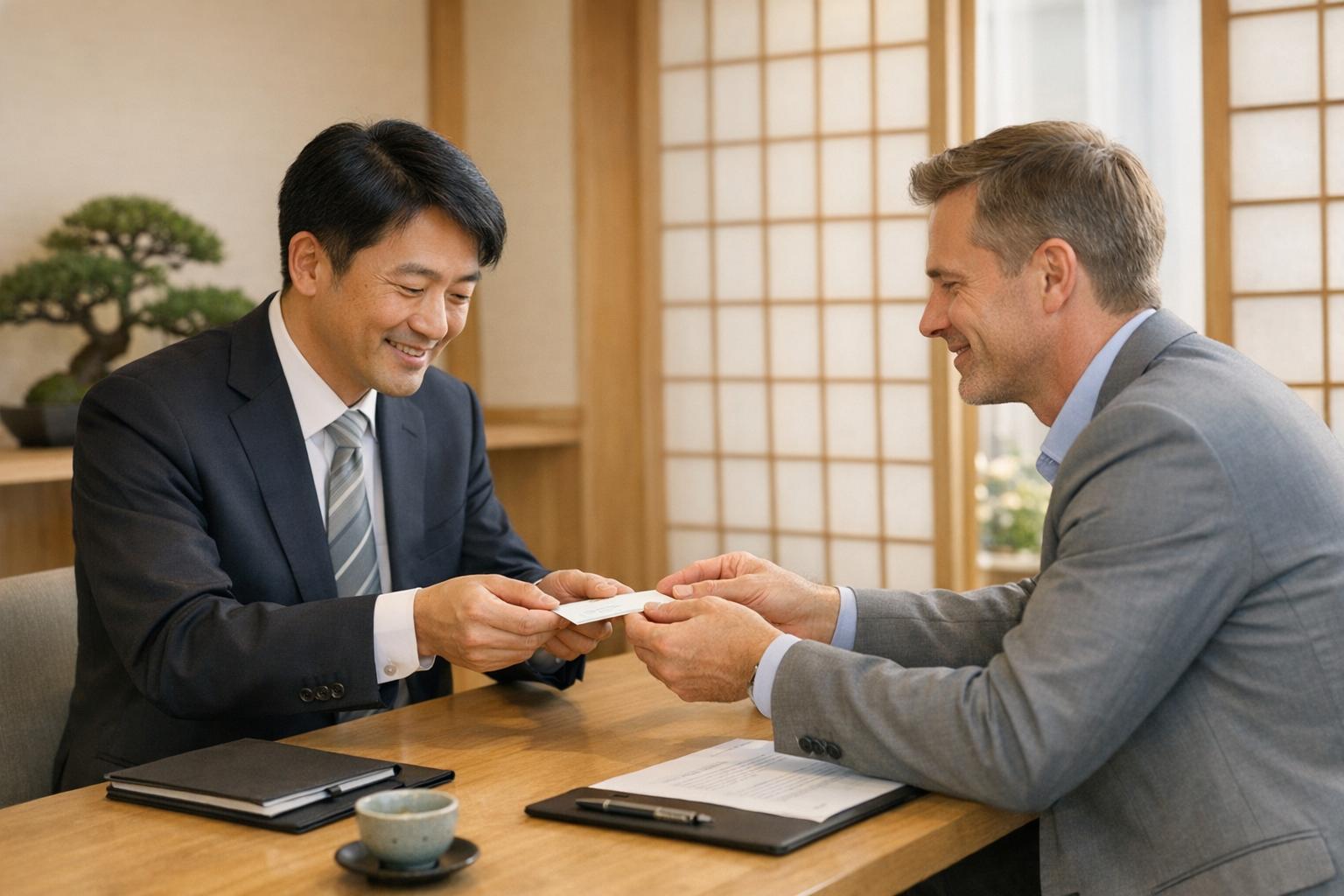
In Japan, exchanging business cards – known as meishi koukan – is a highly ritualized process. It’s not just a quick handoff. Present your card using both hands, ensuring it faces the recipient so they can read it right away. Once you receive a card, don’t write on it or put it away immediately; instead, place it on the table in front of you, arranged according to the seating order.
Punctuality is another key aspect of business etiquette. The "5-minute prior action" rule means you should arrive five minutes early, as being exactly on time can be seen as late. Language is equally important. Japanese business communication relies on three forms of keigo (honorific language): Sonkeigo (to show respect), Kenjougo (to express humility), and Teineigo (for polite, formal interactions). When addressing clients, use -sama during initial meetings and switch to -san for ongoing relationships. However, avoid using -san when referring to members of your own team in front of clients.
Understand Decision-Making Hierarchies
Respecting etiquette is just the beginning – grasping the internal decision-making structure is equally vital. Japanese organizations often rely on Nemawashi (informal groundwork) and Ringi (formal approval processes) to reach decisions. This means that multiple stakeholders, spanning departments like IT, legal, finance, and operations, will evaluate your proposal. It’s likely that the decision-makers won’t be the end-users, so ensure your materials are detailed and address the concerns of all relevant parties.
Adopting the Horenso framework – reporting, updating, and consulting – can help you align with Japanese communication standards. This approach ensures you provide the level of detail they require for internal discussions. After meetings, send a thank-you email within 24 hours, summarizing key points and confirming agreed-upon actions. This not only supports their internal reporting needs but also shows your understanding of their processes.
Step 2: Show Commitment and Reliability
Mastering etiquette is just the beginning when working with Japanese buyers. To truly earn their trust, you need to prove your long-term reliability. Japanese businesses are cautious, often due to past experiences with foreign SaaS companies that exited the market too quickly after missing revenue targets. This history has made them selective, prioritizing vendors who demonstrate both stability and a clear dedication to improvement.
Highlight Your Company’s Track Record
In Japan, certainty is king. With an Uncertainty Avoidance Index score of 92 out of 100, Japanese buyers place a premium on proven reliability over bold promises or cutting-edge features. To resonate with this preference, your marketing should focus on your company’s longevity, financial stability, and client retention rates.
For instance, if your company has been in business for over five years, emphasize that. Share metrics like client retention rates exceeding 90%, uptime statistics above 99.9%, and case studies featuring well-known Japanese brands or global enterprises with a presence in Japan. Companies like Salesforce and Zoom have excelled in Japan by showcasing their decades-long operations, renewal rates above 95%, and endorsements from Japanese firms like SoftBank.
Japanese buyers also value detailed, comprehensive information. Decisions are often made through meticulous research and group consensus, so your materials must be thorough. Provide audited financial statements, third-party certifications such as ISO 27001, and detailed timelines of your company’s milestones in whitepapers or webinars.
"It’s easy to tell which vendors know what they are doing and are really committed to the market just through the quality of their materials and programs."
Naoki Togawa, Manager, Nikkei Business Publications
Commit to Continuous Improvement
Once you’ve established your stability, the next step is to show that you’re committed to ongoing refinement. The concept of kaizen – or continuous, incremental improvement – is deeply ingrained in Japanese business culture, originating with Toyota and still influencing companies today. Adopting this mindset in your SaaS product development signals to Japanese buyers that you share their values of perfectionism and long-term dependability.
Regular updates are key. Share concise changelogs that highlight improvements, and gather user feedback through surveys in Japanese. Then, demonstrate how you’ve used that feedback to shape your product roadmap. Track metrics like Net Promoter Score (NPS) and aim for consistent gains – such as a 10-point quarterly improvement – and share these results with your Japanese clients.
Atlassian offers a great example of this approach. By refining Jira to better align with Japanese workflows, they achieved 30% year-over-year growth in Japan by 2025. Their success came from treating the Japanese market not as an afterthought but as a partnership requiring constant adaptation.
Step 3: Establish Thought Leadership for the Japanese Market
Once you’ve demonstrated reliability and a commitment to improvement, the next logical step is to position your brand as a trusted authority in Japan. This means creating content that directly addresses the unique challenges and expectations of Japanese businesses, particularly their focus on hierarchy and high-quality standards. By doing so, you’ll build on the trust and respect cultivated in earlier efforts.
Create Content Tailored to Japan
Did you know that 72% of Japanese business professionals prefer content in their native language? But simply translating your existing materials isn’t enough. To truly resonate, your content needs to tackle Japan-specific issues. For example, adapting SaaS workflows to accommodate the Ringisho process – a decision-making system where multiple stakeholders collaborate on approvals – is a key topic to address.
Webinars are an excellent way to engage this audience. Between 2020 and 2022, participation in webinars among Japanese professionals doubled. Hosting sessions on topics like overcoming SaaS adoption challenges or integrating software into hierarchical business structures can be highly effective. Salesforce, for instance, ran webinars focused on CRM integration within keiretsu networks, tapping into the group-oriented nature of Japanese enterprises.
To complement webinars, consider publishing white papers that highlight case studies of successful local implementations. Japanese buyers place great value on certainty and social proof, making examples from respected domestic brands far more persuasive than foreign ones. Additionally, optimize blog posts with Japanese search terms like "SaaS 導入 リスク" to attract B2B buyers who rely heavily on smartphones for research.
To take things a step further, collaborate with respected industry figures in Japan.
Collaborate with Local Experts
Japanese buyers tend to trust native experts and rely heavily on word-of-mouth recommendations. Partnering with local industry leaders can help overcome the skepticism often faced by foreign vendors.
You could work with organizations like the Japan SaaS Association or JEITA, or even team up with former keiretsu executives and niche influencers in your field. These collaborations can take various forms – co-authoring white papers, hosting joint webinars, or featuring expert opinions in your blog posts. HubSpot successfully applied this strategy by creating white papers on inbound marketing tailored to Japan’s collectivist culture, which resulted in 20–30% higher engagement rates among B2B buyers.
"Involving trusted local experts or academics as part of the content strategy can significantly amplify a foreign SaaS vendor’s credibility." – Nihonium
Leverage Nihonium’s Expertise
If your team lacks deep local knowledge, Nihonium can fill that gap. They specialize in creating custom webinars, white papers, and blog posts that address Japan’s unique business culture, including its emphasis on risk aversion and quality standards. Nihonium ensures your content aligns with the decision-making processes of hierarchy-driven organizations while also optimizing for SEO and cultural nuances – like prioritizing group harmony (wa) over individual ROI.
Nihonium can also connect you with local experts and academics for joint thought leadership initiatives. Whether it’s co-hosting webinars or moderating Q&A sessions, their services help maintain a professional and authoritative tone throughout the buyer’s journey. By tapping into Nihonium’s local expertise, you can solidify your position as a credible authority in the Japanese market.
Step 4: Build Relationships Through Empathy and Respect
Once you’ve established authority, the next critical step is forming genuine connections with Japanese buyers. This is where your long-term commitment to the market truly shines. In Japan, success isn’t just about closing deals – it’s about demonstrating dedication and reliability over time. Japanese business culture places a high value on personal character and consistency, often prioritizing these qualities over contract terms or performance metrics.
Focus on Long-Term Connections, Not Quick Wins
Japanese buyers have seen their fair share of businesses entering the market briefly, only to leave when things get tough. This history has made them cautious and risk-averse. Before they even consider your product, they need to trust that you’re here to stay.
Building this trust takes time. Schedule multiple meetings, not as formalities, but as opportunities to demonstrate your stability and commitment. Assign a dedicated representative who can maintain consistent communication and act as a reliable point of contact. This approach is essential because 43% of IT product purchases in Japan are made through trusted local vendors. Cold calling, on the other hand, is rarely effective – only 2% of cold calls in Japan result in a booked demo.
By focusing on long-term engagement, you create a foundation for meaningful, culturally aware communication.
Tailor Your Communication to Fit Japanese Business Culture
Japanese business communication is known for being indirect and subtle. Unlike in Western cultures, where directness might be appreciated, Japanese buyers often rely on implied meanings. For instance, if a buyer says, "that might be difficult", it’s usually a polite way of saying no. Picking up on these nuances is key to maintaining harmony.
When challenges arise, address them discreetly rather than in group settings. Public confrontation can disrupt wa (harmony), a central principle in Japanese business practices. Present concerns as constructive suggestions rather than outright problems. Additionally, ensure all materials – whether sales presentations, technical documents, or FAQs – are written in polished, idiomatic Japanese. These materials play a crucial role in the internal Ringi process, where decisions are made collectively, so they must be thorough and professionally translated.
sbb-itb-a752276
Step 5: Localize Your SaaS Product with Professional Support
Once you’ve established trust through etiquette and relationships, your product needs to meet local expectations to truly resonate.
Tailor Your Product and Marketing for Japan
For Japanese consumers, your ability to adapt to their market directly impacts your credibility. Here’s a striking fact: only 50% of Japanese consumers would choose a major global brand over a product with information in their own language – a figure much lower than the global average of 69%. Localization is about more than just translating words; it’s about showing you understand the unique needs of Japanese users.
Japanese users have high expectations when it comes to language and design. They look for interfaces that incorporate formal, honorific-rich language, prioritize mobile usability, and include detailed, hierarchical structures. A poorly translated interface can quickly erode trust.
Documentation is another critical piece of the puzzle. While developers in Japan may be comfortable with English interfaces, they still require comprehensive Japanese guides for troubleshooting and implementation. For technical products, having strong Japanese documentation often matters more than localizing the entire interface. Make sure all customer-facing materials – whether they’re landing pages, technical whitepapers, or user guides – are properly localized. This is especially important for the Ringi approval process, where decision-makers rely heavily on these materials to assess your company’s credibility.
Leverage Nihonium’s Expertise for Market Entry
A localized product is only part of the equation. To succeed in Japan, you need expert market entry support. Nihonium can serve as your fractional Japan team, managing everything from localization to sales, without the need for a full-fledged local office. Their services include product localization by native SaaS specialists, creating marketing funnels through SEO and webinars, and providing fractional sales support to navigate Japan’s intricate sales cycles. This lets you test the waters and generate revenue before investing in a costly legal entity.
Nihonium’s approach goes beyond simple translation. They focus on "cultural calibration", ensuring your UI/UX, documentation, and onboarding flows align with Japanese enterprise standards. On the marketing side, they build lead funnels tailored to platforms like Yahoo! Japan and LINE, which dominate the local digital landscape. For sales, their team of native Japanese-speaking experts handles everything from initial outreach to navigating the Nemawashi (consensus-building) and Ringisho (formal approval) processes that are essential in Japanese B2B transactions. This comprehensive strategy shows the long-term commitment Japanese buyers expect before they’ll trust your company.
Western vs. Japanese Approaches to Building Credibility
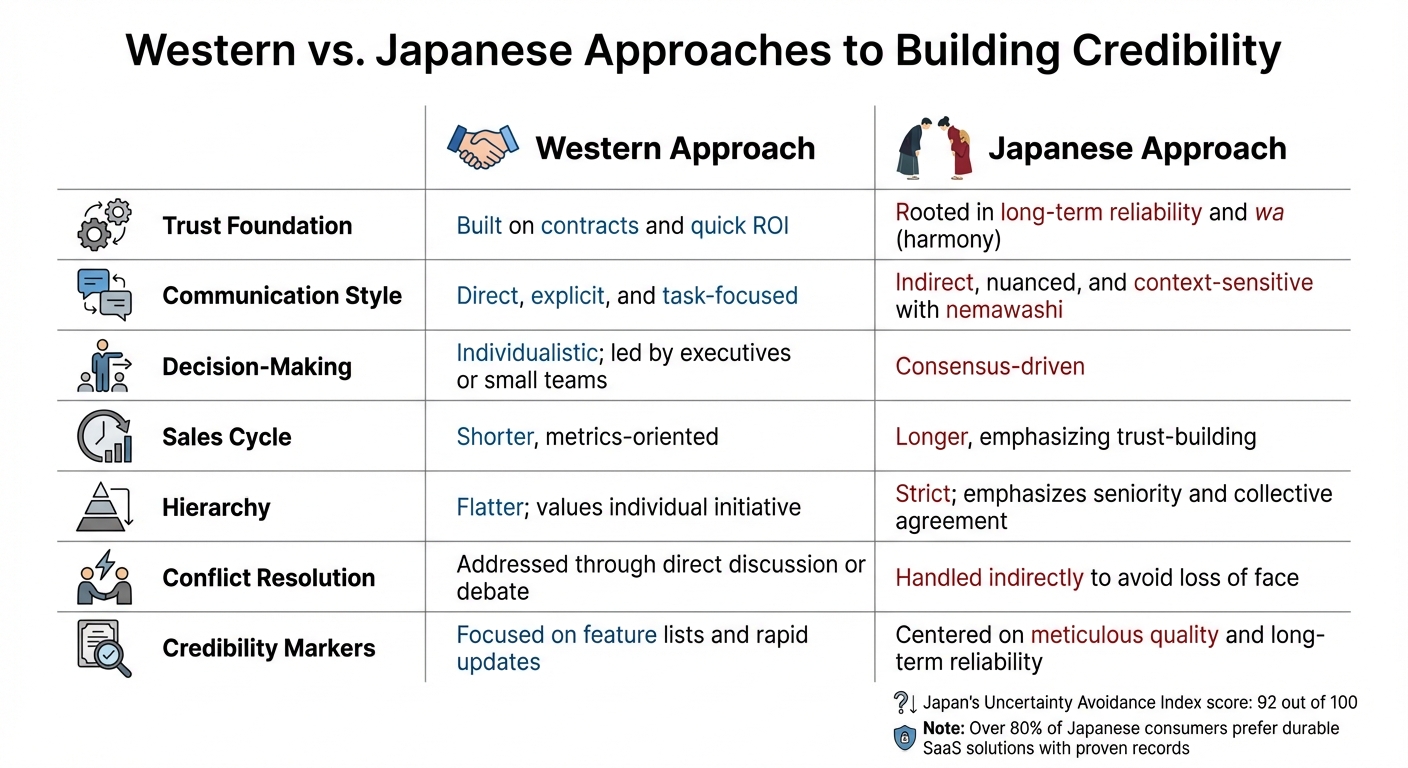
Western vs Japanese Business Credibility Approaches Comparison
Grasping the core differences between Western and Japanese methods of building credibility is vital when stepping into the Japanese market. These differences reflect deeply rooted values that shape every business interaction. Let’s break down how each culture establishes trust and credibility.
In Western business culture, credibility is often tied to individual achievements and self-promotion. Success stories, groundbreaking ideas, and charismatic leadership are key drivers of trust. Western consumers are drawn to bold innovation and proven results. On the other hand, Japanese culture prioritizes group harmony and social validation. Trust is built through collective consensus, peer recommendations, and maintaining strong relationships. Japanese consumers frequently rely on their social networks for recommendations before making decisions.
Western companies tend to focus on short-term gains, employing aggressive sales strategies and emphasizing quick returns on investment to gain trust. In contrast, Japanese businesses prioritize long-term stability. With a Hofstede Uncertainty Avoidance Index score of 92 out of 100 in 2025, Japanese buyers are notably cautious about risk. They value consistent quality, durability, and the gradual development of trust through reliability. For instance, over 80% of Japanese consumers prefer durable SaaS solutions with proven records over flashy, untested offerings.
Communication styles also differ significantly. Western business practices favor direct communication – clear pitches, data-backed arguments, and straightforward negotiations are seen as credible. In Japan, communication is more indirect and nuanced. Subtle cues, active listening, and respect for non-verbal signals are essential to maintaining harmony. Bold self-promotion can undermine trust, whereas consistent service and reliability strengthen loyalty. In Japanese discussions, silence and patience often indicate thoughtfulness and commitment, though these traits may not always be appreciated in Western cultures.
Comparison Table
Here’s a side-by-side look at the key differences between Western and Japanese approaches to credibility:
| Aspect | Western Approach | Japanese Approach |
|---|---|---|
| Trust Foundation | Built on contracts and quick ROI | Rooted in long-term reliability and wa (harmony) |
| Communication Style | Direct, explicit, and task-focused | Indirect, nuanced, and context-sensitive with nemawashi |
| Decision-Making | Individualistic; led by executives or small teams | Consensus-driven |
| Sales Cycle | Shorter, metrics-oriented | Longer, emphasizing trust-building |
| Hierarchy | Flatter; values individual initiative | Strict; emphasizes seniority and collective agreement |
| Conflict Resolution | Addressed through direct discussion or debate | Handled indirectly to avoid loss of face |
| Credibility Markers | Focused on feature lists and rapid updates | Centered on meticulous quality and long-term reliability |
Conclusion
Winning over Japanese buyers requires more than just offering a good product – it demands respect for local etiquette, a proven track record of reliability, a strong presence as a trusted authority, meaningful relationships, and a product tailored to the local market. These are the core strategies explored above.
Localization is non-negotiable. Japanese customers expect products in their native language and are willing to pay a premium for it. As Naoki Togawa, Manager at Nikkei Business Publications, emphasizes:
Everything should be in high-quality, idiomatic Japanese. There’s nothing worse than bad translation. It’s easy to tell which vendors know what they are doing and are really committed to the market just through the quality of their materials.
Cultural differences also play a big role. While Western business practices often favor directness and quick results, Japan leans toward a careful, consensus-driven, and risk-averse approach. Building credibility here means proving your commitment over the long term – through consistent effort, face-to-face interactions, and even after-hours relationship-building – rather than focusing solely on immediate revenue.
For SaaS companies eyeing the Japanese market but lacking the resources for a large upfront investment (around US$400,000), Nihonium offers a practical solution. Their fractional team approach provides localization, marketing, and sales support, helping companies enter the Japanese market without unnecessary financial strain. Nihonium’s expertise reduces risks by offering end-to-end support, including product localization, marketing funnel creation, and tailored market entry strategies .
The key takeaway? Prioritize long-term collaboration over quick wins. Work with partners who deeply understand Japanese business practices, invest in flawless localization, and foster relationships built on trust and cooperation. These steps not only enhance your credibility but also align your business with Japan’s high standards and expectations.
FAQs
What are some key aspects of Japanese business etiquette that foreign companies should know?
Building trust with Japanese business buyers means understanding and respecting their cultural norms. A key practice is the exchange of business cards, which is more than just a formality – it’s a sign of mutual respect. Always present and receive business cards using both hands. Take a moment to carefully look at the card before putting it away, and never place it in your pocket right away, as this can come across as dismissive.
Another important aspect is showing respect for hierarchy. Seniority carries significant weight in meetings and decision-making. When addressing senior members, it’s crucial to show proper deference and acknowledgment of their position. Additionally, indirect communication is a cornerstone of Japanese business culture. Instead of being overly direct, pay close attention to subtle cues and non-verbal signals, as these often carry more meaning than the words spoken.
Lastly, building relationships outside the office plays a vital role in earning trust. Joining informal events like team dinners or after-work drinks can help strengthen bonds on a personal level. By respecting these practices, foreign companies can create genuine connections and establish credibility with Japanese buyers.
How can companies show a strong, long-term commitment to Japanese buyers?
To earn the trust of Japanese buyers, companies must show a genuine, long-term dedication through consistent and thoughtful actions. Start by fully adapting your product, website, contracts, and support materials to meet the expectations of Japanese users. This means going beyond simple translations – focus on high-quality language adaptation and pay close attention to local customs and preferences.
It’s also essential to comply with Japan’s data privacy and security regulations, such as the Act on the Protection of Personal Information (APPI). Make your compliance efforts clear and visible, as this demonstrates respect for local laws and helps build credibility. Additionally, establish a local support team with native Japanese speakers who are skilled in using keigo (polite and respectful language) to provide timely and culturally appropriate customer service.
Building relationships is equally important. Collaborate with well-regarded Japanese firms, attend industry events, and create thought leadership content in Japanese. These steps show that your company is committed to the Japanese market for the long haul, rather than chasing quick sales.
Why is localization important for earning trust with Japanese buyers?
Localization plays a crucial role in earning the trust of Japanese buyers. Providing product or service information in Japanese signals a genuine commitment to their market, which is often a deciding factor for many businesses in Japan. If your website or materials aren’t properly localized, potential customers may feel disconnected or even dismiss your offering entirely due to a lack of familiarity or trust.
But localization goes beyond just translating words. Incorporating culturally relevant expressions and design elements can create a sense of "local authenticity", showing that your company respects and understands Japanese business practices. Research reveals that many Japanese buyers strongly prefer content, reviews, and customer support in their native language – and they’re less likely to make a purchase if these aren’t available. By localizing your website, products, and materials, you not only build credibility but also lay the groundwork for lasting relationships with Japanese clients.
Related Blog Posts
- Japanese B2B Sales: Key Differences from Western Markets
- B2B SaaS Buying Behavior in Japan
- Why Long-Term Commitment Matters in Japan SaaS Sales
- Top 7 Insights on Japanese Business Trust
 English
  Japanese