

When marketing SaaS products in Japan, using Western strategies often fails. Why? Because Japanese content marketing prioritizes trust-building, long-term relationships, and cultural nuances over the direct, results-focused approach common in Western markets. Here’s what you need to know:
- Japanese audiences prefer subtle, respectful messaging that emphasizes harmony and quality. Calls-to-action like "Learn More" work better than aggressive prompts like "Buy Now."
- Western audiences respond to bold, clear messaging that highlights individual success, innovation, and quick results.
- In Japan, decision-making involves group consensus (ringi) and requires extensive research, while Western buyers are more individualistic and make faster choices.
- Japanese content is often detailed and context-rich, reflecting a high-context communication style. Western content leans toward minimalism and straightforward messaging.
- Localization in Japan involves transcreation, adapting tone, design, and even timing (e.g., aligning campaigns with seasonal themes like cherry blossoms).
Quick Comparison
| Feature | Japanese Style | Western Style |
|---|---|---|
| Tone | Subtle, respectful | Bold, assertive |
| Call-to-Action | "Learn More" | "Buy Now" |
| Decision Process | group consensus (ringi) | Individual, fast |
| Content Density | Detailed, context-rich | Brief, minimalist |
| Cultural Focus | Harmony, quality, and tradition | Innovation, speed, and pricing |
To succeed in Japan, SaaS companies must focus on deep localization: respecting language, design, and platform preferences (e.g., LINE, Yahoo! Japan). Building trust and patience are key to connecting with Japanese audiences.
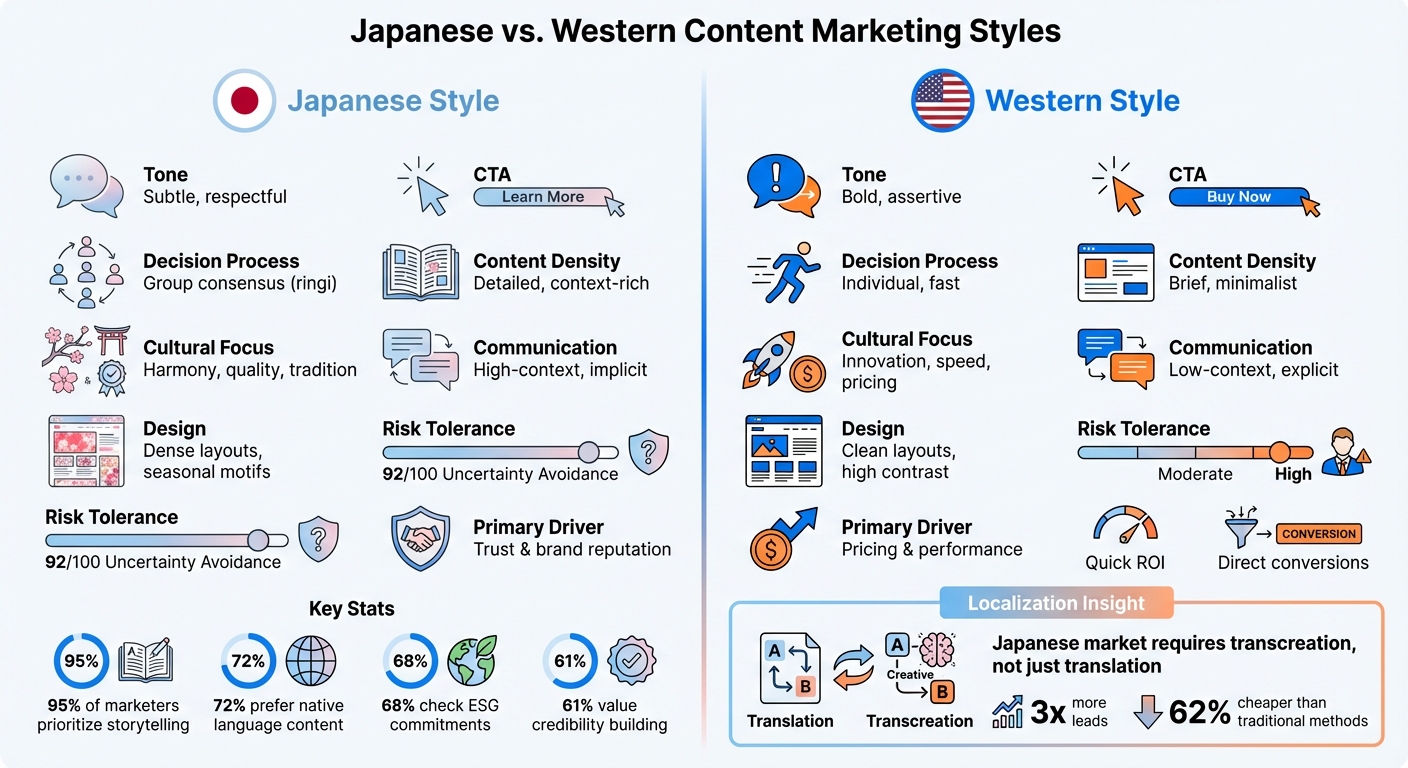
Japanese vs Western Content Marketing: Key Differences in Strategy and Approach
Messaging Styles: Emotional Connection vs. Direct Selling
The way brands communicate with their audiences varies greatly between Japan and Western markets, reflecting different marketing philosophies. In Western contexts, content marketing often follows a transactional approach: identify a problem, offer a solution, and push for immediate action. In Japan, however, the focus shifts to relationship-building, where trust must be established before any sale is even considered.
Japanese Approach: Subtle and Trust-Oriented
In Japan, effective messaging hinges on kuuki o yomu, or "reading the air" – an unspoken understanding of context and nuance. This cultural preference shapes marketing strategies, emphasizing emotional storytelling and subtle calls-to-action like "Learn More" to build trust over time. As Erika S., Director at IGNITE, explains:
Japanese audiences value respect and emotional resonance over hard selling.
Rather than emphasizing standalone product features, Japanese content weaves value into narratives that highlight themes like harmony, craftsmanship, or seasonal relevance. Even the language used plays a key role: proper use of keigo (formal Japanese) and a balanced mix of Kanji, Hiragana, and Katakana are critical. Missteps in formality can instantly damage credibility.
Statistics underscore this approach: 95% of marketers in Japan believe storytelling is vital for capturing attention and managing brand perception, while 61% of B2B marketers prioritize credibility as a key benefit of content marketing. Japanese buyers often look for long-term partnerships built on trust, making this relational approach indispensable.
In contrast, Western marketing takes a much more direct route.
Western Approach: Clear and Outcome-Focused
Western content marketing prioritizes clarity and results. Messaging is designed to drive action immediately, with bold headlines, prominent features, and direct calls-to-action like "Buy Now."
This style aligns with Western consumers’ tendencies toward quicker decision-making and a higher tolerance for risk. They are drawn to measurable outcomes, competitive pricing, and ROI-focused messaging. Individual success and innovation take precedence over collective harmony. Brandon Giles, a content marketing professional at Info Cubic, highlights the difference:
The ‘Buy Now’ to ‘Learn More’ ratio may lean quite a bit more toward the latter for trying to connect with Japanese consumers.
For Western audiences, the goal is simple: drive conversions with clear, actionable benefits.
Comparison Table: Messaging Styles
| Feature | Japanese Messaging | Western Messaging |
|---|---|---|
| Primary Tone | Subtle, indirect, respectful | Bold, direct, assertive |
| Emotional Appeal | Harmony, empathy, tradition | Individual success, innovation |
| Call-to-Action | Soft guidance ("Learn More") | Direct command ("Buy Now") |
| Narrative Focus | Embedded value in stories | Feature lists and benefits |
| Decision Driver | Brand reputation and quality | Pricing and performance |
| Communication Goal | Long-term relationship building | Immediate conversion |
These differences highlight why 43% of Japanese consumers cite "too wordy or poorly written" content as their top complaint about brand messaging. Success in Japan isn’t just about translating content – it’s about rethinking the entire messaging strategy. For SaaS companies looking to enter the Japanese market, adapting to these nuances is not optional; it’s critical for connecting with the audience. This underscores the importance of localization for SaaS products in Japan beyond simple translation.
sbb-itb-a752276
Cultural Drivers: Community vs. Individualism
The difference between Japanese and Western content marketing goes deeper than just language or design – it’s shaped by the cultural values that influence decision-making.
Japanese Perspective: Group Harmony and Tradition
In Japan, marketing is deeply connected to the concept of wa, or harmony, which emphasizes collective benefit over individual success. For SaaS companies, this means highlighting how their product supports the team or organization rather than focusing on personal productivity. This approach aligns with Japan’s consensus-driven decision-making culture.
Japan’s score of 92 out of 100 on Hofstede‘s Uncertainty Avoidance Index shows just how risk-averse Japanese consumers are. They demand extensive details, proof of reliability, and references before making decisions. Brandon Giles of Info Cubic explains it well:
Western consumers are more willing to gamble with their money if they see a good enough deal, but the Japanese are keen to make a sounder investment.
This cautious mindset also extends to brand values. 68% of Japanese consumers prefer brands that show true commitment to ESG (Environmental, Social, and Governance) initiatives, reflecting a focus on corporate responsibility and tradition. Marketing content must be humble and respectful, using keigo (honorific language) to build credibility. Any slip in formality risks damaging trust.
Western Perspective: Individual Success and Innovation
Western content marketing, on the other hand, focuses on personal achievement, creativity, and breaking the mold. Messaging often highlights how a product can help you succeed, innovate, or gain a competitive edge. Decision-making is typically faster and more centralized, with executives often having the authority to make purchasing decisions on their own.
This individualistic culture embraces risk and thrives on change. Western consumers are drawn to bold claims, competitive pricing, and promises of quick returns on investment. They prefer straightforward, fact-based communication that is assertive and designed to prompt immediate action.
Comparison Table: Cultural Influences
| Cultural Driver | Japanese Perspective | Western Perspective |
|---|---|---|
| Core Value | Group harmony (wa) and tradition | Individual success and innovation |
| Decision-Making | Consensus-based (multiple stakeholders) | Executive-led (centralized) |
| Risk Tolerance | Highly risk-averse (92/100 uncertainty avoidance) | Risk-tolerant (embraces "good deals") |
| Communication Style | Indirect, humble, respectful (keigo) | Direct, bold, assertive |
| Primary Focus | Collective benefit and team achievement | Personal productivity and standing out |
| Brand Values | Long-term trust, quality, ESG commitment | Competitive pricing, performance, speed |
For SaaS companies entering the Japanese market, understanding these cultural drivers is essential. 72% of Japanese business audiences prefer content in their native language, and localized case studies consistently outperform simple translations. Success requires rethinking how you position value, build trust, and communicate respectfully.
Content Structure and Visual Design: Detailed vs. Minimalist
The way content is structured and visually presented highlights key differences between Japanese and Western marketing philosophies. These aren’t just stylistic preferences – they reflect deeper cultural approaches to processing information and making decisions. These design principles mirror broader communication styles and expectations.
Japanese Style: Detailed and Context-Rich
Japanese content marketing leans heavily on detail. Pages are often filled with text, images, technical data, and other layered elements that might feel overwhelming to Western eyes. This preference stems from Japan’s high-context culture, where audiences expect extensive information to minimize uncertainty before making decisions.
The Japanese writing system itself supports this density. As Tamko explains:
Japanese people place an emphasis on textual information… there’s information contained not only in the sentence, but also in each word depending on how it is spelled.
Kanji, a core component of Japanese script, allows for compact yet information-rich communication compared to Western alphabets.
Japanese design also incorporates seasonal themes – like cherry blossoms in spring or autumn leaves in fall – and uses subtle gradients to capture cultural nuances and the spirit of omotenashi (hospitality). Instead of relying on bold contrasts, Japanese layouts balance ma (negative space) with harmonious color palettes that reflect seasonal changes. Stylized 2D illustrations and kawaii (cute) characters often replace realistic photography, creating emotional connections that resonate deeply with audiences.
With 80% of Japanese users browsing on smartphones, content must be optimized for smaller screens while maintaining its rich detail. Infographics and vertical videos with subtitles are particularly effective for conveying complex information in a mobile-friendly format. Japanese audiences value thoroughness and view detailed content as a sign of respect and professionalism.
Western Style: Brief and Structured
In contrast, Western design prioritizes simplicity and clarity.
Western content marketing emphasizes minimalism: clean layouts, bold headlines, and well-defined hierarchies guide readers toward specific actions. As App Growth Summit notes:
Western app design typically embraces minimalism, favoring clean and uncluttered layouts. The emphasis is on large visuals and minimal text, supplemented by ample whitespace.
This approach reflects Western low-context communication, where messages are straightforward and explicit. Visual design often uses bright colors, high contrast, and realistic photography to grab attention immediately. Calls-to-action are direct and urgent, featuring phrases like "Buy Now" or "Limited Time Offer" to encourage fast decisions.
Western content is highly structured, focusing on specific product features and benefits. Information is presented step-by-step, with each element designed to move the user efficiently through the conversion funnel. Excessive detail is avoided, as it can slow decision-making. Instead, the goal is to simplify and streamline.
Comparison Table: Content and Design Preferences
| Feature | Japanese Style | Western Style |
|---|---|---|
| Layout Approach | High density, intricate, non-grid layouts | Minimalist, clean, grid-based layouts |
| Information Volume | Context-rich and detailed | Brief and structured |
| Visual Aesthetic | Seasonal motifs, subtle gradients | Bold contrasts, vivid colors |
| Imagery Style | Stylized 2D illustrations, kawaii characters | Realistic photography, bold typography |
| Communication | Implicit, high-context, layered meaning | Explicit, low-context, direct |
| Call-to-Action | Gentle, inviting | Direct, urgent |
| Whitespace Usage | Minimal, reflecting attention to detail | Abundant, reflecting elegant simplicity |
For SaaS companies entering the Japanese market, understanding these differences is critical. Dense content isn’t poor design – it’s a reflection of respect and reliability. As IGNITE’s Director Erika S. aptly puts it:
In Japan, content is not just content. It’s a reflection of trust, tradition, and meticulous attention to detail.
Adapting your visual strategy to align with Japanese preferences is not just a good idea – it’s essential for earning the trust of Japanese decision-makers.
Audience Behavior: Trust-Based vs. Deal-Based Decision-Making
When it comes to understanding audience behavior, diving into how people make purchasing decisions reveals key differences shaped by cultural norms. These insights are crucial for crafting strategies that resonate with specific markets.
Japanese Consumers: Trust and Quality Take Center Stage
Japanese consumers are known for their caution when making purchases. With a score of 92 on Hofstede’s Uncertainty Avoidance Index, they prefer to minimize risks, which often leads to meticulous research before committing to a product or service. In Japan, trust is everything. As ULPA puts it:
In Japan, success depends not only on a great product but on earning trust, where credibility is currency.
This "trust-first" mindset is reflected in the fact that 61% of B2B marketers in Japan rank building credibility as the top benefit of content marketing. Additionally, 65% of Japanese consumers would abandon a brand if its ads appeared in a poor-quality digital environment. While over 80% of Japanese shoppers identify as "saving-oriented", they still prioritize premium quality and durability over short-term savings.
Cultural values like mottainai (regret over waste) and setsuyaku (the art of saving) reinforce the idea that purchases are long-term investments. Social proof also plays a big role – long lines or widespread popularity signal trustworthiness and encourage purchases. Furthermore, 72% of Japanese shoppers evaluate a brand’s environmental and social governance practices before buying, showing that trust extends beyond product quality to corporate ethics.
In B2B settings, decisions often require group consensus (ringi), which can lengthen the sales process but fosters long-term loyalty once trust is established. For foreign brands, this means adjusting expectations: building awareness may take a year, while genuine loyalty often takes four to five years to develop.
Western Consumers: Focus on Deals and Performance
Unlike their Japanese counterparts, Western consumers lean toward transactional decision-making. They are more likely to try new brands if the price is right, favoring cost-effectiveness and measurable performance over long-established reputations. This approach creates a more fluid sense of loyalty, with consumers switching brands quickly when better deals or superior features come along.
Western marketing tends to be direct and results-focused. Shoppers expect clear, upfront details about what a product can deliver, with an emphasis on performance specs and competitive pricing. While quality matters, relationships with brands are less rooted in trust and more in immediate benefits. Decision-making is typically fast and individualistic, with an emphasis on quick returns on investment rather than collective agreement.
Comparison Table: Consumer Decision-Making
| Feature | Japanese Consumers | Western Consumers |
|---|---|---|
| Primary Driver | Trust and brand reputation | Pricing and performance |
| Risk Tolerance | Low (92/100 on Uncertainty Avoidance Index) | Moderate to high |
| Decision Speed | Slow; requires consensus and research | Fast; individual and outcome-focused |
| Research Habit | Exhaustive and detail-oriented | Brief and results-focused |
| Value Focus | Quality and longevity | Cost-effectiveness and ROI |
| Messaging Preference | Subtle, educational ("Learn More") | Direct, urgent ("Buy Now") |
| Loyalty Pattern | Strong once trust is built | Transactional; shifts with better offers |
| Social Proof | Critical (bandwagon effect) | Useful but not essential |
For SaaS companies targeting Japan, this means embracing a more patient and nurturing approach. Swapping aggressive calls-to-action like "Buy Now" for softer ones like "Learn More" aligns better with the longer research cycle. Emphasizing robust after-sales support and maintenance services can also reassure Japanese buyers of your long-term commitment. Comparing local and global review platforms shows that testimonials from respected local brands or influencers are particularly effective, as foreign endorsements often face skepticism.
Specialized localization services, like those offered by Nihonium, can help fine-tune your messaging to meet the expectations of Japanese consumers. By adapting to these behaviors, you can create a stronger connection with your audience and build lasting trust.
The Importance of Localization: Going Beyond Translation
Japanese Market: Cultural Nuance and Seasonal Relevance
When it comes to Japan, translation alone isn’t enough. Localization here means adapting the message itself – not just the words. Transcreation, which ensures the emotional tone and cultural context remain intact, is crucial. For instance, Japanese language subtleties like keigo (honorific speech) convey respect and professionalism, something literal translations often miss.
Japanese consumers value cultural staples like wa (group harmony) and kisetsu-kan (seasonal awareness). This means timing campaigns around cherry blossoms or autumn leaves (koyo) isn’t just a nice touch – it’s a way to demonstrate cultural understanding and earn trust. Even the choice of script – soft Hiragana for friendliness or authoritative Kanji for seriousness – plays a role in shaping the message’s tone. Interestingly, 43% of Japanese respondents say their biggest frustration with brand messaging is that it’s “too wordy or poorly written”.
Platform preferences also differ. Japanese users gravitate toward LINE (with a staggering 92 million users), Note.com for thought leadership, and Yahoo! Japan, which commands 20–25% of the search engine market. This is a sharp contrast to Western markets, where platforms like LinkedIn and Facebook dominate. Additionally, 66% of Japanese business buyers prefer researching software via video content, and with 80% of users browsing on smartphones, mobile-friendly visuals are a must.
Western Market: Standardized Global Content
In Western markets, the focus is often on efficiency and scalability. Companies tend to create one core campaign and roll it out across multiple English-speaking regions with minimal tweaks. The goal? Speed to market and keeping costs low, often using templates designed for direct communication and quick conversions.
This works because cultural expectations across Western audiences are more uniform. Direct calls-to-action like “Buy Now” or “Start Free Trial” resonate with users who value fast decision-making and clear ROI. Visuals are typically clean and minimalist, with short, scannable text and a structured layout that makes information easy to digest.
While localization for non-English markets does happen, it’s often limited to translating text rather than adapting it for cultural nuances. The assumption is that global audiences will align with the brand’s messaging rather than the other way around. While this may work in regions with similar communication styles, it falls short in high-context cultures like Japan, where deeper cultural adaptation is non-negotiable.
Why Localization Matters: Insights for SaaS Companies
These differences highlight just how important localization is for success. Whether it’s addressing Japan’s cultural intricacies or leveraging Western efficiency, SaaS companies must adapt their content to meet local expectations.
For SaaS companies eyeing the Japanese market, localization isn’t just helpful – it’s essential. 72% of Japanese business professionals prefer content in their native language, and 65% of consumers would abandon a brand if its ads appeared in low-quality digital environments. These aren’t minor preferences – they’re deal-breakers.
The financial upside is hard to ignore. In Japan, content marketing can generate three times more leads than traditional methods while being 62% cheaper. But this only happens when the content respects local norms. For example, replacing aggressive Western-style CTAs with softer phrases like “Learn More,” incorporating case studies from well-known Japanese companies, and demonstrating ESG commitments (something 72% of Japanese shoppers check before buying) can make a huge difference.
Specialized agencies like Nihonium focus on this level of cultural adaptation. They go beyond translation, helping with market positioning, seasonal campaign planning, and platform optimization for tools like LINE and Yahoo! Japan. Their strategy acknowledges that succeeding in Japan requires more than just changing the language – it demands a complete rethinking of the go-to-market approach.
The takeaway? Standardized content may work for Western markets, but Japan calls for deeply localized, culturally immersive messaging. Brands that invest in this approach see stronger engagement, faster trust-building, and ultimately, better results in the market.
Conclusion: Key Takeaways for SaaS Companies
Marketing strategies for SaaS companies must adapt when targeting Japanese audiences, as their expectations differ significantly from those of Western markets. While Western audiences favor straightforward, action-oriented messaging with clean, minimalist designs, Japanese audiences value trust-building, harmony, and detailed, relationship-focused communication. This requires a thoughtful, localized approach.
Transcreation – the process of adapting not just language but tone and cultural nuances – is essential. For example, 72% of Japanese business professionals prefer content in their native language, and 88.2% of marketers ensure AI-generated content is reviewed by human editors to maintain cultural accuracy. As Yuga Koda, CEO of Nihonium, explains:
Japanese enterprises prioritize consensus-building, long-term trust, and subtle communication over speed and aggressive sales tactics.
- Yuga Koda, CEO, Nihonium
To connect effectively, SaaS companies should avoid direct, Western-style calls-to-action (CTAs) like "Sign Up Now." Instead, use softer phrases such as "Learn More." Showcase local case studies featuring well-known Japanese brands instead of relying on foreign examples. Additionally, optimizing for platforms like LINE, which boasts over 92 million users, can significantly enhance engagement with Japanese audiences.
Companies like Nihonium excel in helping businesses adapt to these cultural differences, offering services like market positioning, seasonal campaign planning, and platform-specific strategies. By embracing these culturally attuned practices, SaaS companies can build long-term success and trust within the Japanese market.
FAQs
Why is transcreation better than translation for Japanese content marketing?
Transcreation works better than translation in Japanese content marketing because it reshapes content to align with local cultural subtleties, social norms, and audience expectations. While translation emphasizes word-for-word accuracy, transcreation focuses on reimagining the message to strike an emotional and cultural chord with Japanese consumers.
This strategy is particularly crucial in Japan, where communication often leans on subtle cues, indirect expressions, and a strong emphasis on fostering trust over time. By adapting content to reflect these preferences, transcreation enables brands to connect more genuinely with their audience and sidestep potential misinterpretations that can happen with direct translations.
How do cultural values shape decision-making in Japanese and Western markets?
Cultural values have a big impact on how decisions are made in Japan and Western markets, shaping everything from timelines to communication styles.
In Japan, decision-making revolves around group harmony, respect for hierarchy, and achieving consensus. Two practices stand out: nemawashi (laying informal groundwork) and the Ringi system (circulating formal proposals). These methods encourage collaboration and careful planning, often requiring input from multiple stakeholders. The focus is on trust, stability, and proven approaches, which naturally extends the decision-making process. Communication leans toward being indirect, relying heavily on relationship-building and nonverbal cues.
On the other hand, Western markets prioritize speed, individual responsibility, and direct communication. Leaders often make decisions independently, with efficiency and quick results taking center stage. This approach leads to shorter decision cycles and a more straightforward style in negotiations and customer interactions.
Grasping these cultural differences is key for anyone looking to successfully navigate both markets.
What should you focus on when localizing content for Japanese audiences?
When creating content for Japanese audiences, it’s important to pay close attention to cultural nuances and what the audience values. Japanese consumers place a high priority on trust, quality, and subtle communication, so your content should reflect these principles to build credibility.
Localization isn’t just about translating words – it’s about adapting your message, tone, and visuals to align with cultural expectations. For instance, Japanese communication often leans toward indirectness and harmony, so avoid overly direct or forceful language. Instead, aim for a tone that feels polite and respectful. Visuals should also reflect local aesthetics, which often favor simplicity and balance.
To reach your audience effectively, consider using platforms that are popular in Japan, such as local messaging apps or microblogging services. These channels can help you engage more naturally with your audience and foster a stronger connection.
By aligning your content with Japanese preferences and respecting cultural norms, you’ll create a sense of trust and relatability that resonates with your target market.
 English
  Japanese