
Japanese SaaS customers differ significantly from global ones in how they buy, use, and retain software solutions. Here’s what stands out:
- Decision-Making: Japanese companies rely on group consensus (nemawashi and ringi), involving 8–12 stakeholders, compared to 3–5 globally. This extends sales cycles to an average of 9.2 months in Japan versus 4.1 months globally.
- Customization Needs: 65% of Japanese businesses expect custom integrations, far more than the 30% global average. They prioritize software that fits their workflows and regulatory needs, like Japan’s APPI.
- Retention and Loyalty: Japanese SaaS customers have a churn rate of just 4.1% (compared to 8–10% globally). Once trust is earned, they remain loyal, resulting in higher lifetime value.
- Billing Preferences: Fixed subscription models dominate in Japan, with yen-based pricing and detailed invoices aligned with fiscal years. Global markets lean toward flexible, usage-based models.
- Vendor Relationships: Japanese buyers value stability and long-term partnerships over rapid innovation. They adopt fewer apps (35 vs. 93 globally) but integrate them deeply into their operations.
Quick Comparison
| Feature | Japanese SaaS Customers | Global SaaS Customers |
|---|---|---|
| Decision Process | Group consensus (ringi/nemawashi) | Individual or small-team authority |
| Sales Cycle | 9.2 months | 4.1 months |
| Customization | High demand (65%) | Lower demand (30%) |
| Churn Rate | 4.1% | 8–10% |
| Billing | Fixed subscriptions, yen-based | Usage-based, flexible models |
| Vendor Relationships | Long-term, trust-focused | Transactional, performance-driven |
To succeed in Japan, SaaS companies must localize for the Japanese market, build trust, and commit to long-term customer relationships. Patience and tailored strategies are key to thriving in this unique market.
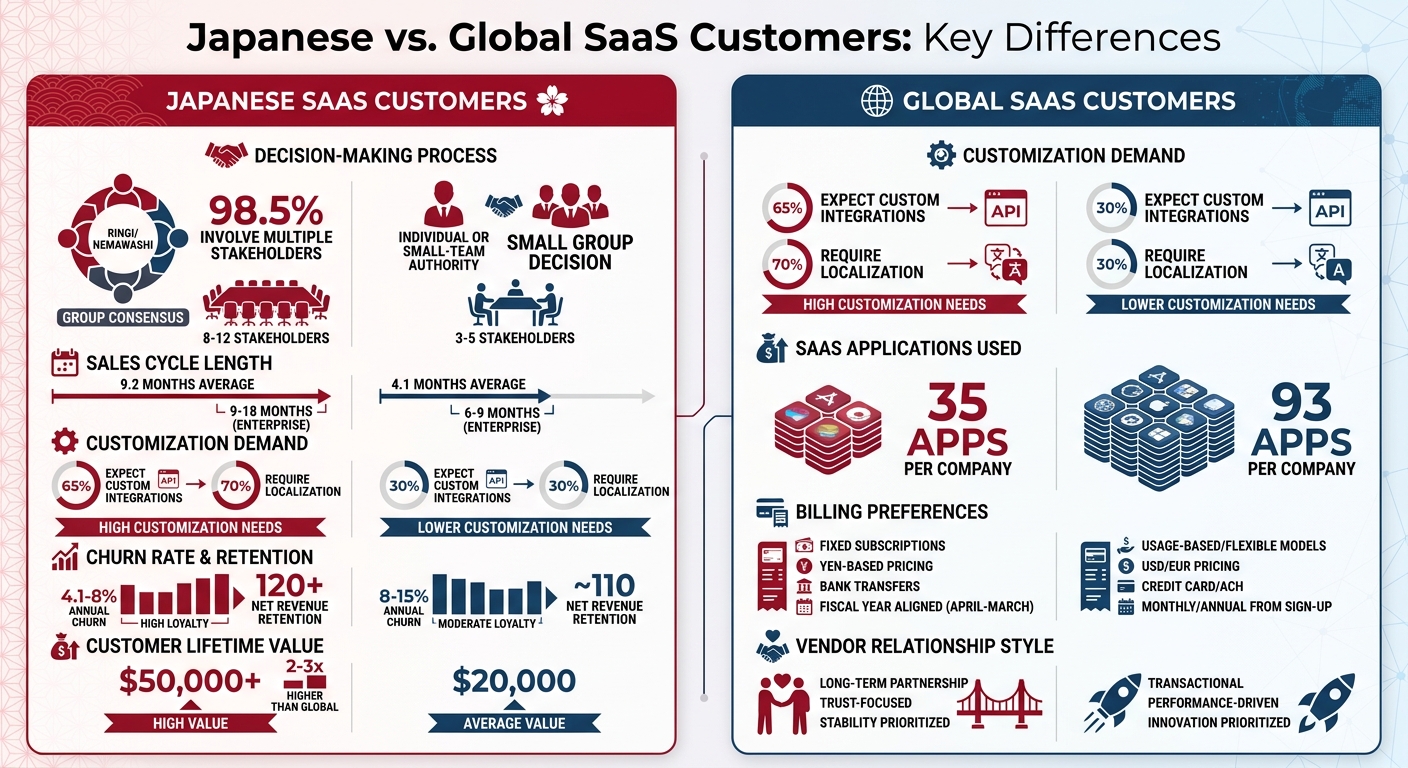
Japanese vs Global SaaS Customers: Key Differences Comparison
Sales Processes: How Japanese and Global Customers Buy SaaS
Group Consensus vs. Individual Decision-Making
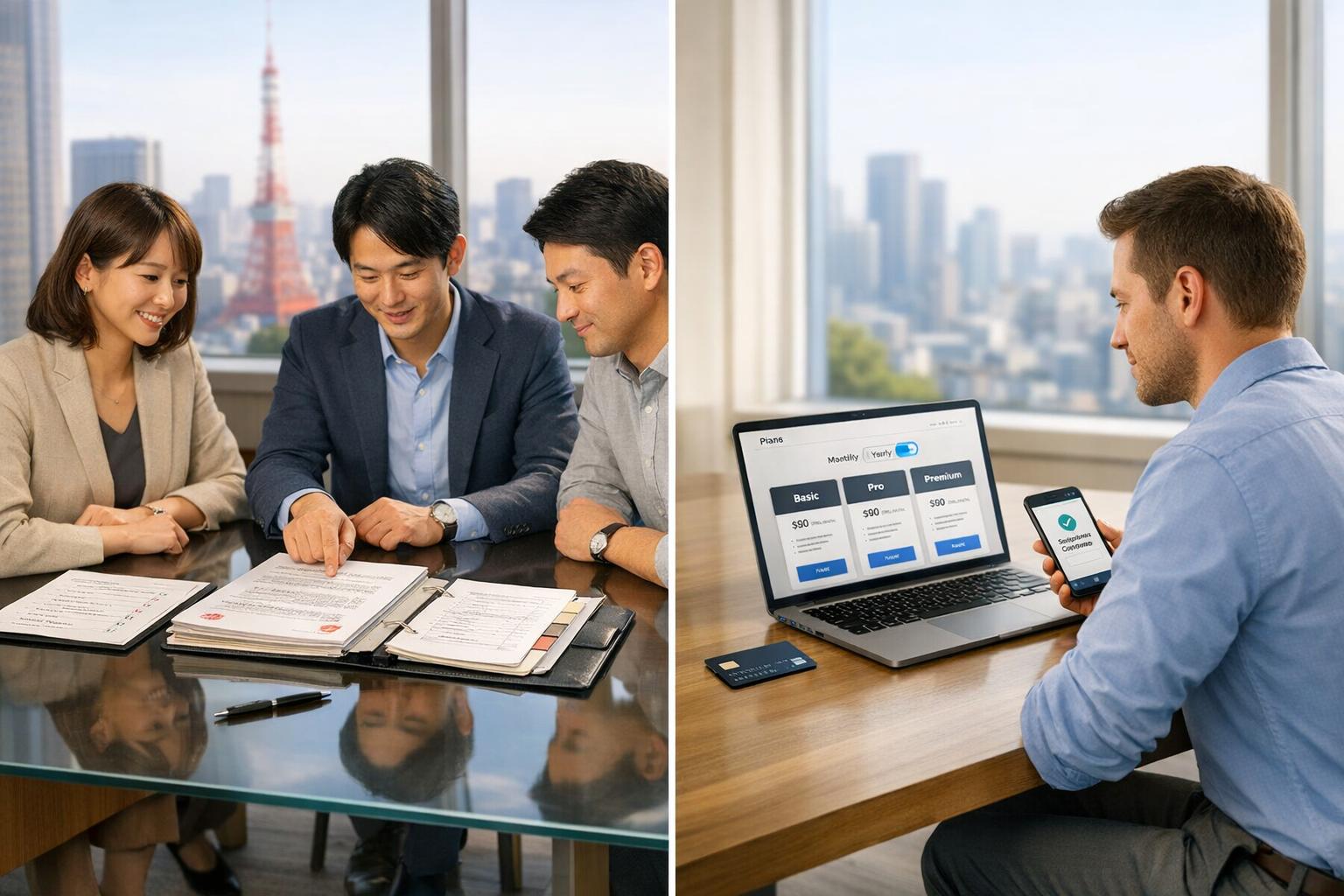
In Japan, buying decisions often follow a structured process known as nemawashi (informal consensus-building) and ringi (formal group approval). Before any official proposal moves forward, stakeholders from various departments – like IT, finance, legal, and management – hold informal discussions to align their views. Only after this groundwork is done does the formal approval process begin. By contrast, in Western markets, decision-making is typically faster, with authority often resting in the hands of a single executive or a small team.
"Even when an executive holds the authority to decide, it is customary for consensus and wide consultation beforehand. This collective approach can extend procurement cycles but ultimately leads to more durable business relationships." – Yuga Koda, Co-Founder, Nihonium
The numbers tell the story: 98.5% of B2B software purchases in Japan involve multiple stakeholders reaching a consensus. On average, Japanese deals require input from 8–12 stakeholders, compared to just 3–5 in global markets. This means vendors need to dedicate more resources to engaging with various decision-makers and creating customized materials for different levels of the organization.
Consider Salesforce’s experience entering Japan. Enterprise deals, such as one with Mitsubishi, took over 12 months to finalize because of the multi-departmental approval process. By contrast, during the COVID-19 pandemic, Zoom saw rapid adoption in the U.S., where individual decision-makers could greenlight purchases in just days or weeks without extensive internal negotiations.
This collaborative decision-making process naturally lengthens the sales cycle.
Sales Cycle Lengths
Because consensus is central to decision-making, Japanese sales cycles are significantly longer than those in global markets. On average, SaaS sales cycles in Japan last 9.2 months, compared to just 4.1 months globally. For enterprise deals, the timeline stretches to 9–18 months in Japan, while similar deals take 6–9 months in Western markets. Mid-market deals in Japan average 6–9 months, compared to 3–6 months globally.
| Region | Average Sales Cycle | Number of Stakeholders | Key Decision Process |
|---|---|---|---|
| Japan | 9.2 months | 8–12 stakeholders | Group consensus (ringi/nemawashi) |
| Global (US/Europe) | 4.1 months | 3–5 stakeholders | Individual or small-team authority |
These extended timelines stem from several factors. Japanese buyers often require proof-of-concept trials, detailed product demonstrations, and in-person meetings to establish trust before committing. Additionally, the ringi document must pass through multiple layers of management for approval, a process that alone can take 2–4 weeks. In fact, 60–70% of the entire project timeline is spent on consensus-building before a formal proposal is even submitted.
To navigate these challenges, SaaS companies need a patient and well-thought-out strategy. Nihonium recommends securing C-level sponsorship and leveraging fractional local sales support to help streamline the consensus process. By doing so, companies could potentially reduce sales cycle times by 20–30% while still maintaining the trust necessary for long-term success.
sbb-itb-a752276
Customization and Integration Requirements
When it comes to SaaS products in Japan, customization and integration play a crucial role in aligning with the country’s unique business practices and sales processes.
Custom Solutions in Japan vs. Standard Products Globally
Japanese businesses often prioritize modifying software to fit their established workflows, hierarchies, and regulatory requirements, rather than adjusting their processes to match standardized software solutions. Many companies also depend heavily on vendors to provide complete operational frameworks and ongoing support. This preference makes the "plug-and-play" model, which is widely accepted in Western markets, less effective in Japan.
"To succeed in Japan, SaaS vendors must go beyond just selling software – they need to equip businesses with the right frameworks, best practices, and ongoing support to ensure seamless adoption and long-term success." – Iku Hirosaki, Director and COO, 01GROWTH
For example, platforms like Salesforce are often so heavily customized in Japan to accommodate local hierarchical structures that standard objects like "Opportunity" and "Campaign" are rarely used. While these customizations address immediate workflow needs, they can create challenges for future upgrades and integrations.
| Feature | Japanese SaaS Customers | Global SaaS Customers |
|---|---|---|
| Operational Alignment | Software is tailored to fit existing workflows and hierarchies | Business processes are adjusted to align with standardized software |
| Product Adoption | Favor customized solutions; "plug-and-play" models are often avoided if disruptive | Prefer standardized, scalable solutions that work out of the box |
| Data Management | Data is often fragmented due to disconnected tools and manual processes like Excel reconciliation | Data is centrally managed with standardized governance across departments |
| Implementation | Requires extensive vendor support and strategic guidance to address knowledge gaps | Typically managed by internal teams, such as operations or RevOps |
While these customizations are essential for aligning with local needs, they often lead to challenges when integrating new solutions with existing systems.
Integration Challenges
Integrating SaaS solutions in Japan comes with its own set of hurdles. Unlike Western markets, where businesses often replace outdated systems with modern cloud platforms, Japanese companies tend to layer new SaaS solutions on top of their legacy systems. This approach creates a patchwork of systems, leading to silos, fragmented data, and inconsistent reporting.
These challenges have real-world implications. For instance, while Japanese companies are eager to adopt AI-powered features, their heavily customized and siloed legacy systems make it difficult to generate the clean, structured datasets that AI tools require. Ironically, the same customizations that help software align with existing workflows can become barriers to adopting new technologies.
To succeed in the Japanese market, SaaS vendors must show how their products can integrate with and improve upon existing infrastructure, rather than expecting businesses to overhaul their current systems. Nihonium, for example, helps global SaaS companies address these integration challenges by offering localization for SaaS products in Japan that goes beyond simple translation. Their services include technical adaptations designed to ensure compatibility with Japan’s unique IT environment. For vendors, demonstrating seamless integration capabilities and offering proactive support is essential to thriving in Japan’s intricate IT ecosystem.
Customer Expectations: Trust, Loyalty, and Retention
Building Trust in Japan
In Japan, customer loyalty isn’t something you can take for granted, even if your brand is globally recognized. Instead, trust needs to be cultivated through local relevance and a demonstrated long-term commitment. Consider this: only 50% of Japanese buyers opt for a well-known brand over a competitor offering localized information, compared to 69% globally. This highlights a critical fact – brand recognition alone won’t win over Japanese customers unless it’s paired with a genuine effort to meet local expectations.
Building trust in Japan often revolves around nemawashi, the practice of consensus-building. Japanese businesses place a high value on testimonials from reputable local companies, partnerships with established domestic entities, and consistent, ongoing engagement. A great example is Slack‘s entry into Japan. By collaborating with Japanese tech leaders like NTT, Slack was able to establish credibility. On the other hand, global customers lean toward quicker decision-making processes, often relying on free trials, demos, or reviews from platforms like G2 or Capterra.
"It’s easy to tell which vendors know what they are doing and are really committed to the market just through the quality of their materials." – Naoki Togawa, Nikkei Business Publications
Another critical element of trust-building is the use of proper keigo (polite language) in customer support and documentation. In fact, 90% of Japanese consumers prefer products with information available in their own language, compared to a global average of 76%. Many SaaS companies entering Japan work with localization experts like Nihonium to adapt their products, sales materials, and support channels to meet these high expectations. This focus on trust-building often leads to the strong retention rates seen in Japan.
Retention Rates and Churn
Once trust is established, Japanese SaaS customers are incredibly loyal. Annual churn rates in Japan are as low as 5–8%, significantly lower than the global average of 10–15%. Additionally, Japanese customers deliver lifetime values that are 2–3 times higher than their global counterparts. This loyalty is rooted in Japan’s business culture, where relationships and stability are prioritized over transactional interactions. High switching costs also play a role, as Japanese customers often view their SaaS providers as long-term partners requiring ongoing support.
Vendors nurture this loyalty through omotenashi – a hospitality-driven approach to service. Dedicated account managers, regular Quarterly Business Reviews, and proactive support help vendors achieve 20–30% higher lifetime value compared to global averages.
| Metric | Japanese SaaS Customers | Global SaaS Customers | Key Driver |
|---|---|---|---|
| Annual Churn Rate | 5–8% | 10–15% | Focus on relationships and risk aversion |
| Customer Lifetime Value | $50,000+ | $20,000 | Long-term contracts and superior service |
| Net Revenue Retention | 120+ | ~110 | Expanding within existing accounts through deep integration |
| Primary Loyalty Driver | Vendor relationship and stability | Product performance and ROI | Relationship-driven vs. transactional focus |
Japanese SaaS vendors also take practical steps to align with local business norms. For example, they prepare ringi-sho (approval documents) for fiscal year-end renewals in March, integrate with domestic platforms like kintone and Sansan, and offer familiar payment methods such as bank transfers. Simply adding local payment options can boost conversion rates by an average of 7.4%.
For global SaaS companies, investing in localization pays off. Fully localizing for Japan can lead to 25–30% higher adoption rates and 15–20% increases in revenue. The return on investment is impressive, with companies earning $25 for every $1 spent on localization efforts.
Billing and Revenue Models
Usage-Based vs. Subscription Models
In Japan, fixed subscription models dominate, while global markets tend to favor usage-based pricing structures.
The ringi process in Japan – where pricing transparency is critical to gaining approval from multiple stakeholders – requires detailed pricing tables and calculators. These tools help build trust and streamline Japan’s multi-layered decision-making process.
Payment preferences also differ significantly. Japanese enterprises lean heavily on bank transfers and monthly invoicing, with pricing in yen and invoices that clearly outline the 10% consumption tax and traditional seals. On the other hand, global markets often prefer credit cards or ACH payments. Incorporating local payment methods has been shown to increase conversion rates by 7.4%, while offering yen-denominated pricing instead of relying on currency conversion can result in a 40% higher market share.
Hybrid models are becoming a popular compromise in both markets. In Japan, these models often combine a predictable base subscription with optional usage-based add-ons, offering budget certainty while allowing for value-based scaling. Globally, 51% of SaaS companies that monetize AI features now use hybrid pricing, reflecting a more flexible approach to cost management. Japanese customers generally expect the base subscription to drive most of the revenue, whereas global customers are more open to variable costs. These differences in billing strategies are a key element in building trust with customers.
| Feature | Japanese SaaS Customers | Global SaaS Customers |
|---|---|---|
| Primary Payment Method | Bank Transfer (furikomi), Monthly Invoicing | Credit Card, ACH |
| Pricing Preference | Predictable Subscriptions / Tiered Packages | Usage-Based, Hybrid, or Per-User |
| Currency | Must be Yen (¥); no decimals | Often USD/EUR; decimals common |
| Billing Cycle | Aligned with the April–March Fiscal Year | Monthly or Annual from sign-up date |
| Tax Handling | 10% Consumption Tax clearly itemized | VAT/GST/Sales Tax varies by region |
| Invoicing | Formal seikyu-sho (often paper/PDF with seals) | Digital receipts or simple PDF invoices |
| Conversion Impact | Localized pricing leads to 40% higher market share | Standardized global pricing is common |
These billing models are about more than just pricing – they act as trust signals. Companies that fully localize their approach, including yen-based pricing, local payment options, and fiscal year alignment, report 25–30% higher adoption rates and revenue increases of 15–20%. For every $1 spent on localization, businesses see a return of $25. Nihonium specializes in helping global SaaS companies navigate these complexities, implementing Japan-specific billing structures that align with local procurement and accounting practices.
Vendor Relationships: Innovation Adoption and Trust
In Japan, building strong vendor relationships is about more than just pricing – it’s about trust, commitment, and understanding local expectations.
Cautious Approach to New Technology
Japanese companies tend to prioritize stability and proven results over adopting the latest innovations. This cautious mindset contrasts with global markets, where rapid adoption of new ideas – even in beta stages – is common.
"Japanese organizations tend to prioritize reliability and long-term vendor support over innovation and speed." – Yuga Koda, Co-Founder, Nihonium
Rather than jumping on emerging technologies, Japanese businesses often wait for global validation before committing. This is especially true for areas like AI, where local proof-of-concept is a must. Decision-making processes, such as ringi (consensus-building) and nemawashi (informal groundwork), naturally slow down adoption. For example, 50% of Japanese companies take over six months to evaluate SaaS solutions, while global firms – especially SMEs – often decide within days or weeks.
This careful approach underscores the importance of long-term, trust-based vendor relationships in Japan.
Depth of Vendor Relationships
Vendor relationships in Japan are deeply personal and require a level of commitment that goes beyond what is typically seen in global markets.
Japanese customers value enduring partnerships with SaaS vendors, whereas global markets often operate on more transactional, performance-focused terms.
"Western customers tend to adopt and replace tools quickly, whereas Japanese buyers aim to make the right decision from the beginning. This leads to higher retention, longer customer lifetimes, and stronger loyalty." – Yuga Koda, Founder, Nihonium
Trust in Japan is built through face-to-face interactions and a strong local presence – think fully localized products and Japanese-speaking support teams – rather than relying solely on product performance. This approach not only strengthens customer loyalty but also creates challenges for new vendors trying to enter the market. On average, Japanese companies use 35 SaaS applications, far fewer than the global average of 93, reflecting their focus on fewer, highly trusted vendors.
| Feature | Japanese SaaS Customers | Global SaaS Customers |
|---|---|---|
| Adoption Driver | Reliability and proven results | Innovation and speed |
| Relationship Style | Deep, long-term partnership | Transactional and metrics-driven |
| Innovation Adoption | Cautious; requires proven local results | Faster; comfortable testing and replacing tools |
| App Density | 35 apps per company | 93 apps per company |
| Trust Building | In-person engagement and local presence | Product experience and reviews |
| Retention/Churn | High loyalty; low churn once adopted | Higher churn; prone to switching vendors |
Nihonium provides global SaaS companies with fractional sales support and a local presence, helping them establish the trust and commitment needed to thrive in Japan’s market.
Conclusion: What SaaS Companies Need to Know About the Japanese Market
Breaking into Japan’s SaaS market requires more than just translating your product – it calls for a complete shift in how you approach sales, support, and building relationships. As we’ve highlighted, Japanese businesses rely heavily on consensus-driven decision-making, often involving 8–12 stakeholders. They also demand a high level of customization, with 70% of enterprises requiring localization compared to just 30% globally. But the effort pays off – once trust is earned, Japanese customers are incredibly loyal, with churn rates far lower than in other markets.
To succeed, companies need to commit to a localized presence. This means having native Japanese support teams, offering yen-based billing options, and embracing the ringi process for decision-making. Businesses that fully localize their offerings often see tangible gains in both user adoption and revenue growth.
"Translation converts words; localization transforms the entire product experience." – Yuga Koda, Co-Founder, Nihonium
Establishing trust is the cornerstone of entering this market. One effective approach is starting small with fractional support to test the waters and scale gradually. Companies like Nihonium specialize in helping global SaaS businesses navigate Japan’s unique, relationship-driven market. Their services include product localization, creating tailored marketing funnels, and providing fractional sales teams with local expertise.
Patience and cultural adaptation are key to thriving in Japan. From designing information-rich landing pages to prioritizing face-to-face interactions, understanding these nuances allows SaaS companies to tailor their global strategies for long-term success in this market.
FAQs
How can we shorten a Japan sales cycle without breaking the ringi process?
To shorten a sales cycle in Japan while respecting the ringi process, prioritize strengthening nemawashi – the informal discussions that happen before formal decision-making. By engaging key stakeholders early and building consensus beforehand, you can cut down on the number of formal approval steps required. Utilize digital tools to share proposals efficiently and maintain clear, consistent communication to keep everyone aligned. Effective nemawashi not only speeds up formal approvals but also respects Japan’s emphasis on consensus-driven decision-making.
What should we localize first for Japan: product, integrations, or support?
To break into the Japanese SaaS market, the first step is localizing your product. Japanese enterprise users typically expect a user interface (UI), documentation, and features that are tailored specifically to their needs. This isn’t just a nice-to-have – it’s essential for meeting local expectations, proving your product fits the market, and earning their trust.
Once your product aligns with user needs, the next focus should be on integrations and providing support that aligns with local practices. These steps help deepen relationships with customers and lay the foundation for long-term success in the market.
How do we set up yen pricing and invoices that match Japan’s fiscal year?
To match yen pricing and invoicing with Japan’s fiscal year (April 1 to March 31):
- Adapt pricing structures to align with Japanese companies’ budgeting timelines.
- Provide annual contracts in yen to suit fiscal year planning needs.
- Tailor invoicing systems to issue invoices at the start or end of the fiscal year.
- Comply with local regulations regarding tax laws and invoicing requirements.
These steps help streamline financial processes and improve alignment with customers.
 English
  Japanese