

When Is The Right Time to Enter The Japanese Market?
Introduction
Entering the Japanese market may be a decision that companies face. This decision may be part of a larger global expansion plan. It may be that there are leading indicators of success in Japan such as increased signups or leads. It may be even that there are Japanese enterprise logos coming in through the self-serve funnel. Japan, being the second-largest Enterprise software market, is full of opportunities for SaaS companies if there’s a proven fit. The million-dollar question is “When should a company consider entering Japan?”
Benchmarks for Japan Entry
There are no defined benchmarks for global expansion or Japan entry, but a few thought leaders have shared their take on when to consider global expansion and Japan entry.
SaaStr’s Jason Take on Europe
SaaStr’s Jason Lemkin is a big advocate of SaaS companies expanding globally. He mentions that in the long run, global expansion moves from becoming a choice to becoming a necessity. When talking about Europe, he says that after acquiring 10 customers, Europe should be considered and treated as a separate segment.
Selling to innovators and early adopters is doable without an entity. He suggests that setting up an entity should be considered when revenue from Europe is between $1m to $2m. The advantage of European companies is that marketing and selling in the local language may not be as strict of a requirement compared to Japan.
Geodesic’s Marcus Otsuji’s Take
Geodesic is a US-based VC firm that helps their portfolio companies enter Japan. Marcus Otsuji, Geodesic’s Japan Country Manager, has written and shared his experience bringing US-based SaaS companies into Japan. He mentions a few metrics and benchmarks as part of considering Japan entry:
1. Product-market fit (PMF) with working go-to-market (GTM): If PMF and there’s working or even semi-working GTM, Japan expansion should be considered.
2. Revenue: This rarely happens, but if there’s revenue already coming from Japan, a formal entry by setting up an entity could be rewarding.
3. Macro trends and indicators: If there are favorable macro-trends, entering Japan should be considered. Otsuji cites supporting a portfolio company’s successful Japan entry based on strong “cloud adoption” metrics in Japan — Cloud adoption was greater in Japan relative to other Asian countries.
4. Competitors: It’s always good to keep tabs on whether the competition is entering Japan.
If the above criteria are met and/or favorable, setting up a local entity and making local hires should be considered.
Summary
Two thought leaders have shared their opinions on when to formally expand globally or enter Japan. As Europe has a lower barrier to entry in terms of language and localization, the EU expansion benchmarks seem to be higher. Lemkin suggests formal EU entry (setting up an entity) after $1m to $2m, while Otsuji suggests consideration for Japan after finding PMF with functioning GTM.
Both thought leaders have a local entity and local hires as milestones in entering a new market. Both mention that at a certain point, local sales and support are required — This is because innovators and early adopters have different buying patterns. Innovators and early adopters may sign up and purchase without a localized product or local sales and support. This seems to be the cause for a different set of metrics between entering the EU and Japan: Japan requires a localized product and local sales and support earlier than Europe, hence less competitive benchmarks/metrics. Combining the insights from both thought leaders, a good time to consider Japan’s entry would be when:
1. There’s PMF in the core market with functioning GTM and proven channels
2. Local innovators and early adopters are coming through the pipeline
3. Overall macro-trend is favorable
Closing the gap between the two thought leaders’ criteria would be ideal. Entering Japan on leading indicators alone is a big leap, but $1m to $2m in revenue before setting up an entity in Japan is also a stretch. Somewhere in between is realistically the necessary validation before taking the step of a local entity and local hires.
Validating the Japanese Market Before Setting Up an Entity
Both thought leaders’ milestones of setting up an entity and making local hires. That being said, companies can do a lot before taking this leap and prematurely setting and hiring locally can have serious consequences. There are also ways put together a lightweight Japan team without an entity of local hires. Nihonium’s goal is to close the gap between basing the market entry decision solely on leading indicators.
Gaining Trust with a Local Presence
Innovators and early adopters may purchase software if the technology is a good fit. A local presence increases the chances of acquiring innovators and early adopters as customers. A local entity is one way of showing commitment to the local market, but there are many other ways to show commitment that can be done before setting up a local entity.
The first is a localized product. Having a localized product shows the market that the company is taking Japan seriously. Having high-quality and industry-specific language is key, as poor translation can easily be spotted and can backfire. Robust documentation is also important, especially if the product requires some initial setup — If the documentation that guides users is in a non-native language, the end user may not be able to get fully set up.
The second is go-to-market. Content can be localized and helps with market education and thought leadership. The more content available, a higher level of trust is formed.
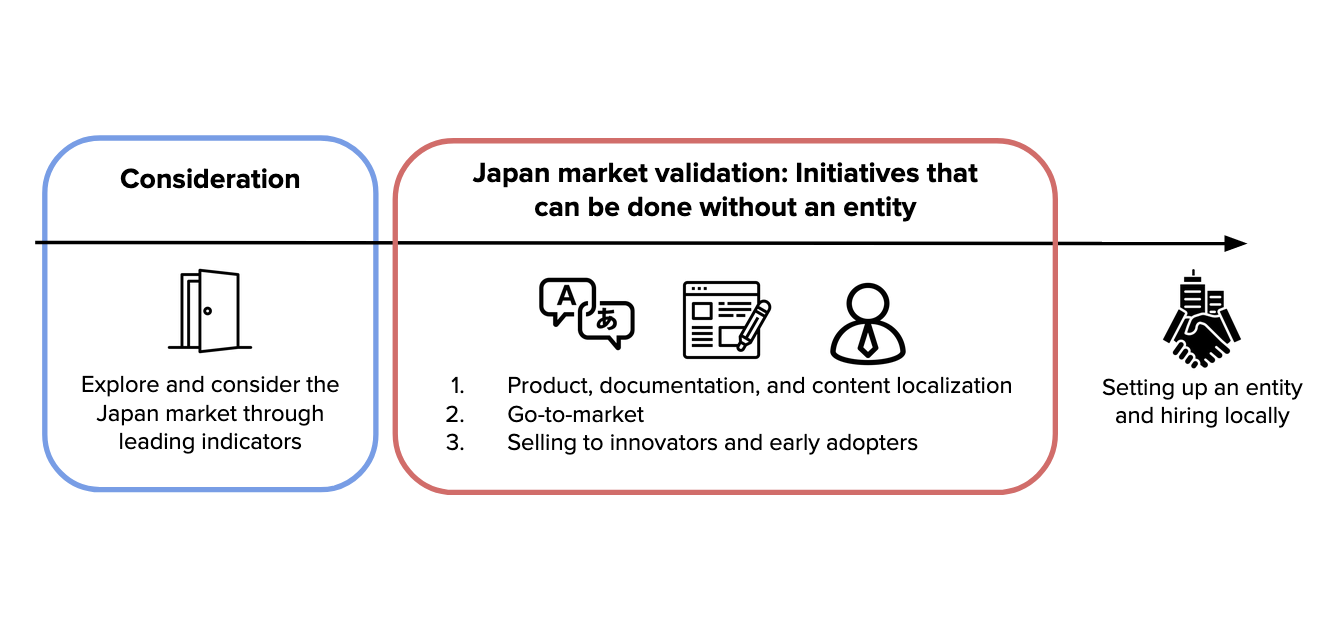 The two initiatives mentioned above can be done without a local entity and show the market that Japan is taken seriously. A skilled translator with a strong understanding of the industry-specific language, the product, documentation, and content can all be localized.
Building trust in Japan is important, as Japanese companies have seen global companies enter and exit Japan rather swiftly. In some cases, global companies can generate revenue without any localization, but a localized product increases the chances of acquiring innovators and early adopters who buy without any salespeople involved. Once there’s revenue generated from Japan through innovators and early adopters, setting up an entity and making local hires may be a good decision.
Sales and Support
Local sales and support is the next level of validating the Japanese market. After selling to innovators and early adopters who may need little guidance, the next layer of buyers will need to be sold to. Having local language sales is important, but the leap in making local hires may still feel big. Initially, SaaS sales may be sufficient with a product-driven approach with fractional support, as the growth and sales strategy evolves with the target audience.
A possible solution is to outsource sales to Nihonium.io. The other option is to find local resellers and partners, which comes with a different set of challenges. That being said, there are options to sell in the local market without having to set up a local entity or to hire locally.
In the long run, hiring a sales leader and a sales team will be important to take Japan entry and growth to the next level.
Conclusion
Entering any new market is highly opportunistic, but requires a real commitment (a common mistake that companies make is not fully committing and treating Japan as an extension of US go-to-market). Entering the Japanese market may require a higher level of initial commitment level than in other markets, especially unique language. Especially when compared to the European market, this may lead to weaker leading indicators, such as revenue or leads.
That being said, there are options for closing the gap and getting more validation to have higher conviction in entering Japan. The initial steps to acquire your first Japanese customer, such as localization and go-to-market, can be done to a certain level without setting up a local entity. These initiatives will help provide clarity in the decision-making around entering the Japanese market. If you’d like to learn more about validating the Japanese market, book a free consultation here.
 Japanese
  English