

Consequential Mistakes to Avoid When Entering the Japan Market
Introduction
Japan is the second largest enterprise software market and entering the Japanese market is a good option for many SaaS companies. With Japan being rather isolated with a unique language and processes, entering Japan can be full of uncertainties. Figuring out the right timing for Japan entry is one aspect of the difficulty of Japan entry. Other aspects must be demystified and considered to bring acquire your first customers in Japan.
6 Things to Avoid When Entering Japan
There are a few common mistakes that companies make when entering the Japanese market. Making these mistakes may make the companies’ time in Japan ephemeral. Avoiding these mistakes may increase the chances of success in Japan.
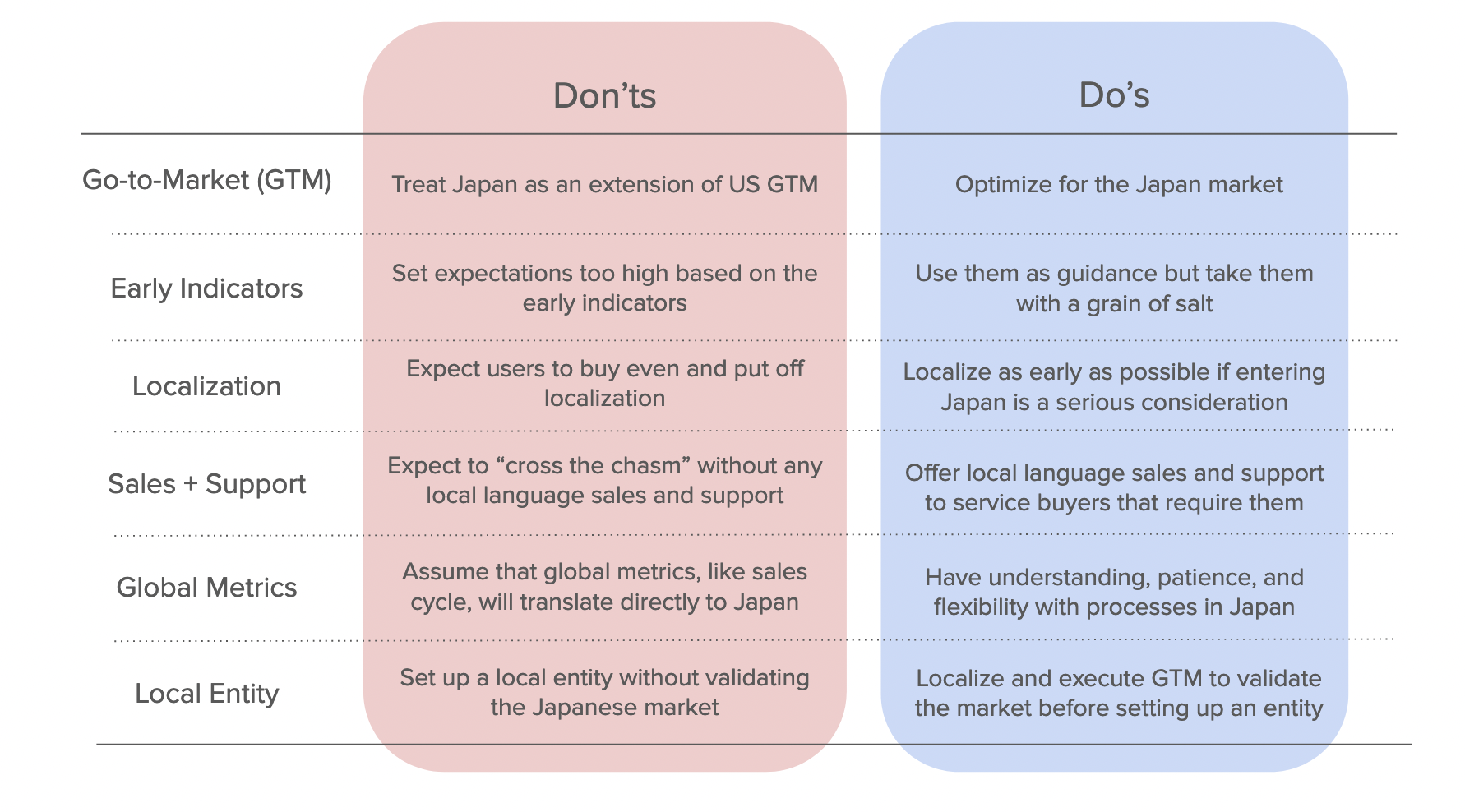 Treating Japan Go-To-Market as an Extension
Japan has a different go-to-market (GTM) playbook. Sales is conducted differently and the growth strategy evolves with the maturity of the company’s presence in Japan. Copying and pasting the global strategy and expecting it to work in Japan may be setting the company up for failure.
For example, content and keywords being searched in Japan are likely going to be different. Creating content targeted to the English-speaking market and translating it into Japanese may not lead to strong performance. The level of knowledge and maturity, which are different across different countries, play into the difference in what people search for. Optimizing for what works in the specific region is crucial. This can be easily worked around by using marketing tools and understanding the market. Publishing a few articles and further optimizing for the local market is also a great way to gauge the market. The same concept can be applied to SEM. Converting keywords are going to be different, so optimizing for the Japanese market is going to be crucial.
Another aspect that needs to be addressed is the overall growth strategy. Product-led growth (PLG) is the ideal growth strategy for many companies. In Japan, it’s very rare to see pure PLG plays, especially in the B2B SaaS realm. Expecting PLG to work in Japan because it has had success in other markets may lead to disappointing results. Understanding where your product fits in the product-led growth and sales-led growth (SLG) scale is important. There’s likely more SLG required than initially imagined (hence the SLG-oriented CTA) and adopting agility around this is key.
Rely Too Heavily on Early Indicators
Early indicators are necessary to create benchmarks and make data-driven decisions. When entering a new market, these early indicators of success may need to be taken with a grain of salt.
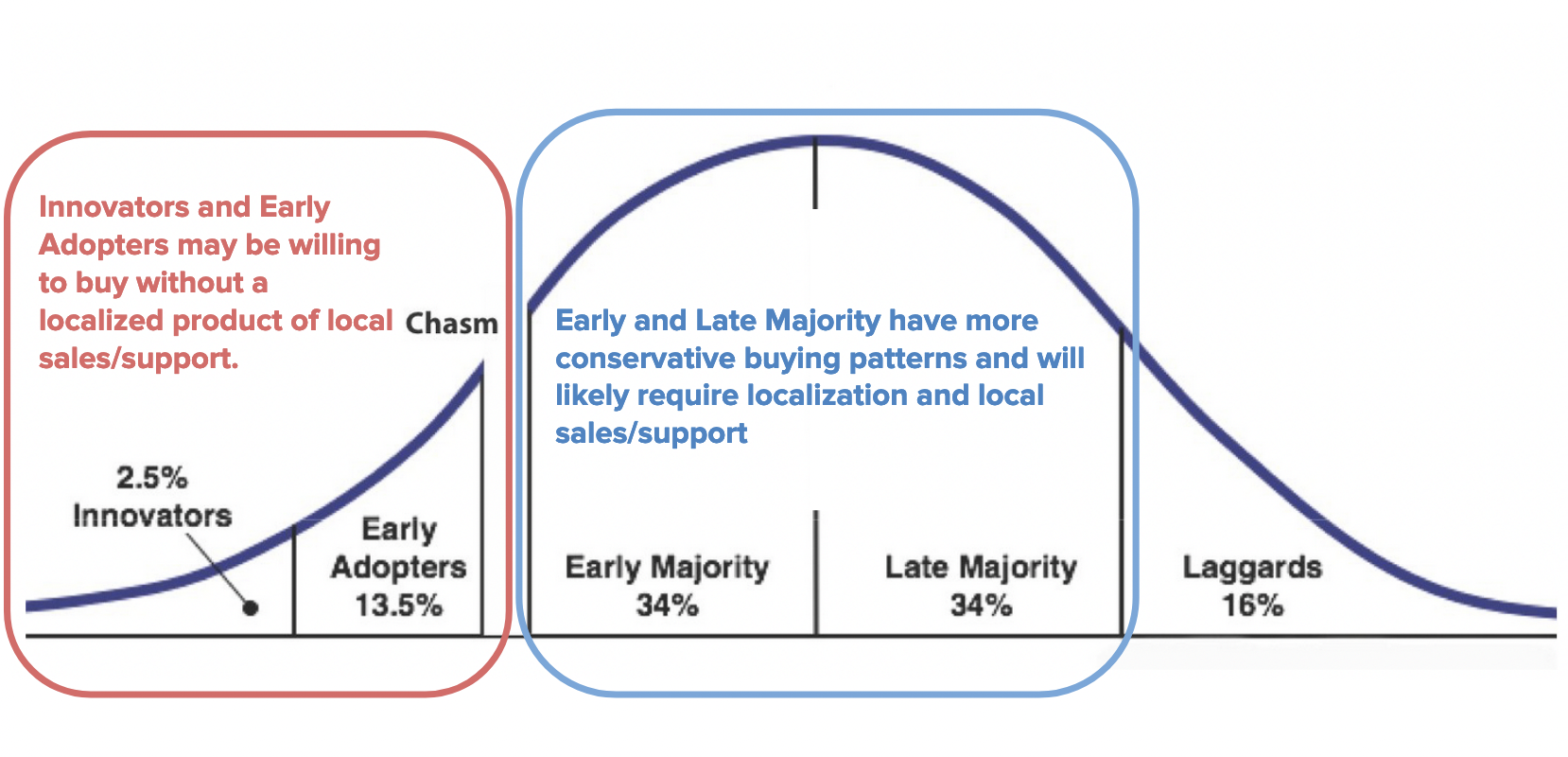
The early indicators are made up of innovators and early adopters. Innovators and early adopters have a completely different buying pattern than the early majority and the late majority. The innovators and early adopters may sign up for a trial and even purchase the product without any local sales or a localized product. Deciding to put off product localization and local language sales and support due to these early indicators will likely lead to disappointing results. Instead, investing the revenue from Japan into building a presence in Japan is likely the wiser choice.
Making decisions from early indicators is key, but they sometimes paint a bubblier picture. Understanding that the early indicators may be embellished will lead to more sound decisions around crossing the chasm in the Japanese market.
Putting Off Localization
In the rare and amazing case of a company having success selling without any localization, they’ll likely need to localize to expand on that growth and cross the chasm. After the initial layer, buyers become more strict in their requirements. This is twofold in that end-users may have less familiarity with English, but the number of stakeholders increases. These stakeholders are part of the buying process unique to Japan called the Ringisho process and may never be end-users of the product. To appease both the end users and the stakeholders, the website, product, and documentation are (almost) required to be localized. Localization is also highly relevant in gaining the trust of the Japanese market. To truly give the website a local feel, it’s important to understand the similarities and differences in Japanese and global landing pages. When localizing, AI and machine translations may seem like an easy option. Though AI and machine translations have made significant progress, the quality is not quite sufficient and may seem awkward, especially for native speakers. Poor localization needs to be avoided, as it has consequential adverse effects.
Lacking Local Language Sales and Support
The next level of localization is to have local language sales and support. The rare and amazing case of a company having revenue without any localization or local language sales and support may hinder decision-making. Local sales and support may feel unnecessary, but the majority of buyers will not buy without local sales or support. If you have plans to add local sales of support, it’d be best to keep your leads in a list and address them when the Japanese sales and support are put in place. When you expand into outbound sales, Japanese sales becomes imperative.
Basing Success on Global Metrics
Assuming that some level of success in Japan has been achieved, product localization is complete, and local sales and support are put in place, the team is ready to go to accelerate revenue generation in Japan. The trap that many companies fall into is benchmarking to global metrics. Companies expect similar results from global metrics and set goals in milestones based on them. Using the benchmarks is important, but having flexibility and understanding that the Japanese market operates differently is important.
Expecting deals to progress and close at the same rate as global deals may be the biggest contributor to companies entering Japan and leaving within two years. The sales cycle is longer due to the multiple stakeholders in the buying process. Gaining the trust of the buyer is also a large component of selling. Setting expectations, especially around time and speed, may lead to disappointing results. On the other hand, once a relationship is built, companies will stay loyal customers. Companies that have had success in Japan are the ones that gained the trust of the market and had patience with the Japan entry process.
Assume a Local Entity is Necessary for Initial Entry
Setting up a local entity is one option for Japan entry and is crucial at a certain stage. It is important to considering the stages of Japan market entry. Some Japanese companies prefer to do business with the local entity of a global company. Hiring locally is also key to expanding in the Japanese market. Over time, a solid country manager and team will likely be a key factor in success in Japan.
An entity is definitely the right option for many companies, but (prematurely) setting up an entity and hiring locally is costly and comes with risk. The ideal situation would be to have validation and conviction in full entry into Japan. Many GTM motions can be done without an entity and would help validate the Japanese market. Localization, marketing, and lightweight sales can all be done without an entity. The results of these initiatives can provide further clarity in whether the next level of investment in the Japan market is a good idea.
Conclusion
Entering any new market comes with uncertainties. Entering the Japanese market may be even more unclear, as there are nuances specific to Japan. The uncertainty leads to common mistakes that deter success in Japan. Avoiding these mistakes is crucial for both short and long term success in Japan. Having patience and flexibility is key to Japan market entry. Reducing the risk by gaining further validation is also another way to add certainty. If you’d like to learn more about the Japan market, book a free consultation here.
 Japanese
  English