
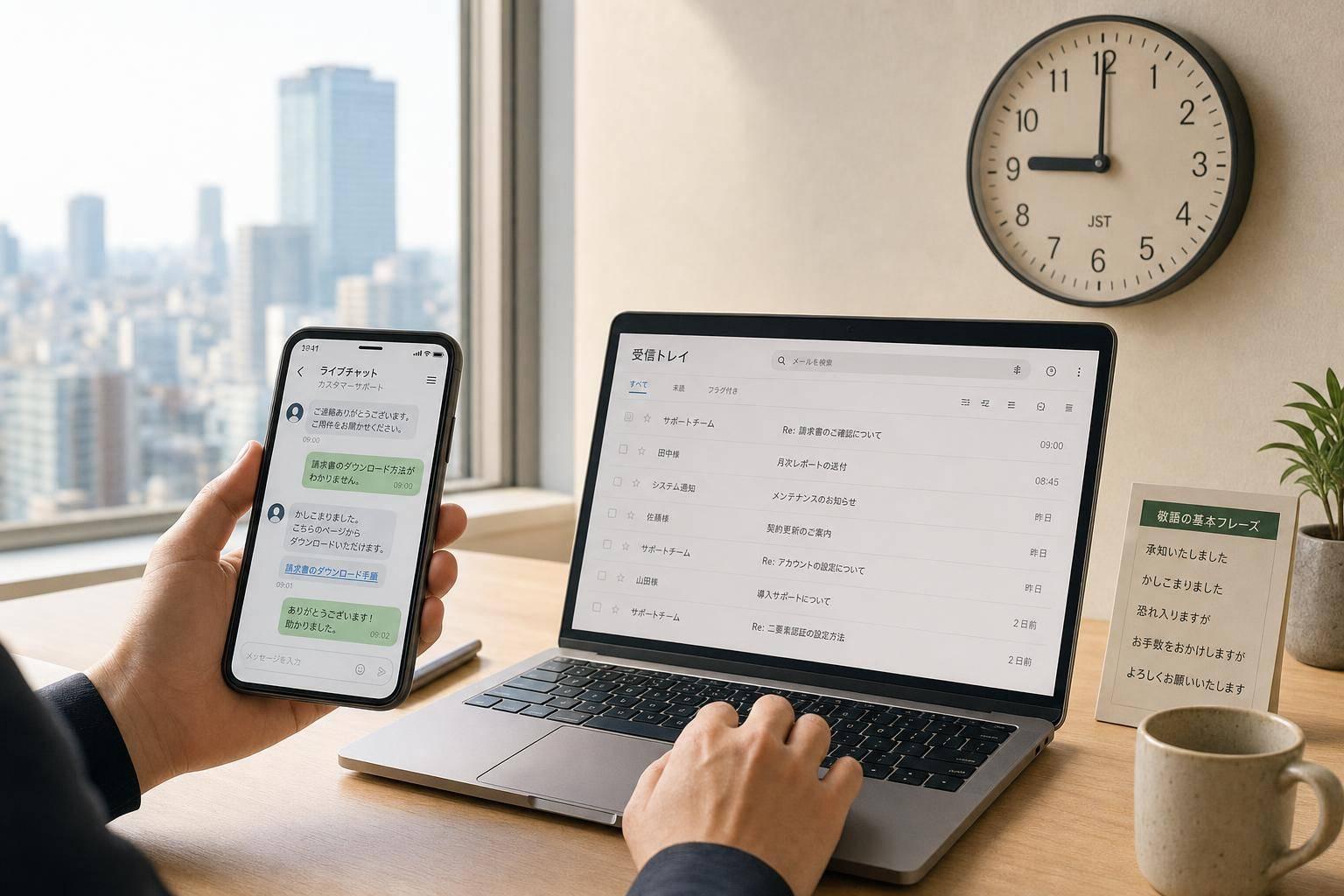
In Japan’s SaaS market, customer support isn’t just a service – it’s a dealbreaker. With the market projected to reach market projected to reach $13.8 billion by 20263.8 billion by 2026, choosing between live chat and email support can directly impact customer retention. Here’s the key takeaway:
- Live Chat: Ideal for quick, real-time problem-solving (e.g., login issues, navigation help). Works best for SMBs and B2C customers who value speed and convenience. Requires high staffing and JST business hour coverage.
- Email Support: Perfect for complex, detailed issues and formal communication. Preferred by enterprise clients for its precision, record-keeping, and structured responses. Needs native Japanese speakers to ensure proper tone and formality.
Quick Comparison
| Feature | Live Chat | Email Support |
|---|---|---|
| Response Time | Real-time | SLA-based (asynchronous) |
| Best For | Simple, urgent issues | Complex, detailed problems |
| Customer Perception | Fast and convenient | Formal and thorough |
| Staffing Needs | High (live agents required) | Moderate (queue-based) |
| Preferred Audience | SMBs, B2C | Enterprise, B2B |
Key Insight: Japanese customers expect politeness, accuracy, and local time zone support. While live chat impresses with speed, email shines for its formality and detail. Combining both channels, tailored to customer needs, ensures better retention and trust.
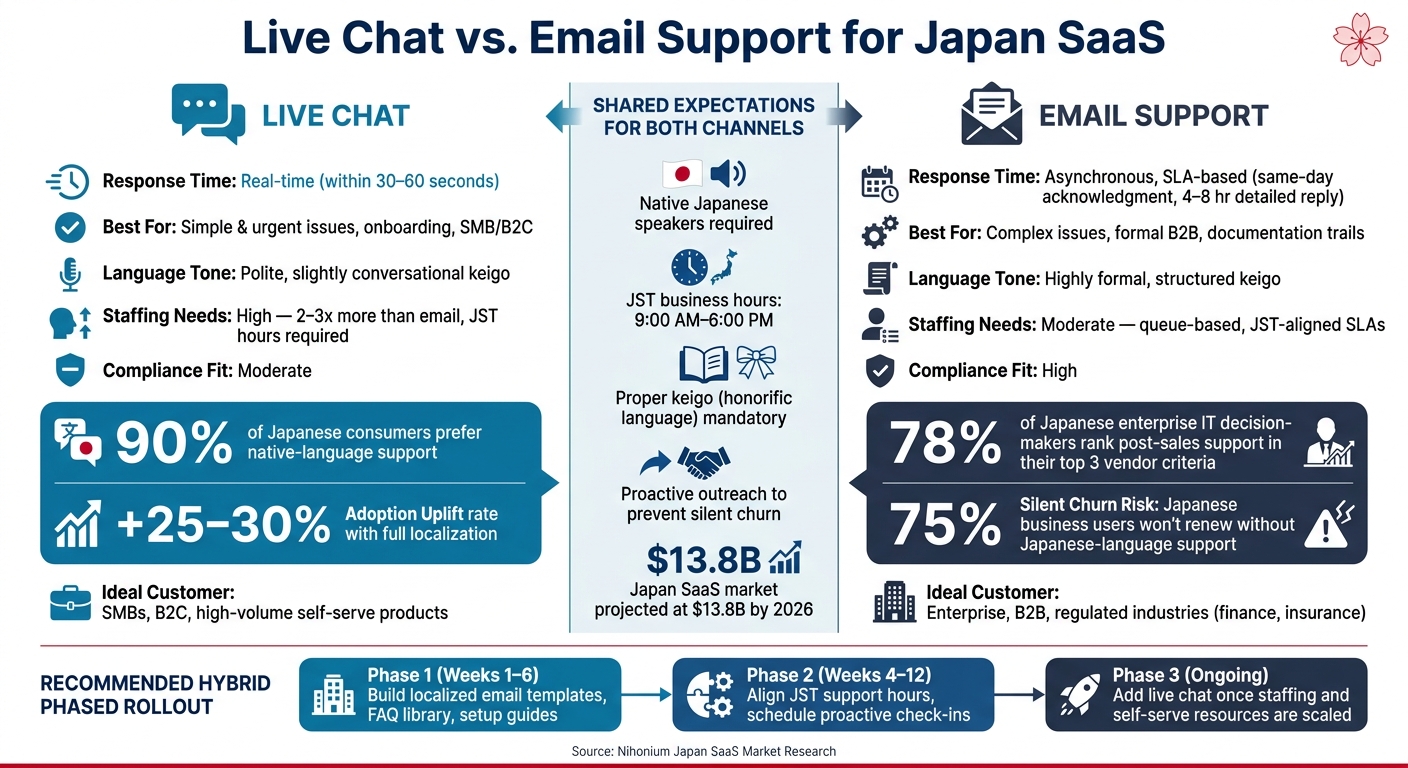
Live Chat vs. Email Support for Japan SaaS: Side-by-Side Comparison
What Japanese Customers Expect from SaaS Support
Japanese customers hold service quality to exceptionally high standards, and even minor mistakes can quickly erode trust. This expectation influences every interaction they have with customer support.
Politeness and Formality in Customer Communication
In Japan, how you say something is just as important as what you say, making localization for SaaS products essential. Business communication traditionally follows strict formalities, rooted in keigo (honorific language), and this cultural norm extends to customer support. Casual or overly informal responses can come across as disrespectful. Even in live chat, where speed is essential, agents are expected to maintain this level of formality – a challenging skill to scale effectively.
Speed vs. Accuracy: Balancing Two Key Expectations
Japanese customers value both quick responses and precise solutions. Live chat is popular for its ability to provide immediate answers and clarify misunderstandings in real time. However, email remains the preferred option for issues that require detailed explanations, attachments, or step-by-step instructions, particularly for users who may not feel comfortable with live interactions. A combined approach – using live chat for instant reassurance and email for thorough follow-ups – helps meet these dual expectations. Choosing the right channel is key to delivering effective support.
B2B vs. B2C SaaS Support Needs in Japan
Support expectations vary significantly between B2B and B2C customers in Japan. B2C users typically prioritize fast and seamless experiences, making live chat an ideal option. On the other hand, B2B customers, particularly enterprise buyers, expect a more proactive and detailed level of service that reflects Omotenashi (the spirit of selfless hospitality). This often includes formal documentation like meeting minutes, progress updates, and usage reports, which are better suited for email or structured support portals.
The stakes are especially high in the B2B space. A striking 78% of Japanese enterprise IT decision-makers rank post-sales support quality among their top three factors when choosing a vendor – placing it even above pricing and features. As Yuga Koda, Co-Founder of Nihonium, explains:
"Japanese enterprise buyers routinely expect 90%+ CSAT scores as a minimum standard, and the gap between Western-standard customer success and Japan-market customer success is one of the leading causes of failed market entries." – Yuga Koda, Co-Founder, Nihonium
For B2B accounts, timely responses are critical. A same-day acknowledgment is mandatory, with detailed replies expected within 4–8 hours. Missing this window – even once – can quietly undermine a relationship that may have taken months to cultivate.
sbb-itb-a752276
Live Chat Support for Japan SaaS: Pros and Cons
Benefits of Live Chat in Japan
Japanese customers are known for their high standards when it comes to service, valuing both speed and accuracy. Live chat fits this need perfectly, offering immediate, native-language support that aligns with their expectations. Research shows that 90% of Japanese consumers prefer buying products with information provided in their own language – far above the global average of 76%. This makes real-time Japanese-language chat a critical tool during onboarding or when addressing interface concerns, as it can directly impact customer retention.
Another key advantage is the ability to apply proper keigo (formal Japanese language) in live chat. Responding with the correct level of politeness and respect is a cornerstone of Japanese business etiquette. A timely, well-worded reply not only demonstrates cultural understanding but also builds trust. Companies that fully localize their support, including live chat, often see adoption rates increase by 25–30% and revenue grow by 15–20% in Japan compared to those that rely solely on translated materials. These benefits set a strong foundation, but they come with operational challenges that must be addressed.
Challenges and Staffing Requirements
Running live chat support isn’t without its hurdles. The real-time nature of chat means higher staffing demands – typically requiring 2–3 times the resources compared to email support. Agents must be available to respond instantly, as Japanese customers expect replies within 30–60 seconds. A delay of more than two minutes is generally unacceptable.
Time zone differences add another layer of complexity. Japanese enterprise clients, particularly large organizations with 500+ employees, often require support during local business hours (9:00 AM–6:00 PM JST). If your service level agreement only covers US or EU time zones, you might be disqualified before negotiations even begin. Additionally, the chat interface must accommodate Japanese Input Method Editors (IME) for smooth kanji input. Since Japanese text is typically 30–50% longer than English, standard chat layouts may also need adjustments.
Language expertise is equally crucial. Japanese enterprise customers can easily identify auto-translated content, which can damage credibility and trust. Addressing these challenges is essential to determine whether live chat is the right primary channel for your business.
When Live Chat Should Be Your Primary Channel
Live chat is most effective for resolving quick, straightforward issues like login problems, navigation assistance, account setup, or payment errors. It’s also a good fit for small and medium-sized businesses (SMBs), especially during market entry. For example, you could start with partial JST coverage, such as 9:00 AM–1:00 PM, before expanding your hours as demand grows.
Another strength of live chat lies in proactive outreach during onboarding. Japanese customers are less likely to voice dissatisfaction directly and may silently cancel their subscription upon renewal. Using live chat to initiate contact can uncover and resolve problems early. For high-volume, self-service products where users need quick reassurance, live chat often proves to be the best primary channel. These advantages and challenges will help guide your decision-making as you evaluate support strategies for the Japanese market.
Email Support for Japan SaaS: Pros and Cons
Benefits of Email Support in Japan
In Japan, email remains the go-to support channel for many B2B SaaS companies, primarily because it aligns with the cultural emphasis on precision and formality. Japanese business culture values carefully crafted, polished communication, and email allows support agents to provide detailed responses using proper keigo (respectful language). Additionally, email creates an official record of communication, which is especially important in regulated industries like finance, insurance, and enterprise procurement. For large enterprise clients, having a formal email support channel with clearly defined SLAs during JST business hours is often a non-negotiable requirement.
Email also shines when handling complex issues. Whether it’s a step-by-step technical guide, a detailed billing explanation, or a response requiring coordination across multiple teams, email gives agents the time to provide thorough, well-thought-out solutions. As Emily Carter, a customer service software expert, states:
"Email is preferred when issues require step-by-step analysis and multi-team reviews."
These strengths make email a powerful tool for SaaS companies, but it also comes with unique challenges in the Japanese market.
Challenges and Requirements for Email Support
The main challenge with email support in Japan is maintaining quality. Japanese enterprise customers are quick to notice machine-translated responses or improper formality, which can harm your credibility. As Naoki Togawa from Nikkei Business Publications observed:
"It’s easy to tell which vendors know what they are doing and are really committed to the market just through the quality of their materials."
To meet expectations, it’s essential to have native Japanese speakers with SaaS expertise handle support emails. Machine translations should always be reviewed by humans to avoid errors. Additionally, creating a library of pre-approved templates that incorporate proper keigo and industry-specific terminology can ensure consistency and professionalism in your communication.
Another critical factor is availability. For enterprise clients, full JST business-hour coverage (9:00 AM–6:00 PM) is often required. While SMB customers might accept partial coverage, such as 9:00 AM–1:00 PM JST, larger accounts typically expect full support during business hours. Balancing these demands is crucial for building trust and meeting client expectations.
When Email Should Be Your Primary Channel
Given these considerations, email is most effective when accuracy and thoroughness are essential. For SaaS companies working with enterprise clients, operating in regulated industries, or managing complex onboarding processes, email should be a cornerstone of the support strategy.
Email is also invaluable for addressing a common challenge in the Japanese market: silent churn. Japanese customers often avoid escalating issues and may cancel their subscriptions without warning. Proactive email check-ins can help identify and resolve problems early. As Yuga Koda, Co-Founder of Nihonium, explains:
"Japanese enterprise customers rarely escalate issues – they cancel silently at renewal. Proactive customer health monitoring and scheduled check-ins are the only reliable early warning system for Japan accounts."
This proactive approach is especially important given that 75% of Japanese business users will not renew a SaaS subscription if post-sale support in Japanese is unavailable. Furthermore, enterprise buyers in Japan often expect detailed written documentation – sometimes as extensive as 30–50 pages for setup guides – making email a natural and effective channel for delivering these materials.
How to Choose the Right Support Channel for Japan
Live Chat vs. Email Support: Side-by-Side Comparison
Choosing the best support channel comes down to understanding your customer base, the complexity of your product, and the resources you can allocate. Here’s a quick comparison to guide your decision:
| Channel | Response Speed | Best For | Language Tone | Staffing Needs | Compliance Fit |
|---|---|---|---|---|---|
| Live Chat | Instant | Simple questions, onboarding, SMB/B2C | Polite, slightly conversational | High (real-time JST coverage) | Moderate |
| Email Support | Asynchronous | Complex issues, formal B2B, documentation trails | Highly formal, structured keigo | Moderate (JST-aligned SLAs) | High |
For larger accounts, email support is ideal due to its formal tone and ability to meet compliance needs. On the other hand, live chat works well for SMBs or SaaS products with less intensive onboarding requirements – provided your team can cover Japan Standard Time (JST) business hours.
This comparison highlights key differences and sets the stage for a phased rollout that balances immediate needs with long-term scalability.
Hybrid Approach and Phased Rollout
Given Japan’s preference for casual vs. business Japanese communication, a phased rollout ensures your operations are both effective and culturally appropriate. Many SaaS companies entering the Japanese market lack the resources to fully manage both channels from the start, making this approach a practical solution.
Phase 1 (Weeks 1–6): Build the foundation. This includes creating localized setup guides, a Japanese-language FAQ library, and professional email templates that use appropriate keigo. These elements are critical since Japanese IT buyers often assess documentation quality before committing to a contract.
Phase 2 (Weeks 4–12): Align operations. Focus on setting up JST-aligned support hours and scheduling proactive check-ins. While SMBs might accept partial time zone overlap initially, enterprise clients typically demand full JST coverage, as noted earlier.
Phase 3 (Ongoing): Introduce live chat. Once your documentation can handle routine queries and your staffing is scaled, live chat becomes a viable option. Email support can manage a 1:25–30 customer success manager (CSM)-to-account ratio if paired with strong self-serve resources, while live chat requires direct scaling with team size.
This phased strategy helps build a strong foundation while maintaining flexibility for future growth. Partnering with experts can further streamline this process.
How Nihonium Can Help
Providing accurate, culturally sensitive support is essential, as outlined above. Nihonium specializes in bridging this gap for global SaaS companies. Their services include auditing onboarding flows, localizing in-app content, and creating detailed Japanese training materials and email templates tailored to your industry’s keigo requirements.
For companies with fewer than five Japan-based accounts, Nihonium offers a fractional Japanese-speaking CSM service. This solution provides JST-aligned support and proactive account management without the expense of hiring full-time staff. It’s a practical way to address the silent churn that often surprises foreign SaaS vendors.
"75% of Japanese business users will not renew a SaaS subscription without Japanese-language post-sale support – making localization a retention requirement, not a nice-to-have." – Yuga Koda, Co-Founder, Nihonium
Conclusion: Matching Support Channels to Your Japan SaaS Goals
There’s no one-size-fits-all solution when it comes to selecting the right support channels for your SaaS business in Japan. The best choice depends on factors like your customer base, the complexity of your product, and the resources you have at your disposal. For example, enterprise clients typically expect formal email support aligned with Japan Standard Time (JST) as a basic requirement for procurement. On the other hand, SMBs and B2C users are often more receptive to immediate, real-time support options. Whatever you choose, your strategy should reflect the cultural and operational nuances we’ve explored in this article. But remember, the channel is just the starting point – what truly matters is delivering consistently excellent interactions.
As Naoki Togawa from Nikkei Business Publications emphasizes, Japanese customers evaluate foreign vendors based on the quality of their interactions. Proper keigo (polite language), availability during JST hours, and proactive outreach aren’t optional – they’re the minimum expectations for demonstrating your commitment to this market.
One critical challenge to keep in mind is silent churn. Unlike in some other markets, Japanese customers rarely voice complaints before canceling their service. This means that a purely reactive support model – no matter the channel – could leave you unaware of issues until it’s too late. To address this, proactive check-ins and assigning a dedicated Customer Success Manager (CSM) to oversee the entire customer lifecycle are essential steps to bridge that gap.
For businesses looking to enter the Japanese market seamlessly, Nihonium offers tailored solutions such as fractional bilingual CSMs, localized documentation, and phased go-to-market support. As we’ve discussed, proactive customer engagement and culturally aligned support practices are key to avoiding silent churn and building the trust needed for long-term success.
FAQs
What support hours do Japan customers expect (JST vs. 24/7)?
Japanese customers generally anticipate support during Japan Standard Time (JST) business hours, from 9 a.m. to 6 p.m. This is especially important for addressing complex issues that need local language proficiency and an understanding of regional nuances. For small and medium-sized businesses (SMBs), offering partial coverage – such as from 9 a.m. to 1 p.m. – might be acceptable in the early stages. However, enterprise clients typically demand full coverage during JST business hours.
Keep in mind, limited support during U.S. or European time zones can be a dealbreaker, particularly for managing high-value or intricate accounts.
How can I keep keigo and tone consistent across chat and email?
To maintain a professional and respectful tone in Japanese customer support, it’s crucial to establish a unified style guide that outlines formal keigo usage. This guide should provide clear instructions on proper expressions, honorifics, and polite phrasing to ensure all communications reflect Japanese business etiquette.
Training your team on the nuances of Japanese culture and respectful language is equally important. This includes understanding context-specific expressions and how to adapt tone appropriately for different scenarios. Standardized templates can also be a valuable tool, offering pre-approved phrasing to ensure consistency across both chat and email channels.
Finally, regular quality checks and feedback sessions are essential. These help identify areas for improvement and reinforce polished, respectful communication. By focusing on these practices, your team can deliver professional and culturally appropriate support at all times.
When should I roll out a hybrid chat+email support setup in Japan?
A combined chat and email support system works perfectly when your SaaS company is prepared to deliver localized, culturally aware assistance – especially during onboarding and those crucial early customer success stages. Use chat for fast, casual conversations, and rely on email for more detailed, formal exchanges.
Before onboarding your first Japanese clients, make sure you have Japanese-language support ready to go. This includes localized documentation and trained native-speaking support staff to meet client expectations and avoid any gaps in service.
Related Blog Posts
- Japanese Customer Support: Essential Best Practices
- Japanese Email Etiquette for SaaS Companies
- Why Promptness Matters in Japanese Customer Support
- 5 Content Tips for Japanese SaaS Audiences
 Japanese
  English