

Want to succeed in Japan’s $11.6 billion SaaS market? Localization is the key. Foreign companies struggle to connect because generic content often fails to meet Japanese expectations. Here’s what you need to know:
- Politeness matters: Use formal, respectful language (keigo) to build trust. Avoid aggressive sales tactics.
- Details win: Japanese buyers value in-depth, data-backed content. Be specific about results and processes.
- Mobile-first design: Over 70% of B2B web traffic comes from mobile. Ensure fast load times, clear layouts, and user-friendly navigation.
- Consistency builds trust: Long-term support and uniform messaging reassure cautious buyers.
- Design for preferences: Use detailed menus, culturally relevant visuals, and localized interfaces.
Localized content can boost conversion rates by 25–30%. Start by tailoring your tone, design, and messaging to align with Japanese business norms.
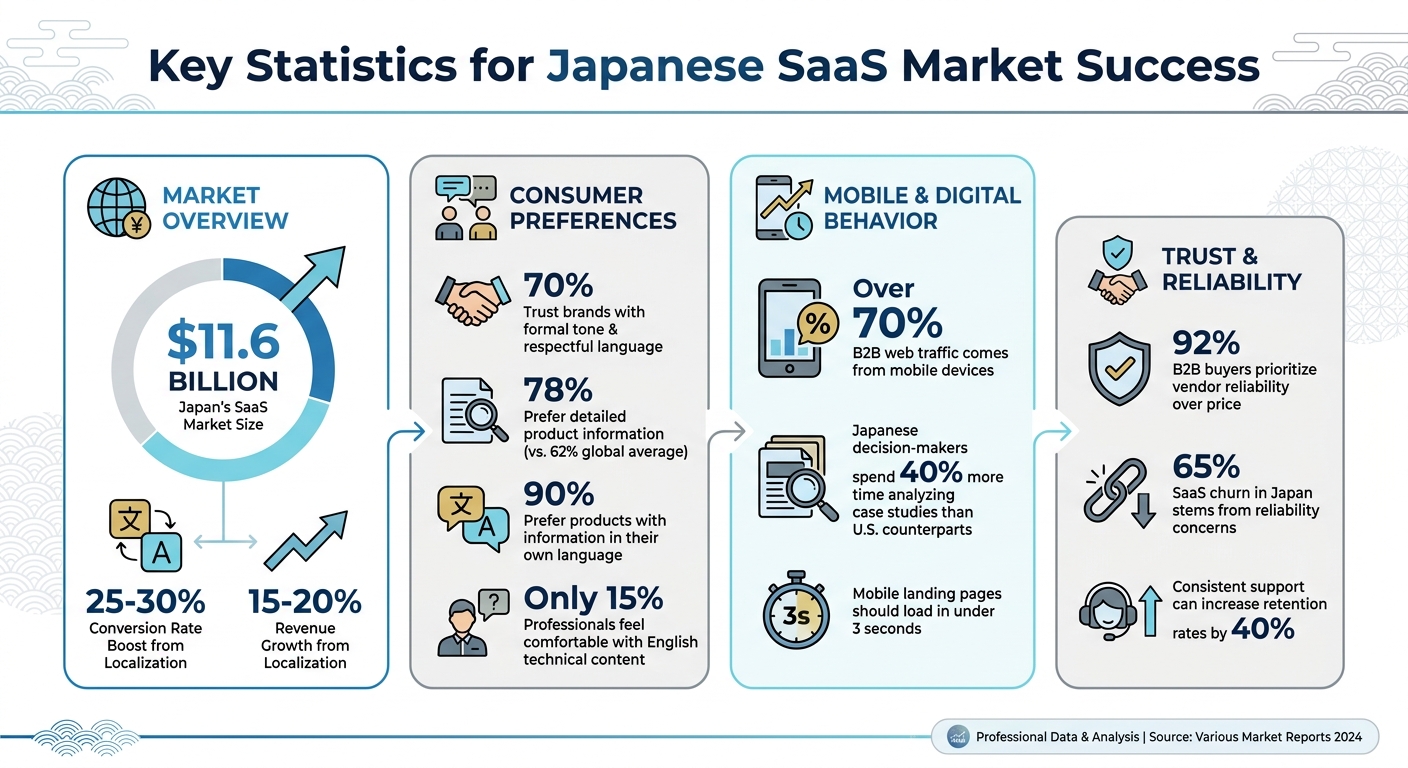
Key Statistics for Japanese SaaS Market Success
1. Use a Formal and Humble Tone
In Japanese business culture, politeness, respect, and humility are non-negotiable. Unlike Western SaaS marketing, which often thrives on bold claims about being "disruptive" or "groundbreaking", that kind of messaging doesn’t resonate in Japan. Here, the focus is on keigo – formal honorific language – and modesty. This isn’t just a preference; it’s a cultural expectation. In fact, about 70% of Japanese consumers are more inclined to trust brands that maintain a formal tone and respectful language. Missteps in tone can erode your credibility almost instantly.
The distinction between formal (keigo) and casual (tameguchi) speech goes beyond style – it’s a fundamental part of communication. Casual language in professional settings can come across as disrespectful or even dismissive of the market’s standards. Small errors, like misusing honorifics in your sales materials or user interface, can make your brand seem unprepared or uncommitted before potential customers even engage with your product.
"Indirect communication and humility are key – pushy, assertive sales language will likely backfire in a Japanese boardroom." – Yuga Koda, Founder, Nihonium
When crafting calls-to-action, opt for polite phrasing. For example, instead of saying "Try Now", use 今すぐお試しください ("Please try now"). Avoid aggressive marketing promises like instant success or radical transformation. Japanese buyers tend to be cautious and prefer messaging that highlights reliability, proven results, and long-term partnerships over flashy claims of disruption.
Additionally, Japanese decision-makers value group consensus and a high-context communication style. This means your content should rely on peer validation and third-party endorsements rather than self-promotion. Case studies featuring local companies, industry certifications, and data-driven evidence are key to establishing the trust (shinrai) required to move forward. By focusing on these elements, you demonstrate your commitment to building the kind of dependable, long-term partnerships that Japanese businesses prioritize.
sbb-itb-a752276
2. Provide Detailed, Information-Rich Content
Japanese SaaS users expect more than just surface-level content – they value in-depth, data-driven explanations that leave no room for ambiguity. A recent study found that 78% of Japanese consumers prefer detailed product information before making a purchase, compared to a global average of 62%. This preference isn’t just a cultural quirk; it’s a critical step in earning the trust necessary for advancing purchasing decisions. To make the most impact, organize your content in a clear and logical format.
Instead of relying on vague claims like "improves efficiency", back up your statements with specifics. For example, rather than saying "enhances productivity", explain how your product "reduced manual processing time from 8 hours to just 15 minutes for managing 10,000 customer records." This level of detail matters because Japanese decision-makers spend 40% more time analyzing case studies and whitepapers than their U.S. counterparts. To meet this expectation, include technical details such as implementation timelines, total cost of ownership (TCO), integration features, and security certifications.
A clear structure also makes your content easier to digest. Consider using the Ki-Sho-Ten-Ketsu framework, a four-part structure that includes introduction, development, a turning point, and resolution. Begin with strategic context and background, move into supporting data and analysis, and finish with actionable recommendations. Breaking down complex topics into hierarchical sections – using H2s for main ideas, H3s for subtopics, and H4s for finer details – aligns with how Japanese professionals process information and supports the ringi decision-making process. This approach also facilitates open discussions about potential implementation hurdles.
Take inspiration from successful examples. In Q1 2023, Salesforce Japan localized its Trailhead platform with scenario-based modules featuring over 50 Japan-specific case studies, including ROI data like "¥50,000,000 savings via automation." This effort led to a 45% increase in course completion rates (22% to 32%) among 15,000 Japanese users in three months, along with a 28% boost in paid conversions. Similarly, Slack’s 2022 Japan campaign included integration guides with metrics like "35% productivity gain", driving a 62% increase in adoption year-over-year among 500+ enterprise clients and generating $12,000,000 in ARR growth.
To address concerns about implementation complexity, provide a transparent overview of timelines, resource requirements, and potential challenges, along with strategies to overcome them. Japanese audiences value this level of honesty. Including troubleshooting guides, prerequisites, system requirements, and compatibility details upfront enables decision-makers to evaluate whether your solution aligns with their specific needs. This transparency builds confidence and sets the stage for long-term partnerships.
3. Design for Mobile and Simple Navigation
In Japan, mobile devices play a massive role in how professionals access SaaS content. In fact, more than 70% of Japanese B2B web traffic comes from mobile devices. Even traditional enterprises rely on mobile research during commutes or in between meetings. This mobile-first behavior emphasizes the need for your content to be accessible and easy to navigate – especially since trust is built on clear, reliable information.
A mobile-friendly design ensures that your content is just as effective on the go as it is on a desktop. To achieve this, consider using modular, block-based layouts that allow users to scan content quickly. Each block should have clear headings, making it easy for visitors to find key resources like product demos, case studies, or pricing details. Place essential elements – such as client logos, trust badges, and security certifications – above the fold so they’re immediately visible. Keep in mind that Japanese text often requires more vertical space than English, so your layout should accommodate this while staying clean and organized.
Speed is another critical factor. Mobile landing pages should load in under 3 seconds. Sticky call-to-action (CTA) buttons are also a must, as they make it easier for users to take action without needing to scroll back up.
Here’s a quick overview of the key mobile design practices for SaaS in Japan:
| Feature | Best Practice for Japanese Mobile SaaS |
|---|---|
| Font Size | 16px or larger for better readability |
| Load Time | Under 3 seconds |
| CTA Style | Sticky or floating buttons for constant visibility |
| Form Entry | Autofill for postal codes and Furigana validation |
| Layout | Modular blocks with clear headings and bullet points |
To make things even easier for users, include features like automatic postal code lookups to fill in address fields instantly. Adding Furigana input fields for names is another helpful touch, as it aligns with local preferences. Lastly, remember that Japanese users often favor detailed menus and granular controls compared to Western audiences. These elements can make a significant difference in creating a seamless and user-friendly mobile experience.
4. Build Trust Through Consistency and Long-Term Support
In Japan’s market, where reliability is king, trust isn’t built overnight – it’s earned through consistency and a clear commitment to long-term partnerships. Japanese B2B buyers are particularly cautious, with 92% prioritizing vendor reliability over factors like price when choosing SaaS solutions. This means your content and actions must consistently show that you’re here for the long haul, not just a quick win.
Consistency is key at every touchpoint. From your website to support documents, ensure your branding, tone, and messaging remain uniform. This reassures Japanese stakeholders that your business is stable and dependable.
"Japanese organizations tend to favor stable, low-risk solutions and form long-lasting vendor relationships based on trust and proven reliability, rather than rapid iteration and disruption"
As Yuga Koda, CEO of Nihonium, points out, Japanese buyers value stability over rapid innovation. This makes it crucial to maintain a consistent approach throughout the entire customer journey.
Case studies are your secret weapon. Japanese buyers often rely on local success stories before even considering a trial. For instance, Salesforce Japan secured a five-year deal with Mitsubishi UFJ Financial Group in 2022 by offering quarterly training sessions and case studies tailored to similar companies. This strategy boosted adoption by 35% across 10,000 users, leading to $15 million in annual recurring revenue growth. Their success hinged on demonstrating long-term dedication, including localized data centers and round-the-clock Japanese customer support.
Make your support commitments clear and specific – statements like “five-year free updates and 24/7 Japanese support” go a long way. Back them up with testimonials from satisfied clients. A 2023 Gartner report revealed that 65% of SaaS churn in Japan stems from concerns about reliability, while consistent support can increase retention rates by 40%. Monthly newsletters featuring Japan-specific updates and case studies from well-known companies like Rakuten or SoftBank can help nurture leads during the typical 6-12 month decision cycle.
Keep in mind that Japanese decision-making involves multiple stakeholders and follows the ringi consensus process. Provide detailed, easy-to-share documentation to help internal advocates push your solution through approval workflows. HubSpot Japan’s partnership with Recruit Holdings from 2020 to 2023 is a great example of this approach. They used ongoing webinars and localized case studies to grow their user base from 500 to 4,200, achieving 42% year-over-year revenue growth. The takeaway? Consistent messaging and unwavering support build trust and demonstrate your commitment to a lasting partnership. This trust lays the groundwork for adapting your approach further to meet Japanese preferences in design and communication.
5. Respect Cultural Preferences in Design and Language
Design and language choices can reflect how well you understand Japanese expectations. While Western SaaS products often lean toward clean, minimalist interfaces, many Japanese B2B users prefer detailed menus and extensive control settings. In Japan, information density is often associated with reliability, so overly simplified designs might feel less dependable to this audience. This cultural nuance should guide every aspect of your visual and textual design.
When it comes to visual design, focus on creating a sense of order and clarity. Japanese users value subtle visual details that convey professionalism and stability. Incorporating tools like diagrams, process flows, and charts can help overcome language barriers and facilitate decision-making among multiple stakeholders. Additionally, small but thoughtful touches – like culturally relevant mascots or images depicting Japanese business settings – can make a big difference. Avoid generic Western stock photos and aim for visuals that resonate with Japanese business culture.
Precision in language is equally important. With only 15% of Japanese professionals feeling comfortable with English technical content, proper localization is non-negotiable. Use the polite teineigo form (です/ます style) for help centers and documentation, while reserving the more formal keigo for landing pages, sales materials, and error messages. Avoid direct commands like "You must do X", and instead opt for softer, more respectful suggestions such as "X is recommended" or "Please consider X". Aggressive Western-style sales language is often seen as off-putting in Japan, where humility and indirect communication are highly valued.
Localization should also extend to interface elements for a seamless user experience. For example, adapt input forms to follow Japanese conventions: list surnames before given names, use local date formats, and include Furigana fields for name pronunciation. In presentations, use a minimum 24-point font for readability and stick to a "one idea per screen" approach to encourage group discussions. For call-to-action buttons, avoid literal translations like "Try Now" and instead use a more polite phrase, such as 今すぐお試しください (imasugu otameshi kudasai, "Please try now").
Japanese customers often see translation quality as a reflection of your commitment to their market. Mistakes like inconsistent politeness levels or incorrect Katakana usage for technical terms can hurt your credibility. Attention to these details demonstrates your dedication to building trust and meeting the expectations of Japanese users.
Conclusion
Succeeding in Japan’s SaaS market involves much more than just translating your content – it’s about rethinking how you communicate, design, and build relationships. By focusing on a formal tone, offering in-depth content, optimizing for mobile users, building trust, and respecting local nuances, these strategies work together to deliver a truly localized experience. When your content aligns with Japanese business expectations, you show the kind of commitment and dependability that Japanese buyers hold in high regard.
The benefits of effective localization are hard to ignore. Companies that fully localize for Japan often experience 25–30% higher adoption rates and see 15–20% revenue growth from Japanese users. Additionally, 90% of Japanese consumers prefer products with information in their own language, and only half are willing to choose a well-known brand over a competitor if local-language content isn’t available. These statistics highlight just how essential it is to have a comprehensive localization strategy.
"For SaaS companies entering Japan, localization is the single most decisive factor in whether your product earns trust and adoption." – Yuga Koda, Co-Founder, Nihonium
Achieving successful localization requires local expertise. Nihonium offers end-to-end solutions, including product localization, tailored marketing and GTM strategies, and fractional sales teams, ensuring every interaction reflects an authentic Japanese experience.
FAQs
How do I know if my Japanese tone and keigo are correct?
To make sure your Japanese tone and keigo (honorific language) are accurate, it’s essential to align with local norms and business etiquette. Collaborate with native speakers or professionals to test your language and refine its appropriateness. Prioritize formal and respectful expressions, using proper keigo to reflect politeness and acknowledge social hierarchy. Consistent feedback from native speakers or cultural experts will help ensure your communication stays accurate and respectful.
What proof points do Japanese SaaS buyers expect before a demo?
Japanese SaaS buyers prioritize high-quality localization, adherence to local data privacy regulations, native-language support, and communication that aligns with their cultural norms. These elements are essential for establishing trust and showing genuine dedication to the Japanese market.
What are the most important mobile UX changes for Japan?
When designing for the Japanese market, certain mobile UX adjustments can make a big difference:
- High Information Density in App Store Screenshots: Japanese users often prefer detailed visuals that pack more information into a single frame. This approach helps convey the app’s functionality and features at a glance.
- "Collage" Style Presentation: Instead of focusing on one clean image, use a collage format to showcase multiple UI elements. Pair these visuals with explanatory text to provide clarity and context.
- Detailed Visual Communication Over Minimalism: Minimalist designs may not resonate as well in Japan. Instead, prioritize visuals that are rich in detail, helping to build trust and clearly communicate the app’s value.
These strategies cater to local preferences, making it easier to connect with Japanese users and highlight what your app offers effectively.
Related Blog Posts
- Japanese UI/UX Design: Key Requirements for SaaS
- Study: Impact of Cultural Nuances on SaaS Partnerships in Japan
- How Japanese Culture Shapes SaaS Messaging
- Why Tone Matters in Japanese SaaS Marketing
 Japanese
  English