

Japanese SaaS companies are reshaping business culture in Japan by adopting faster, more agile decision-making processes compared to other industries in Japan. Here’s what you need to know:
- Decision Speed: SaaS companies have reduced decision timelines to 2–4 weeks, compared to the 4–6 months typical in manufacturing and finance.
- Leadership: They use top-down leadership with roles like CEO, CTO, and CFO, unlike traditional firms where middle management holds more power.
- Innovation: Tools like OKRs and sprint reviews drive efficiency, while generative AI integration is gaining traction.
- Market Growth: The SaaS market grew 25.7% year-over-year in 2022, far outpacing the 1.2% growth in manufacturing.
- Challenges: Despite progress, SaaS adoption in Japan is still low at 4%, leaving plenty of room for growth.
For global SaaS companies entering Japan, success depends on balancing local business practices with the need for speed and innovation. Respecting consensus-driven approaches while maintaining agility is key.
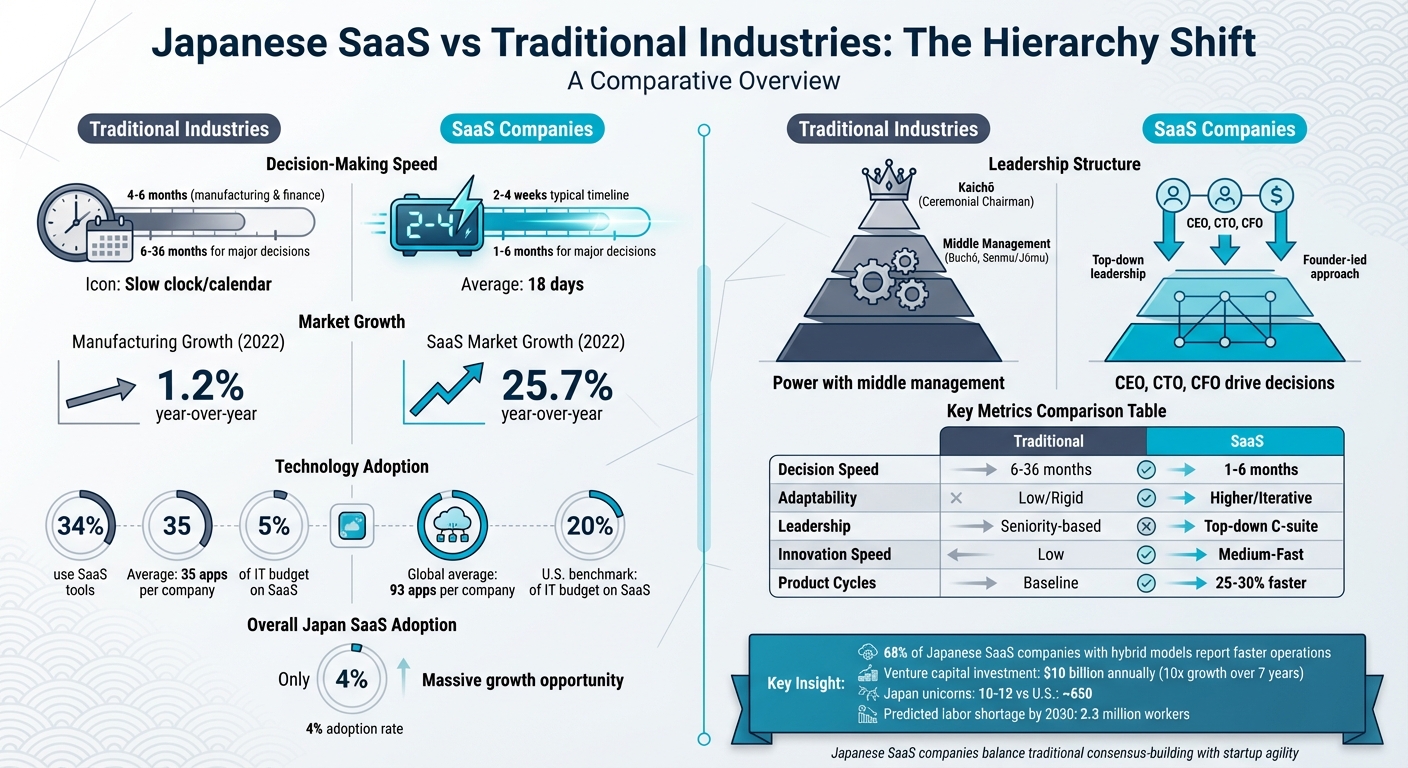
Japanese SaaS vs Traditional Industries: Key Differences in Decision-Making and Innovation
1. Japanese SaaS Companies
Decision-Making Speed
Japanese SaaS companies have shifted gears when it comes to decision-making, moving away from the slower, traditional processes. Instead of relying on the ringi-sei system, where proposals are reviewed and approved in a step-by-step manner, these companies lean toward a more direct, top-down approach. This quicker pace is essential in the fast-moving SaaS world, where product cycles are short, and customer demands change rapidly.
While many SaaS companies have reduced their dependence on nemawashi – a pre-meeting negotiation process that often determines 70–90% of outcomes – they haven’t completely abandoned it. Some still use a hybrid approach, especially when dealing with large enterprise clients or navigating regulatory challenges. This balance allows them to maintain efficiency without losing the benefits of consensus-building.
This focus on speed often means decision-making power is concentrated at the top, creating a leadership model that stands out.
Power Structures
In Japanese SaaS companies, leadership is centralized, with Founders or CEOs holding significant authority. Unlike traditional Japanese firms, where decision-making can be diffused across multiple layers of management, SaaS companies adopt Western-style executive roles like CTO, CFO, and CMO. These roles are instrumental in steering product strategy and overall company direction.
Interestingly, there’s no hidden "shadow network" of retired executives or founding family members influencing decisions behind the scenes. Shinji Asada, Founder of One Capital, highlighted this cultural shift, emphasizing the importance of direct communication:
"The amazing founders have to choose the VC… my short answer [to being chosen] was to speak the same language."
This streamlined leadership structure enables faster decision-making and a sharper focus on innovation.
Executive Leadership Roles
SaaS executives in Japan often come from impressive backgrounds, including prestigious universities and global tech giants like Google, Facebook, and Salesforce. Some leaders also hail from Japan’s major trading houses, such as Mitsubishi and Itochu, leaving stable jobs to pursue innovation. These leaders bring a "product-first" mindset, actively engaging in product development and inside sales to stay connected with the technical needs of their customers.
With SaaS adoption in Japan still at just 4%, there’s a huge opportunity for growth. Success in this space often depends on understanding local buyer behavior and sales strategies and tailoring solutions accordingly.
These lean leadership teams, made up of highly skilled professionals, are driving rapid progress within their organizations.
Adaptability to Innovation
Japanese SaaS companies are embracing innovation by combining efficient decision-making with a data-driven approach. Tools like OKRs, sprint reviews, and other metrics are becoming standard, helping these companies innovate faster than traditional industries, where new projects often require approval from every affected department.
Generative AI is also becoming a priority. SaaS platforms are increasingly seen as "systems of record" that can harness proprietary data to improve user productivity. Shinji Asada, Founder of One Capital, explained this shift:
"Generative AI needs to be integrated with all SaaS companies because SaaS is basically a system of record."
- Shinji Asada, Founder, One Capital
This innovation-driven mindset is supported by a surge in venture capital. Over the past seven years, annual venture capital investment in Japan has grown tenfold to about $10 billion. While Japan currently has only 10–12 unicorns compared to roughly 650 in the U.S., the gap is closing as talent from U.S. tech companies helps fuel domestic SaaS growth.
sbb-itb-a752276
2. Traditional Japanese Industries
Traditional Japanese industries operate quite differently from the fast-moving SaaS companies, relying on lengthy, consensus-driven hierarchies that significantly influence their pace and adaptability.
Decision-Making Speed
The decision-making process in these industries is notoriously slow. Using the ringi-sei system, decisions undergo multiple levels of review before gaining final approval. This means major decisions can take anywhere from 6 to 36 months, a stark contrast to the 1 to 6 months typical in Japanese SaaS companies.
Another key aspect is nemawashi, a process of informal pre-meeting discussions that lays the groundwork for decisions. This step often determines 70–90% of the outcomes before formal meetings even occur. As Osaka Language Solutions pointed out:
"In the majority of established Japanese companies in 2026, the decisive moment has already passed by the time the meeting starts".
While this approach emphasizes harmony and collective responsibility, it also makes it harder for these industries to respond quickly to market changes. The layers of review and consultation create intricate power dynamics that further complicate decision-making.
Power Structures
In traditional industries, while the President (Shachō) holds the ultimate authority on paper, they rarely initiate significant strategic moves. Instead, the real influence lies with Buchō (General Managers) and Senmu/Jōmu (Senior/Managing Directors), who control the flow of information and can block proposals before they even reach the top. Lower-level staff contribute to this dynamic by stalling proposals through additional data requests, creating a system where decisions are heavily influenced by a network of relationships.
At the top of this hierarchy is the Kaichō (Chairman), whose role may be ceremonial but whose opinions still carry significant weight on major projects. Trust, or shinrai, plays a central role in these power structures and is built over time through personal meetings and long-term relationships.
Executive Leadership Roles
Executives in these industries focus on long-term stability and tend to be cautious when adopting new vendors or technologies. They often require repeated assurances of quality and customer support before making commitments. This conservative mindset is also evident in their reliance on manual processes, including paper-based workflows and traditional Hanko seals for documentation.
The IT systems in these industries are often tied to keiretsu business groups, where internal system integrators like Fujitsu and NTT Data develop custom software for their affiliated companies. This approach limits the use of standardized tools and reinforces the insular nature of decision-making within these corporate families. It’s a stark contrast to the more flexible and risk-tolerant practices seen in SaaS companies.
Adaptability to Innovation
Traditional industries have been slow to adopt new technologies. Only 34% of Japanese companies use SaaS tools, with an average of 35 apps per company compared to the global average of 93. Additionally, SaaS spending in Japan accounts for just 5% of total IT budgets, whereas in the United States, it’s closer to 20%.
Michael Fritzell has observed that Japan’s IT sector remains heavily hardware-focused. This preference for on-premise legacy systems stands in sharp contrast to the more agile, cloud-based solutions embraced by SaaS firms. However, external pressures – such as a predicted labor shortfall of 2.3 million workers by 2030 – are forcing traditional industries to reconsider their stance and explore automation and digital transformation.
Pros and Cons
Japanese SaaS companies vs. traditional industries often prioritize speed and customer retention, while traditional firms focus more on risk management, often at the expense of agility.
The ringi system – a process involving collective decision-making – plays a key role in customer retention for SaaS companies. It ensures thorough buy-in, leading to extended customer lifetimes. As Yuga Koda from Nihonium puts it:
"Japanese buyers aim to make the right decision from the beginning. This leads to higher retention, longer customer lifetimes, and stronger loyalty".
On the other hand, traditional industries rely on layered management and sequential approvals to minimize risks and maintain stability. However, these processes can significantly slow down decision-making. While SaaS companies might take 1 to 6 months to finalize decisions, traditional sectors can stretch this timeline to 6 to 36 months. This slower pace often clashes with the need for quick product testing or iterative development. In such environments, agility is sometimes viewed as "chaos" or as a lack of clear accountability.
These operational differences are also rooted in contrasting leadership structures. SaaS companies typically adopt a founder-led, top-down approach, where CEOs and other C-suite executives make key decisions. In contrast, traditional industries place decision-making power in middle management roles, such as Buchō or Senmu/Jōmu. This structure values adherence to hierarchy, and breaking from it can be seen as a breach of trust.
Here’s a side-by-side look at some of the key differences:
| Feature | Traditional Japanese Industries | Japanese SaaS Companies |
|---|---|---|
| Decision-Making Speed | Very slow; 6–36 months with sequential approvals | Moderate; 1–6 months, aided by digital tools |
| Adaptability | Low; rigid frameworks hinder innovation | Higher; iterative approaches with accountability |
| Leadership Dynamics | Seniority-based; power lies with middle management | Top-down; C-suite drives strategy |
| Customer Retention | High; built on long-term trust | Extremely high; rigorous buy-in reduces churn |
| Innovation Speed | Low; ideas pass through multiple layers | Medium to fast; data-driven and experimental |
For global SaaS companies looking to expand into Japan, understanding these trade-offs is crucial. Success hinges on finding a balance between respecting local business practices and maintaining the agility required to thrive in digital markets.
Conclusion
Japanese SaaS companies have found a way to balance the structured nature of traditional business with the flexibility of startups. Their hybrid hierarchical models combine strong executive leadership with independent, cross-functional teams. This approach has cut decision-making times significantly – down to an average of 18 days, compared to the 45 days typical in more conventional industries. It’s a system that allows for consensual decision-making without the long delays that often plague legacy sectors.
The results speak for themselves: 68% of Japanese SaaS companies using these hybrid models report faster operations, with product release cycles that are 25-30% quicker than those of traditional competitors. Companies like freee and Money Forward demonstrate how blending executive vision with autonomous team structures can drive growth while respecting the trust-building processes that Japanese customers value.
For global SaaS companies eyeing the Japanese market, adapting to these hybrid expectations is non-negotiable. Simply importing flat, Western organizational models won’t work. As Dr. Yuki Nakamura from Hitotsubashi University points out, 75% of Japanese SaaS leaders believe this balanced approach is essential for staying competitive on a global scale. Success means embracing practices like the ringi system and nemawashi while maintaining the speed needed for rapid product development.
To succeed, global entrants should consider strategies like appointing local executives familiar with consensus-driven decision-making, creating fractional sales teams to navigate hierarchical purchasing dynamics, and focusing on building relationships rather than relying on aggressive sales tactics. Companies like Nihonium provide critical support in these areas, offering services such as product localization, marketing funnel development, and sales team support. These efforts can cut market entry timelines by as much as 50% [context].
Ultimately, thriving in Japan’s SaaS market requires understanding and respecting its dual focus on consensus and agility. The ability to navigate these hierarchical nuances will determine whether your company faces delays or builds the trusted partnerships needed for long-term success.
FAQs
How do Japanese SaaS companies stay fast without losing consensus?
Japanese SaaS companies have found a way to balance quick action with the need for collective agreement, thanks to cultural practices like nemawashi and the ringi system. Nemawashi involves informal discussions to align stakeholders early on, while the ringi system circulates proposals for feedback and approval. These approaches allow for thorough consideration and early agreement, which helps avoid conflicts down the line. Although their organizational structures tend to have more layers compared to U.S. firms, the collaborative nature of their decision-making process promotes efficiency once everyone is on the same page. This system builds trust and ensures teams are aligned before moving forward.
Who really makes decisions in Japanese SaaS organizations?
In Japanese SaaS companies, decision-making operates within a hierarchical framework that prioritizes consensus and formalized approval processes. While it might seem like senior executives hold the ultimate authority, real influence often rests with senior managers, members of founding families, or individuals with key relationships. Practices such as nemawashi (informal consensus-building) and ringi (a bottom-up approach to approval) play a central role. These methods involve multiple stages of discussion, which can extend decision timelines but ensure collective agreement and reduce risks.
What should a global SaaS company change to sell successfully in Japan?
Breaking into Japan’s SaaS market requires more than just a great product – it demands a deep understanding of the country’s unique business culture. Japanese companies often follow a hierarchical structure, meaning decision-making typically involves senior executives and thorough internal discussions. This process can take time, but it’s a crucial part of doing business in Japan.
Building trust is non-negotiable. Japanese buyers value long-term relationships and prefer to work with partners they can rely on. Establishing credibility and demonstrating commitment to these relationships can make all the difference.
Localization also plays a key role. Translating materials into Japanese and tailoring marketing efforts to align with local customs and preferences are essential steps for successfully entering the market. Without these adjustments, even the best SaaS solutions may struggle to gain traction.
Related Blog Posts
- AI in Japan SaaS: Market Insights
- Cultural Factors Behind Japanese Consensus Building
- Long-Term Perspective in Japan: Lessons for SaaS
- How Japanese Middle Managers Make Decisions
 Japanese
  English