

If you email Japanese business contacts, the first line can change how your message feels. A direct English-style opening may sound abrupt, while the right Japanese opener shows respect, relationship status, and the purpose of the email right away.
I’d boil the article down to this:
- Use one opener for first contact
- Use another for existing contacts
- Switch to a thank-you, request softener, or apology when the situation calls for it
- Keep the tone formal in external B2B email, following standard business culture in Japan
- Don’t translate line by line; use the phrase that fits the job
The article covers 15 greeting lines for common SaaS cases, including:
- Existing client emails
- Shorter opener for known contacts
- Reconnecting after months of silence
- Greeting + self-introduction
- First-time outreach
- Cold email apology opener
- Content-based outreach
- Thank-you after repeated support
- Post-meeting follow-up
- Thanks for steady replies or help
- Late reply apology
- Softening a request
- Reschedule request
- Serious service-issue apology
- Apology for a disappointing outcome
The main point: pick the line based on relationship, timing, and message type.
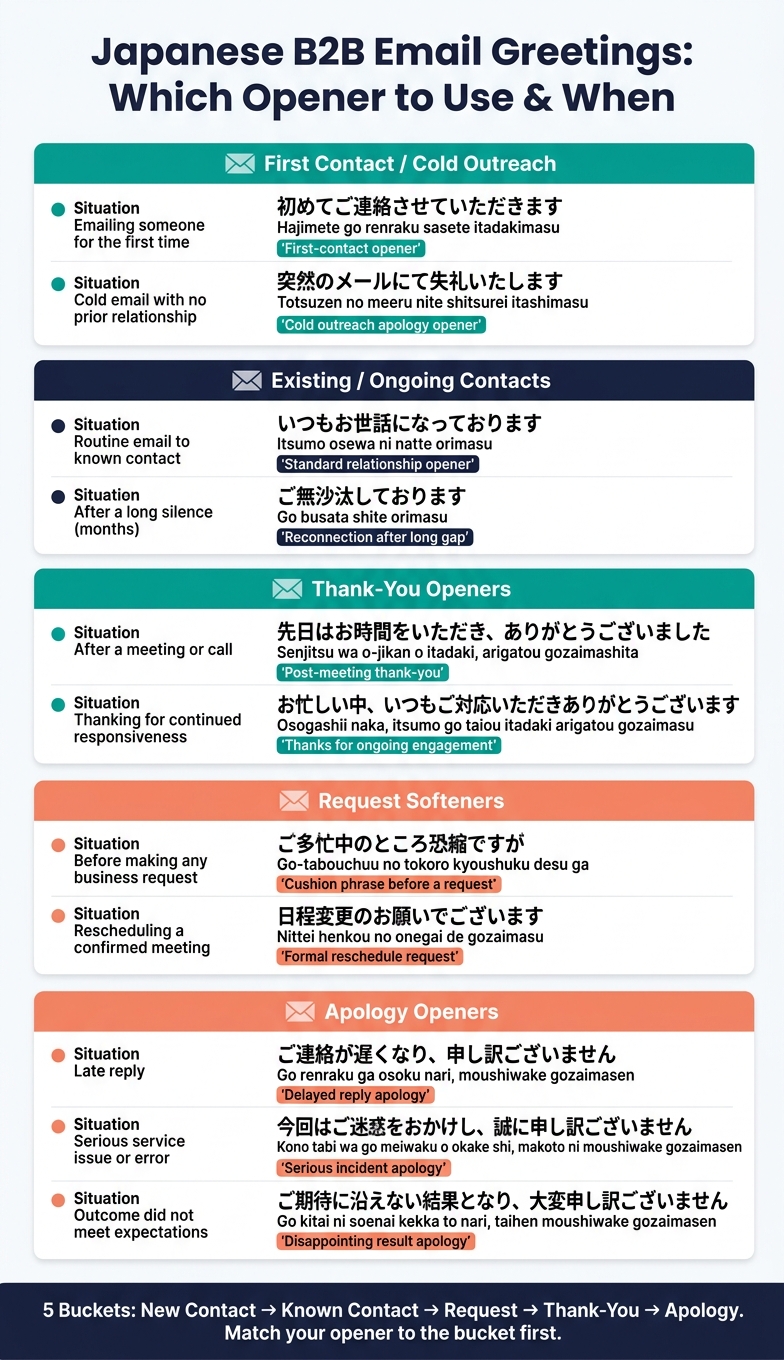
Japanese B2B Email Greetings: Which Opener to Use & When
Quick Comparison
| Situation | Best opener type | What it does |
|---|---|---|
| First email | First-contact line | Shows there is no prior exchange |
| Cold outreach | Apology + self-intro | Softens an out-of-the-blue message |
| Active client thread | Standard business opener | Marks an existing business relationship |
| Long gap since last email | Reconnection line | Acknowledges the silence |
| After a meeting | Thank-you opener | Shows respect for the other person’s time |
| Late response | Apology opener | Owns the delay at the start |
| Asking for something | Cushion phrase | Makes the request sound less blunt |
| Service issue or bad news | Strong apology | Puts the apology first before details |
A simple rule helps: new contact, known contact, request, thanks, or apology. Once you sort the email into one of those buckets, the right greeting becomes much easier to choose.
sbb-itb-a752276
How Japanese Business Email Openings Work in SaaS Contexts
Basic Email Structure for External Business Messages
Japanese business emails follow a fixed structure. Think of it as a template with set parts, where each line has a job to do.
| Order | Component | Japanese Term | Purpose |
|---|---|---|---|
| 1 | Subject Line | Kenmei | Clear, specific purpose – often with brackets like 【ご確認】 |
| 2 | Recipient | Atena | Company, department, title, and name + Sama |
| 3 | Greeting | Aisatsu | Standard set phrase for external business email |
| 4 | Self-Introduction | Nanori | Your company name and your name |
| 5 | Main Body | Honbun | Core message, leading with the conclusion |
| 6 | Closing | Musubi | Standard sign-off, e.g., Yoroshiku onegaishimasu |
| 7 | Signature | Shomei | Full contact details |
Once that structure is in place, the next move is picking the right opening line for the relationship and the situation.
When to Use Standard Set Phrases
In SaaS, the opening changes based on who you’re writing to. A cold outbound email doesn’t start the same way as a note to someone you’ve already spoken with.
For existing contacts, use Itsumo osewa ni natte orimasu. It fills the greeting slot and shows an active business relationship. For first-time contact – which comes up all the time in SaaS outbound sales – use Hajimete go-renraku itashimasu. That line makes it clear there hasn’t been any prior exchange.
The key point is simple: the slot stays the same, but the phrase changes.
Why Direct English Translations Sound Wrong
Literal English-style openings can feel abrupt or unfinished in Japanese B2B email. The same problem shows up in requests.
Take Kakunin shite kudasai. On paper, it means “please confirm.” But in a business email, it can land more like an instruction than a polite ask. The softer written version – Go-kakunin no hodo yoroshiku onegai moushiagemasu – adds no hodo to turn a blunt command into a deferential request.
The meaning doesn’t change. The tone does.
That’s where many English speakers get tripped up. English business email often rewards speed and directness. Japanese business email leans on structure and deference instead. And the greeting line is usually the first place where that gap shows up.
The 15 lines below show which opening fits cold outreach, follow-ups, apologies, schedule changes, and meeting recaps.
What to Look for in Each Greeting Line
Each entry gives you the Japanese phrase, romaji, literal meaning, business function, use case, tone, and common misuse. That makes it much easier to compare all 15 lines at a glance and choose the one that fits the moment.
This matters more than it might seem. A greeting line in Japanese business writing doesn’t just open the message. It also shows how you see the relationship, how formal you want to be, and how careful you’re being with the other person’s time.
Japanese Phrase and Romaji
Each line appears in Japanese first, with romaji next to it.
Plain-English Meaning and Business Function
Literal meaning and business function are not the same thing. This field shows what the phrase signals to the recipient, not just what the words mean on paper.
Use Case, Tone, and Common Misuse
Each entry points out the right relationship, tone, and common misuse. In Japanese business email, greetings often signal both respect for the reader and humility on your side. Use the wrong level, and the first impression can feel off.
With that format in mind, the 15 greetings below are easy to scan by relationship, tone, and use case.
1. Itsumo osewa ni natte orimasu
Japanese: いつもお世話になっております
Romaji: Itsumo osewa ni natte orimasu
Closest English function: Formal relational opener
Primary use case
Use this as your default opener when you’re writing to someone you already know in a business setting. It fits the kind of repeat contact that shows up all the time in SaaS: monthly check-ins, renewal talks, customer success follow-ups, and support tickets from current users.
The point is simple: it sets a respectful tone and shows that the relationship is already in motion before you get into the main message.
Use it only when that relationship already exists.
Formality level and relationship stage
This is a high-formality phrase. It uses orimasu, the humble (kenjougo) form of iru, which lowers the sender’s position to show respect to the recipient. In plain English, it’s standard formal language for external business email.
That last part matters. Use it only with existing contacts. Because itsumo points to an ongoing relationship, it can sound off in cold outreach, almost like you’re acting familiar before you’ve earned it.
Translation risk
Don’t translate this literally. It’s a set greeting, not a line-by-line statement. In practice, its role is closer to "Dear [Name]" than to a direct expression of thanks.
And here’s the part people often miss: with an existing contact, leaving it out is often the bigger error. For first-time outreach, switch to a different opener.
2. Osewa ni natte orimasu
Japanese: お世話になっております
Romaji: Osewa ni natte orimasu
Closest English function: Standard business opener for existing contacts
Primary use case
This is the shorter version of the previous phrase. Use it as a standard opener with external contacts you already know, like when a Customer Success manager checks in on an active account.
It points to an ongoing business relationship with someone outside your company. It is not meant as a literal thank-you. In practice, it works as a clean, polite way to open an email once the relationship is already in place.
Formality level and relationship stage
This sits at the same formal level as the previous line, just in a shorter form. Use it in routine business email with external contacts after your first exchange.
One detail matters here: internal email usually takes a different opener. Osewa ni natte orimasu is used for clients, partners, and vendors outside your organization. For coworkers or managers inside your company, Otsukaresama desu is the better fit.
Translation risk
Do not translate it word for word. It works as a standard opener tied to the relationship, not as a literal statement of thanks.
3. Go busata shite orimasu
Japanese: ご無沙汰しております
Romaji: Go busata shite orimasu
Closest English function: Reopening contact after a long silence
Primary use case
Use this when you already know the person, but it’s been a long time since your last email. It fits cases like a former client, an inactive lead, or a partner you haven’t spoken with in quite a while. The phrase shows that you’re aware of the gap and that you’re addressing it before moving into your main message. It falls between an opener for regular contact and one for first contact.
When to use it
Use this with external clients, partners, or superiors after a long stretch of no contact. It’s too formal for people you email on a regular basis. As a rule of thumb, save it for gaps of several months or more. If the contact is still active, use Itsumo osewa ni natte orimasu instead.
Translation risk
This phrase does more than say that time has passed. It also carries a sense of apology for the silence.
4. Osewa ni natte orimasu, [Company Name] no [Name] to moushimasu
Japanese: お世話になっております、[会社名]の[名前]と申します
Romaji: Osewa ni natte orimasu, [Company Name] no [Name] to moushimasu
Closest English function: "I’m [Name] from [Company]."
Primary use case
This line does two jobs at once: it greets the reader and tells them who you are.
That makes it a good fit when your email needs both pieces in the opening line. In Japanese business email, that’s a common pattern. Use this form after the first exchange with an external contact, when a simple greeting on its own isn’t enough.
Formality level
This phrase sits at standard formal business Japanese.
The key verb is moushimasu. It’s the humble (kenjougo) form of to iimasu, so it keeps your self-introduction modest, which is what external B2B email usually calls for.
In day-to-day use, this is the default opener for continued contact with people outside your company.
When to use
Use this after the first exchange when you need both:
- a greeting
- a formal self-introduction
Translation risk
Write "[Company Name] no [Name] to moushimasu". Don’t write "[Name] from [Company]."
Also, don’t add -san or -sama to your own name or company.
5. Hajimete go renraku sasete itadakimasu
Japanese: 初めてご連絡させていただきます
Romaji: Hajimete go renraku sasete itadakimasu
Closest English function: First-contact opener
Primary use case
Use this line when you’re emailing someone for the first time and there hasn’t been any prior exchange. It’s the right fit for cold outreach, referral introductions, and follow-up after an event or a content download.
Don’t use Osewa ni natte orimasu here. That phrase works better once a relationship is already in motion.
If the email feels a bit out of the blue, pair this with the apology opener in item 6. That small extra step can make the message feel less abrupt before you move into your main point.
Formality level
This is highly formal keigo. The humble ending lowers your position, which makes it a good match for external B2B email.
Relationship stage
Use this only in the first email of a thread. Once the recipient replies, switch to Osewa ni natte orimasu.
Translation risk
Don’t use Hajimemashite in formal written business email. After this opener, introduce yourself as "[Company Name] no [Your Name] to moushimasu."
6. Totsuzen no meeru nite shitsurei itashimasu
Japanese: 突然のメールにて失礼いたします
Romaji: Totsuzen no meeru nite shitsurei itashimasu
Closest English function: Cold outreach apology opener
Primary use case
Use this when item 5 feels too direct for a cold email. It’s a standard opener for a first message to a prospect or partner when you don’t have any prior relationship yet, such as cold outreach, partner prospecting, or event follow-ups. It softens the start before you get to the main point.
Follow it right away with your self-introduction: "[Company Name] no [Your Name] to moushimasu." Put the apology-style opener first, then introduce yourself.
Formality level
This is standard external business keigo.
Relationship stage
Use this only for first contact. Once a thread exists, switch to Itsumo osewa ni natte orimasu.
Translation risk
Don’t skip this opener in cold outreach. In Japanese business email, it’s a normal and expected way to begin. If you jump straight into your message, it can feel too abrupt to a Japanese reader. Also, don’t swap it for Moushiwake gozaimasen – that phrase is too heavy for first contact.
7. Itsumo subarashii kontentsu o haiken shite orimasu
Japanese: いつも素晴らしいコンテンツを拝見しております
Romaji: Itsumo subarashii kontentsu o haiken shite orimasu
Closest English function: Rapport-building opener for content-based outreach
Primary use case
Use this as a first-contact opener when you want your email to feel personal from the start. It works well in cold or warm outreach to prospects or early-stage partners whose blog posts, white papers, webinars, or LinkedIn posts you’ve actually read.
The key word here is haiken (拝見). It’s the humble (kenjougo) form of “to see” or “to read,” so it lowers your own action as a sign of respect for the other person’s work. That’s why it fits formal outreach so well. If you switch it to mimashita, the tone becomes too casual for a first email.
Formality level
Both haiken and orimasu make this line very polite. The rest of your email should stay at that same level, or the message can feel uneven.
Relationship stage
This opener is a good fit for prospect research, webinar follow-up, or partner outreach. It’s not the best choice for existing customers. In that case, Itsumo osewa ni natte orimasu fits better. For broad outreach sent without a personal content reference, use Hajimete go-renraku itashimasu instead.
Translation risk
The main risk is using this line without a real, specific reference. If you praise someone’s content in a vague way, it can sound like a template. To make it land, mention the exact article, webinar, or post you read. Then move into your main point with tsukimashite wa.
There’s also one usage rule you don’t want to miss: never use haiken for the recipient’s actions. It should only describe your own act of viewing or reading. If you use it for them, you lower them instead of showing respect.
8. Itsumo kangei itadaki arigatou gozaimasu
Japanese: いつもお迎えいただきありがとうございます
Romaji: Itsumo omukae itadaki arigatou gozaimasu
Closest English function: Gratitude opener after repeated support or hospitality
Primary use case
Use this opener when someone has hosted, received, or supported you more than once. That could be after a partner meeting, an onboarding session, or a customer support exchange where the help went above and beyond.
It works best as a short thank-you before your main message when you’re writing to active customers, long-term partners, or people you’ve been in touch with again and again. It’s a good fit for thank-you follow-ups after meetings, visits, or especially helpful support.
This is not a default opener for routine customer follow-up.
Formality level
This is a high-formality phrase. Once you use it, keep the rest of the email at the same polite level.
Relationship stage
Use it only with established contacts. It doesn’t fit a first-contact email.
Translation risk
This phrase is less common than standard relationship openers, so context matters. Use it only when your message clearly carries appreciation.
A common mistake is reading kangei as “welcome” in a literal sense. In a B2B SaaS email, that can sound odd or misplaced. The better read here is gratitude for repeated support, not literal hospitality.
9. Senjitsu wa o jikan o itadaki, arigatou gozaimashita
Japanese: 先日はお時間をいただき、ありがとうございました
Romaji: Senjitsu wa o jikan o itadaki, arigatou gozaimashita
Closest English function: "Thank you for your time recently" – a formal post-meeting opener
Primary use case
Use this after demos, discovery calls, QBRs, partnership talks, or support reviews. The meeting should already be over. From there, your email should get straight to what comes next.
Formality level
This is high-formality keigo. It uses humble and polite forms, which makes it a good fit for clients and senior stakeholders.
Relationship stage
Use it only after a real interaction. Don’t use it in cold outreach.
Translation risk
Two mistakes show up a lot.
First, people use Senjitsu for a meeting that happened earlier the same day. That’s not right. In that case, use Honjitsu instead.
Second, some people write o-jikan itadaki instead of o-jikan o itadaki. For the formal version, keep the particle o in place.
The phrase changes based on timing, not meaning.
| Timing | Correct phrase | When to use |
|---|---|---|
| Same day as the meeting | Honjitsu wa o-jikan o itadaki… | Use when you send the email on the meeting day |
| One or more days later | Senjitsu wa o-jikan o itadaki… | Use after at least one day has passed |
After the greeting, move right into the meeting outcome. Add one concrete point from the conversation, like a pain point, a feature request, or the agreed next step.
10. Osogashii naka, itsumo go taiou itadaki arigatou gozaimasu
Japanese: お忙しい中、いつもご対応いただきありがとうございます
Romaji: Osogashii naka, itsumo go taiou itadaki arigatou gozaimasu
Closest English function: Thank you for your continued responsiveness despite your busy schedule – a formal opener for an established relationship
This opener fits best when the other person has already been helping move things along. It works well when you want to thank someone not just for reading your email, but for actively staying engaged.
Primary use case
Use this when “thank you for your time” feels too vague. It’s a better fit when the recipient has been following through – replying, sending data, or completing onboarding steps. You’ll often see it in customer success, support, and account management emails.
Formality level
Use high-formality business Japanese with external clients and senior stakeholders. It combines osogashii naka, a cushion phrase that acknowledges the recipient is busy, with itadaki, the humble form of receiving. That choice lowers the sender’s position and shows respect to the recipient.
Relationship stage
Use this only with people you already know. Itsumo means “always,” so in early outreach it can sound like you’re assuming a level of contact that doesn’t exist yet.
Translation risk
The biggest trap is translating it word for word. A natural English version is: Thank you for your continued responsiveness despite your busy schedule. There’s also a tone issue here. If you lean too hard on the “busy schedule” part, the email can start to sound apologetic. The goal is to sound considerate, not sorry.
| Phrase component | Literal translation | Natural B2B English |
|---|---|---|
| Osogashii naka | In your busy schedule | Despite your busy schedule |
| Itsumo | Always | Continued / Ongoing |
| Go-taiou | Your handling | Your support / Your responsiveness |
| Arigatou gozaimasu | Thank you | We appreciate / Thank you |
11. Go renraku ga osoku nari, moushiwake gozaimasen
Japanese: ご連絡が遅くなり、申し訳ございません
Romaji: Go renraku ga osoku nari, moushiwake gozaimasen
Closest English function: I apologize for the delay in contacting you
If the issue is a late reply, start with an apology. This phrase works well when your message was delayed, especially in external SaaS emails to prospects, customers, and partners. After that, get straight to the point: explain the reason, then state the next step.
Primary use case
Use it for delayed onboarding answers, late proposal follow-ups, and slow support updates. In practice, the structure is simple: apology first, then the reason, then the fix or expected date.
Formality level
Moushiwake gozaimasen is one of the most respectful ways to apologize in a business email. It fits external recipients and other formal business communication.
Translation risk
The most natural English match is "I apologize for the delay in contacting you" or "I am sorry for the late reply." In this context, go-renraku sounds more natural than henshin for external business email. It also feels more formal and less tied to a direct reply.
Use the lighter versions only in internal or less formal situations.
| Phrase | Formality | Best fit |
|---|---|---|
| Go renraku ga osoku nari, moushiwake gozaimasen | High | External clients, prospects, formal partners |
| Henshin ga osoku nari, moushiwake arimasen | Medium | Internal colleagues, established partners, or less formal situations |
| Henshin ga osoku nari sumimasen | Less formal | Internal colleagues only – never external |
12. Go-tabouchuu no tokoro kyoushuku desu ga
Japanese: ご多忙中のところ恐縮ですが Romaji: Go-tabouchuu no tokoro kyoushuku desu ga Closest English function: I know you’re busy, but…
Use this when you’re about to make a request, not when you’re apologizing. It’s a kushon kotoba, or cushion phrase, that softens the ask before you get to the point. In Japanese business email, skipping this kind of buffer can come across as blunt or a bit careless.
Primary use case
Put it before requests like:
- asking for a meeting
- requesting a document review
- following up on a renewal
- asking someone to look into a technical issue
Formality and relationship stage
High. Kyoushuku (恐縮) shows humility and respect. That makes it a good fit for external clients, senior stakeholders, and new prospects. With close partners or casual back-and-forth, it can feel too stiff.
Translation risk
Don’t translate kyoushuku word for word. The plain-English function is "I know you’re busy, but…" If there’s a service outage or an actual mistake on your side, use moushiwake gozaimasen instead. This phrase is for requests, not errors.
Use the lightest phrase that still fits the relationship and the size of the ask.
13. Kondo no uchiawase ni kanshi, nittei henkou no onegai de gozaimasu
Japanese: 今度の打ち合わせに関し、日程変更のお願いでございます
Romaji: Kondo no uchiawase ni kanshi, nittei henkou no onegai de gozaimasu
Closest English function: I’d like to request a reschedule of our meeting.
Use this when a meeting is already on the calendar and you need to move it without sounding blunt. This phrase is very formal and fits a confirmed appointment. It also works well as an email subject line: 日程変更のお願い.
Primary use case
This is a good fit for messages to external clients, new prospects, or senior stakeholders when you need to reschedule a confirmed demo, QBR, onboarding session, or client review. Right after this phrase, add a clear apology and offer three alternate options with the date, weekday, and time.
Translation risk
One easy mistake is being too direct. 「日程を変更してください」 sounds like a command, which is too abrupt here.
If the change is last minute, the timing matters just as much as the wording. When the meeting is the next day or sooner, call first and then send the email.
| Context | Recommended Phrase | Formality |
|---|---|---|
| Formal client or prospect | Kondo no uchiawase ni kanshi, nittei henkou no onegai de gozaimasu | Very high |
| Internal team | Nittei henkou o onegai dekimasu ka? | Casual/polite |
14. Kono tabi wa go meiwaku o okake shi, makoto ni moushiwake gozaimasen
Japanese: 今回はご迷惑をおかけし、誠に申し訳ございません
Romaji: Kono tabi wa go meiwaku o okake shi, makoto ni moushiwake gozaimasen
Closest English function: We sincerely apologize for the inconvenience caused on this occasion.
Use this phrase for the most serious apology situations. It fits cases where your team made a real mistake and the recipient was already affected. Think service failures like an outage, a billing error, or a missed deadline. This is not the kind of line you use for a routine follow-up or a small schedule shift.
Primary use case
Put this at the very top of a dedicated apology email. Start with the apology, then move straight into the fix, the resolution date, and the step you’re taking to stop the same issue from happening again. Be specific about timing. Instead of saying “as soon as possible,” give an exact resolution date. If the issue is serious, call first, then send the email as the written record.
Formality level
Use this with external clients, partners, and senior stakeholders.
Relationship stage
This phrase works best with an existing client or partner after a real service failure. If you use it with a new contact before any issue has happened, it can create confusion or distrust.
Translation risk
Translate meiwaku as “inconvenience,” and keep moushiwake gozaimasen as “we sincerely apologize.”
| Phrase Component | Literal Translation | Professional English Equivalent |
|---|---|---|
| Kono tabi wa | This time | Regarding this issue |
| Go-meiwaku | Nuisance / Trouble | Inconvenience |
| Makoto ni | Truthfully | Sincerely / Truly |
| Moushiwake gozaimasen | There is no excuse | We sincerely apologize |
15. Go kitai ni soenai kekka to nari, taihen moushiwake gozaimasen
Japanese: ご期待に沿えない結果となり、大変申し訳ございません
Romaji: Go kitai ni soenai kekka to nari, taihen moushiwake gozaimasen
Closest English function: We sincerely apologize that the result did not meet your expectations.
Use this when the answer is no, but you still need to protect the relationship. It works well when a reviewed request, trial, or proposal ends with bad news. In a B2B SaaS setting, that can mean rejecting a feature request, pushing back a bug fix, ending a PoC without success, or declining a pricing or terms request.
Primary use case
Put this at the top of an email when the main message is disappointing news. A simple structure works best: Apology → Reason → Next Step. Start with the phrase, explain in clear and neutral terms why the request could not be met, then offer the next-best option. If a feature request will not move forward, a workaround is often the right follow-up.
Formality level
Very high. The phrase uses taihen moushiwake gozaimasen, which is one of the most formal standard business apologies in Japanese. That makes it a strong fit for external clients, senior stakeholders, and other serious cases. For smaller issues, use moushiwake gozaimasen without taihen.
Relationship stage
Use it in established client relationships or in late-stage sales cycles where expectations have already been set.
Translation risk
Don’t translate this word for word. In Japanese, this is a fixed apology for an outcome that fell short of expectations. In English, the safer move is to lead with the apology and then explain the reason.
The table below breaks the phrase into parts so you can match the apology to the right English function.
| Phrase Component | Literal Translation | Natural English |
|---|---|---|
| Go-kitai ni | To your expectations (honorific) | Regarding your expectations |
| Soenai kekka to nari | Became a result that could not align | The outcome did not meet |
| Taihen | Greatly / Extremely | Deeply / Sincerely |
| Moushiwake gozaimasen | There is no excuse | We sincerely apologize |
Tone, Formality, and Translation Mistakes to Avoid
How to Match Tone to the Situation
Match your opener to three things: the relationship, the timing, and how big the request is.
For a first message to a senior stakeholder or enterprise prospect, use more formal humble verbs such as moushiagemasu instead of itashimasu. When you’re making a request or offering an apology, place the cushion phrase from item 12 before the main point. That small move softens the message and helps it land better.
Use these rules to choose the right opener in the workflows below.
Common Mistakes English-Speaking Teams Make
The biggest problems usually aren’t grammar mistakes. They’re structure mistakes.
English-speaking teams often:
- Open without a greeting formula. Going straight to the point can feel abrupt. The opening phrase signals respect for the working relationship.
- Use Otsukaresama desu with clients. That phrase is for colleagues, not external contacts.
- Write vague subject lines. Subject lines should include bracketed tags that show the purpose, such as 【ご確認】API仕様について.
- Mix up verb directions. If you use a humble verb like haiken suru for something the client did, that’s a clear etiquette mistake. Humble verbs describe your actions; honorific verbs describe theirs.
- Translate apologies by function, not word for word. The standard form is Go-renraku ga osoku nari, moushiwake gozaimasen.
Safe Choices vs. Risky Choices: Comparison Table
The table below gives you a fast way to avoid common tone mistakes.
| Category | Risky (English-Driven) | Safe Japanese Alternative | Why It Matters |
|---|---|---|---|
| Subject line | "Question" or "Hello" | 【ご質問】API連携の仕様について | Vague subjects are easy to miss; brackets make inbox scanning and search easier |
| Opening | Jumping straight to the point | Itsumo osewa ni natte orimasu | Skipping the formula can come across as dismissive |
| Internal vs. external greeting | Otsukaresama desu (to a client) | Osewa ni natte orimasu | Otsukaresama desu is for colleagues |
| Making a request | "Please check the attached." | Go-kakunin itadakemasu deshou ka | A direct command can sound pushy; the tentative form is standard |
| Delayed reply | "Sorry for the delay." | Go-renraku ga osoku nari, moushiwake gozaimasen | Use the formal humble apology |
| Post-meeting note | "Thanks for the meeting." | Senjitsu wa o-jikan o itadaki, arigatou gozaimashita | This adds formality and shows respect for the recipient’s time |
For first contact, add a formal nanori at the top of the body: company, department, and name.
Next, apply these choices to outreach, customer success, support, and post-meeting emails.
Using These Greetings in Real SaaS Email Workflows
Outbound Sales and Partnership Outreach
Use the first-contact greetings from the list when you don’t have an existing relationship yet. For cold outreach, start with Totsuzen no meeru nite shitsurei itashimasu (item 6). That’s the standard opener for a first email. Then follow it with a formal self-introduction: [Company Name] no [Your Name] to moushimasu.
If you’re reaching out through a referral, use Hajimete go renraku sasete itadakimasu (item 5) and mention the referral right after the greeting. Then state your purpose and keep the self-introduction formal. Once the email thread turns into a regular exchange, switch to greetings that reflect the relationship.
Customer Success, Onboarding, and Renewals
Use Itsumo osewa ni natte orimasu (item 1) for onboarding emails, implementation updates, and renewal-related account messages.
For renewal requests, add a softening phrase first: Go tabouchuu no tokoro kyoushuku desu ga (item 12). Then use Go-kakunin no hodo, yoroshiku onegai moushiagemasu to present the renewal as a polite request before you get to the actual ask.
Support Issues, Delays, and Post-Meeting Recaps
When the email deals with a problem or a tight timeline, start with an apology or a thank-you before the request.
For incident emails, begin with Itsumo osewa ni natte orimasu (item 1). Then add Go meiwaku o okake shi, makoto ni moushiwake gozaimasen (item 14), followed by the incident details. Use clear labels for the date, scope, cause, response, and prevention.
For post-meeting recap emails, send the message within 24 hours. Open with Senjitsu wa o-jikan o itadaki, arigatou gozaimashita (item 9), then summarize the next step.
Conclusion
Japanese business email follows set patterns. The greetings above aren’t random lines you copy and paste. Each one matches a specific moment: first outreach, ongoing contact, an apology, a schedule change, or a note after a meeting.
That’s why these 15 lines matter. Use the right opener, and your email comes across as polite and respectful. Use the wrong one, and the message can land a bit cold or abrupt.
If your team is putting these patterns to work across many emails, support on the ground can help. For Japan localization and go-to-market support, Nihonium helps with product localization, marketing funnels, fractional sales support, and market entry strategy.
FAQs
How do I choose the right opener fast?
Stick with a standard opening that fits the situation instead of making it up each time.
- Existing contact: いつもお世話になっております
- First outreach: 初めてご連絡いたします
- Post-meeting follow-up: 先日はありがとうございました
- Reply to an inquiry: お問い合わせありがとうございます
If you save these as templates, it’s much easier to keep your emails consistent, professional, and respectful.
When should I switch from a first-contact greeting to a standard one?
Switch as soon as the first introduction is out of the way.
In your first email, use Hajimete go-renraku itashimasu. After that, switch to Itsumo osewa ni natte orimasu when emailing that contact. If you leave out this standard phrase in later messages, your email can come across as abrupt and unprofessional in Japanese business communication.
What are the biggest mistakes non-native teams make in Japanese email openings?
Common mistakes include:
- Skipping いつもお世話になっております when writing to someone you already know. That can make the email feel abrupt right from the start.
- Using casual language or leaving out honorifics.
- Writing the way people speak instead of using standard business email phrasing.
- Using vague subject lines, or no subject line at all, which makes the email harder to triage.
Even small slips like these can make the tone feel unprofessional or out of sync with the situation.
 Japanese
  English