

If I want to win an enterprise SaaS deal in Japan, I should plan for group approval, not one-person persuasion. Most deals take 6 to 18 months, often involve 8 to 12 stakeholders, and spend 60% to 70% of the timeline on internal alignment before the final approval step.
Here’s the short version:
- Deals are often decided before the final sign-off
- Mid-level managers can stop a deal
- Nemawashi is the private, internal alignment stage
- Ringi is the formal approval document and routing process
- I can’t do nemawashi for the buyer, but I can help the internal champion do it
- My best tools are Japanese-language summaries, security and compliance docs, JPY pricing, and department-specific answers
- Pushing quarter-end pressure usually hurts more than it helps
A simple rule: if I miss IT, finance, legal, security, or end users, the deal can stall even when my main contact says yes.
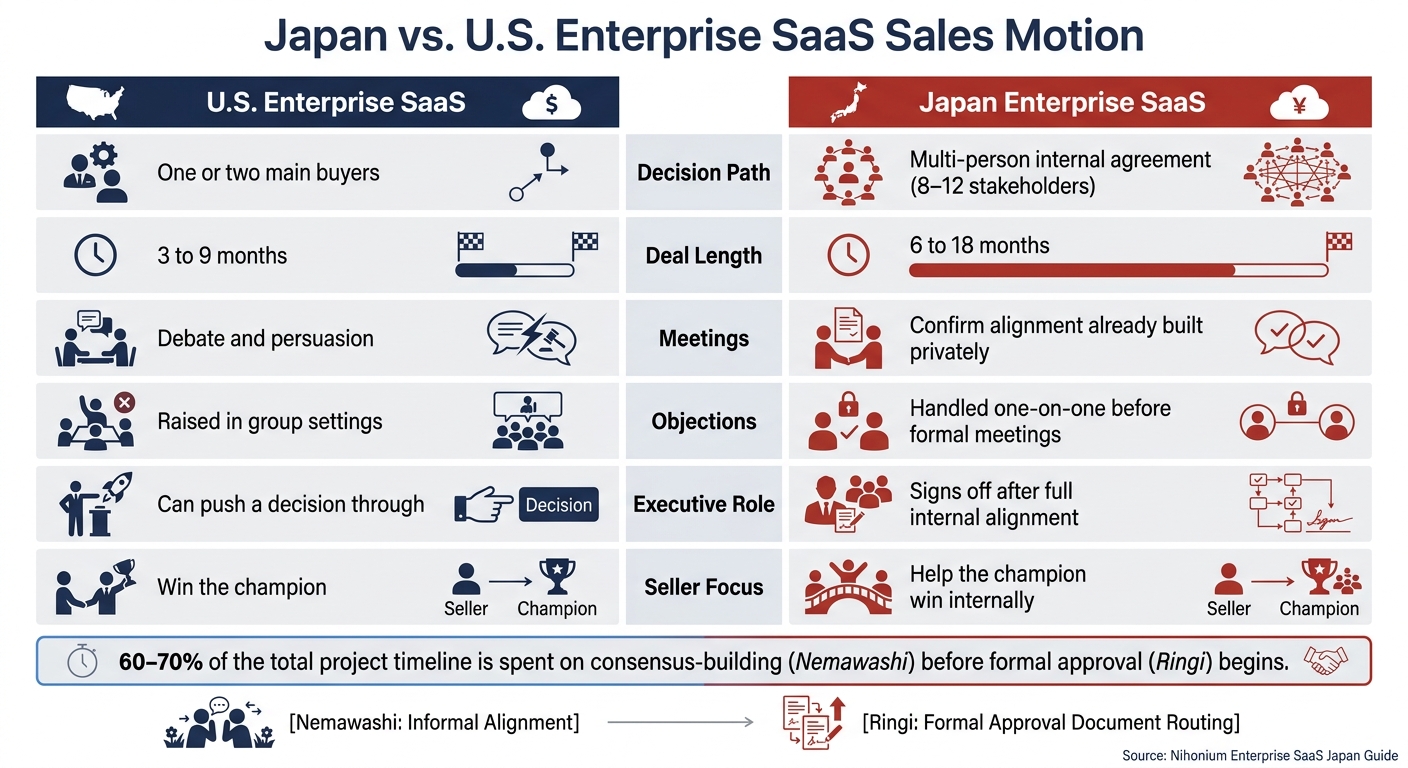
Japan vs. U.S. Enterprise SaaS Sales: Key Differences
Quick Comparison
| Topic | Common U.S. SaaS Motion | Japan Enterprise SaaS Motion |
|---|---|---|
| Decision path | One or two main buyers | Multi-person internal agreement |
| Deal length | 3 to 9 months | 6 to 18 months |
| Meetings | Debate and persuasion | Check alignment already built |
| Objections | Brought up in group settings | Handled in private first |
| Executive role | Can push a decision through | Signs off after internal agreement |
| Seller focus | Win the champion | Help the champion win inside |
So if I’m selling into Japan, I need to navigate SaaS adoption blockers by thinking less about pressure and more about helping the buyer build internal agreement with less back-and-forth.
sbb-itb-a752276
How Japanese Consensus Decision-Making Works in Enterprise SaaS
In Japan, consensus building usually happens in two stages: informal alignment first, formal approval second.
A typical enterprise SaaS deal in Japan involves 8–12 stakeholders, compared with 3–5 in Western markets. Risk is spread across the company, so those 8–12 people usually need to line up before formal approval even begins. That group often includes an internal champion – often a kachō, or section chief – along with IT security, finance, compliance, end users, and senior executives. Each group has skin in the game. And each one needs to feel comfortable before the purchase moves ahead.
Nemawashi: Informal Alignment Before Formal Approval
Nemawashi means “going around the roots” – getting the ground ready before formal approval. In enterprise sales, it refers to the quiet, one-on-one groundwork an internal champion does before any formal proposal is submitted.
During nemawashi, the champion meets each key stakeholder separately to introduce the idea, hear concerns, and adjust the proposal based on that input. A good rule is three touchpoints per stakeholder: introduce, refine, confirm.
Vendors can’t take part in nemawashi directly. This process happens fully inside the customer’s organization. Your role is to equip the champion so they can move it forward with confidence. That usually means:
- localized materials
- clear ROI data
- answers to objections each department is likely to bring up
Once that internal alignment is in place, the champion turns it into a formal proposal.
Ringi: The Formal Approval Path for SaaS Purchases
After nemawashi creates quiet agreement, the champion drafts the ringi-sho – a formal proposal document that moves through the company for sequential approval. Each manager in the chain stamps the document with their hanko (personal seal), moving from junior staff up to senior leadership.
The ringi-sho is a structured internal document. It usually includes a project summary, the reason this vendor was chosen, a yen budget with tax included, security certifications and other proof points, and the approval chain. If a vendor provides a ringi-ready pack in native Japanese, it becomes much easier for the champion to draft the document correctly.
Many companies now use electronic stamps, but the step-by-step approval logic stays the same.
Why These Processes Extend SaaS Sales Cycles
Nemawashi and ringi are the main reason Japanese enterprise deals take longer. Japanese organizations usually spend 60–70% of the total project timeline on the consensus-building phase alone. Mid-market SaaS deals average 6–9 months. Enterprise deals run 9–18 months.
Getting to a senior decision-maker early doesn’t make the deal move faster. Their approval comes at the end of a process where every layer below them already needs to be lined up. If a ringi-sho sits with one signatory for three weeks, that’s often a sign the pre-consultation was incomplete and an upstream concern still needs to be worked through.
A practical planning rule: forecast three weeks for every five decision-makers, plus a 20% buffer. Use that timeline to map stakeholders early and pace the deal around the approval chain.
Build the Deal Around Stakeholders, Champions, and Internal Approval
Map Every Stakeholder Who Influences the Purchase
With nemawashi and ringi in place, the next move is simple: map every person who can shape the outcome. That means everyone who can slow or stop approval, not just the person who signs at the end.
Look past the direct buyer. You also need to account for IT security, finance, legal, procurement, end users, and the informal blockers who can slow consensus behind the scenes. Miss even a small stakeholder, and consensus can stall during nemawashi.
The table below shows who matters, what each group cares about, and what you should hand them.
| Stakeholder Role | Primary Concerns | What to Provide |
|---|---|---|
| Business Owner / Sponsor | Operational goals, efficiency gains | Case studies, efficiency metrics, 1-page Japanese summary |
| Internal Champion | Internal alignment, project success, personal reputation | ROI/TCO templates, competitive comparison tables |
| IT / Security | Integration, data residency, system stability | Security questionnaires in Japanese, ISMS/ISO 27001 certs |
| Finance | Budget impact, TCO, ROI, JCT handling | JPY-denominated proposals, multi-year cost breakdowns |
| Legal / Procurement | APPI compliance, contract terms | APPI mapping, data processing agreements |
| End Users | Ease of use, workflow impact | Native-language testimonials, localized demos |
| Informal Blockers | Harmony, cross-departmental impact | Informal briefings, pre-consultation meetings |
Use the routing list as a signal check. It shows the champion where support is thin and where concerns still need work. If a stamp sits too long at one point, that usually means a department still has an open issue. It’s often not just a paperwork slowdown.
Support Internal Champions Who Carry Nemawashi Forward
Your champion is the person carrying the deal inside the company. They need backing, context, and materials they can use without extra work.
"The internal champion’s political capital, organizational knowledge, and communication skills are critical to deal success. Equipping your champion with the right materials… directly supports their nemawashi efforts." – Nihonium
Your job is to make internal advocacy as easy as possible. Give them a Japanese summary for the ringi-sho, a JPY proposal with JCT included, security certifications, and department-specific responses for IT, finance, and legal.
One rule matters a lot here: do not go around the champion. Reaching out to their manager directly can weaken their standing inside the company and hurt the deal. If an issue comes up, handle it with the champion in private, not around them.
Even a strong champion needs the right meeting cadence and written proof to keep things moving.
Pace the Deal to Match Japanese Approval Timelines
A Japanese enterprise SaaS deal usually moves through four phases. Each phase has its own job. Blur them together, and friction shows up fast.
| Deal Phase | Activity Focus | Pacing Goal |
|---|---|---|
| 1. Credibility Building | Trust, social proof, case studies | Establish your company as a "safe" choice |
| 2. Active Nemawashi | One-on-one meetings, private objection handling | Reach informal consensus across all departments |
| 3. Ringi Circulation | Document tracking, technical evidence delivery | Support the champion as the document moves up the chain |
| 4. Final Procurement | Legal review, hanko collection, JCT alignment | Finalize contract without forcing artificial deadlines |
Don’t push for a U.S. quarter-end close date. Japanese companies work on an April–March fiscal year, and budget decisions tend to bunch around that cycle. Your timeline should match the buyer’s budget calendar, not your own.
"The slow cycle is the feature, not the bug; the consensus expectation is the design, not the side effect." – Patric Sawada, Founder, Silkdrive
That pace only works when meetings and documents are built for consensus instead of pressure. Once the approval path is mapped, every meeting and every document should help support that path.
Design Meetings and Written Materials for Consensus
Run Meetings That Lower Risk and Build Credibility
Start with discovery, not a product-led pitch. Ask about current workflows, pain points, and priorities. That gives your champion something useful they can carry into internal discussions.
As the deal moves forward, change the focus of meetings too. Early on, discovery matters most. Later, the conversation should move toward risk review and implementation details. Match your team to the room. If the client brings in an executive, bring your country head or a senior account executive. If the discussion turns technical, bring specialists who can handle detailed questions on the spot.
Group meetings work best when they confirm alignment you’ve already built in one-on-one conversations. That’s why the follow-up matters just as much as the meeting itself.
Create Written Materials That Slot into Ringi-Sho Drafts
Build materials that the champion can attach to internal review with little to no editing. A Japanese one-pager is especially useful here. The goal is simple: give the originator wording they can paste into the ringi-sho summary without having to rewrite it.
"The seller’s contribution to a clean summary is a Japanese-language one-pager that the originator can lift directly: not a marketing document, not a translated European deck, a one-page Japanese summary that the originator can attach as the source for the ringi-sho summary." – Patric Sawada, Founder, Silkdrive
Include documents that answer the questions internal reviewers are likely to ask:
| Document Element | What It Needs to Include |
|---|---|
| Executive Summary | Purpose, proposed action, and total cost in JPY (JCT inclusive) |
| Problem Statement & Rationale | Why this vendor, why now, and strategic fit |
| Implementation Plan | Milestones, responsibilities, onboarding, and training scope |
| Security & Compliance | ISMS certificates, ISO 27001 reports, APPI compliance attestations |
| Financial Impact | Multi-year cost breakdown, ROI projections, aligned to the buyer’s April–March fiscal year |
Keep dates, numbers, and currency formatting consistent across every document. If one file says ¥12,000,000 and another says JPY 12 million, people pause, ask questions, and send it back for edits. That kind of rework slows approval.
Once the pack is ready, treat each meeting as raw material for something the champion can circulate inside the company.
Use Clear Summaries and Comparison Tables to Support Approval
After each meeting, send a recap that can travel internally: decisions made, open points, and next steps.
"Case studies are also an important part of supporting documents… it’s the most requested sales collateral." – Yuga Koda, Co-Founder, Nihonium
Case studies help back up the summary with proof. Comparison tables help in a different way: they make change easy to see. A current-state vs. post-implementation table shows who changes, what changes, and who owns each step. That’s not just tidy documentation. It reduces uncertainty about post-purchase workload, which is a common reason people hesitate.
| Area | Current State | Post-Implementation |
|---|---|---|
| Workflow | Existing process and responsibilities | Proposed process and responsibilities |
| Risk Review | Open questions and objections | Documented responses and mitigations |
| Budget Review | Informal cost discussion | JPY proposal with JCT and ROI summary |
| Stakeholder Alignment | Separate conversations | Shared reference for IT, Legal, and Finance |
| Ownership | Unclear next steps | Clear accountability for vendor and buyer teams |
These materials make nemawashi easier because absent stakeholders still get a clear internal reference. When people can read the summary, scan the table, and see who owns what, approval tends to move with less friction. Once those materials are in place, localization becomes the next lever for final approval.
Localize the Sales Motion and Support Final Approval
Why Localization Improves Nemawashi and Ringi Outcomes
Once you’ve mapped stakeholders and activated your champion, localization often becomes the line between steady progress and a stalled review.
It cuts friction across each review step. During nemawashi, your champion is having one-on-one conversations with IT, legal, finance, and department heads. If the material is only in English or points to compliance frameworks that feel unfamiliar, those talks tend to drag.
"Japanese websites tend to be longer with more information than their US counterparts… The level of context needed for the Japanese buyer to advance to the next stage of the sales process is much higher." – Yuga Koda, Co-Founder, Nihonium
Japanese-language security, legal, and finance documents help each reviewer check the points that matter to them without sending the champion back for more detail. The same idea carries into the ringi stage. Localized summaries, local proof points, and technical documents give the originator what they need to complete the ringi-sho with less back-and-forth.
How Nihonium Supports Consensus-Driven Enterprise SaaS Sales
For teams selling from outside Japan, the goal isn’t just translation. It’s support that helps get approval over the line.
Many global SaaS teams have the product, but they don’t have the local material or process support needed for approval in Japan. Nihonium helps close that gap with Japan localization and fractional sales support for global SaaS companies. In practice, that means helping teams put together a ringi-ready collateral pack: Japanese one-pagers, JPY-denominated proposals, and ISMS and APPI documentation. These are the materials champions need to keep approvals moving.
"Japanese enterprise deals are won through the quality of support provided to the internal champion navigating the ringi process." – Yuga Koda, Co-Founder, Nihonium
The material that helps during private alignment also has to hold up inside the formal approval document. Their fractional sales support also covers stakeholder mapping and champion enablement. That matters most during nemawashi, when the vendor usually doesn’t have direct access to every decision-maker.
Conclusion: The Rules for Winning Approval in Japan
Enterprise SaaS deals in Japan aren’t won with pressure or artificial urgency. They’re won by building alignment across stakeholders before the formal document starts circulating.
Nemawashi builds that alignment. Ringi records it. Your internal champion moves both forward, but only if they have the right material at the right moment. Localized, ringi-ready support is what helps final approval move ahead without delay.
FAQs
How do I find the real decision-makers?
Work closely with your internal champion. In many cases, you won’t be part of the internal nemawashi process yourself, so ask a simple question early: who else needs to weigh in, and who has already been part of the discussion?
Map the full stakeholder chain. That includes formal approvers in IT, Finance, and Legal, plus the quieter influencers behind the scenes. If you miss those people, they can slow down or stop the proposal once it moves into ringi approval.
What should a ringi-ready sales pack include?
A ringi-ready sales pack needs to be data-rich and written in native Japanese.
It should include a ringisho proposal that covers:
- the project summary
- the business problem and justification
- the implementation plan
- a clear assessment of risks and benefits
You should also include total cost of ownership, ROI, and implementation fees.
Supporting materials matter too. Add localized case studies, security certifications, data residency documents, technical architecture diagrams, and a one-page summary your champion can share internally.
How can I support my champion without overstepping?
Support your champion as an enabler, not a direct participant. You won’t be in internal nemawashi meetings, so your job is to arm them with strong Japanese-language materials they can bring into those discussions.
Create short, department-specific briefs for IT, finance, and leadership. Each one should speak to what that group cares about most. For IT, that may mean security, setup, and system fit. For finance, focus on cost, budget impact, and expected return. For leadership, keep the focus on business goals, risk, and timing.
Then use a catchball approach. Send the proposal over, get feedback back, and refine it as the conversation moves along. Think of it like a steady back-and-forth, not a one-shot pitch. That gives your champion room to answer concerns in a way that feels natural and keeps their standing strong inside the company.
Related Blog Posts
 Japanese
  English