
Feedback is the backbone of successful partner enablement programs. It turns one-way training systems into interactive, effective processes that drive real results. For SaaS companies, especially those entering markets like Japan where 70% of SaaS sales in Japan come from indirect channels, feedback helps identify gaps in training, refine sales strategies, and improve localization efforts. Partners who receive structured, feedback-driven training can generate 6x more revenue than those who don’t.
Key Takeaways:
- Why Feedback Matters: It highlights gaps in partner training, sharpens messaging, and improves sales outcomes.
- Feedback Goals: Define clear objectives to focus feedback collection and ensure actionable insights.
- Metrics to Watch: Track satisfaction (NPS, CSAT), engagement (onboarding completion), readiness (certification rates), and outcomes (time to first deal, win rates).
- Localization in Japan: Tailor content to Japanese norms using native language and cultural understanding for better partner engagement.
- Action Plan: Use surveys, interviews, and data to gather feedback, prioritize issues, and implement targeted improvements.
Feedback isn’t just a tool – it’s a way to build trust, improve performance, and strengthen partnerships. By acting on feedback, you create programs that partners value and rely on.
Setting Feedback Goals and Metrics
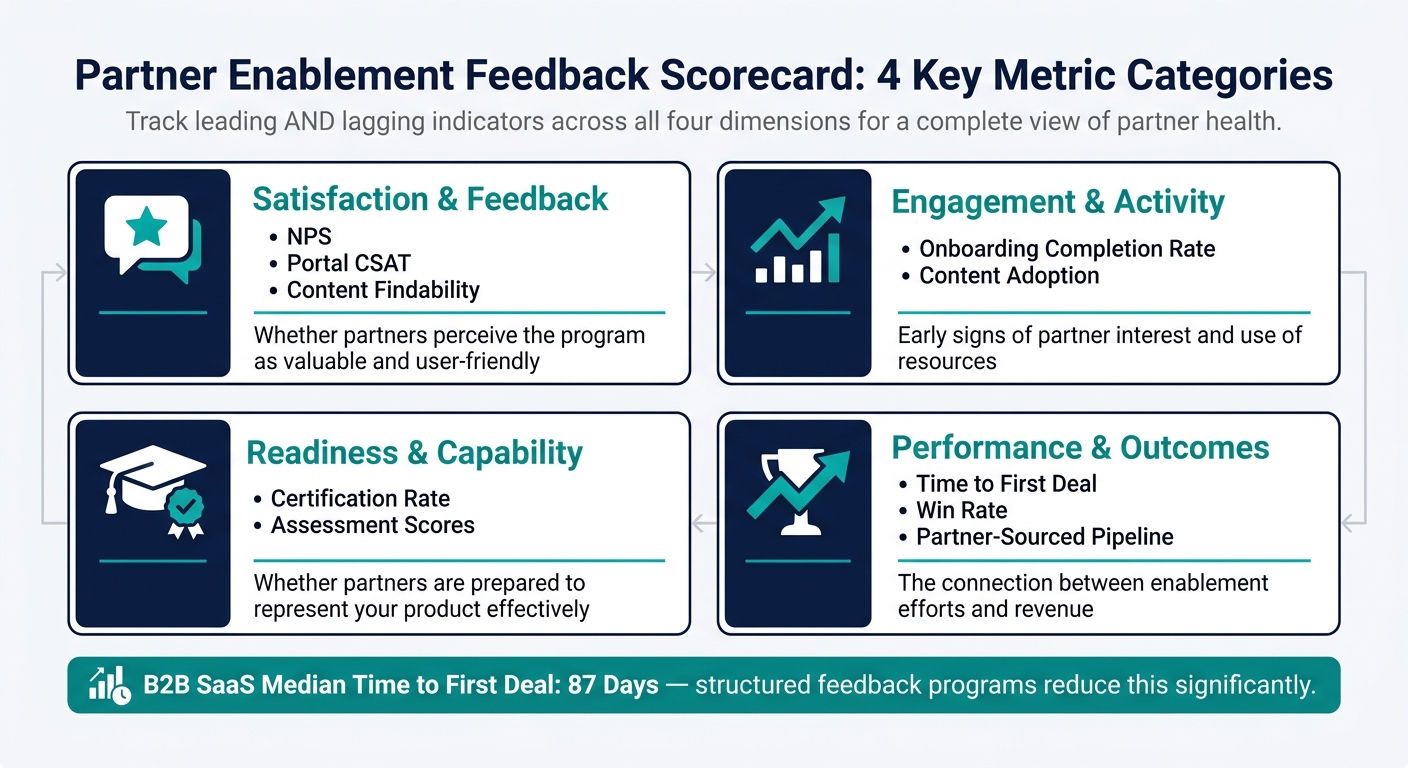
Partner Enablement Feedback Metrics: 4 Key Categories to Track
Define Your Enablement Objectives
Before diving into feedback collection, it’s essential to set clear objectives. Without a defined purpose, feedback can end up being more noise than insight.
Start by evaluating where your partner program stands today. Map out the key milestones in your partner journey and pinpoint where partners tend to stall or lose interest. Tailor your objectives based on partner types. For instance, referral partners often need concise positioning and quick onboarding, while resellers benefit more from in-depth product knowledge and structured certification programs.
A structured 90-day plan can help you get started:
- First 30 days: Define success metrics and establish baselines.
- Next 30 days: Segment partners and create scorecards.
- Final 30 days: Link training activities to measurable pipeline outcomes.
Once your objectives are set, the next step is transforming them into actionable feedback goals.
Turn Objectives into Feedback Goals
Clear objectives should lead to focused feedback questions. Gathering feedback without alignment to your goals wastes time and effort.
For example, if reducing partner ramp time is your priority, your feedback goal might be: "Are partners finding the onboarding content clear and complete enough to close their first deal?" On the other hand, if your aim is to boost partner-sourced revenue, you might ask: "Do partners feel confident in the sales messaging to effectively compete against alternatives?"
"Partners often sell your competitors’ products, as well as yours. If your value propositions aren’t compelling and easy to understand, those partners might find it easier to sell your competitors’ products instead." – Alex Walton, Copywriter, Sales Enablement Collective
For companies operating in Japan, it’s crucial to assess the quality of localized content. This is especially important for systems integrators (SIers), who play a significant role in enterprise decision-making. SaaS companies targeting Japan can benefit from expert localization services, such as Nihonium (https://nihonium.io), to ensure their messaging aligns with local expectations.
Once you’ve crafted precise feedback questions, it’s time to identify metrics that measure both immediate progress and long-term impact.
Choose the Right Feedback Metrics
When selecting metrics, it’s important to distinguish between leading and lagging indicators. Lagging metrics, like total partner revenue, show past performance. Leading metrics, such as onboarding completion rates or certification progress, provide insights into future outcomes.
A well-rounded feedback scorecard should address four key areas:
| Metric Category | Key KPIs | What It Tells You |
|---|---|---|
| Satisfaction & Feedback | NPS, portal CSAT, content findability | Whether partners perceive the program as valuable and user-friendly |
| Engagement & Activity | Onboarding completion, content adoption | Early signs of partner interest and their use of resources |
| Readiness & Capability | Certification rate, assessment scores | Whether partners are prepared to represent your product effectively |
| Performance & Outcomes | Time to first deal, win rate, partner-sourced pipeline | The connection between enablement efforts and revenue |
A particularly insightful metric is time to first deal. For B2B SaaS companies, the median is 87 days. However, businesses with well-structured enablement programs often achieve much faster results. Monitoring this metric helps you determine whether your feedback efforts are driving meaningful changes or just adding activity. It’s a direct way to link feedback to tangible improvements in your partner program.
sbb-itb-a752276
Embedding Feedback into the Partner Training Journey
Once you’ve identified what to measure, the next challenge is figuring out when to gather feedback. Timing matters – strategically placed feedback checkpoints can turn a flood of data into actionable insights. This approach ensures feedback becomes a core part of every phase in the partner journey.
Collecting Feedback Across the Partner Lifecycle
Each stage of the partner lifecycle comes with its own set of challenges, which means your feedback tools need to adapt accordingly. For example:
- Onboarding: Use post-training surveys and certification analytics to gauge whether partners are absorbing the material and feel equipped to sell effectively.
- Activation: Metrics like time to first deal and first registered opportunity reveal whether your enablement strategies are translating into real-world performance.
- Ongoing partnerships: Quarterly Business Reviews (QBRs) and monthly councils provide a platform to address recurring challenges and prioritize solutions.
To make feedback truly impactful, build an integrated intake system. This system should consolidate diverse inputs – surveys, support tickets, usage data, and partner submissions – into one place. Without this integration, feedback risks becoming fragmented and less actionable. A unified system not only streamlines data collection but also strengthens your ability to act on the insights you gather.
Closing the Feedback Loop
Gathering feedback is just the beginning; taking action on it is what keeps partners engaged. A "You said, we did" approach works wonders. Regularly share updates that directly link partner feedback to program changes – whether it’s a revamped onboarding module, an enhanced certification track, or new resources added to the partner portal.
"The biggest benefit [of feedback] is trust. When you act on feedback, partners feel valued, and engagement rises." – Kiflo
To keep the momentum going, ensure that incoming feedback is routed to a Partner Account Manager (PAM) or Product Manager with a defined response time. This prevents partners from feeling like their input has disappeared into a void. Even better, co-create solutions with your partners to address their needs directly and strengthen trust.
Feedback Considerations Specific to Japan
Timing and responsiveness are essential everywhere, but feedback collection in Japan comes with unique challenges. Japanese business culture often leans toward indirect communication, meaning dissatisfaction may be expressed through subtle signals rather than explicit complaints. As Nihonium explains, “Japanese customers rarely complain directly – effective health scoring must monitor engagement patterns, support ticket sentiment, and stakeholder relationship depth to detect risk early”.
To navigate these nuances, conduct feedback sessions in Japanese with native speakers and prioritize in-person interactions. Language matters – a significant 72% of Japanese B2B buyers expect native-language experiences before they’ll seriously engage with a product. For high-value partners like Systems Integrators (SIers) such as NTT DATA and Fujitsu, face-to-face relationship building is worth the extra effort. SaaS companies entering the Japanese market can also leverage services like Nihonium to bridge cultural and language gaps with localized strategies and native-speaker expertise.
Designing Effective Feedback Tools
Effective tools transform feedback into actionable steps that improve outcomes.
How to Build Effective Surveys
Keep surveys short – ideally under five minutes. Longer surveys tend to lose respondents, and the quality of responses often declines toward the end.
Focus your questions on three main areas: content accuracy (is the training material correct and current?), localization quality (does the content align with the market’s needs?), and training delivery (was the format and pacing appropriate?). Timing is key – send surveys immediately after significant events like onboarding, closing a first deal, or Quarterly Business Reviews (QBRs), rather than sticking to a fixed schedule.
Tailor questions to the partner’s experience level. New partners may need clarity on onboarding, while experienced ones might provide insights into competitive positioning. The best feedback tools not only gather data but also inform ongoing program improvements.
"Partners who see their input reflected in program changes stay engaged longer. Partners who fill out surveys and never hear back stop filling out surveys." – Team Guideflow
How to Run Partner Interviews
While surveys provide a broad overview, interviews dig deeper. They’re especially useful when a partner becomes unresponsive or struggles to close deals – these situations often reveal issues that surveys miss.
Start with inactive partners. Ask what prevented them from closing deals and what resources they felt were missing. These conversations often yield candid insights, uncovering gaps that active partners might overlook or hesitate to share. For active partners, interviews can help explore recurring issues flagged in survey data. For example, if multiple partners find a training module confusing, interviews can pinpoint the exact problem.
Approach interviews with structure but stay flexible. Use a prepared script to guide the conversation, while allowing room to explore unexpected insights that arise.
Adapting Feedback Tools for Japan
To make surveys effective in Japan, adapt them to fit local communication norms. In Japan, indirect communication is common, as direct criticism is often avoided to maintain harmony. This means partners might rate training as "satisfactory" even if they’re disengaged. Scaled questions, such as Likert scales, are more effective than open-ended ones, as they allow respondents to express nuanced opinions without feeling confrontational.
Pay close attention to language and tone. Use formal, respectful language (Keigo) in surveys and interview scripts to convey professionalism. Casual or overly informal phrasing can undermine trust before the conversation even begins. Additionally, 59% of Japanese executives report that hierarchical structures influence their willingness to participate in B2B surveys. Cold outreach is often ineffective; participation is typically trust-driven, relying on warm introductions and established relationships.
Tailoring feedback tools in these ways ensures they resonate with Japanese partners and lead to meaningful improvements in partner enablement.
Nihonium supports SaaS companies in navigating these complexities by providing bilingual feedback tools that are localized – not just translated – and aligned with business practices like the ringi approval process and Japan’s April fiscal year cycle.
Turning Feedback into Program Improvements
Categorizing and Prioritizing Feedback
Once feedback starts rolling in, the real challenge is making sense of it. Feedback from surveys, interviews, and support tickets is often raw and unstructured, so it needs to be organized before it can drive meaningful changes.
Start by tagging each piece of feedback based on factors like partner type, issue category, severity, and the effort required to address it. This system helps spot patterns and ensures that the right teams handle the right issues. To decide what to tackle first, use an impact-versus-effort framework. Score each issue based on factors like revenue risk, how often it occurs, and the effort needed to fix it. For example, a confusing onboarding module flagged by multiple resellers might take priority over a minor formatting issue flagged by just one partner, even if both require similar amounts of work.
"Partners often sell your competitors’ products, as well as yours. If your value propositions aren’t compelling and easy to understand, those partners might find it easier to sell your competitors’ products instead." – Sales Enablement Collective
Don’t rely on just one type of data. Combine insights from multiple sources: relational data (like NPS scores), transactional data (such as post-training CSAT), qualitative input (from interviews), and operational signals (like tagged support tickets or portal login frequency). Once you’ve identified and prioritized the most pressing issues, test your updates thoroughly before rolling them out.
Testing and Validating Program Updates
After prioritizing feedback, start by testing updates internally. Internal testing can catch up to 78% of workflow errors before they impact your partners. This step is a low-risk way to avoid costly mistakes down the line.
Next, pilot the updates with a small group of 5–8 partners from different segments. Run the pilot for about two weeks and collect structured feedback on usability and relevance. Fine-tuning during this phase can increase satisfaction scores by roughly 34% when the updates are fully deployed. Once validated, roll out the updates in strategic phases.
To measure the success of your changes, use cohort comparisons. For example, compare the performance of partners onboarded with the updated program – using metrics like ramp time and deal velocity – against a control group that used the older version. If the average ramp time to a first deal (currently 87 days in B2B SaaS) shows a meaningful improvement, it’s a clear sign the updates are effective.
When rolling out changes to your existing partner base, consider a phased approach. Migrating partners in 2–3 waves over 4–6 weeks reduces disruptions and gives your team time to gather and respond to additional feedback between each wave.
Using Feedback to Improve Localization
Feedback from Japanese partners often highlights unique challenges that global teams might miss – like friction in the ringi approval process, the lack of Japanese-language battlecards for competitors such as Cybozu or Sansan, or pricing tools that don’t support yen-based invoicing.
Address localization issues based on their practical impact. Start with core needs like Japanese-language UI and documentation. In Japan, 72% of B2B buyers expect native-language engagement, so gaps in these areas can directly hinder deals. Once foundational issues are resolved, move on to adapting workflows, such as the ringi approval process, before tackling more advanced integrations.
Closing the loop on feedback is key to building trust. For example, a simple note like, "Based on your feedback, we localized our ROI calculator for JPY", shows that partner input leads to real changes. Tools like Nihonium can help SaaS companies streamline this process, ensuring that sales tools, training materials, and messaging align with Japan’s specific business norms rather than being mere translations.
Building a Feedback-Driven Operating Model
Creating a feedback-driven operating model is crucial for turning partner insights into actionable steps that improve your enablement program.
Assigning Ownership of the Feedback Process
When no one owns the feedback process, valuable insights can pile up without leading to real change. This not only stalls progress but risks disengaging your partners. To avoid this, assign clear responsibilities across your team:
- Customer Ops: Collects feedback from surveys, portals, and support tickets, ensuring all data is centralized.
- RevOps: Organizes the data using a consistent classification system, categorizing it by severity, ARR at risk, and the effort required for resolution.
- Partner Account Managers (PAMs): Work directly with partners to address feedback, co-developing solutions and following through on actions.
- Channel Chief or Enablement Lead: Oversees the entire process, ensuring alignment with partner priorities.
"The customers I work with that have a partner enablement manager tend to have a much more organized and fully-fleshed out program that gets partners up and running (and driving revenue) quickly." – Nima Hafezi, Senior Customer Success Manager, PartnerStack
Another effective governance approach is establishing a Partner Advisory Council (PAC). By hosting these sessions twice a year, you can provide top partners with early access to your roadmap in exchange for honest, strategic feedback. This structured approach goes beyond the limitations of ad-hoc surveys.
Once roles are defined, the next step is integrating partner feedback into your operational systems.
Connecting Feedback to Your Systems and Tools
Feedback that lives in spreadsheets or scattered email threads rarely leads to meaningful change. Instead, channel it directly into the tools your team uses every day, ensuring it drives continuous improvement.
Your Partner Relationship Management (PRM) platform should act as the central hub, connecting feedback to deal registrations, partner tier statuses, and portal activity. Meanwhile, your Learning Management System (LMS) can track training progress, identifying areas where partners struggle or revisit content frequently. On top of that, AI coaching tools can analyze sales pitches, providing instant feedback on objection handling and other skills before they become pain points.
| Tool Category | Primary Function | Key Integration |
|---|---|---|
| PRM Platforms | Manage portals, deal registrations, partner tiers | CRM (e.g., Salesforce, HubSpot) |
| LMS Platforms | Deliver training, certifications, role-specific learning paths | PRM (for tier-based access) |
| AI Coaching | Provide real-time feedback on pitches and objection handling | LMS (for readiness validation) |
To ensure even less active partners engage, adopt a push-first strategy by sharing updates and insights through email or Slack.
Maintaining Feedback Quality in Japan
Once feedback is integrated into your systems, maintaining its quality becomes especially important in culturally nuanced markets like Japan. In this context, digital surveys may not suffice. Instead, prioritize in-person, structured interactions that align with Japan’s focus on trust and relationship-building.
For example, conduct Quarterly Business Reviews (QBRs) in Japanese, led by a native-speaking partner manager, to encourage open and honest feedback. Complement these with local roundtables or exclusive partner events to gather deeper, qualitative insights that formal reviews might miss.
If your company manages Japanese partnerships remotely, working with a local partner like Nihonium can help. Nihonium offers fractional sales support and local expertise, ensuring partner feedback is interpreted within the right cultural context. This is especially critical since approximately 70% of SaaS sales in Japan are driven by indirect channels such as SIers and VARs. In this market, partner feedback directly impacts performance and growth.
Conclusion: Using Feedback to Strengthen Partner Enablement
Structured feedback is the backbone of successful partner programs. Partners who undergo structured, feedback-driven training generate 6x more revenue than those who don’t. That’s a massive difference, especially when 68% of companies selling through channel partners already identify partner enablement as their biggest hurdle.
The idea is simple: take visible action on feedback. When partners see their suggestions lead to an improved battlecard, a more user-friendly deal registration form, or a revamped certification path, they stay engaged. On the flip side, ignoring their input can erode trust and hurt participation.
This approach becomes even more critical in markets with distinct cultural dynamics. Take Japan, for instance, where 70% of SaaS sales are driven by indirect channels like SIers and VARs. Here, feedback isn’t just about improving programs – it’s a critical source of market intelligence. As Yuga Koda, Co-Founder of Nihonium, explains:
"Underinvesting in localization for SaaS products in Japan while overestimating the transferability of Western PMF is the most common reason SaaS companies fail in Japan."
For SaaS companies navigating Japan’s unique partner ecosystem, Nihonium bridges the gap between global strategies and local execution. Their fractional sales support and localization services ensure feedback from Japanese partners is correctly interpreted and used in ways that respect local business practices, compliance standards, and buyer expectations.
Building a feedback-driven program takes time. It requires clear ownership, reliable tools, and a commitment to closing the loop. But when done right, it transforms partner enablement from a cost center into a powerful revenue engine.
FAQs
How do I pick the best feedback metrics for my partner program?
To select the most effective feedback metrics, blend qualitative insights from partners with quantitative performance data. Begin by conducting surveys with 15–20 partners to identify key challenges and refine your onboarding process. Metrics like Net Promoter Score (NPS) can help gauge satisfaction and loyalty. Pair this feedback with measurable outcomes such as time to close the first deal and the value of partner-sourced pipelines. This approach ensures your program not only addresses partner concerns but also contributes meaningfully to revenue growth.
What’s the fastest way to close the loop with partners on feedback?
The fastest way to improve your enablement strategy is to incorporate partner feedback directly into your roadmap. Tools like surveys can help you pinpoint onboarding challenges and support needs by gathering input from 15–20 partners. Acting on this feedback during product updates and throughout the partner lifecycle demonstrates value, boosts engagement, and builds lasting relationships. For more in-depth insights, consider formal options like Partner Advisory Councils.
How should feedback tools change for partners in Japan?
Feedback tools in Japan thrive when they emphasize personal, high-touch engagement, reflecting the country’s business culture. Japanese partners, including resellers and systems integrators, often value direct and attentive support over the more hands-off approaches common in Western markets. To gather meaningful feedback, prioritize structured, in-depth conversations conducted in the local language rather than relying on automated surveys. This approach fosters openness and honesty, providing valuable insights to fine-tune product-market fit, adapt features, and align sales materials with the preferences of local buyers.
Related Blog Posts
- Ultimate Guide to Content Partnerships in Japan
- How to Measure Partner Training ROI
- Guide to Training Japanese SaaS Partners
- Customer Feedback in Japan: Common Challenges
 English
  Japanese