

If you’re trying to collect customer feedback in Japan, you’ve likely run into these issues: indirect communication, poor localization, hierarchy-driven bottlenecks, and scattered data. These challenges make it tough to get clear, actionable insights from Japanese users. Here’s a quick breakdown of the key problems – and how to solve them:
-
Indirect Feedback: Japanese customers often avoid direct criticism. They might say “I’ll think about it” instead of pointing out flaws.
- Fix: Build trust with regular, face-to-face interactions. Use indirect questions like, “How can we better support your workflow?”
-
Localization Gaps: Surveys and tools in English alienate users. Non-localized content signals a lack of commitment to the market.
- Fix: Fully localize all touchpoints – surveys, support, and even release notes. Use formal, respectful Japanese.
-
Hierarchy Issues: Feedback gets watered down due to multi-layered decision-making processes.
- Fix: Create multi-level feedback systems, including anonymous channels for junior staff and structured QBRs for executives.
-
Fragmented Data: Feedback is often spread across different tools, making it hard to act on.
- Fix: Centralize feedback into one system. Ensure it complies with Japan’s privacy laws and is accessible in Japanese.
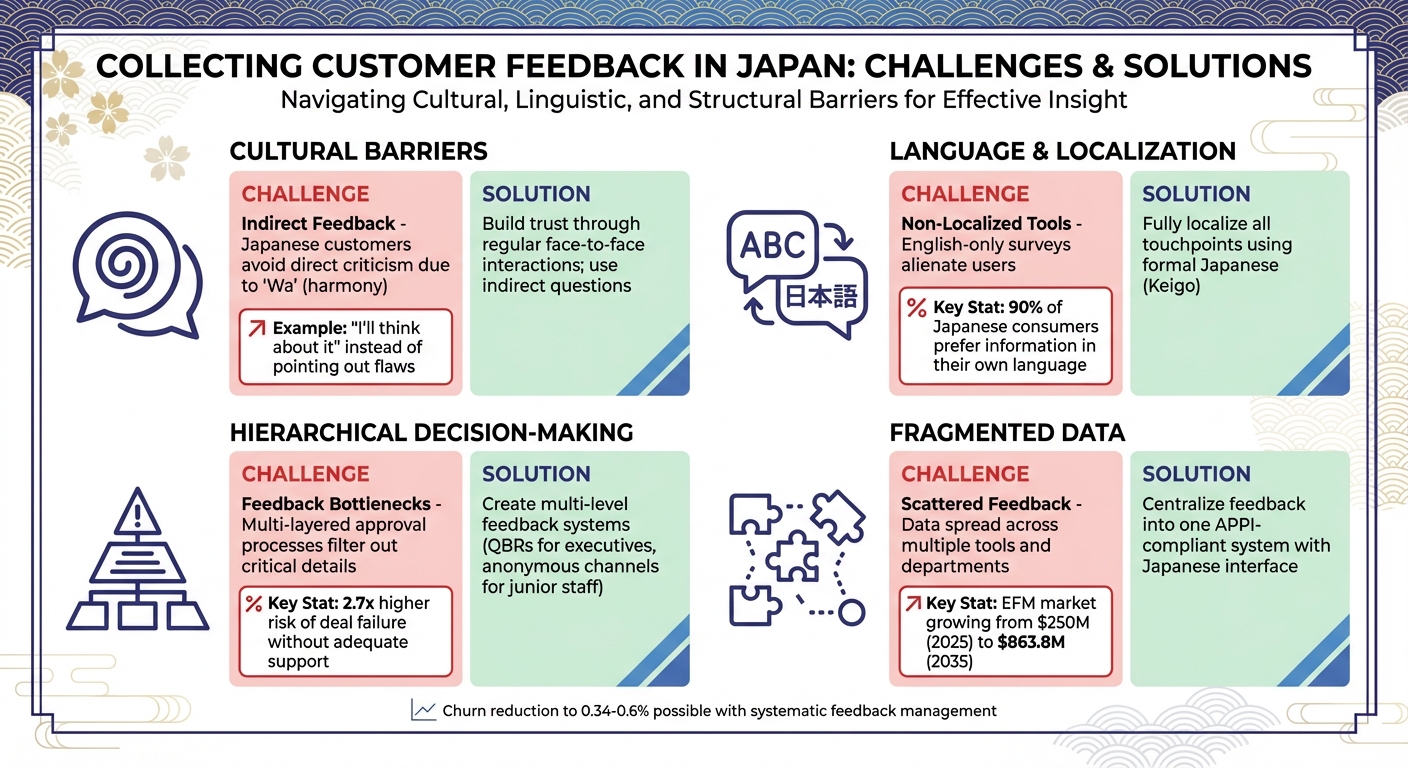
4 Key Challenges in Collecting Customer Feedback in Japan and Solutions
Cultural Barriers: Japanese Communication Styles and Feedback
Challenge: Low Response Rates and Unclear Feedback
In Japan, the cultural value of Wa (harmony) often discourages direct criticism. Instead of openly saying, "this feature doesn’t work", Japanese customers may opt for more polite phrases like "I will consider it" (kento sasete itadakimasu). This preference for indirect communication is deeply rooted in practices like Kuuki wo yomu (reading the atmosphere) and Nemawashi (building internal consensus). While these approaches maintain harmony, they result in feedback that is often too vague to address issues promptly. This lack of actionable input can lead to unnoticed problems, such as software bugs or poor localization, which quietly erode customer satisfaction and retention. Utilizing comprehensive Japan go-to-market services can help mitigate these risks by ensuring products resonate with local expectations.
Solution: Build Trust and Use Indirect Questions
Establishing trust is key. Assigning dedicated account representatives who regularly interact with customers can make a significant difference. Misako Onoda, Chief Representative of Japan Intercultural Consulting, highlights this approach:
"Every time I stop by a client, I get to meet someone new, or they bring up something by saying ‘by the way, as long as you’re here’… The more excuses I can find to put my face in front of the client’s, the more information I can get about their needs."
Instead of asking direct questions like "What don’t you like?" try framing them indirectly, such as "How can the product better support your workflow?" Pay attention to "by the way" moments, which often occur toward the end of meetings when customers feel more at ease and are likely to share honest feedback. Additionally, practicing Omotenashi – a proactive approach to customer care – by monitoring usage patterns can help identify and address potential issues before they escalate.
sbb-itb-a752276
Language and Localization Gaps: Reducing Feedback Friction
Challenge: Non-Localized Surveys and Support Channels
When feedback tools are only available in English, they can create confusion and hesitation among users. For example, English-only labels on required fields, privacy notices, or error messages can make customers uneasy about how their data and comments will be used. This concern is especially pronounced in Japan, where privacy expectations are particularly high. Unsure about what kind of response is expected, many users either skip surveys entirely or choose neutral, non-committal answers that provide little value.
The lack of localization also sends an unspoken message: Japanese inquiries might receive slower or less thorough responses. This discourages users from submitting detailed bug reports or feature requests. Instead, they may resort to phone or email – if those options are even available in Japanese. The result? Feedback loops become dominated by bilingual or globally minded users, leaving mainstream Japanese customers, especially those in traditional industries, unheard.
The numbers back this up: 90% of Japanese consumers prefer buying products with information in their own language. Additionally, Japanese small and medium-sized enterprises (SMEs) are 2.7 times more likely to abandon a purchase if sales support isn’t adequate. To address these challenges, every interaction point with customers must be fully localized.
Solution: Localize All Feedback Touchpoints
The key to reducing these barriers lies in thorough localization. This goes far beyond basic translation. Every feedback channel – surveys, in-app messages, support forms, help center articles, and email templates – should be tailored to Japanese language and culture. Use polite forms of Japanese (sonkeigo) when asking for opinions, and humble expressions (kenjougo) when describing your company’s efforts. This approach shows respect and encourages users to share honest, meaningful feedback.
It’s also essential to treat Japanese feedback as a top-tier data source. Build a localization pipeline that includes glossaries to maintain consistency, and create Japanese survey templates that align with global feedback standards. Set internal deadlines for updating Japanese content to ensure timely responses. On the analytics side, tag feedback by language and region to preserve the unique insights provided by Japanese customers.
Another crucial step is to show customers that their feedback makes a difference. Publish release notes and changelogs in Japanese, and let users know when their input has led to product improvements. This not only closes the feedback loop but also reassures customers that their voices matter. For companies new to the Japanese market, partnering with a localization expert like Nihonium – which focuses on product localization and go-to-market strategies for global SaaS – can help streamline these efforts, from crafting survey language to integrating Japanese feedback into broader decision-making processes.
Hierarchical Decision-Making: Getting Past Filtered Feedback
Challenge: Feedback Bottlenecks from Company Hierarchies
In Japan, the structured and layered decision-making process can make it tough to get accurate customer feedback. This formal system, known as the Ringi process, often waters down insights as they move up the chain of command. The issue? Those at the top – who ultimately approve decisions – are rarely the ones using the product. Yuga Koda, CEO of Nihonium, puts it plainly:
"The decision-making process, the Ringisho process, includes multiple decision-makers. In many cases, the decision-makers will have little exposure to the product itself and are not end users".
Here’s how this plays out: a Shunin (unit chief) might notice a critical issue with a workflow. But by the time that information reaches the Kacho (section chief) and Bucho (department chief), it’s often stripped of the granular details that reflect actual user challenges. Instead, feedback is reframed to align with broader corporate goals, leaving vendors with a distorted picture of the real issues.
The results are striking. When companies lack adequate support for navigating internal approval processes, the likelihood of a deal falling through jumps 2.7 times. Only 10.1% of buyers reported missing this support, compared to 27.2% of non-buyers. Common hurdles include gathering the necessary internal data (14.9% of buyers) and overcoming internal opposition (8.5%). Even more telling, 19.9% of failed purchases were due to breakdowns in proposal or approval stages.
To bridge this gap, companies need feedback systems that connect with every layer of the organization without disrupting the established hierarchy.
Solution: Create Multi-Level Feedback Channels
In Japan, bypassing hierarchy isn’t an option. Instead, the key is to create feedback systems that align with the existing structure, ensuring every level of the organization has a voice. Start by mapping out the organization – identify key roles, from the Senmu (senior executives shaping strategy) to the Shunin (team leads who engage directly with end users).
Once you understand the structure, implement tailored feedback mechanisms for each role:
- Quarterly Business Reviews (QBRs) for senior executives, focusing on ROI metrics and documentation that supports the Ringi process.
- Workshops for middle managers, providing a platform to discuss operational challenges and share insights.
- Anonymous feedback channels, like in-app surveys or confidential forms, allowing junior staff to report technical issues without fear of disrupting workplace dynamics.
When positioned thoughtfully, anonymous tools are particularly effective in Japan. They empower frontline employees to raise concerns that might otherwise be filtered out by the hierarchy. To measure success, track metrics such as response rates by role, the time it takes to resolve issues, and whether critical problems are being flagged earlier in the process. These indicators will reveal whether your approach is cutting through the bottlenecks.
For companies unfamiliar with Japan’s business culture, teaming up with local experts like Nihonium can be invaluable. They can help design systems that respect cultural norms while capturing genuine user feedback, paving the way for a stronger market presence.
Operational Barriers: Centralizing and Using Feedback Data
Challenge: Feedback Scattered Across Multiple Tools
SaaS companies in Japan often struggle with fragmented customer feedback data spread across various channels. Insights get buried in support tickets, sales notes, partner reports, and social media interactions. This scattered setup makes it incredibly hard to identify trends or take meaningful actions.
The root of this issue lies in how departments independently adopt different tools. For example, marketing teams might rely on their own CRM and social media platforms, while sales teams use separate engagement tools, and IT support operates its own ticketing systems. This siloed approach leads to disconnected customer sentiment, inefficient issue tracking, and wasted resources. To unlock the value of customer feedback, a unified solution is desperately needed.
The Japanese SaaS landscape adds another layer of difficulty. By 2025, over 60% of mission-critical IT systems in Japan will be more than two decades old. Many companies still rely on paper-based processes or Excel spreadsheets for daily operations, which makes consolidating feedback digitally a significant challenge.
| Department | Common Tools Causing Data Fragmentation | Impact on Feedback |
|---|---|---|
| Marketing | CRM, Email Marketing, Social Media Tools | Disconnected customer sentiment; inefficient ad spend |
| Sales | CRM, Sales Engagement Platforms | Fragmented data disrupts lead tracking and sales funnel |
| IT/Support | Monitoring Tools, Support Ticketing Systems | Complex operations and inconsistent issue tracking |
Solution: Create a Central Feedback System and Regular Reports
To address this fragmentation, implementing a centralized feedback system is crucial. A SaaS management platform can provide a clear view of your tech stack, helping you spot usage trends, eliminate redundant tools, and consolidate customer feedback into a single repository. In fact, Japan’s Enterprise Feedback Management (EFM) market is expected to grow from $250.0 million in 2025 to $863.8 million by 2035, with large enterprises accounting for 54.7% of the market. This growth underscores the growing importance of centralized feedback systems in staying competitive.
When establishing a central system, ensure it complies with Japan’s data privacy laws (APPI) and delivers fully localized feedback surveys instead of relying on machine translation. Naoki Togawa, Manager at Nikkei Business Publications, highlights this point:
"There’s nothing worse than bad translation. It’s easy to tell which vendors know what they are doing and are really committed to the market just through the quality of their materials and programs".
Localization matters deeply in Japan. Surveys show that 90% of Japanese consumers prefer products with information in their native language, and 66% of B2B buyers are willing to pay more for localized products with proper support.
Additionally, structured feedback loops between Japanese frontline teams and global product teams are essential. Scheduling monthly or quarterly reviews can help identify pain points early and turn them into actionable insights. Feedback trends should also be compiled into reports, as these are often required for internal decision-making in Japanese organizations. With company websites accounting for 31.4% of feedback collection touchpoints in Japan, integrating these into your central system is a must.
Centralizing feedback can significantly improve customer retention, reducing monthly churn rates to as low as 0.34% to 0.6%. By systematically organizing and acting on feedback, you not only enhance your product but also build trust, fostering long-term loyalty among Japanese customers.
Working with Local Experts for Better Feedback Operations
How Local Partners Help with Feedback Collection
Global SaaS companies often face challenges turning Japanese customer feedback into actionable product improvements. With the cultural and operational hurdles previously discussed, local partners can offer the expertise and infrastructure needed to simplify feedback collection. Instead of hiring expensive local managers (who can cost around $400,000 annually for two employees), companies can work with local partners like Nihonium, which acts as a fractional Japan team.
These partners bring several key advantages to the table. They can interpret subtle, indirect communication cues – for example, knowing when a customer’s "I will think about it" actually means "no" or hints at a need for alternative options. They also design feedback programs tailored to Japanese business norms. For instance, they can establish support desks staffed by native speakers who use formal Keigo language and provide Omotenashi-style service, which anticipates customer needs before they are explicitly expressed. This approach is vital because insufficient sales support during internal approval processes significantly increases the risk of losing a sale – 10.1% of buyers lacked support compared to 27.2% of non-buyers. By leveraging this localized expertise, companies can ensure that feedback from Japanese customers directly informs meaningful product updates.
Making Japan-Specific Feedback Count
Feedback only holds value when it shapes your product roadmap. Local experts are skilled at distinguishing between universal needs and Japan-specific requirements. For example, Japanese users often prefer user interfaces with higher information density and may require features like furikomi (bank transfer) invoicing, which are less common in other markets.
Partners like Nihonium help bridge the communication gap between Japanese customers and global product teams by creating structured feedback loops and detailed reports that align with Japanese decision-making styles. They assist in prioritizing which Japan-specific needs require immediate attention and which can be addressed later, ensuring development resources are directed toward changes that improve product-market fit. This expertise will become increasingly important as Japan’s Enterprise Feedback Management market grows from $250.0 million in 2025 to a projected $863.8 million by 2035. By transforming localized insights into product improvements, businesses can demonstrate their commitment to the Japanese market. These tailored adjustments build upon the earlier strategies for tackling cultural and operational challenges.
Conclusion: Solving Feedback Challenges in Japan
Key Takeaways for SaaS Companies
Tapping into valuable customer feedback in Japan involves overcoming four primary hurdles: cultural tendencies that lead to ambiguous feedback, language preferences (with 90% of Japanese consumers favoring communication in their native language), hierarchical decision-making layers (where insufficient sales support can raise purchase cancellation risks by 2.7×), and fragmented operations caused by disconnected tools.
Addressing these issues requires thoughtful strategies. Start by fully localizing your feedback channels with high-quality, nuanced Japanese – steer clear of machine translations. Build a feedback framework that gathers insights from all levels, including end users, team leaders, and executive sponsors. Consolidate this data into a unified system, with reports tailored to align with Japan’s business practices. With these steps, you’ll be better equipped to gather actionable feedback.
Next Steps for Your Japan Expansion
Turn these strategies into results by taking the following steps. Begin with a 30-day audit of your feedback processes to identify areas lacking localization, low engagement rates, and gaps in multi-tiered input. Within the next 60–90 days, roll out a fully localized feedback channel. This could be a Japanese-language NPS survey, a native support desk that uses formal Keigo, or structured conversations with customer champions responsible for internal approvals.
For U.S.-based SaaS teams unfamiliar with Japanese business norms, collaborating with local experts can make a big difference. Organizations like Nihonium provide fractional Japan teams who can interpret subtle communication nuances, design feedback systems suited to the market, and bridge the gap between Japanese customer insights and global product strategies. With Japan’s Enterprise Feedback Management market expected to grow from $250.0 million in 2025 to $863.8 million by 2035, companies that refine their feedback processes to suit Japanese preferences will gain a strong edge in retaining customers and driving revenue growth.
FAQs
How can companies address the challenge of indirect customer feedback in Japan?
In Japan, communication often leans toward the indirect side, with customers preferring subtlety over direct criticism. This means businesses need to sharpen their ability to interpret implicit feedback. Training staff to pick up on non-verbal cues – like pauses, silences, or carefully polite language – is essential. Tools such as anonymous surveys, quick polls, or follow-up calls asking open-ended questions like, "How can we improve your experience?" can provide a comfortable way for customers to share their thoughts.
Trust plays a central role in fostering better communication. Responding promptly and thoughtfully to concerns, as well as assigning dedicated account managers, can make customers feel valued and understood. Companies can further strengthen relationships by embracing culturally-aware practices, such as omotenashi – a concept that emphasizes anticipating and meeting customer needs before they are even expressed. By aligning with Japan’s nuanced communication style, businesses can transform subtle feedback into meaningful improvements, driving customer satisfaction.
How can SaaS companies effectively localize feedback channels for Japanese customers?
To connect effectively with Japanese customers through feedback channels, it’s essential to tailor your approach to their cultural norms and language preferences. Start by ensuring that all interfaces – whether surveys, support tickets, or in-app prompts – are written in native Japanese and incorporate keigo, the formal honorific language. This approach conveys respect, which is highly valued in Japan. Avoid direct refusals or overly blunt phrasing, as politeness and indirect communication are preferred.
Choose platforms that align with Japanese user habits, such as LINE, email, and phone. These channels should be optimized for mobile devices, as over 60% of Japan’s web traffic comes from smartphones. Offering a dedicated local representative who can respond promptly – ideally within the same business day – helps build trust and reflects the principle of omotenashi, which emphasizes anticipating and meeting customer needs.
Transparency is another key factor in gaining trust. Provide detailed information upfront, such as clear privacy policies that comply with Japan’s APPI law, comprehensive FAQs, and well-defined escalation processes. When collecting feedback, use rating scales and open-ended questions to accommodate the Japanese preference for subtle and indirect communication. By addressing these cultural nuances, SaaS companies can build stronger relationships with Japanese customers and gather meaningful insights to improve their offerings.
How can businesses overcome hierarchical feedback delays in Japan?
In Japan, feedback often passes through several layers of approval due to hierarchical decision-making processes like nemawashi and ringi. These practices are designed to preserve organizational harmony and trust, but they can also slow down the process of gathering and acting on feedback.
To navigate these challenges, businesses can take a few key steps:
- Identify decision-makers early: Start by pinpointing the key stakeholders and understanding the approval structure to ensure smoother communication.
- Leverage informal discussions: Apply nemawashi to gather input and build consensus before submitting formal proposals, easing the path for approvals.
- Adapt communication style: Use polite and professional Japanese for all materials to show respect and align with local cultural norms.
By integrating these approaches, companies can minimize delays while maintaining trust and fostering collaboration.
Related Blog Posts
- Japanese Customer Support: Essential Best Practices
- Study: Impact of Cultural Nuances on SaaS Partnerships in Japan
- Study: Generational Trends in Japanese Business Communication
- Direct vs. Indirect Communication in Japan
 English
  Japanese