
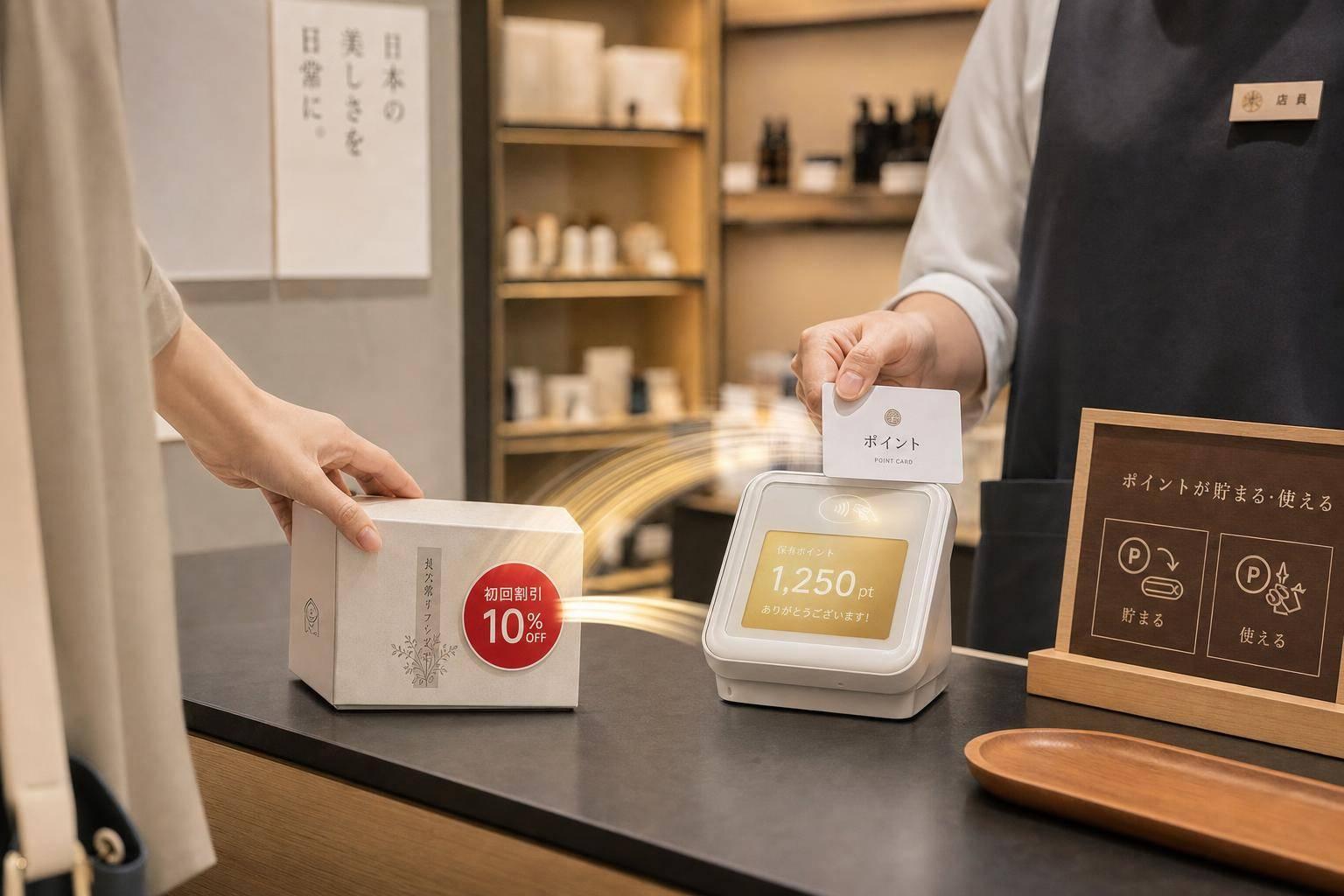
If I had to boil it down to one rule, it’s this: use discounts to win your first deal in Japan, and use loyalty programs to keep and grow the account.
That’s the short answer. In this market, price is not just about cost. It also affects how buyers judge risk. A deep price cut can help a new vendor get attention, but it can also make buyers wonder what’s wrong. That’s one reason large Microsoft Enterprise Agreement discounts in Japan often land at 35%–48% off list, about 3–5 points tighter than similar U.S. deals.
Here’s what I’d keep in mind:
- Discounts work best at entry: first purchase, pilot-to-paid, and annual commitment offers
- Loyalty programs work best after the sale: renewal, upsell, referrals, and product use
- Bad discount habits hurt retention: one test showed 50% off the first month got a 5.7% contract rate but only 39% continuation, while free support got a 5.2% contract rate and 45% continuation
- Japan already has strong points behavior: points feel familiar, and the market reached about $18.67 billion in FY2024
- Execution matters: pricing, copy, tax display, and buyer approval materials all shape how your offer is received
If you’re entering Japan, I’d keep the pricing story simple: start with low-friction entry, tie savings to commitment, and move to rewards that support usage and renewal instead of cutting price again and again.
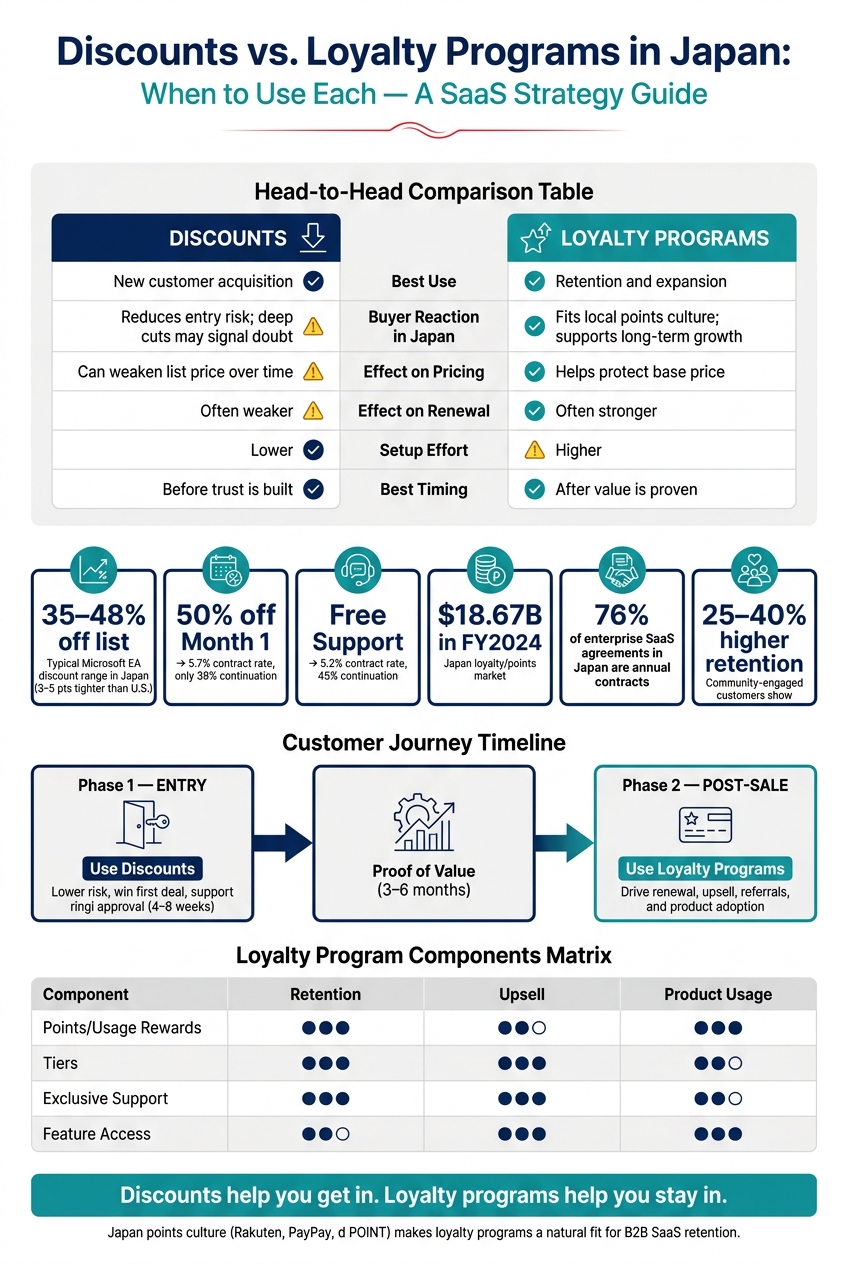
Discounts vs. Loyalty Programs in Japan: When to Use Each
Quick Comparison
| Factor | Discounts | Loyalty Programs |
|---|---|---|
| Best use | New customer acquisition | Retention and expansion |
| Buyer reaction in Japan | Can reduce entry risk, but deep cuts may create doubt | Fits local points behavior and long-term account growth |
| Effect on pricing | Can weaken list price over time | Helps protect base price |
| Effect on renewal | Often weaker | Often stronger |
| Setup effort | Lower | Higher |
| Best timing | Before trust is built | After value is proven |
That’s the core tradeoff: discounts help you get in; loyalty helps you stay in.
sbb-itb-a752276
Discounts in Japan: Good for Acquisition, Risky for Long-Term Pricing
In Japan, discounts usually show up in three forms: introductory price cuts, annual or multi-year commitment discounts, and time-limited launch promotions. Annual commitment discounts of 10%–20% compared with monthly billing are common, and buyers in Japan often see that as a fair trade.
Where Discounts Work Best
Discounts tend to work best with first-time buyers, pilot-to-paid conversion, and enterprise procurement. They give internal champions something concrete to take into consensus-building and formal approval. That matters because enterprise software deals in Japan often pass through several approval steps and can take 4–8 weeks, so anything that makes sign-off easier can help.
That’s why discounts should be tied to entry instead of becoming the default pricing story. If price cuts feel unplanned or too aggressive, they can set off red flags. A clearly explained, time-bound offer linked to a commitment comes across as professional and steady.
What Discounts Can Damage
The main risk shows up at renewal. In B2B SaaS testing, a "50% off the first month" offer produced a 5.7% initial contract rate, but only a 39% continuation rate. A "free support" benefit, by contrast, reached a 5.2% contract rate with a 45% continuation rate. The discount helped win the deal. The value-add did more to keep the customer.
Repeated discounting creates another problem: it teaches buyers to wait for the next promotion. Over time, that weakens pricing discipline and squeezes margins.
In Japan, very low prices can also signal higher risk. So discounts need to look deliberate, not desperate. A fast, frequent, or unexplained price cut can read as risk instead of value.
Once an account is won, loyalty programs usually do a better job of reinforcing value without cutting the base price. That makes discounts useful for acquisition, but much less effective as a long-term retention tool.
Loyalty Programs in Japan: A Better Fit for Retention and Expansion
Discounts can help you win an account. Loyalty programs help you keep it and grow it.
In SaaS, loyalty programs are about more than points. Given the current state of SaaS in Japan, these programs are becoming essential for long-term growth. They can include usage rewards, tiered benefits, referral credits, tenure perks, and premium support. In Japan, these incentives often work differently from discounts, and they can do a better job on retention. When loyalty benefits feel like earned value, they help keep customers engaged without training them to expect lower prices.
Why Point-Based Rewards Feel Natural in Japan
Point-based rewards fit Japan well because buyers already see points as usable value, not a gimmick. Big ecosystems like Rakuten, PayPay, and d POINT have shaped buyer behavior across segments, so points are often treated as something close to cash in day-to-day decision-making. That also makes them easier to justify inside a company than a direct price cut.
Simplicity matters here. Japanese buyers tend to respond well to clear earn-and-redeem rules and benefits they can predict. If the tier structure gets too busy or hard to follow, trust can drop instead of grow.
| Loyalty Component | Effect on Retention | Effect on Upsell/Expansion | Effect on Product Usage |
|---|---|---|---|
| Points/Usage Rewards | High | Medium | High |
| Tiers | High | High | Medium |
| Exclusive Support | High | High | Medium |
| Feature Access | Medium | High | High |
This is why loyalty tends to work best after acquisition, when the focus moves from getting approval to driving renewal and account growth.
The Operational Challenges for SaaS Teams
A loyalty program can look good on paper and still fall apart in practice. For B2B SaaS in Japan, execution takes solid analytics, localized communication in proper keigo (formal Japanese), and steady program management so benefits still make sense as accounts grow.
One common mistake is rewarding purchase frequency when the bigger goal should be adoption. The best rewards tie back to behavior that shows account health: finishing onboarding, reaching feature-usage milestones, or driving advocacy through reviews on platforms like ITreview or BOXIL.
That matters because community-engaged customers in Japan show 25% to 40% higher retention rates than non-engaged users. When rewards match account behavior, not just contract renewals, they can support expansion in a more natural way.
For global SaaS teams, this is usually where things get messy. Without local support, the program can become hard to run and even harder to explain. Teams in that position can use Nihonium for localized messaging, program design, and account management.
Discounts vs. Loyalty Programs: Which Works Better and When in Japan
The better choice comes down to where the customer is in the journey. Discounts help get people in the door. Loyalty programs help keep them there.
Once you look at acquisition, retention, and pricing side by side, the difference is pretty clear.
| Factor | Discounts (Price Cuts) | Loyalty Programs (Points) |
|---|---|---|
| Acquisition Effectiveness | High – reduces entry risk for unproven brands | Low – requires established trust first |
| Retention Impact | Low – can train buyers to wait for the next deal | High – builds habitual usage and ongoing participation |
| Brand Perception | Risky – may signal low quality or lack of confidence | Positive – signals long-term commitment |
| Implementation Complexity | Low – straightforward to execute | High – requires local system integration |
| Fit with Japan’s points culture | Low – misses ingrained points behavior | Very High – aligns with established consumer habits |
| Ability to Preserve Premium Pricing | Poor – undercuts headline price over time | Strong – rewards without marking down list price |
By Buyer Stage: Entry vs. Expansion
This tradeoff shifts once a customer moves from evaluating your product to actually using it.
At the entry stage, a discount can lower the risk of trying a brand that still feels unproven. That matters in Japan, where buyers often want a bit more certainty before they commit. The best use case here is a clear offer with a firm deadline. No fuzziness, no endless promo.
For first-time buyers, discounts tend to work better. After the sale, loyalty programs make more sense because they support adoption, repeat use, and renewal. Put simply: one helps start the relationship, the other helps extend it.
By Brand and Revenue Strategy
Brand position changes the answer again.
If you’re selling a premium product, discounts can chip away at price integrity. Over time, that can make the listed price feel less believable. Loyalty programs avoid that problem. They give customers a reason to stay engaged without cutting the headline price, while also supporting NRR and GRR goals.
Next, the strategy is how to combine both without weakening list price.
Building a Japan-Ready Pricing Strategy
How to Use Both Without Undercutting Your Pricing
Use monthly billing to lower entry friction, then move live accounts to annual contracts after proof of value.
For market entry, monthly billing is often the smarter move than a headline discount. It helps reduce friction in the ringi approval process and gives buyers a low-risk way to test your product. Once you’ve shown value – usually within three to six months – you can shift the account to an annual contract with built-in savings.
A simple way to frame the annual plan is "two months free." You can also pair it with starter kits, bundles, or free support extensions.
After the account proves value, the job changes. At that point, you’re no longer just lowering risk. You’re shaping renewal behavior. Once the account is live, shift to loyalty mechanics. Rewards tied to renewal or referrals can keep customers engaged without changing your headline price. About 76% of enterprise SaaS agreements in Japan are set up as annual contracts, so it makes sense to design renewal incentives around the April–March fiscal year, with January–March as the main outreach window.
Key Takeaways for SaaS Leaders
Discounts tend to work best at the entry stage, where they reduce the risk of trying an unfamiliar brand. Loyalty programs – especially points-based rewards – fit retention and renewal better.
Japan’s points market reached about $18.67 billion in FY2024. In Japan, loyalty tends to work best when it feels like membership, not markdowns.
In Japan, the offer and the way you present it are part of the same pricing decision. Pricing pages need to show tax-inclusive figures (zeikomi). Sales materials need to support the nemawashi process with detailed ROI documentation. Customer-facing copy needs to meet keigo standards.
Local formatting, approval materials, and customer copy all affect whether your pricing feels credible. For Japanese enterprise buyers, these are basic expectations. A Japan-focused partner like Nihonium can help localize pricing language, build market-fit funnels, and support trust-based sales execution.
FAQs
How much discount is too much in Japan?
In Japan, heavy discounting can do more harm than good. Instead of making your offer look like a smart deal, it can make buyers wonder if the product is lower quality or if the business is unstable.
For SaaS, a 10% to 20% discount for an annual plan compared with monthly pricing is standard. It also fits local procurement expectations.
Go much further than that, and you may run into trouble. Frequent discounts or deep price cuts can weaken trust. Many Japanese buyers see stable pricing as a sign of trust and fair dealing.
When should a SaaS company switch from discounts to loyalty rewards?
In Japan, discounts usually work best as part of annual contracts, not as a short-term sales play. A common range is 10%–20%.
Once trust is in place and the relationship gets deeper, shift the focus to loyalty rewards. At that point, negotiated rates and commitment-based rewards fit the long-term, relationship-driven approach and can help reduce churn.
What loyalty program works best for B2B SaaS in Japan?
In Japan’s B2B SaaS market, relationship-based loyalty tends to work better than consumer-style point programs. Long-term, trust-based partnerships matter more than simple discounts. In many cases, discounts can even weaken perceived value.
The better play is to invest in the relationship itself. That means high-touch support, clear communication, customized service, annual contracts, dedicated account management, and native Japanese support.
Those steps do more than keep customers happy. They help build commitment, reduce churn, and signal the kind of stability Japanese enterprises expect.
Related Blog Posts
- Local vs Global SaaS Pricing: Japan Market Guide
- Why Long-Term Commitment Matters in Japan SaaS Sales
- Japanese vs. Global SaaS Support: Key Differences
- Japanese SaaS Customers vs. Global Customers: Key Differences
 English
  Japanese