

Solution Optimized for Japan: Mackerel’s Unique Position
Introduction
Mackerel is an infrastructure monitoring tool created by Hatena, a Japanese company. Hatena is most well-known for its content-related software, Hatena Blog (blog hosting), and Hatena Bookmark (social bookmarking).
Mackerel was first released in beta in May 2014 and released the GA version in September 2014. Analyzing Mackerel is interesting because it’s one of the few SaaS tools created in Japan that has global competitors but doesn’t target a Japan-specific regulation or nuance. Many SaaS solutions in Japan are solutions dedicated to specific verticals with Japan-specific nuances or regulations. For example, HR and accounting are different in Japan and require a platform that optimizes for local needs. Mackerel is a unique case where the global and domestic solutions have similar products with no Japan-specific nuances to work through barriers to work through. This is a rare example (including the availability of data, as Hatena is a public company) of local optimization being the real differentiator between the local and global products.
First-Mover Advantages of a Local Product
When Hatena released Mackerel, AppDynanics, SolarWinds, and DynaTrace were already powerhouses in the US market. New Relic, a powerhouse on the APM side, released infrastructure monitoring in 2016. DataDog was also rapidly up-and-coming. There were plenty of established global competitors, but all three of these companies did not enter Japan or optimize for the Japanese market for a few years after Mackerel launched. As a result, Mackerel was the only locally optimized solution:
1. AppDynamics added Japanese UI and support in April 2020
2. SolarWinds, based on the timing of the press releases, engaged the Japanese market once from 2012 to 2013 and restarted in 2020
3. DynaTrace began offering a Japanese UI in 2022
4. New Relic entered the Japanese market in August 2018
5. DataDog entered the Japanese market in November 2019.
Mackerel had roughly a four-year grace period (end of 2014 to late 2018) of being one of the only, if not only, locally optimized infrastructure monitoring SaaS platforms in the market. Working in a market with limited locally optimized solutions, Mackerel experienced rapid growth.
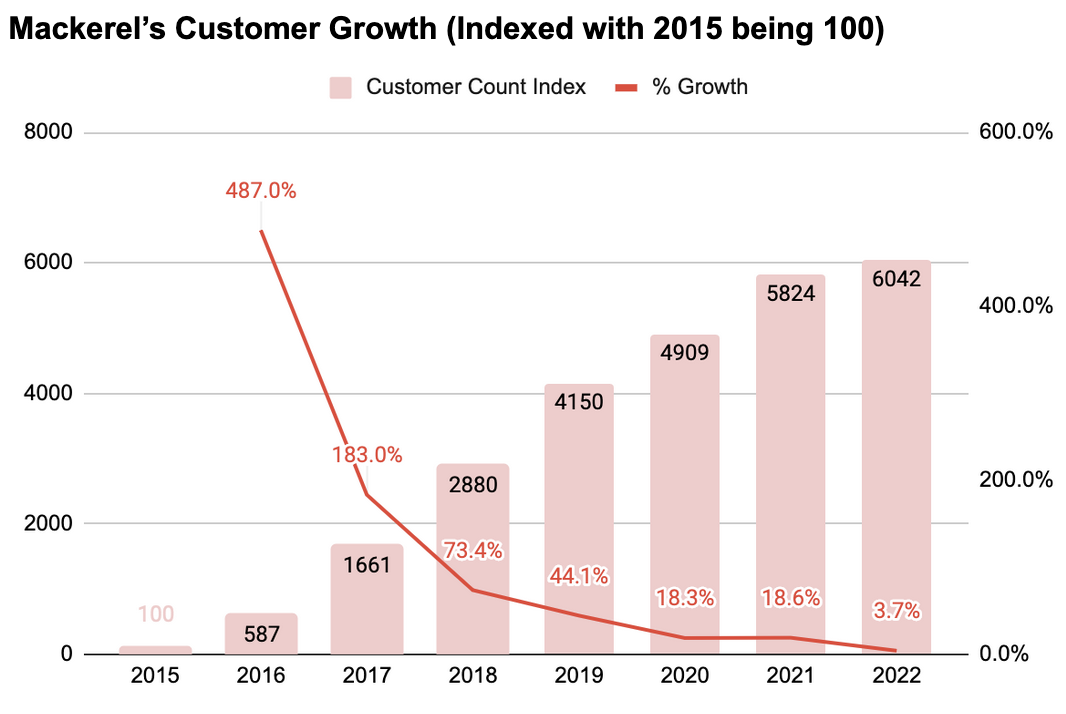 Source: Hatena’s annual earnings presentations (2018-2023)
In the data Hatena has released, it indexed 2015, its first full year of operations, as 100. Note that this is not the number of customers. That being said, Mackerel experienced 487% customer growth in 2016, the second full year of operations. The growth continued and the number of customers grew by about a multiple of 29x by the end of 2018 compared to the end of 2015. The growth during the grace period of being the locally optimized solution was strong and Mackerel picked up strong local brands like Nintendo, CyberAgent, and NTT EAST.
Although the growth rate declined significantly, Mackerel continued to show growth after the global players entered the market, which makes sense as it takes time for global companies to earn the trust of Japanese companies. In the recent earnings reports though, Hatena didn’t include the indexed customer figure, so this may be an indication that growth has stopped or even revered. Nonetheless, Mackerel experienced significant and rapid growth while it was the only player in the market.
Plenty of Categories with Limited Competitors
Global companies are realizing the potential of the Japanese SaaS market. Japan is the second-largest enterprise software market with a high appetite to incorporate new SaaS solutions. That being said, there is plenty of room for SaaS companies to enter the Japanese market. Comparing G2 (global SaaS review site) and ITReview (Japanese SaaS review site), G2 has 93k products listed across 1.7k categories and ITReview has 8,927 products listed across 810 categories. There are about 900 categories that are still up for grabs in Japan.
As Japan plays catchup, SaaS in Japan still lags behind the global markets. The Japanese market is full of opportunities for categories that have proven product market fit in global markets but haven’t fully matured in the Japanese market. This is the typical pattern of companies entering Japan. This also adds to Japan’s lag in software, as these software companies enter Japan after proven product-market fit in their core market. That said, though a domestic offering, Mackerel shows the power of the first mover advantage of providing a locally optimized solution for a service that has proven global product market fit.
The Japanese market is also great for companies that are challenging incumbents and are introducing new workflows. Though it may take time to close enterprise deals, starting early with go-to-market in Japan helps build a local presence and gain the trust of the local market. If challenger companies are willing to play the long game, they may eventually gain access to the second-largest enterprise software market. For these challenger companies, setting up an entity may be high risk and costly, so working with a market entry partner like Nihonium to validate Japan may make more sense.
Conclusion
Mackerel provides insight into the power of a locally optimized solution for a product with global product-market fit: Even with global alternatives, there is a need for a locally optimized solution. Localization, local sales and support, and a local presence are all important for success in the Japanese market. Companies may see these efforts as a cost center, but without going through this process, the Japan entry efforts are being set up for failure. Building a local presence, usually starting with localization, has to be seen as an investment to potentially gain access to the second-largest enterprise software market. If Japan entry is something you’re considering, book a consultation here.
 English
  Japanese