

Reducing the Risk of Japan Entry by Entering by Phases
Introduction
Entering a new market is a massive initiative and should not be taken lightly. Significant resources will have to go into the initiative for Japan entry to succeed. The risk involved in entering the Japanese market may prevent companies from entering the market, but the risk can be reduced significantly by taking a measured approach. Setting up a local branch or entity may seem like a natural first step, but there is much that can be done before. Validating the market is key to reducing the risks involved with Japan market entry.
A Measured Approach to Japan Entry
The Japanese market provides massive potential for global software companies. There is a push for digital transformation (partially mandated by the government) with a lack of software being offered since Japanese end-users prefer to use a locally optimized product. Optimizing the product for the Japanese market includes localization but also requires the company to have a local presence. This initially can be achieved without an entity or full-time employees in Japan. The end goal may be to create a team in Japan and scale, but without validation, the risks are too large. On the other hand, if Japan market entry succeeds, you’ll have access to the second-largest enterprise software market in the world. Pursuing Japan market entry blindly is a fool’s errand. Taking a measured approach will reduce the risk and increase visibility in the Japanese market.
Phase 1: Consideration
When considering entering the Japanese market, there usually is a catalyst that provokes interest. It may be news that a competitor closed a large Japanese client or set up shop in Japan. It may be that there’s traffic or leads coming from Japan. Whatever the reason is, the first step in entering the market is doing diligence on the Japanese market and understanding the market traction.
Doing even light research on the market will help you understand the positioning of your product. Ideally, you’ll have a decent understanding of the local competitor and trends to see if there is potential product-market fit (PMF). Chatting with someone who understands the local market is a quick and easy way to get an initial sense of the market. Deeper research can supplement the decision.
On top of the research, ideally, there are leading indicators that warrant consideration. Companies that are considering Japan may have a metric-based catalyst in their interest in Japan. Companies may have traffic or leads coming in from Japan. In some rare cases, some companies may have self-serve Japanese customers. The combination of positive feedback on initial market research and the promising leading indicators is a great starting point for considering Japan market entry.
Phase 2: Initial Entry and Validation
Once the decision to enter the Japanese market has been made, the first step is not to hire and build a team (unless you have the budget and the conviction that Japan will be a success). There are ways to experiment and test the Japanese market without a local team. The goal is to minimize the financial commitment level while getting validation on the Japanese market. Entering the Japanese market does require a real commitment of time and mental capacity, so if the Japanese market is going to be a distraction, then it’s best to push back the Japan entry.
Setting up a local entity and building a team will be costly. This is the financial investment to avoid until the Japanese market has been validated. Further investment should be considered when the market is properly validated. During this initial entry and validation phase there are a few foundational tasks that need to be completed.
The first is localization. Localization is key as Japanese end-users prefer to use a locally optimized product. Localization is also important to create a local presence and gain the trust of the local market. Without a localized product, how will the end-users trust that you’re serious about entering the Japanese market?
Localization alone will not be sufficient to validate the Japanese market. The ultimate goal is to bring on customers and see if there’s real PMF. Conducting some sales and marketing will be the next step. The marketing will help with market education and increasing awareness. There’s also a need for sales to be done in Japanese. There’s a workaround for getting sales and marketing done without a local team. You can work with a Japan entry consultancy (like Nihonium) or find local resellers. Resellers, at times, can add tremendous value by providing local sales and support. Creating a win-win relationship will be important for effective results but entry partners will help mitigate the risk of investing in the Japanese market without validation.
Phase 3: Further Commitment and Entry
Once there is decent traction and pipeline, setting up an entity and putting together a team will be the next step. Putting together a modest team of three will cost over $300k a year. To make sure that this investment pays off, the initial validation is important. The newly built team will also have a head start with localization complete and some sales and marketing motions already in place.
When building out a team, it is important to hire the right people. Finding the right local leader is paramount to the local success. Japan has a very relationship-based business culture. Making sure that the local leader has the right background, experience, and network will be important. There are many failed Japan market entry attempts due to selecting the wrong country manager. There is inherent key person risk with the country manager (which applies to any leader in any geography). Adding breadth with strong marketing validation (Phase 2) will reduce this risk.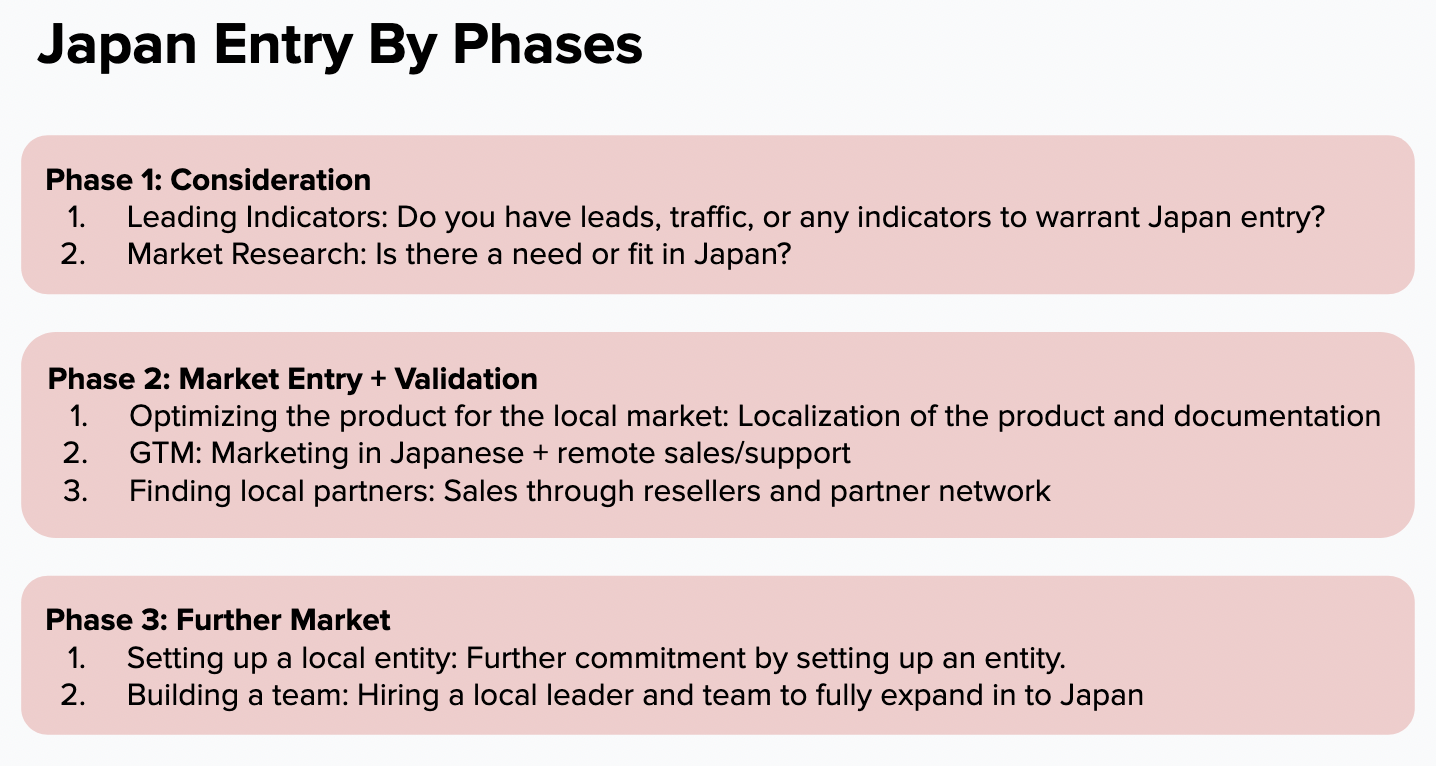
Conclusion
Entering the Japanese market comes with risks, but these risks can be managed if a measured entry approach is taken. Proper market validation is the key to managing this risk. With thorough validation, the predictability visibility into the market entry will increase. On the other hand, the lack of market validation is a recipe for disaster. If you are looking to validate the Japanese market, book a free consultation here.
 English
  Japanese