

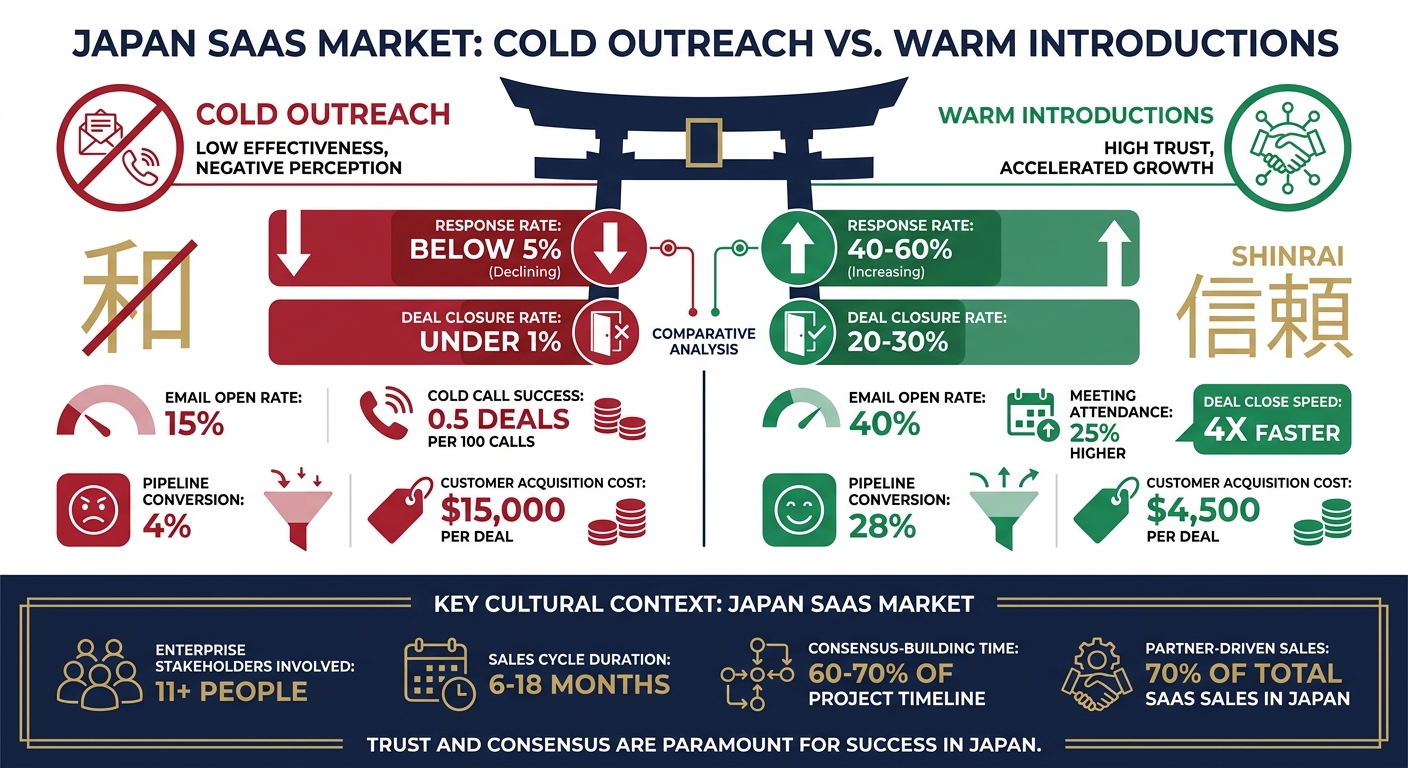
If you’re B2B SaaS sales in Japan, personal introductions aren’t optional – they’re essential. Cold emails and calls rarely work, with response rates below 5% and deal closures under 1%. But warm introductions? They boost response rates to 40%-60% and closure rates to 20%-30%. Why? Japanese business culture prioritizes trust (shinrai) and harmony (wa), making referrals from trusted contacts a must.
Key Takeaways:
- Cold outreach struggles: Response rates below 5%, deal closures under 1%.
- Warm introductions excel: 40%-60% response rates, 20%-30% closure rates.
- Decision-makers: Enterprise deals often involve 11+ stakeholders.
- Sales cycles: Typically 6-18 months due to consensus-building (nemawashi).
For SaaS companies, leveraging local networks and partners is the most effective way to navigate Japan’s trust-driven market. Partnerships, face-to-face meetings, and understanding cultural norms like nemawashi can significantly speed up sales cycles and improve outcomes.
Cold Outreach vs Warm Introductions in Japan SaaS Sales: Performance Comparison
Japanese Business Culture and Personal Introductions
Building Trust Through Face-to-Face Meetings
In Japan, building personal trust takes priority over showcasing product features. This makes face-to-face meetings a key step before any formal evaluations can occur. Japanese buyers typically follow a structured journey: they move from initial awareness to research, then to trust validation, internal alignment, and finally, the purchase decision. As Kensuke Morimoto, a Japan GTM Specialist, puts it:
"Japan does not buy software. Japan buys commitment." – Kensuke Morimoto, Japan GTM Specialist
These in-person meetings play a vital role in establishing trust and demonstrating a vendor’s long-term dedication to the Japanese market. For enterprise clients, this signals reliability and a genuine investment in the relationship. This emphasis on personal interaction is also reflected in the meticulous preparation that precedes these meetings.
Nemawashi and Enryo
The concept of nemawashi (根回し) – literally "going around the roots", referencing the groundwork done before transplanting a tree – illustrates the informal consensus-building process that is central to Japanese business culture. Before making any formal proposal, stakeholders are approached individually to gain their support. Yuga Koda, Co-Founder of Nihonium, highlights its importance:
"Nemawashi is where deals are won or lost. In Japanese enterprise sales, formal meetings confirm decisions that have already been made through informal consensus-building."
This process is highly time-intensive, with Japanese companies often dedicating 60–70% of a project’s timeline to consensus-building. The nemawashi cycle itself can take anywhere from 9 to 17 weeks. Alongside this, enryo (遠慮), or restraint, also shapes professional interactions. Indirect communication is often used to maintain harmony and avoid public criticism. This cultural approach calls for patience and careful listening to fully grasp client concerns and priorities.
sbb-itb-a752276
Research on Relationship-Driven Sales in Japan
Why Cold Outreach Fails in Japan
In Japan’s trust-centered business culture, cold outreach methods that succeed in other markets often fall flat. According to McKinsey‘s research, cold outreach in Japan achieves response rates below 2%, significantly lower than the global average of 5–10%. A 2023 Gartner report highlights that cold email open rates in Japan hover around just 15%, compared to 40% for warm introductions. Similarly, HubSpot‘s 2024 Japan SaaS sales benchmark report shows that cold email conversion rates for enterprise deals remain under 1%.
Cold calling fares even worse. On average, it produces only 0.5 deals per 100 calls in Japan, compared to a global success rate of 5%. Surveys by JETRO reveal that 65% of Japanese executives either ignore or respond negatively to cold calls, which can damage future opportunities.
But it’s not just about poor performance numbers – cold outreach often harms relationships. A Harvard Business Review case study on Japanese business practices found that 70% of recipients view unsolicited emails as disrespectful, associating the sender with a lack of trustworthiness. This cultural friction often stems from a lack of product localization and understanding of local etiquette. This reaction reflects Japan’s enryo culture, where unsolicited contact is seen as a breach of social norms that emphasize restraint and proper introductions. On the flip side, warm introductions align with Japan’s relational approach, delivering far better results.
How Warm Introductions Drive Results
Warm introductions through trusted networks yield far better outcomes in Japan. A 2022 Forrester study on relationship-driven selling in Asia found that warm introductions achieve 30% higher engagement rates in Japan compared to cold outreach. Data from the Nomura Research Institute also shows that deals initiated through personal introductions close four times faster and have 25% higher initial meeting attendance rates.
The conversion rates tell a similar story. Bain & Company’s 2024 Japan market entry report reveals that pipelines built through warm introductions convert at 28%, compared to just 4% for cold leads. A study by the Japan SaaS Association found that 60% of deals exceeding $100,000 originated from personal networks, with sales cycles three times shorter.
Dr. Yuki Kondo, a sales expert at Tokyo University, explains in a 2023 whitepaper that warm introductions tap into enryo culture by reducing perceived risks and fostering immediate rapport. These findings connect directly to the principles of shinrai (trust) and wa (harmony), which are deeply ingrained in Japanese business practices. McKinsey data further underscores this point, showing that 85% of Japanese executives prefer vendor referrals from trusted networks.
The financial advantages of warm introductions are equally compelling. A 2024 Marketo Japan study found that the customer acquisition cost for cold outreach is around $15,000 per deal, while warm introductions bring that down to $4,500 – a cost efficiency that’s five times better for referral-based sales. This underscores the critical role of personal connections in reducing costs and improving outcomes in Japanese enterprise sales.
Case Studies: SaaS Companies Using Personal Introductions
Working with Local Partners for Nemawashi
From September 2023 to August 2024, Integrate.io, a data pipeline platform, collaborated with Nihonium to break into the Japanese market using a fractional sales and localization strategy. Instead of spending $55,000 to $75,000 to establish a local entity, Integrate.io relied on Nihonium’s local sales expertise to run product demos and host benkyōkai sessions – small, informal study groups designed to build trust with enterprise prospects.
This localized strategy paid off, helping Integrate.io land contracts with one of Japan’s largest advertising firms and a global automotive leader. By adopting a fractional sales model, they delivered the "local touch" that Japanese buyers expect while avoiding the steep costs and lengthy timelines – 12 to 18 months and over $300,000 in first-year expenses – typically needed for direct market entry.
Rather than rushing for quick wins, the team prioritized informal briefings and educational sessions, allowing decision-makers to reach internal consensus before moving forward with formal proposals.
This case demonstrates the value of a localized approach to SaaS, but it also highlights the critical role of managing formal stakeholder introductions in Japan.
Navigating Ringisho Through Stakeholder Introductions
Japan’s intricate stakeholder approval processes further emphasize the importance of personal introductions. On average, Japanese enterprise SaaS purchases involve 8–12 stakeholders, compared to just 3–5 in Western markets. Each department – ranging from IT security and finance to procurement, business units, and executive sponsors – needs to approve the ringisho (formal proposal document), which often requires physical hanko stamps.
"In a market where 98.5% of B2B software purchases involve multiple internal stakeholders and consensus-driven approval, that existing trust is a prerequisite."
– Yuga Koda, Co-Founder, Nihonium
SaaS companies that succeed in Japan often work with local partners to navigate this complex process. These partners map out the stakeholder chain, identify key individuals, and facilitate warm introductions to decision-makers. Additionally, they equip internal champions with customized, stakeholder-specific one-pagers in fluent Japanese. These champions then conduct nemawashi – behind-the-scenes consensus-building – on behalf of the vendor, ensuring that all stakeholders are aligned before the formal ringisho process begins.
The consensus-building phase typically accounts for 60–70% of the total project timeline in Japan, which explains why B2B SaaS deal cycles there range from 6 to 18 months, compared to 3 to 9 months in Western markets. Skipping this critical step risks not only embarrassing stakeholders but also derailing potential deals.
Measurable Benefits of Introduction-Based Sales
Localized introductions in Japan bring measurable advantages, including stronger customer loyalty and faster growth through partner-driven strategies.
Higher Customer Retention Rates
Sales in Japan thrive on relationships, leading to noticeably lower churn rates compared to Western markets. For enterprise SaaS products, churn rates in Japan hover around 1–2%, far below global averages. This stability is largely due to Japan’s consensus-based decision-making process. Once ringisho approval is secured, companies rarely switch vendors.
On average, Japanese companies use 35 apps, much fewer than the global average of 93. This means each app holds a more critical role in daily operations. When introduced through trusted connections, SaaS tools become deeply integrated into workflows, making them indispensable and increasing the cost of switching.
"Japanese buyers tend to be highly attentive and diligent during evaluation, and once a decision is made, they are less likely to churn. Western customers tend to adopt and replace tools quickly, whereas Japanese buyers aim to make the right decision from the beginning."
– Yuga Koda, Nihonium
This strong customer loyalty not only ensures retention but also builds a solid foundation for expanding partner networks, which fuels further market growth.
Growing Through Partner Networks
Introduction-based sales also drive growth by leveraging partner ecosystems. In Japan, 70% of SaaS sales come through partner channels, compared to just 30% in direct sales. For example, Zoom generates 70% of its Japanese revenue through partners, while in the U.S., partners account for only 10% of revenue.
Consider Cybozu, a major Japanese SaaS provider. In FY2023, the company earned ¥8.4 billion ($56M) from partner sales, which made up 62.9% of its total revenue. Cybozu collaborates with about 450 partners and supports over 350 product integrations. Similarly, Safie, a cloud-based security service, reported that 57% of its ¥8.4 billion FY2021 sales came through partnerships. A key driver was its alliance with SECOM, Japan’s largest security company.
Partner networks are especially effective in reaching the 68% of the market represented by the early and late majority – buyers who require trust and credibility before adopting new solutions. For instance, AI Inside expanded its partner network to over 100 partners after launching its program in December 2017. By FY2021, the company projected a 47% increase in Average Contract Value, thanks to enterprise access gained through these partnerships.
These statistics highlight how relationship-focused strategies and robust partner ecosystems create a winning formula for SaaS companies in Japan.
How Nihonium Supports Introduction-Driven Sales in Japan
Entering Japan’s enterprise SaaS market isn’t just about having a strong product. Success here hinges on local credibility, trusted relationships, and an understanding of business culture. As previously discussed, personal introductions are key to building trust. Nihonium plays a vital role in this process by offering tailored strategies and expertise to help global SaaS companies effectively adopt introduction-driven sales approaches.
Let’s explore how Nihonium’s local expertise translates into actionable support for sales teams.
Fractional Sales Support for the Japanese Market
Nihonium’s fractional sales model connects SaaS companies with seasoned local sales professionals. These experts, boasting 10–20 years of experience, come with established networks in specific industry verticals. This means they can immediately tap into relationships with enterprise decision-makers and channel partners.
The strategy revolves around warm introductions through trusted intermediaries. In Japan, about 70% of enterprise SaaS sales are driven by the channel partner ecosystem [38,39]. Nihonium’s teams leverage these networks, maintaining relationships with major Systems Integrators like NTT Data, Fujitsu, and NEC, as well as Value-Added Resellers, to create pathways into their client bases.
"Japanese business culture places exceptional value on introductions from trusted intermediaries, making a networked sales approach significantly more effective than cold outreach." – Nihonium
Their approach also incorporates nemawashi, a critical practice in Japanese business that involves informal groundwork to build alignment before formal proposals move into the ringi approval process. By navigating internal hierarchies and keiretsu affiliations, Nihonium identifies the right decision-makers for outreach. This careful, relationship-first strategy results in conversion rates that are three times higher for introductions (25–30%) compared to cold outreach (8%) and delivers larger deal sizes – on average, 50% bigger – thanks to access to enterprise-level opportunities [9,26].
Another advantage? Nihonium’s fractional teams can begin outreach quickly, typically within 2–4 weeks, as opposed to the 6–12 months required to build a local team from scratch. The cost is also far lower: first-year expenses range from $180,000 to $480,000, which is 40–65% less than the $535,000 to $825,000 needed to establish a local entity and hire a direct team [38,39].
Of course, introducing a product to Japanese enterprises requires more than just sales expertise – it demands precise localization.
Localization and Market Entry Services
For introductions to succeed, SaaS products must meet the high expectations of Japanese enterprises. Nihonium ensures this by adapting products, messaging, and outreach strategies to align with the nuanced demands of Japanese business culture.
During their two-to-four-week activation period, Nihonium refines a company’s value proposition into a Japan-specific sales playbook. This playbook accounts for the formal and hierarchical nature of Japanese buyers. Product demonstrations are adjusted to be more thorough and structured, addressing concerns like implementation, data residency, and system integration.
Localization also covers all customer-facing materials, including SaaS landing pages in Japan. Nihonium develops Japanese-language case studies and customizes security and compliance FAQs, including details about APPI (Act on the Protection of Personal Information). Marketing materials are crafted to emphasize reliability and the benefits of long-term partnerships. Proper keigo (formal language) and accurate titles are used to establish credibility with senior decision-makers.
This tailored approach significantly boosts engagement, improving material receptivity by 60% during stakeholder meetings. When combined with fractional sales support, this integrated strategy helps SaaS companies navigate the complex ringisho approval process more smoothly. The result? Less sales friction, faster consensus, and a 90% retention rate in the first year, thanks to ongoing relationship management [9,26].
Conclusion
In Japan’s SaaS market, personal introductions aren’t just helpful – they’re essential. The numbers speak for themselves: cold outreach yields response rates below 1%, while warm introductions achieve a striking 20–30% success rate for initial meetings. This stark contrast highlights the importance of trust (shinrai) and credibility in Japanese business culture.
The role of interpersonal connections cannot be overstated. Practices like nemawashi and the ringi system, which have been discussed throughout, are game-changers for global SaaS companies entering this unique market. Take Salesforce Japan as an example: in 2023, they boosted enterprise deals by 35% – securing $150 million in contracts – through local partner introductions and nemawashi-driven processes with Mitsubishi UFJ Financial Group. These efforts shortened sales cycles by an impressive 28% compared to traditional approaches.
The data backs this up: companies leveraging local partner introductions report 40% higher acquisition rates and 25% better retention. HubSpot’s 2022 entry into Japan is a prime example. By utilizing partner networks, they saw a 50% improvement in customer retention and closed 12 major deals worth ¥2.5 billion ($18 million) after warm introductions to Sony and Panasonic executives.
To succeed in Japan, businesses must embrace cultural fluency, build local networks, and exercise patience. Prioritizing face-to-face meetings, adapting to consensus-driven decision-making, and collaborating with experts who understand the market’s complexities are critical steps. In Japan, long-term relationships outweigh quick wins, shaping the strategies of companies that aim to thrive in this market.
For global SaaS companies, partnering with local experts like Nihonium can unlock the door to Japan’s business landscape. Trust, cultivated through personal introductions, remains the foundation of any successful market entry strategy.
FAQs
How do I get warm introductions in Japan?
Building trust is essential when seeking warm introductions in Japan. Respectful communication, patience, and understanding local practices, such as Nemawashi (a process of informal consensus-building), play a big role in fostering relationships.
Face-to-face meetings are highly valued, so prioritize in-person interactions whenever possible. Attending business events is another effective way to connect with potential partners or collaborators. Additionally, leveraging trusted local networks or working with partners who already have established relationships can open doors.
Collaborating with experts who understand Japanese business etiquette can also make a difference. These professionals often have connections with key decision-makers and are well-versed in the subtle art of relationship-building, which is crucial in the Japanese business environment.
Who should I meet first in a Japanese enterprise deal?
Start by connecting with informal stakeholders to establish trust and build consensus through nemawashi – a Japanese practice of laying the groundwork for decisions by consulting key individuals beforehand. In Japanese business culture, deals heavily emphasize relationship-building, mutual trust, and collective agreement. These initial, behind-the-scenes discussions are crucial for ensuring success before moving on to formal meetings.
How can I shorten Japan’s 6–18 month sales cycle?
To shorten Japan’s typically long 6–18 month sales cycle, it’s crucial to align with the country’s business culture. Japanese companies place a strong emphasis on trust and long-term relationships, so in-person meetings and workshops are key to building that trust.
Approaches like account-based selling, forming local partnerships, and adapting products to the Japanese market can strengthen engagement and foster connections. It’s also important to remember that decision-making in Japan often requires consensus among multiple stakeholders. This means patience and consistent relationship-building are just as important as the strategies you employ.
Related Blog Posts
- B2B SaaS Buying Behavior in Japan
- Long-Term Perspective in Japan: Lessons for SaaS
- 5 Customer Acquisition Tips for SaaS in Japan
- Trust vs. Speed: Priorities in Japan SaaS Sales
 English
  Japanese