

Localizing support for Japan requires more than just translation – it demands understanding Japan’s language, business norms, and customer expectations. Here are the key challenges SaaS companies face and how to address them:
- Language Precision: Japanese customers expect native-level fluency across all support channels. Missteps in formal speech (keigo) or improper translations harm credibility.
- Communication Style: Directness is avoided. Japanese buyers value detailed, respectful, and relationship-focused interactions.
- Extended Sales Cycles: The consensus-driven ringi process involves multiple stakeholders, requiring long-term engagement and detailed documentation.
- Cloud Adoption Concerns: Resistance to cloud services stems from reliance on legacy systems and strict data regulations.
- Trust Building: A lack of local presence raises doubts about commitment. Japanese buyers prefer vendors who demonstrate stability and accountability.
Solutions:
- Hire native Japanese speakers for support roles or use fractional local teams.
- Train support staff in Japanese business etiquette, including formal language and indirect communication.
- Offer domestic data hosting and partner with local IT vendors for system integrations.
- Establish a local presence, even if minimal, to gain credibility.
Companies investing in these efforts see adoption rates increase by 25–30% and revenue grow by 15–20%. For every $1 spent on localization, there’s a $25 return. Localization isn’t optional – it’s essential for success in Japan.
Challenge 1: Delivering Japanese-Language Support Across All Channels
Japanese customers expect native-level fluency across all support channels – whether it’s phone, email, or live chat. This isn’t just about speaking the language; it’s about mastering keigo (polite speech) and delivering responses that are both precise and culturally appropriate. Using the wrong level of formality or overly casual phrases can come across as disrespectful and harm your brand’s credibility almost instantly.
The complexity of the Japanese language adds to the challenge. It uses three writing systems – hiragana, katakana, and kanji – where meanings often depend on context. To make things trickier, Japanese frequently omits subjects, leaving room for misinterpretation. Machine translations often fail to capture these subtleties, especially when it comes to applying honorifics correctly. If customers encounter awkward phrasing or formatting errors, it sends a clear message: the company hasn’t fully committed to understanding the local market.
The stakes are high. Around 72% of Japanese B2B buyers insist that all communication be conducted in Japanese. Unlike Western customers who may be fine with concise help documentation, Japanese users expect in-depth guides, detailed FAQs, and highly specific answers. Sparse or poorly translated content can feel untrustworthy, like a "foreign import". Adding to the challenge, Japan ranks 87th globally in English proficiency, so relying on English support isn’t a viable option. Only 50% of Japanese buyers would choose a familiar brand over one offering native-language support, compared to 69% globally.
Solution: Build Localized Support Channels with Cultural Adaptation
To meet Japan’s unique linguistic and cultural needs, your support strategy needs to be localized at every level. Start by establishing dedicated Japanese support operations led by native speakers who understand SaaS and the nuances of Japanese business culture. This includes creating Japan-specific knowledge bases, localizing backend content like error messages and transactional emails, and aligning support availability with Japanese business hours.
Your support system should include:
- Local phone lines and Japanese email addresses.
- Live chat staffed by native speakers fluent in Japanese business etiquette.
- Rigorous quality assurance by native linguists to ensure accuracy and proper formality in all customer-facing content.
If building a full in-country team isn’t feasible yet, consider fractional local support as an alternative. Services like Nihonium offer access to trained, native-speaking support staff who can provide culturally appropriate assistance without the overhead of setting up a dedicated office. This approach ensures your support meets Japanese expectations for professionalism and responsiveness, even if you’re still scaling your presence in the region.
sbb-itb-a752276
Challenge 2: Managing Cultural Differences in Communication Style
Japanese business communication follows principles that differ significantly from Western norms. While global teams often emphasize directness and efficiency, Japanese customers value interactions that prioritize harmony and relationship-building over quick resolutions. If support teams fail to adapt to these expectations, trust can quietly erode.
The concept of wa – or harmony – guides every customer interaction in Japan. Direct confrontation or explicit disagreement is generally avoided. Instead, concerns are expressed through subtle cues, polite hesitation, or carefully worded indirectness. Western-trained support agents who miss these nuanced signals and push for immediate answers risk violating these norms. Even the quality of localized materials can reflect a vendor’s understanding of the market.
A single cultural misstep, such as mishandling hierarchical cues or communicating too assertively, can undo months of relationship-building. This is especially risky in a market like Japan, where skepticism toward foreign vendors and resistance to cloud adoption are already high. Missteps in communication can reinforce negative perceptions, potentially leading to customer churn.
The challenges extend beyond tone. Japanese customers expect thorough, detail-heavy exchanges and rely on consensus-driven decision-making. This process often involves multiple stakeholders and extensive documentation. Support agents who treat all contacts the same, without recognizing organizational hierarchy, fail to meet these expectations, leaving customers dissatisfied.
Solution: Train Support Teams in Japanese Business Practices
Addressing these communication gaps requires focused training in Japanese business etiquette. Teams need to understand not just the language, but also the cultural context, starting with keigo – the honorific language system that signals respect. Role-playing exercises can help agents practice recognizing indirect cues and responding appropriately.
Given the preference for detailed, structured communication, training should include frameworks like Ki-Sho-Ten-Ketsu. This approach starts with broad context before diving into specifics, aligning with Japanese expectations for step-by-step explanations. Support scripts should be rewritten to use formal and humble language, and agents must learn how to navigate hierarchical decision-making, including when to escalate issues and how to provide comprehensive documentation to facilitate consensus.
Nihonium offers tailored training programs that teach these essential skills, ensuring support teams can interpret subtle signals and maintain relationship-focused interactions. This investment pays off: companies that localize their communication strategies report 25–30% higher adoption rates and 15–20% revenue growth, building the long-term trust that Japanese customers value most.
Challenge 3: Managing Extended Sales Cycles and Multi-Level Approvals
In Japan, B2B sales cycles can stretch anywhere from six months to two years. This is largely due to the ringi process – a system of multi-level approvals that reflects the country’s consensual decision-making style. For support teams, this means a sustained commitment to providing technical documentation and educating stakeholders throughout the process.
The challenge becomes even tougher when managing these relationships from outside Japan. Time zone differences, language barriers, and the lack of a local presence can make it nearly impossible to deliver the "high-touch" engagement that Japanese buyers expect. Support teams must juggle concerns from various departments – like IT, finance, and compliance – while also offering detailed technical validation to satisfy cautious decision-makers. Consider this: over 60% of Japanese IT budgets go toward maintaining legacy systems. This means support teams are often navigating complex integration issues that can’t be solved with cookie-cutter solutions or automated responses.
Japanese buyers aren’t just looking for quick answers – they need to feel confident that their vendor is a stable, long-term partner. As Export.gov points out, "Business is rarely discussed seriously before a relationship is developed." Without consistent, culturally aware engagement, it’s easy for momentum to stall, and deals often fade away during the lengthy deliberation phase. Successfully navigating this environment requires a support strategy tailored specifically to these challenges.
Solution: Use Fractional Local Teams for Ongoing Customer Relationships
One way to overcome these hurdles is by leveraging fractional local teams. These part-time professionals can maintain relationships without the steep costs of full-time local staffing. They play a critical role in guiding prospects through the multi-level approval process by offering native-level communication, facilitating nemawashi (pre-consensus discussions), and addressing integration issues tied to legacy systems.
Fractional teams act as a bridge between global product standards and Japan’s specific technical needs. They gather feedback, ensure precise translations of technical documents, and advocate for Japanese market requirements within your organization. SaaS companies that adopt this approach can sustain engagement over long sales cycles – typically 6–12 months – and build the trust that Japanese buyers prioritize. Nihonium, for instance, excels in this area by providing fractional sales support with dedicated local professionals. These teams maintain consistent, culturally aligned customer relationships, ensuring a reliable support presence throughout the entire procurement process.
Challenge 4: Handling Cloud Adoption Concerns and Customization Requests
Japanese companies tend to approach cloud adoption with caution. Over 60% of their IT budgets are allocated to maintaining legacy systems, which creates resistance to fully transitioning to the cloud. This hesitation is often fueled by risk aversion, concerns over data sovereignty, and the strict compliance requirements of the Act on the Protection of Personal Information (APPI). These factors also drive an increase in demands for customization.
Many businesses in Japan rely on highly customized legacy systems, meaning they expect any new solutions to integrate seamlessly with their existing infrastructure. For support teams unfamiliar with the local market, even straightforward requests can evolve into complex discussions about legacy system compatibility.
Data hosting is another critical concern. Many enterprise customers insist on domestic data centers to comply with regulatory preferences and reduce perceived risks associated with using foreign servers. Without clear and transparent documentation about data storage practices, negotiations can quickly hit a standstill.
The need for customization doesn’t end with initial implementation. Japanese enterprise customers often favor user interfaces that offer detailed menus and granular control options. If these expectations aren’t met, support teams can face frequent requests for UI adjustments, additional configuration options, and integration with local tools.
Solution: Offer Flexible Support Options and Partner with Local IT Vendors
Tackling these challenges requires a strategy that combines flexibility with localized expertise. Start by exploring domestic data center options, such as AWS Japan, Microsoft Azure Japan, or NTT, to address concerns about data sovereignty.
For managing customization requests, consider that nearly 70% of SaaS sales in Japan are facilitated through partner channels. Partnering with local system integrators and IT vendors can simplify the "last mile" of integrating with legacy systems. These partners bring deep knowledge of Japanese corporate workflows and can bridge the gap between standardized products and the specific needs of local businesses, allowing your internal team to focus on core product development.
To ensure smooth collaboration, establish clear frameworks using tools like RACI documentation (Responsible, Accountable, Consulted, Informed). This approach helps define roles and creates clear escalation paths for resolving complex technical issues. Additionally, equip your partners with comprehensive Japanese-language documentation and technical training to enable them to handle local integration projects confidently.
Nihonium offers tailored market entry strategies designed to meet Japan’s unique requirements. Their expertise helps SaaS companies build effective partner ecosystems and robust support structures that address both cloud adoption concerns and customization needs. By aligning with global best practices and accommodating Japan’s specific expectations, this approach ensures consistent product delivery while meeting the high-touch demands of Japanese enterprise buyers.
Challenge 5: Establishing Trust Without Physical Presence
For Japanese buyers, relying solely on remote support often raises red flags. A company without a local presence can be seen as lacking commitment to the market. This perception creates fears that the vendor might pull out if revenue targets aren’t met, leaving customers to deal with disrupted workflows, broken compliance processes, and the daunting task of rebuilding systems from scratch.
This issue becomes even more critical during the Ringi approval process. With multiple stakeholders involved – like legal, finance, and IT – many of whom don’t speak English, relying exclusively on remote support and English-language materials can create significant hurdles. Local teams often have to translate and justify vendor information themselves, adding delays to an already lengthy sales cycle. Beyond just inconvenience, this reflects deeper concerns about operational security. Buyers want assurance that any issues can be resolved in Japanese and that the vendor will take responsibility when problems arise. Without a physical presence, trust built through earlier localized communication and support can erode, making the Ringi process even more challenging.
Solution: Build Local Teams and Establish Market Presence
Creating a tangible local presence is key to overcoming these challenges. Even something as simple as having a physical address – like one in a coworking space – can boost credibility during procurement. For companies unable to establish a full local entity, fractional local teams can provide native-level interactions without the costs of permanent staffing.
Beyond just being physically present, demonstrating expertise and authority in the market builds trust. Hosting webinars with local industry experts, publishing case studies featuring well-known Japanese brands, and issuing press releases in Japanese lend the formality and professionalism that generic communication often lacks. Nihonium, for example, excels in this area by offering services like local thought leadership and strategic partnerships with Japanese market leaders. Their fractional sales and support teams help SaaS companies navigate complex sales cycles while showcasing commitment to the market. This approach bridges practical gaps and reassures buyers that the company is invested in their success.
Global vs. Japanese Support Standards: Key Differences
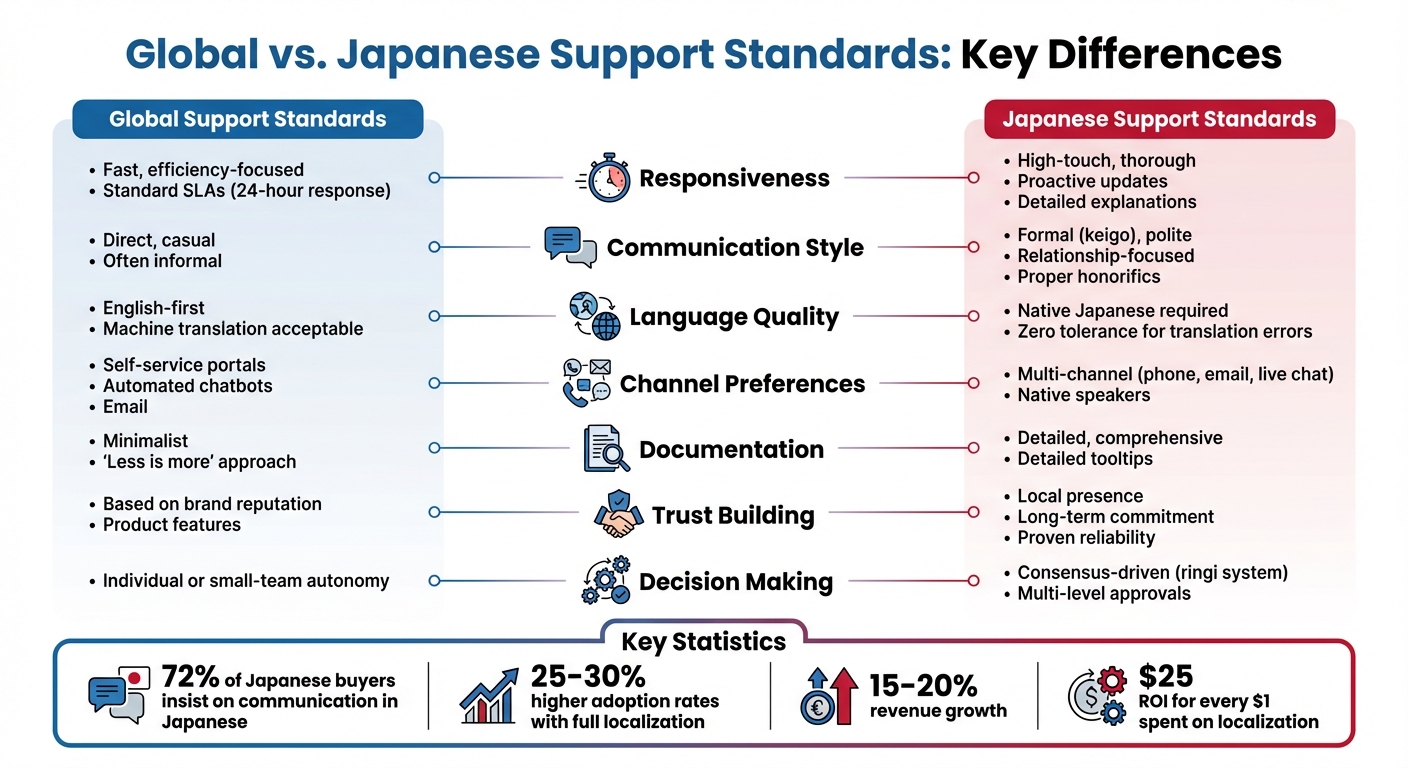
Global vs Japanese Customer Support Standards Comparison
Bridging the gap between global and Japanese support practices is essential for creating strategies that resonate in Japan. Western approaches often need to adjust to align with Japan’s high expectations.
When it comes to responsiveness, the focus differs widely. Global standards prioritize speed, using tools like 24/7 chatbots, quick ticket resolutions, and standardized SLAs. In contrast, Japanese customers value thoroughness and proactive communication over sheer speed. They expect detailed updates, clear explanations for issues, and reassurances that problems won’t happen again.
Communication styles also stand out as a major difference. Western support often leans on direct, casual, and efficiency-driven interactions. Japanese support, however, requires a formal tone, adhering to keigo (formal Japanese), polite language, and respect for hierarchical relationships. The quality of localized materials is seen as a direct indicator of a company’s commitment to the market. Missteps in formality or tone can quickly erode trust and credibility.
The preferred support channels further highlight these differences. While global standards focus on self-service portals, automated systems, and community forums, Japanese customers expect multi-channel support with native speakers available by phone, email, and live chat. They also demand detailed documentation, complete with comprehensive tooltips – a stark contrast to the minimalist design philosophy often favored in Western systems.
Research underscores the importance of localization for SaaS in influencing buying decisions. Companies that fully localize their services, including native Japanese support, often see adoption rates jump by 25–30% and revenue grow by 15–20%. Nihonium exemplifies this by offering native Japanese support teams and tailored strategies, which foster trust and demonstrate the long-term commitment Japanese customers expect.
Comparison Table: Global vs. Japanese Support Standards
The table below summarizes the key differences between global and Japanese support practices, offering actionable insights for aligning with Japanese customer expectations.
| Dimension | Global Support Standards | Japanese Support Standards |
|---|---|---|
| Responsiveness | Fast, efficiency-focused with standard SLAs (e.g., 24-hour response) | High-touch, thorough, with proactive updates and detailed explanations |
| Communication Style | Direct, casual, often informal | Formal (keigo), polite, relationship-focused with proper honorifics |
| Language Quality | English-first; machine translation acceptable for other regions | Native Japanese required; zero tolerance for translation errors |
| Channel Preferences | Self-service portals, automated chatbots, email | Multi-channel (phone, email, live chat) with native speakers |
| Documentation | Minimalist, "less is more" approach | Detailed with comprehensive tooltips |
| Trust Building | Based on brand reputation and product features | Based on local presence, long-term commitment, and proven reliability |
| Decision Making | Individual or small-team autonomy | Consensus-driven (ringi system) with multi-level approvals |
Conclusion
Localizing customer support for Japan goes far beyond just translating words – it’s about reshaping how you connect, communicate, and show dedication to your audience. The hurdles are substantial: offering native-language assistance across all channels, mastering formal communication styles like keigo, navigating consensus-driven decisions, addressing concerns about cloud adoption, and building trust without a physical presence.
The numbers highlight the stakes: 72% of Japanese buyers insist on communication in Japanese before adopting a product. Companies that fully localize often see adoption rates climb by 25–30% and revenue grow by 15–20%. Even more compelling, for every $1 spent on localization, businesses typically see a $25 return on investment. These figures could make or break your success in the market.
Achieving this requires precision. Native Japanese support teams must be well-versed in business etiquette. Payment methods need to align with local norms. Data handling has to comply with APPI standards, and UI/UX must cater to detail-oriented users. Additionally, fractional local teams can help manage Japan’s longer sales cycles without the hefty $400,000 expense of setting up a full local entity. As Nihonium aptly puts it, “Translation is a language task. Localization is a market entry strategy.”
To meet these needs, Nihonium provides comprehensive solutions for SaaS companies, from product localization and marketing funnel adjustments to fractional sales support and cultural alignment. Their services help bridge the gap between global practices and Japanese expectations, fostering the shinrai (trust) that’s essential for long-term partnerships in Japan.
The Japanese market rewards businesses that show commitment through thoughtful localization and a meaningful local presence. By tackling these challenges head-on, companies can earn the trust and loyalty of Japanese customers. Investing in localized support isn’t optional – it’s the key to turning cultural intricacies into a competitive edge.
FAQs
When should we hire native Japanese support vs. use a fractional team?
When tasks demand deep cultural understanding, subtle communication skills, and consistent interaction – like customer service or technical support – hiring native Japanese professionals is the way to go. Native speakers offer not only language expertise but also the ability to navigate cultural nuances, which helps establish trust and rapport with Japanese customers.
For short-term projects such as product localization or market research, where cultural fluency isn’t as essential, fractional teams can be a smart choice. This flexible approach works well for early market testing or when you’re working with a tighter budget. It allows you to get the job done without committing to a full-time team.
How can we support the ringi approval process without slowing down deals?
To keep the ringi process moving smoothly, focus on creating detailed and well-organized proposals that tackle stakeholder concerns right from the start. Incorporate nemawashi – informal, behind-the-scenes discussions – to build trust and ensure everyone is on the same page early on. By prioritizing consensus and paying attention to relationship-building, you can navigate the formal approval stages more efficiently and keep the deal progressing without unnecessary delays.
What’s the minimum local presence needed to build trust in Japan?
Building trust in Japan hinges on showing a genuine commitment to the local market. This involves maintaining consistent relationships, offering customer support tailored to local needs, and collaborating with respected Japanese companies. These actions reflect an awareness of Japanese business practices and play a key role in establishing credibility.
Related Blog Posts
- Japanese Customer Support: Essential Best Practices
- Guide to Training SaaS Teams for Japanese Customers
- How Risk Aversion Delays SaaS Deals in Japan
- 5 Ways Consensus Shapes SaaS Market Entry in Japan
 English
  Japanese