

Facebook Ads are a game-changer for SaaS companies targeting Japan. Why? They dominate the B2B space with an active audience of 26 million monthly users, including decision-makers and C-suite executives. Unlike LinkedIn, which is perceived as a job-hunting tool, Facebook thrives in Japan’s trust-oriented business culture, making it the go-to platform for professional engagement.
Here’s why Facebook Ads are effective for SaaS in Japan:
- Audience Reach: Facebook has a much larger user base in Japan compared to LinkedIn, with over 80% of its users aged 30 or older, including a significant number of professionals.
- Cost Efficiency: Lower CPCs (average $0.83) and CPAs ($19.68) compared to Google Ads make Facebook a budget-friendly option for long-term engagement.
- Trust-Oriented Targeting: Facebook’s real-name policy aligns with Japan’s preference for transparency and credibility in B2B relationships.
- Localized Approach: Tailoring content to Japanese preferences, such as using polite language (keigo) and incorporating cultural elements, boosts campaign effectiveness.
While Google Ads capture high-intent buyers and LinkedIn works for international professionals, Facebook excels at building long-term connections that align with Japan’s lengthy 12–18 month sales cycles. SaaS companies can maximize results by combining Facebook Ads with localized strategies and expert guidance.
Quick Overview:
- Best for Awareness & Engagement: Facebook Ads
- Best for High-Intent Searches: Google Ads
- Best for International Targeting: LinkedIn Ads
For SaaS companies entering Japan, Facebook offers the perfect blend of reach, cost-efficiency, and alignment with local business practices.
1. Facebook Ads
Audience Targeting
In Japan’s B2B landscape, Facebook stands out as a key platform. While LinkedIn has limited traction, Facebook dominates, with nearly 45% of its users aged 30 to 39 and around 55% being male. This makes it an essential tool for reaching professionals in the region.
Facebook’s real-name policy aligns seamlessly with Japan’s trust-driven business culture. Unlike other platforms where anonymity is common, Facebook’s transparent profiles help establish credibility, which is crucial for B2B transactions. Over 70% of users log in to follow companies, brands, or stay updated on industry news, making it a hub for professional engagement.
To effectively target the right audience, combining various signals is key. For instance, marketers can merge job titles with behavioral data (like managing business pages) and firmographics, such as company size, to zero in on decision-makers. A great example is transportation SaaS company TripMaster, which added $504,758 in net new ARR in 2025 by linking Facebook conversion data to their CRM and focusing on SQL quality instead of just lead volume. Similarly, Orion Labs achieved a 4X boost in sales opportunities by leveraging Facebook’s B2B targeting features.
This level of precision targeting lays the groundwork for highly efficient ad campaigns.
Cost Efficiency
Facebook delivers excellent cost efficiency for B2B marketers. On average, B2B SaaS companies report a CPC of $0.83 and a CPA of $19.68. Retargeting campaigns further reduce costs, cutting qualified lead expenses by up to 60% compared to cold outreach – a significant advantage in Japan, where sales cycles often span 12 to 18 months.
Video ads, in particular, are a standout choice in Japan. They generate three times as many leads and reduce cost per lead by 280% compared to static images. For example, Humble Bunny helped a luxury fashion brand achieve an average ad recall lift of 91.16% over three months by experimenting with creative content and landing pages and tracking performance. Additionally, Meta’s GEM AI model, which analyzes user behavior in real time, has been shown to increase conversions by about 5% on Instagram and 3% on Facebook Feed.
This combination of affordability and effectiveness makes Facebook an appealing option for Japanese B2B campaigns.
Cultural Fit
In Japan, Facebook is widely seen as a platform for building professional relationships rather than job hunting. This perception makes it a natural fit for fostering the trust and long-term connections that are critical in Japanese B2B sales. Moreover, the platform’s detailed content aligns with local expectations for technical precision and reliability.
Reels have proven especially effective, driving 50% higher B2B SaaS conversions. Incorporating elements of Japanese culture – such as seasonal themes or holidays like Golden Week – can enhance click-through rates and demonstrate a genuine understanding of local traditions. Additionally, targeting by age is particularly effective in Japan, where purchasing authority often correlates with seniority and experience.
Facebook’s alignment with Japanese business practices and its ability to foster trust make it a valuable tool for B2B marketers in the region.
sbb-itb-a752276
2. Google Ads
Audience Targeting
Google Ads stands out by focusing on users with clear purchasing intent, making it a powerful tool for capturing demand. When someone searches for terms like "project management software pricing" or "Salesforce alternative", they’re already well along in their buying journey. This approach complements a broader digital marketing strategy by targeting active searchers who are ready to take action.
In Japan, the search landscape has its own unique characteristics. While Google holds about 70% of the market share, Yahoo! Japan also plays a significant role in search behavior. Many Japanese professionals use Yahoo! Japan as their default portal, so running campaigns on both platforms is essential to fully capture search intent. By bidding on keywords that signal commercial interest, businesses can intercept competitor queries, protect their brand traffic, and attract demo requests from users already in the decision-making phase. Unlike Facebook’s behavior-driven targeting, Google’s reach depends entirely on search volume, making it a more intent-focused platform.
Cost Efficiency
While Google Ads often has a higher cost-per-click (CPC) compared to platforms like Facebook, it delivers leads of superior quality. Globally, the average CPC for Google Ads is $5.26, compared to Facebook’s $1.88. However, Japanese advertisers enjoy lower CPCs – about 47% less than U.S. averages. The cost per lead typically hovers around $70.11, slightly higher than Facebook Lead Ads’ $57.
This higher CPC is offset by better conversion rates. Google Search ads convert at an average rate of 7% to 7.5% across industries, significantly outpacing social media’s 1.5%. Leads generated through Google Ads often signal organizational intent, making them closer to Sales Qualified Leads (SQLs). In Japan, where decision-making often involves the consensus-driven "Ringi" process, these high-intent leads are especially valuable as they align with the country’s methodical approach to business decisions.
Cultural Fit
Cultural nuances play a big role in how ads perform in Japan. Japanese audiences value politeness and subtlety, so aggressive calls-to-action like "Buy Now" can feel pushy or even distrustful. Softer prompts, such as "Learn More" (詳しくはこちら), resonate better with local users.
"What sounds like a friendly, action-driven headline in English might come across as pushy, rude, or untrustworthy in Japanese."
Japanese users also prefer ads that are rich in detail. While Western ad designs often lean toward minimalism, Japanese audiences respond better to information-dense formats. Comprehensive descriptions and detailed sitelink extensions help build trust and transparency. Additionally, incorporating Kanji, Kana, and Romaji into keyword strategies is vital, as search behavior varies between writing systems depending on the context. For businesses entering the Japanese market, localization services like Nihonium (https://nihonium.io) can help tailor strategies to meet these specific needs.
It’s worth noting that Japanese users tend to be more cautious before clicking on ads. Click-through rates may be lower compared to Western benchmarks, but this reflects a thoughtful, risk-averse mindset. Japanese buyers prioritize vendor stability and long-term relationships over impulsive decisions, which can lead to more reliable sales outcomes in the long run.
3. LinkedIn Ads
Audience Targeting
LinkedIn has a relatively small presence in Japan, reaching just 4.2 million active users – roughly one-tenth of Facebook’s monthly audience. This limited reach makes LinkedIn less impactful for B2B marketing in the region. Many Japanese professionals see LinkedIn as a job search tool rather than a networking platform. Brandon Giles from Info Cubic Japan notes:
"The Japanese view LinkedIn is primarily as a search engine for job seekers, and not much beyond that."
Profiles on LinkedIn in Japan are often outdated, as users typically update them only when actively seeking jobs. This results in a user base that skews toward bilingual professionals, recruiters, or those engaged in international business. Unfortunately, this leaves a large portion of local decision-makers out of reach, further limiting LinkedIn’s effectiveness in Japan.
Cost Efficiency
LinkedIn’s high cost-per-click (CPC) in Japan significantly reduces its appeal. CPC rates generally range from $5 to $20 or more, far higher than Facebook’s $0.50 to $2.00. Campaigns on LinkedIn often struggle with low engagement, as the platform is not a primary space for professional interaction among Japanese users. Alvin Tsoi from The Egg highlights this issue:
"Japanese people view LinkedIn more as an international job search site than a professional networking platform… Facebook is where business decision makers are most active."
For SaaS companies operating on tight budgets, LinkedIn ads often fail to deliver meaningful returns in Japan. The combination of low engagement and a limited audience makes it difficult to justify the platform’s higher costs.
Cultural Fit
LinkedIn’s structure and approach often clash with Japanese business culture. Professionals in Japan are generally reserved about sharing personal details online, and LinkedIn’s open networking model can feel at odds with local preferences for privacy and modesty. The platform’s predominantly English-language interface also creates accessibility challenges for many users. In Japan, professional networking relies heavily on personal referrals and face-to-face interactions, which LinkedIn struggles to replicate.
While LinkedIn does cater to professionals, its cultural disconnect gives Facebook a clear advantage in Japan. Building shinrai (trust) is a cornerstone of Japan’s B2B market, and platforms that align with these trust-based practices are more effective. For SaaS companies aiming to reach Japanese enterprises, LinkedIn works best for highly targeted, account-based campaigns focused on international firms.
Pros and Cons
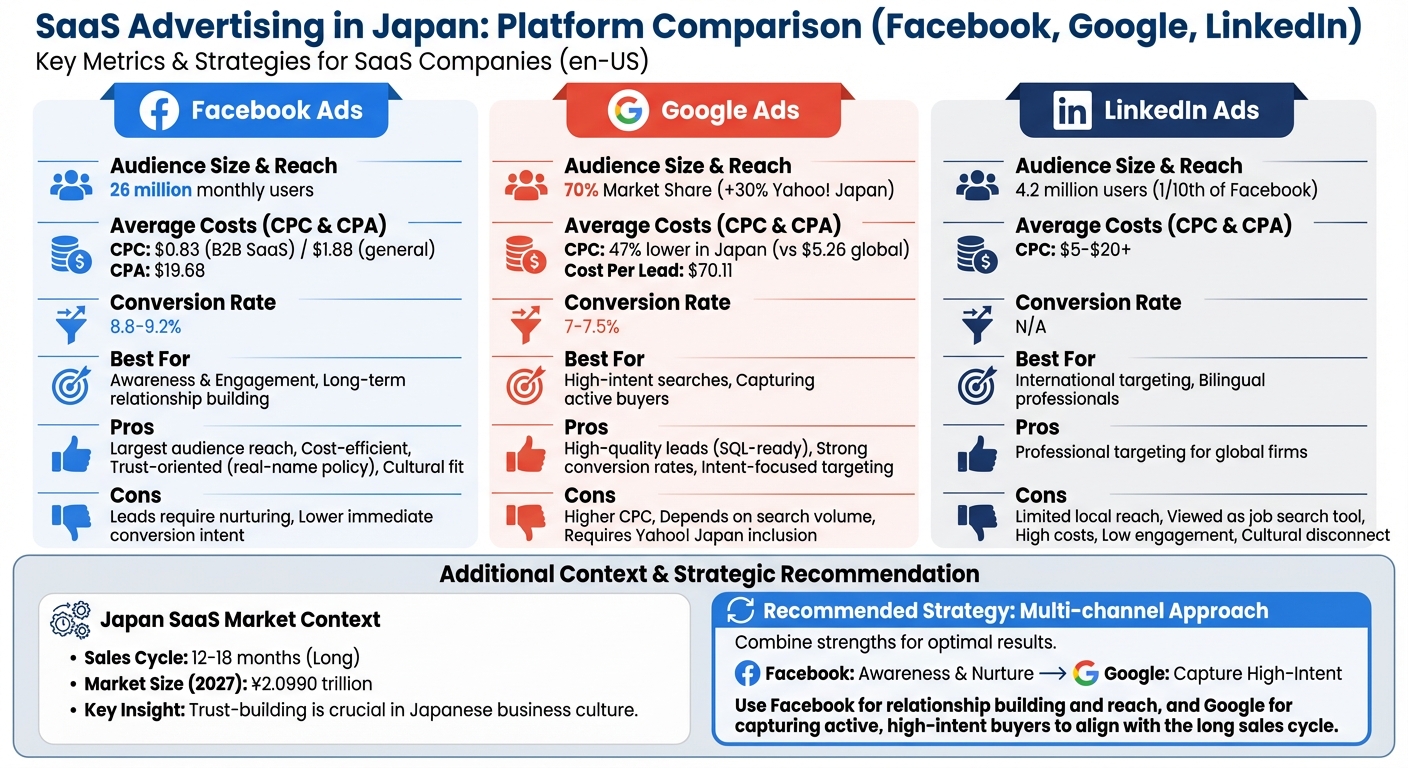
Facebook vs Google vs LinkedIn Ads for SaaS in Japan: Cost and Performance Comparison
When entering the Japanese SaaS market, each advertising platform brings its own mix of advantages and challenges. Understanding these factors helps allocate your budget wisely and craft a multi-channel strategy that plays to each platform’s strengths.
Facebook Ads are a standout for reaching Japan’s decision-makers, with an audience of 26 million – significantly larger than LinkedIn’s 3–4 million. Plus, Facebook offers a lower average CPC at $1.88 compared to Google’s $5.26. While Facebook is excellent for awareness campaigns, its leads often require nurturing to convert, with conversion rates hovering between 8.8% and 9.2%.
Google Ads, on the other hand, excel at capturing high-intent buyers actively searching for terms like "software pricing." This makes them a source of strong sales-qualified leads. However, the higher costs and reliance on existing search volume can be limiting. It’s also crucial to include Yahoo! Japan in your campaigns, as it accounts for nearly 30% of search traffic in Japan.
LinkedIn Ads are better suited for targeting international professionals but fall short in reaching local Japanese decision-makers. They also come with higher CPCs, making them less cost-effective.
The most effective strategy combines these platforms. Facebook can drive brand awareness and warm up audiences, while Google Ads can capture those ready to take action. This approach aligns well with B2B SaaS sales cycles in Japan, which typically span 12–18 months. In such a trust-driven market, building relationships over time is crucial before buyers commit.
Conclusion
Facebook Ads stand out as a powerful tool for SaaS companies aiming to break into the Japanese market. With around 26 million monthly active users, Facebook significantly outpaces LinkedIn in Japan, making it the go-to platform for reaching corporate decision-makers and C-suite executives. This is critical in a country where building trust is key to navigating the lengthy 12–18 month sales cycles often required for enterprise deals.
While Google Ads excel at capturing immediate search intent, Facebook shines in fostering long-term engagement. Its ability to retarget users and support relationship-building aligns perfectly with Japan’s consensus-driven "ringi" decision-making process. Additionally, Facebook’s real-name culture ensures more reliable targeting, giving SaaS companies a direct line to professional audiences that other platforms with anonymous users simply can’t match.
However, succeeding in Japan requires more than just leveraging the right platform. Tailored communication is essential. This means crafting ad copy in keigo (polite Japanese), designing visually dense creatives that resonate with local preferences, and ensuring landing pages accommodate local payment methods like bank transfers and convenience store payments. These localization efforts demonstrate a company’s commitment to meeting the expectations of Japanese buyers.
To further enhance their market entry, SaaS companies can work with partners like Nihonium. Nihonium offers services that go beyond translation, providing fractional sales support, marketing funnel development, and custom go-to-market strategies aligned with Japanese business culture. Their expertise ensures that every stage of the buyer journey – from the first Facebook ad to the final procurement decision – reflects a deep understanding of local needs. This integrated approach not only builds trust but also signals a genuine commitment to Japanese enterprise clients.
With Japan’s SaaS market projected to hit ¥2.0990 trillion by 2027, combining Facebook’s reach with precise localization strategies positions SaaS companies to succeed in one of Asia’s most promising enterprise software markets.
FAQs
How should I split budget between Facebook and Google in Japan?
In Japan, it’s important to tailor your budget to each platform’s strengths. Facebook is particularly effective for B2B marketing and establishing trust, especially with professionals aged 30 and older. On the other hand, Google Ads are great for capturing high-intent leads through its search and display networks. A good starting point is a 50/50 or 60/40 split, focusing more on Facebook for building brand awareness and using Google Ads to drive traffic from users with clear intent. From there, adjust your allocation based on the results and your specific goals.
What Facebook targeting works best for Japanese B2B decision-makers?
When targeting Japanese B2B decision-makers on Facebook, some strategies stand out as especially effective. Start by leveraging lookalike audiences built from your existing customer data. This helps you reach users with similar traits to your current clients.
Focus on individuals over 30 years old who use Facebook primarily for professional networking. This aligns with how the platform is often utilized in Japan, where Facebook serves as a tool for business connections.
Finally, combine prospecting to find new leads with remarketing to re-engage users who’ve already interacted with your brand. Together, these approaches make Facebook a powerful channel for connecting with Japanese decision-makers in the B2B space.
What localization changes boost Facebook ad conversions in Japan?
Localization tweaks can make a big difference when running Facebook ads in Japan. Start by using formal Japanese (keigo) to show respect and professionalism – this is especially important in business contexts. Pair this with visuals that resonate with Japanese culture, as imagery plays a significant role in capturing attention. Your messaging should also align with Japanese business norms, emphasizing trust, harmony, and group-oriented values.
Beyond Facebook, knowing the local digital landscape is crucial. Platforms like LINE, Yahoo! Japan, and Twitter Japan are hugely popular and can complement your advertising efforts. Understanding how these platforms are used can help you craft a more effective strategy for reaching your audience in Japan.
Related Blog Posts
- Native Advertising Best Practices for Japan SaaS
- How SaaS Companies Localize Ads for Japan
- 5 Customer Acquisition Tips for SaaS in Japan
- Japanese SaaS Market: Positioning Case Studies
 Japanese
  English