

Japan’s marketing calendar revolves around timing, not just messaging. Success hinges on aligning campaigns with fiscal cycles, seasonal trends, and key events. This alignment is a critical component of a successful SaaS GTM strategy in the region. Here’s a quick breakdown:
- Fiscal Year (April 1–March 31): March sees heavy B2B sales activity as budgets close, while April opens new opportunities with fresh budgets.
- Seasonal Peaks: Summer (June/July) and winter (December) drive consumer and B2B activity. Plan content 6–8 weeks ahead to capture early interest.
- Holiday Downtime: Avoid major campaigns during Golden Week (late April–early May), Obon (mid-August), and New Year (late December–early January) when business slows.
Key opportunities include:
- Spring (Jan–May): New Year (Oshogatsu), fiscal year-end spending, cherry blossom season, and Golden Week.
- Summer (June–Aug): Rainy season, summer bonuses, Ochugen gifting, and Obon.
- Autumn (Sept–Nov): Trade shows, Halloween, Black Friday, and Oseibo (year-end gifting).
- Winter (Dec–Jan): Winter bonuses, Christmas (romantic focus), and New Year promotions.
Timing is everything – publish content early, avoid holiday closures, and update seasonal campaigns annually to stay relevant.
Spring Campaign Windows: January to May
Spring in Japan, spanning January to May, is a bustling period for marketing. It blends deep-rooted traditions, a unique fiscal calendar, and major travel events into a series of high-spending opportunities. Timing is everything during this season.
New Year and Winter Holiday Promotions (January)
January revolves around Oshogatsu (New Year), a time when consumers embrace a "fresh start" mindset. A key retail driver is Fukubukuro – mystery "lucky bags" sold at significant discounts. In Japan, searches for fukubukuro rival the intensity of Black Friday searches in the US. Adding to this spending surge are winter bonuses, which can range from one to five months’ salary at larger companies.
For SaaS businesses, January is the perfect time to promote tools for productivity, health, and home organization. Japanese consumers are particularly open to products that support personal growth and habit-building during this period. Content should be ready by December 20 to capture search interest before the New Year holiday closures slow activity.
"A foreign brand with no content strategy around gift-giving is absent at exactly the moments Japanese consumers are most motivated to spend." – Tokyo SEO Maker
Fiscal Year-End and New Fiscal Year Start (March–April)
March and April are pivotal for B2B marketing and buying patterns in Japan. By December, businesses should begin outreach, as deals closing in March often stem from relationships and proposals initiated months earlier. April, on the other hand, ushers in new budgets, creating opportunities for fresh proposals and vendor evaluations.
This period also aligns with Shin-seikatsu ("New Life"), a season when students and new employees relocate, driving demand for home goods, electronics, and onboarding tools. This surge in demand makes it a critical time to optimize SaaS landing pages in Japan for conversion.
"Even the most well-crafted proposals may fail to gain traction if delivered at an ill-suited time." – TAMLO
As the fiscal year transitions, consumer interest shifts toward cherry blossom season and Golden Week.
Cherry Blossom Season and Golden Week (April–May)
Sakura season, from late March to early April, is a brief but impactful consumer peak. Brands across industries like food, cosmetics, and retail launch limited-edition cherry blossom-themed products to capture the season’s fleeting allure. Packaging with sakura designs significantly boosts engagement during this short two-to-three-week window.
Golden Week, which runs from April 29 to May 6 in 2026, is Japan’s largest travel period, with 20–25 million people traveling domestically or internationally. Golden Week content should go live by mid-March to align with high-intent booking searches, which typically taper off by April 15. A practical tip: instead of creating new seasonal content annually, update existing articles with the current year (e.g., "Best Golden Week Travel Deals 2026") to leverage SEO momentum.
Below is a summary of the key spring campaign dates and their focus areas:
| Period | Key Event | Primary Focus | Content Deadline |
|---|---|---|---|
| January | Oshogatsu / New Year | Lucky bags, wellness, productivity | Dec 20 |
| March | Fiscal Year-End / White Day | B2B budget cycles, reciprocal gifting | Feb 28 |
| March–April | Shin-seikatsu (New Life) | Home goods, appliances, onboarding tools | Early March |
| April | Sakura / New Fiscal Year | Limited editions, proposals, formal wear | Mid-March |
| Late April–May | Golden Week | Travel, outdoor gear, Mother’s Day | March 15 |
sbb-itb-a752276
Summer Campaign Windows: June to August
Summer in Japan unfolds across three distinct phases: June’s rainy season, July’s bonus-driven spending, and August’s holiday lull. Each period offers unique opportunities for marketers, as strategies adapt from spring’s fiscal transitions and festive highlights.
Rainy Season Promotions (June)
June kicks off Japan’s rainy season, known as Tsuyu. With outdoor activities taking a backseat, people gravitate toward indoor pursuits like streaming, home workouts, and organizing their spaces. For SaaS companies, this is a prime time to spotlight localized tools that boost productivity and support at-home or remote lifestyles.
Advertising costs are typically lower in June, offering a window to build brand awareness before competition ramps up later in the summer. This period also coincides with the start of the Ochugen gifting season and the approach of summer bonuses, making it an ideal time for B2B teams to engage in Q2 budget discussions or pitch cost-saving solutions.
"In Japanese marketing, itsu uru ka (いつ売るか) – ‘when you sell’ – matters as much as what you sell." – Chokudori ASP
To make the most of this quieter month, publish summer-themed content six to eight weeks ahead to align with early planners. After this calm period, consumer activity ramps up in July, driven by seasonal events and bonus payouts.
Summer Festivals and Obon (July–August)
July ushers in a surge in consumer spending, fueled by summer bonuses. These payouts encourage big-ticket purchases, travel bookings, and self-indulgent spending. The Ochugen gift-giving season peaks during this time, with gift sets priced around ¥3,000, ¥5,000, and ¥10,000 being especially popular. Seasonal events like Tanabata and fireworks festivals further energize markets, creating opportunities for fashion, travel, and entertainment brands.
In contrast, August sees a slowdown as the Obon holiday, typically observed from August 10 to 16, brings the country to a near standstill. Offices empty, decision-makers go on leave, and logistics operations slow down. During this period, it’s wise to pause or significantly scale back B2B ad spending and campaigns reliant on heavy logistics. Instead, focus on offering educational materials like whitepapers or checklists, as professionals often use this downtime for research. By August 19, when routines resume, outreach efforts can pick up again.
| Month | Key Events | Primary Opportunity | Timing Note |
|---|---|---|---|
| June | Tsuyu, Father’s Day | Indoor tools, brand awareness | Lower CPCs; publish content six to eight weeks early |
| July | Bonuses, Tanabata, Ochugen | Big-ticket purchases, gifting campaigns | Target bonus spend; use price-specific gift guides |
| August | Obon, Summer Festivals | Educational content, relationship building | Pause B2B ads Aug 10–16; resume Aug 19 |
Autumn Campaign Windows: September to November
As summer winds down, autumn breathes new life into Japan’s market with a surge in business activity and cultural events. September marks the start of the fiscal year’s second half for many companies, October is packed with major B2B trade shows, and November gears up for year-end gifting and bonus-related spending. For SaaS companies, these three months present a prime opportunity for targeted campaigns. Understanding the current landscape of SaaS adoption in Japan is crucial for timing these efforts effectively.
Back-to-School and Business Reopenings (September)
September feels like a reset button. Schools are back in session, offices return to full capacity, and businesses dive into Q4 planning and forecasting for the next fiscal year (starting in April). A standout date is September 1 – Disaster Prevention Day, which drives significant interest in emergency preparedness products and services. Looking ahead to 2026, Silver Week (September 21–23) offers a rare five-day holiday stretch, boosting domestic travel and leisure-related spending. To make the most of this period, aim to launch B2B campaigns before September 21, as many decision-makers may be offline during the holiday.
Timing is key when it comes to content. Publish autumn-focused materials six to eight weeks ahead of peak dates to capture early planners and allow time for indexing. As October approaches, trade shows and seasonal events provide fresh engagement opportunities.
Trade Shows and Halloween (October)
October is a big month for B2B lead generation in Japan. High-profile events like Japan IT Week and Inter BEE attract vendors, procurement teams, and decision-makers, making it a critical time for vendor selection and implementation talks. The best strategy? Pair pre-event promotions on platforms like LinkedIn with post-event follow-ups, such as sending a whitepaper or relevant resource within a week of the event.
On the consumer side, Halloween has become a major commercial event, especially among people aged 20–35. While it’s not about trick-or-treating, the focus on costumes, limited-edition food and beverages, and "Instagrammable" moments has fueled its popularity. For SaaS brands targeting younger professionals or consumer markets, Halloween-themed campaigns can drive engagement. Keep visuals playful and tailored to Japanese preferences rather than relying on Western-style horror imagery.
Fall Gifting and Seasonal Promotions (November)
November ramps up with Black Friday and early Oseibo preparations. In Japan, Black Friday has evolved into a one- to two-week "smart shopping" event, typically held in mid-to-late November. This period aligns with Labor Thanksgiving Day (November 23), bridging autumn clearance sales with winter bonus spending. During these seasonal peaks, conversion rates across affiliate networks can soar by 40–150% compared to quieter periods.
Oseibo, the practice of giving year-end gifts to express gratitude, also kicks off in November. Businesses and individuals alike begin selecting gifts for clients and superiors, contributing to a market worth over ¥500 billion (~$3.2 billion USD) annually. Popular price points include ¥3,000, ¥5,000, and ¥10,000. For affiliate campaigns, increasing commission rates by 20–30% during this time can motivate publishers and capitalize on the bonus-season buzz.
| Month | Key Events | SaaS/B2B Focus | Consumer Focus |
|---|---|---|---|
| September | H2 Start, Silver Week, Disaster Prevention Day | Q4 budget planning, productivity tools | Travel, back-to-school, preparedness |
| October | Japan IT Week, Inter BEE, Halloween | Trade show lead gen, vendor selection | Costumes, themed F&B, autumn foliage |
| November | Black Friday, Oseibo prep, Labor Thanksgiving | Next fiscal year budget setting | Smart shopping, gifting, bonus planning |
Winter Campaign Windows: December to Early January
December is Japan’s biggest spending month, largely thanks to winter bonuses (tōki shōyo) that range from one to five months’ worth of salary. These bonuses, typically paid in mid-December, fuel purchases of big-ticket items like luxury goods, appliances, and travel. Timing is everything – this is a prime window to close deals and secure year-end budgets.
Year-End Business Activity and Holiday Closures (December)
For B2B, December is all about spending leftover budgets. Many Japanese companies close their third quarter in December, so teams rush to use any remaining approved funds before the year wraps up. If you’re pitching to decision-makers, aim to start conversations by early December, and keep proposals short to accommodate the end-of-year crunch.
"December is Japan’s highest-spending month… Christmas is a romantic occasion – couples exchange gifts and eat strawberry shortcake." – Chokudori ASP
On the consumer side, Oseibo gifting continues through mid-December, with people exchanging premium gifts. By Christmas Eve (December 24), the focus shifts to romantic celebrations. In Japan, Christmas feels more like Valentine’s Day, with couples giving gifts like jewelry or booking fancy dinners. High-end experiences and accessories dominate the season.
Keep in mind that December’s gift-related keywords often push CPC bids two to three times higher. To stay competitive, consider increasing CPA commissions by 20–30% for better publisher placement. Also, most businesses and logistics services shut down from December 29–30 through January 3 (Oshogatsu), so scaling back campaigns that rely on timely delivery can help you avoid customer dissatisfaction.
Once the holiday closures wrap up, the focus shifts toward early January promotions.
New Year Planning and Promotions (Late December to Early January)
After the year-end spending frenzy and Oshogatsu closures, businesses and retailers dive into New Year promotions. Early January brings Hatsuuri (the year’s first sales) and Fukubukuro – sealed "lucky bags" sold at steep discounts. These promotions generate excitement and drive foot traffic, with Fukubukuro searches rivaling "Black Friday deals" in the U.S.. Retailers use this period to clear inventory while creating buzz on social media.
January also brings a shift in consumer focus toward self-improvement. Fitness, productivity tools, and organizational products see a surge in demand, making it a great time for SaaS companies to market these solutions. On the B2B front, January becomes a key month for vendor evaluations and RFP reviews as businesses prepare for the fiscal year starting in April.
"January becomes one of the strongest months for vendor evaluations and RFP reviews as teams prepare for the April fiscal year." – COVUE
To make the most of New Year promotions, ensure your campaigns are live by December 15. Using visuals tied to Japanese New Year traditions – like Osechi dishes and decorative motifs – can help you connect with local audiences and build trust.
| Period | Key Event | Consumer Behavior | B2B/SaaS Strategy |
|---|---|---|---|
| Early–Mid December | Oseibo & Winter Bonuses | Premium gifting; high-ticket purchases | Finalize proposals to capture remaining budgets |
| December 24–25 | Christmas | Romantic gifts, jewelry, dining | Use concise messaging; avoid family-centric themes |
| December 29–January 3 | Oshogatsu | Nationwide holiday; business closures | Pause ad spend and logistics-intensive campaigns |
| January 2–5 | Hatsuuri & Fukubukuro | Lucky bag shopping; first-sale bargains | Resume campaigns targeting resolution-driven buyers |
| Mid–Late January | New Year Planning | Focus on fitness, productivity, and organization | Leverage peak vendor evaluations and RFP reviews |
Japan-Specific Campaign Planning Rules
In Japan, timing isn’t just important – it’s everything. Unlike many Western campaign workflows, where flexibility often reigns, Japan demands meticulous planning and extended preparation periods. This is especially true when evaluating options for entering the Japanese market. To succeed, you’ll need to build extra time into your campaign calendar.
Extended Lead Times for Japan Campaigns
Japanese consumers start searching for seasonal events far earlier than you might expect – typically 3–6 weeks in advance. To stay ahead, your content needs to be live and indexed well before the search surge begins. For major events like Golden Week or Oseibo, aim to publish content 6–8 weeks ahead. For smaller events, a 4-week lead time is usually sufficient.
Creative assets like banners, ad copy, and affiliate links should be submitted 2–4 weeks before launch. Missing these submission windows can mean losing out on prime ad placements. As Tokyo SEO Maker explains:
"Publishing a Golden Week travel guide in late April, when the holiday has already begun, means you missed the peak search window entirely."
Another key strategy is keeping your seasonal pages updated with the current year (e.g., "Best Business Software for Japan 2026"). Google Japan’s algorithm places heavy emphasis on freshness and update history for seasonal searches. Regularly refreshing existing pages often delivers stronger results than creating entirely new ones.
These longer timelines reflect Japan’s unique consumer behavior and seamlessly tie into the challenges posed by holiday-related scheduling.
Scheduling Around Holiday Closures and Business Cycles
Beyond early publishing, your campaign planning must also account for Japan’s holiday cycles. Three major holiday periods – Golden Week (late April to early May), Obon (August 10–16), and Oshogatsu (December 29 through January 3) – can disrupt business operations. During these times, offices close, logistics slow down, and key decision-makers are often unavailable. Attempting to run B2B outreach or logistics-heavy campaigns during these windows is rarely effective.
Here’s a quick guide to recommended publication deadlines for key events:
| Event | Recommended Publication Deadline | Peak Search Window |
|---|---|---|
| Oshogatsu (New Year) | December 20 | Mid-Dec – Late Dec |
| Valentine’s Day | January 28 | Late Jan – Feb 10 |
| White Day | February 28 | Late Feb – Mar 10 |
| Cherry Blossom Season | February 28 | Early March – Peak Bloom |
| Golden Week | Mid-March | Mar 15 – Apr 20 |
| Ochugen (Mid-year Gift) | June 1 | Late May – Early July |
| Oseibo (Year-end Gift) | November 10 | Early Nov – Dec 15 |
| Black Friday | Late September | Late November |
Incorporating these deadlines into your schedule ensures your campaigns align with Japan’s fiscal and cultural rhythms.
For B2B campaigns, Japan’s April–March fiscal year creates a unique budget cycle compared to the U.S. The critical "budget flush" period runs from January through March, meaning outreach should start in December to stay on decision-makers’ radars during final budget approvals. If you’re planning a major product launch or campaign for April, all contracts, localized materials, and compliance reviews with local partners need to be finalized by late February.
These strategies aren’t just helpful – they’re essential for navigating Japan’s structured approach to seasonal and fiscal planning.
Seasonal Event Table: A Full-Year Overview
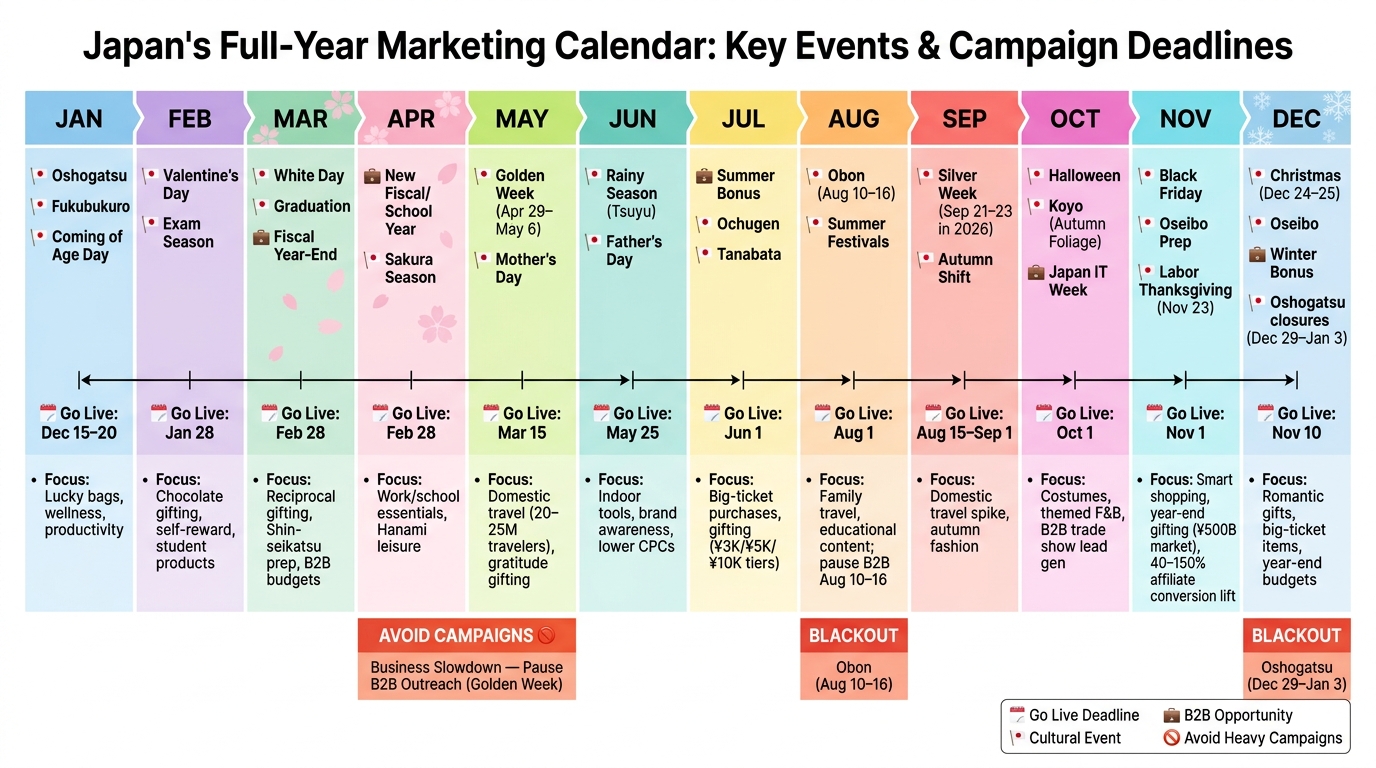
Japan’s Full-Year Marketing Calendar: Key Events & Campaign Deadlines
Here’s a handy table summarizing key seasonal events and marketing opportunities across the year. It’s a quick reference to help with campaign planning and timing.
Special Note: September 2026 brings a rare twist – a five-day Silver Week cluster (September 21–23) is expected to drive a significant increase in leisure travel. Additionally, the Oseibo gifting season highlights the importance of allocating resources effectively during the year’s final months.
| Month | Major Events | Marketing Implications | Recommended "Live" Date* |
|---|---|---|---|
| January | Oshogatsu, Fukubukuro, Coming of Age Day | Focus on the "reset" mindset; promote lucky bag sales, wellness, and resolution-related products | Dec 15–20 |
| February | Valentine’s Day, Exam Season | Chocolate gifting (women to men), self-reward beauty and sweets, and student support products | Jan 28 |
| March | White Day, Graduation, Fiscal Year-End | Emphasis on reciprocal gifting, Shin-seikatsu (new lifestyle) prep, and B2B budget spending as Japanese SaaS companies compete for year-end allocations | Feb 28 |
| April | New Fiscal/School Year, Sakura | Essentials for work and school, commuting gear, and Hanami (cherry blossom viewing) leisure | Feb 28 |
| May | Golden Week, Mother’s Day | Domestic travel surge (20–25 million travelers), gratitude gifting, and a slowdown in B2B activity | Mar 15 |
| June | Rainy Season (Tsuyu), Father’s Day | Push dehumidifiers, rain gear, indoor hobbies, and prep for summer bonus spending | May 25 |
| July | Summer Bonus, Ochugen | Highlight big-ticket electronics, formal mid-year gifting; summer bonuses average ≈ $6,605 USD | Jun 1 |
| August | Obon, Summer Festivals | Promote family homecoming travel, regional specialty gifts, and expect minimal B2B activity | Aug 1 |
| September | Silver Week (2026: Sep 21–23), Autumn Shift | Spike in domestic travel, autumn fashion trends, and senior-oriented gifts | Aug 15–Sep 1 |
| October | Halloween, Koyo (Autumn Foliage) | Costumes, themed food and drinks, and travel for leaf-viewing | Oct 1 |
| November | Black Friday, Oseibo Prep, Shichi-Go-San | Encourage "smart shopping" for winter bonuses and early year-end gift planning | Nov 1 |
| December | Christmas, Oseibo, Winter Bonus | Focus on romantic gifts, year-end parties (Bonenkai), and self-reward spending on big-ticket items | Nov 10 |
*"Live" refers to the optimal time to publish content for maximum campaign effectiveness.
Quick Tip: In Japan, Christmas is celebrated in a secular way, with a strong focus on couples. Christmas Eve is especially popular for dining out and exchanging partner gifts.
Localization Notes for Japan
When localizing campaigns in Japan, timing is everything. Align your messaging with key cultural moments that influence consumer behavior. For example, January and April are pivotal reset periods for Japanese consumers. These months mark times when people are more open to adopting new habits or switching brands. Missing these windows can make it much harder to gain traction for the rest of the quarter.
Tone matters just as much as timing. Japanese audiences prefer messaging that feels grounded and intentional, rather than overly promotional. For instance, during Japan’s rainy season in June, practical, solution-focused copy tends to perform well. On the other hand, during Oseibo (the year-end gifting season), a formal and appreciative tone reflects an understanding of the occasion’s cultural significance. In regions like Osaka, a more straightforward and approachable style resonates best.
Gift culture plays a big role in shaping consumer behavior. During Ochugen (summer gifting) and Oseibo, shoppers often focus on specific price tiers – ¥3,000, ¥5,000, and ¥10,000 – because social norms dictate how much to spend based on the relationship. Crafting gift guides around these price points aligns your offerings with how people naturally shop during these periods.
"Japanese consumers do not simply buy when they need something; they buy at socially sanctioned moments." – Chokudori ASP
Visual design also carries significant weight. Seasonal imagery, like sakura (cherry blossoms) in spring or momiji (autumn leaves) in fall, is more than just decoration – it demonstrates cultural awareness and builds trust with Japanese audiences. Starbucks Japan showcased this perfectly in 2023 with its Sakura collection. Described as "a perfect fusion of seasonal essence and caffeinated experience", the campaign struck a chord with consumers during the spring "New Lifestyle" season.
By weaving these localization strategies into your seasonal marketing plans, you can better connect with Japanese audiences.
How Nihonium‘s Localization Services Can Help
Nailing the strategies above can be tricky, especially for teams unfamiliar with Japan’s unique market dynamics. That’s where Nihonium comes in. They specialize in helping global SaaS companies adapt to Japan’s market with services like product localization, marketing funnel creation, fractional sales support, and tailored market entry strategies. Rather than relying on generic translations, Nihonium ensures your campaigns are built to reflect how Japanese businesses and consumers actually operate – season by season.
Conclusion: Making the Most of Japan’s Marketing Calendar
Japan’s marketing calendar is more than just a timeline – it’s a guide to understanding how businesses and consumers make decisions. Budget cycles, cultural traditions, and seasonal cues all play a role in shaping purchasing behavior. Simply put, timing can make or break a campaign.
"Japan rewards brands that treat seasonality as strategy, not decoration." – BeBoundless
Research shows that aligning marketing efforts with cultural events can increase engagement by as much as 300%. For B2B businesses, sales cycles typically range from 6 to 18 months. This means planning ahead is crucial – timing is everything.
To succeed, campaigns should follow these essential practices: publish SEO content 6–8 weeks before peak search periods, steer clear of major outreach during Golden Week, Obon, and the New Year holiday season, and update seasonal content annually instead of starting from scratch. These steps ensure campaigns stay relevant and effective over time.
Preparation and cultural sensitivity are key to winning in Japan. Campaigns that respect the traditional ringi decision-making process, focus on appropriate price points for gifting, and align with cultural moments consistently outperform those that don’t.
"A one-size-fits-all global strategy rarely succeeds." – BeBoundless
For those navigating the state of SaaS in Japan, the seasonal calendar is an essential resource. Review it quarterly, adapt to trends like Silver Week 2026 (September 21–23), and refine your approach as you gain deeper insights into your audience’s behavior throughout the year.
FAQs
When should I publish seasonal content for Japan?
To make an impact in Japan, timing your content around major seasonal events is key. Consumer searches for holidays tend to spike 3–8 weeks before the actual event, even though campaign planning often begins 3–6 months earlier. For example, if you’re targeting New Year’s, aim to have your content live by December 20.
Rather than creating brand-new posts every year, consider updating your existing ones. This approach lets you build on previous engagement and maintain relevance without starting from scratch.
Which Japan holidays should I avoid for B2B campaigns?
Avoid planning critical B2B activities during major Japanese holidays, as many businesses either close or operate at a slower pace. Key periods to watch out for include Golden Week (April 29–May 6), late December to early January (New Year), and Obon in mid-August. During these times, staff availability drops, decision-making slows, and engagement with professional services tends to decline.
How do I plan around Japan’s April–March fiscal year?
To align with Japan’s fiscal year, which runs from April to March, it’s crucial to adjust your B2B marketing and sales strategies to match local budget cycles. The January to March period is especially important for securing approvals and taking advantage of year-end spending opportunities. Meanwhile, April brings fresh budgets, making it the perfect time to launch new projects, conduct vendor evaluations, and establish thought leadership. Nihonium provides tailored strategies to help SaaS companies navigate these cycles efficiently.
Related Blog Posts
- Ultimate Guide To Japan Campaign Analytics
- Ultimate Guide to Co-Marketing in Japan
- How to Localize Email Campaigns for Japan
- Japanese SaaS Customers vs. Global Customers: Key Differences
 Japanese
  English