

If I were entering Japan with a SaaS GTM strategy today, I would not start with every social platform. I would start with LINE, X, and YouTube and use each one for a clear job.
Here’s the short version:
- LINE is best for follow-up, support, and buyer nurture
- X is best for market listening, reactions, and early engagement
- YouTube is best for demos, tutorials, and product proof
- note helps with long-form business content
- Zenn helps when developers or IT teams shape the deal
- LinkedIn, Facebook, Instagram, and TikTok can help, but only in narrower use cases
I’d also keep these points in mind from day one:
- Japan’s SaaS market hit Japan’s SaaS market hit $13.8 billion in 20263.8 billion in 2026
- Buying cycles often run 3 to 18 months
- LINE has about 96 million to 98 million monthly active users
- X has about 66.5 million to 67 million monthly active users
- YouTube has about 70 million monthly active users
- Webinars in Japan can turn about 30% of attendees into sales opportunities
- LinkedIn is much smaller in Japan, with about 2.4 million to 3 million monthly active users
What does that mean for you?
It means Japan social for SaaS is not about posting everywhere. It’s about using a small set of channels to help buyers:
- Find you
- Check you
- Share your materials inside their company
- Contact sales when they’re ready
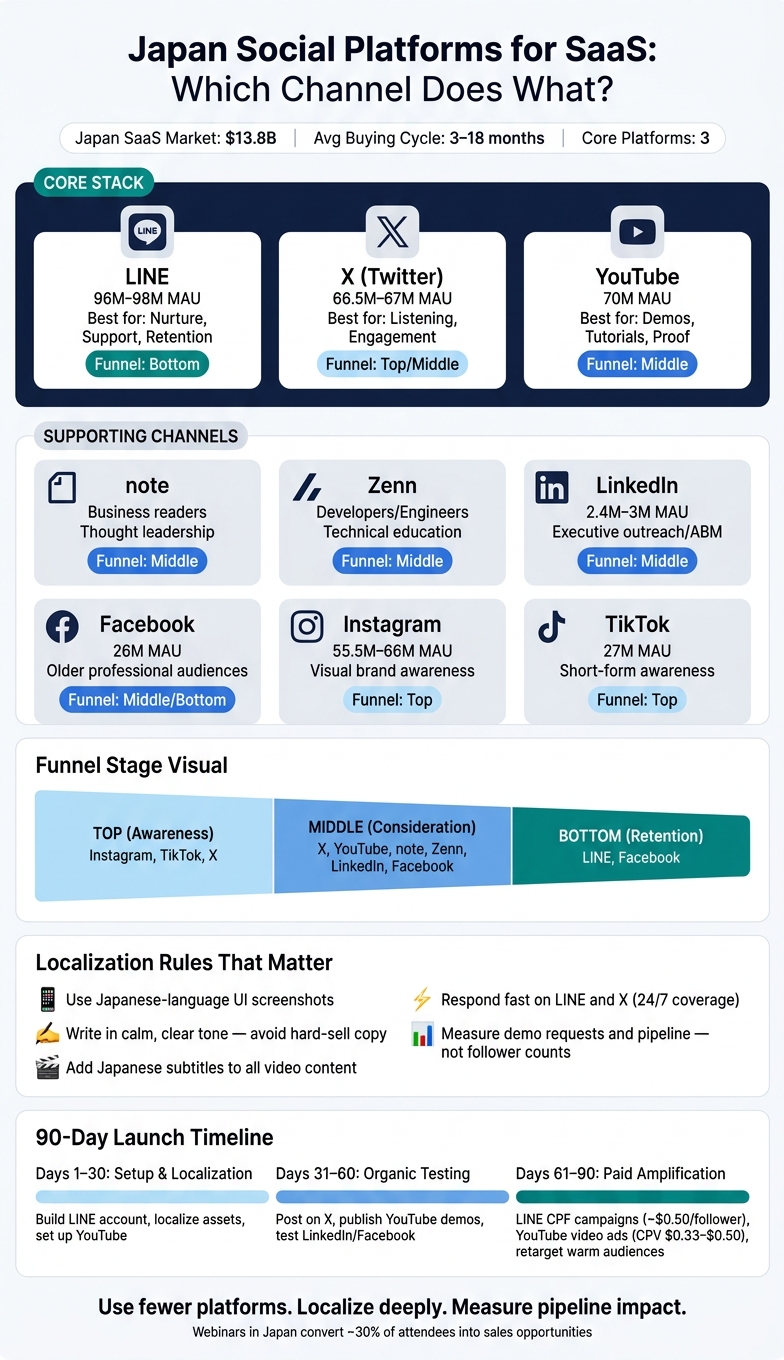
Japan Social Platforms for SaaS: Platform Comparison Guide
Quick comparison
| Platform | Best Use | Funnel Stage | Best Content |
|---|---|---|---|
| LINE | Nurture, support, retention | Bottom | Messages, FAQs, follow-up |
| X | Listening, engagement, category talk | Top / Middle | Short posts, threads, news |
| YouTube | Product education and proof | Middle | Demos, webinars, walkthroughs |
| note | Business thought leadership | Middle | Long-form articles |
| Zenn | Technical education | Middle | Dev tutorials, docs |
| Executive outreach | Middle | Company updates, ABM posts | |
| Older professional audiences | Middle / Bottom | Events, business posts | |
| Brand awareness | Top | Visual posts, Reels | |
| TikTok | Short awareness plays | Top | Short educational clips |
A few rules matter more than anything else:
- Use Japanese-language UI screenshots (common on SaaS landing pages in Japan), not English ones
- Write in a calm, clear tone instead of hard-sell copy
- Add Japanese subtitles to video
- Be ready for fast replies, especially on LINE and X
- Track business results like webinar clicks, demo requests, and retention – not just follower counts
In other words: use fewer platforms, localize more deeply, and measure pipeline impact. This approach aligns with the broader B2B SaaS sales landscape in the region. That’s the core idea behind the full guide.
sbb-itb-a752276
Japan Social Platform Roles for SaaS Teams
For most SaaS launches in Japan, only a small set of platforms matters. The nine channels that usually deserve attention – LINE, X, YouTube, Instagram, TikTok, Facebook, LinkedIn, note, and Zenn – each do a different job.
That’s the key point: pick channels based on function, not popularity alone.
Start with the ones that help with discovery, validation, and buyer follow-up. Leave the rest alone until they have a clear role. If you try to show up on all nine at once, you spread the team too thin and execution slips. The table below shows where each platform fits so you can build a lean first stack.
| Platform | Primary Audience | SaaS Use | Funnel Stage | Content Format |
|---|---|---|---|---|
| LINE | Mass market (96M–98M MAU) | Nurture & direct support | Bottom / Retention | Messaging, stickers, coupons, quizzes |
| X (Twitter) | B2B and general users (66.5M–67M MAU) | Engagement and listening | Top / Middle | Short text, threads, news |
| YouTube | All ages (70M MAU) | Education & trust-building | Middle | Long-form video, tutorials, webinars |
| Professionals in their 30s to 50s (26M MAU) | Professional networking | Middle / Bottom | Professional posts, events | |
| Millennials / Gen Z (55.5M–66M MAU) | Visual brand awareness | Top | High-quality images, Reels | |
| TikTok | Gen Z / 20s (27M MAU) | Short-form awareness | Top | Short edutainment clips |
| Niche B2B and recruiting (2.4M–3M MAU) | Niche ABM / executive outreach | Middle | Professional updates | |
| note | Business readers | Thought leadership | Middle | Long-form posts |
| Zenn | Developers / engineers | Technical education | Middle | Technical tutorials and documentation |
LINE, X, and YouTube as the Core Working Stack
If you need a starting point, begin with the three channels that do most of the heavy lifting for trust and buyer movement: LINE, X, and YouTube. LINE handles follow-up. X gives you live market language and reaction. YouTube helps people see how the product works.
LINE is more than a messaging app in Japan. It acts like part of the go-to-market plumbing. With 98 million monthly active users, LINE Official Accounts support drip campaigns, automated support flows, and direct communication with buyers.
"LINE functions as Japan’s marketing infrastructure… Platforms without a LINE strategy face a structural disadvantage." – Nihonium
X is the strongest listening channel for category language and competitor signals in Japan, with 67 million MAU. Business conversations, product reactions, and industry news all move through X. That makes it a good place to learn how buyers describe the problem before they start comparing vendors.
YouTube is a strong fit for product walkthroughs, tutorials, and webinar replays because Japanese buyers use it to check how a product works in practice.
Instagram, TikTok, Facebook, and LinkedIn as Supporting Channels
These platforms make sense when the audience is narrower or the buying stage is more specific.
- Use Instagram and TikTok for awareness
- Use Facebook for older professional audiences
- Use LinkedIn for narrow executive outreach
LinkedIn has only 2.4 million to 3 million MAU in Japan. It is used mostly for international business and job hunting, so it should not be the center of your plan. Instagram and TikTok also tend to sit lower on the priority list for most B2B launches because their user base leans younger and less tied to buying decisions.
note and Zenn for Long-Form and Technical Content
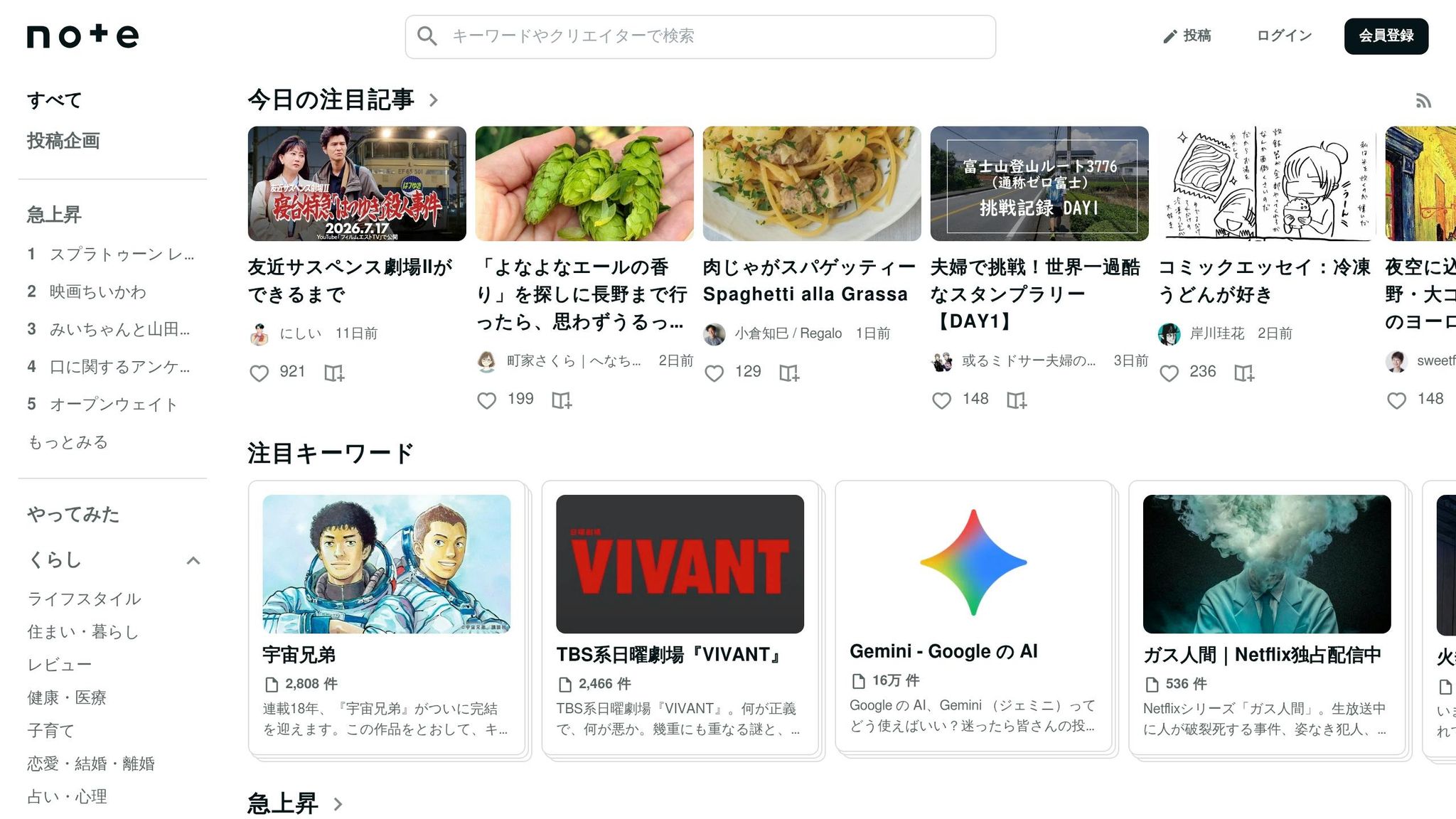
These channels are useful when depth matters more than reach.
Use note for long-form thought leadership that helps buyers build internal agreement. Use Zenn for technical content when engineers or IT stakeholders shape the sale.
Once the role of each channel is set, the next move is to match content to Japanese buyer expectations and platform norms.
Audience Patterns, Content Rules, and Localization Standards
How Japanese Users Evaluate SaaS Brands on Social
Once the platform mix is set, the next piece is the content itself. Japanese B2B buyers tend to judge SaaS brands through trust, consistency, and proof. Native-language content, verified reviews, and case studies usually matter more than polished social posts that feel broad or generic.
Japanese buyers lean heavily on domestic review sites when checking SaaS options, and they use X to look for honest product comments from actual users. Social content that points people to verified reviews and case studies fits that behavior well. Sales cycles in Japan often last 3 to 18 months because decisions are usually made through consensual decision-making. So social content needs to support a longer buying process, not push for a fast conversion.
Platform Content Restrictions and Compliance Checks
LINE has strict rules for accounts and ads. Verified LINE Official Accounts are only available to businesses registered in Japan, and the approval process is strict. Unverified accounts can still operate, but they lose trust signals and search features. LINE ads also block regulated, adult, gambling, dating, MLM, and religious categories. On the ad side, headlines must stay within 20 characters and descriptions under 75 characters.
Across platforms, it also helps to avoid hard-charging demand-gen language. Phrases that perform well in U.S. campaigns can come across as too aggressive in Japanese business settings. In most cases, informative messaging built around expertise is a better match.
What Good Localization for SaaS Products Looks Like in Social Content
The DailyFX Japan case shows what happens when a brand shifts from hard-sell creative to localized, insight-led content: 30%+ average monthly follower growth and a 110.29% increase in click-through rate.
In practice, that means adjusting several parts of the content at the same time:
- CTAs should offer learning or context instead of asking for immediate action.
- Screenshots and UI demos should show Japanese-language interfaces, not English ones.
- Video content should include localized subtitles, since many people watch during commutes with the sound off.
- On X, Japanese formatting markers like ▼, ①, and ※ can help posts stand out within the character limit.
Support flows need the same level of care. On LINE, buyers expect 24/7 responsiveness, and chatbot coverage for FAQs is now standard. On X, slow replies to public mentions can hurt credibility fast. Teams entering Japan should also prepare materials that work for internal review, such as downloadable proposal templates, ROI documentation, and case studies formatted for internal sharing. Buyers often need these assets to build agreement inside the company before any purchase decision moves ahead.
These standards affect both organic posts and paid creative in the next section.
Organic and Paid Playbooks by Funnel Stage
Once your platform stack is in place, organize content by funnel stage. The goal isn’t to be everywhere. It’s to build a tight stack that moves buyers from discovery to validation to demo.
Organic Programs for Awareness, Education, and Nurture
Start with one core asset. Then repurpose it across channels based on funnel stage: X for visibility, YouTube for education, LINE for nurture, and note for deeper decision support.
YouTube works well for demos, how-tos, and webinar replays. On X, post educational content, reply to product mentions, and track industry conversations to build trust. When someone follows your LINE Official Account, use that opening well. Send onboarding sequences, share case studies, and answer questions in a channel built for direct conversation. For buyers who want more detail before they engage, note helps reach business decision-makers with long-form content.
Organic traction should guide budget decisions. If a topic or format performs well on its own, that’s usually a good sign it’s worth putting money behind.
Paid Media Choices for Early-Stage Japan Expansion
Paid spend should follow organic signals, not come first. Once you can see which topics and formats are getting traction on X and YouTube, that’s your cue to amplify them with budget.
LINE Ads can build a warm audience through friend acquisition at about $0.50 per new follower (CPF). YouTube video ads are a fit for top-of-funnel awareness, with CPV usually between $0.33 and $0.50. After someone engages with your content, LINE retargeting can help move them toward a webinar registration or demo request. Webinars deserve extra attention here – in Japan, they can convert 30% of participants into sales opportunities.
Sample Channel Sequencing for the First 90 Days
Launch in stages: setup, testing, then amplification. That flow lines up with how Japanese B2B buying patterns influence SaaS evaluation – trust-building assets first, validation content next, and paid follow-up after messaging is confirmed.
| Phase | Timeframe | Focus |
|---|---|---|
| Setup & Localization | Days 1–30 | Build a LINE Official Account, localize core assets, set up a YouTube channel with Japanese-language content |
| Organic Testing | Days 31–60 | Post on X for listening and engagement, publish YouTube demos, and test B2B messaging on Facebook and LinkedIn |
| Paid Amplification | Days 61–90 | Run LINE CPF campaigns on validated content, launch YouTube video ads, and retarget warm audiences into demo or trial flows |
The table below maps each platform to its organic and paid role, giving the team a clear reference point as the program grows.
| Platform | Organic Role | Paid Role | Main Objective | Expected KPI |
|---|---|---|---|---|
| LINE | Customer service / retention | Friend acquisition | Loyalty & conversion | Message open rate / LTV |
| X (Twitter) | Real-time listening / news | Content promotion | Awareness & engagement | Reposts / mentions |
| YouTube | Education / SEO | Top-of-funnel video ads | Trust & discovery | View duration / search rank |
| B2B networking | Targeted lead gen | Professional credibility | Lead quality / CTR | |
| Thought leadership | Sponsored InMail | High-value B2B leads | Conversion rate |
KPIs, Team Setup, and Conclusion
KPIs That Connect Social Activity to Pipeline and Retention
Once you’ve set your channel mix and content rules, judge success by business results, not vanity metrics. Follower counts can look nice on a dashboard, but they don’t say much on their own. The metrics that matter are the ones tied to pipeline and retention. Understanding the State of SaaS in Japan helps set realistic benchmarks for these figures.
| Platform | Awareness KPI | Consideration KPI | Pipeline/Retention KPI |
|---|---|---|---|
| LINE | Friend growth (via ads/stickers) | Message open rate, click rate | Coupon redemptions, inquiry volume |
| X (Twitter) | Impressions, reach | Engagement quality (replies, reposts) | Link clicks to webinars or demos |
| YouTube | Views (Shorts, ads) | Watch depth, retention rate | Assisted conversions, description clicks |
| note / Zenn | Article views | Time on page, saves/bookmarks | Sign-ups from embedded links |
| Reach among target professionals | Content engagement from decision-makers | Lead form completions |
Use this table to track each platform by funnel stage and business outcome.
Metrics also fall apart fast when no one owns them. Clear reporting lines matter just as much as the KPI list itself.
Lean Team Structure for Running Japan Social
You don’t need a big team to run Japan social well. But you do need the right roles covered.
At a minimum, that means:
- A strategy owner
- A native-level Japanese editor or copywriter
- A designer or video editor
- Someone who works with sales or customer success
Poor Japanese hurts trust and makes localization look weak. Only 8.7% of Japanese professionals report confidence using English, and machine-translated copy can be penalized by search engines and users. That’s why the localization lead should review every asset before launch, not just for grammar, but for tone and fit.
The sales coordination piece is easy to miss, but it matters a lot. Webinar attendee lists and LINE inquiry data should go straight to your SDR team. Social without sales follow-up is just content production. If your internal team doesn’t have Japan experience, outside support – such as what Nihonium provides through fractional sales and localization services – can fill those gaps without requiring a full local hire.
Conclusion: Use Fewer Platforms, Localize Deeply, and Measure Business Outcomes
Use a small platform stack, localize it well, and measure pipeline impact. LINE, X, and YouTube make up the core working set. Supporting channels should earn their place only if you have the capacity to keep them active. Paid media should follow organic signals, and every KPI should tie back to awareness quality, pipeline contribution, or customer retention.
FAQs
How should a small SaaS team prioritize Japan social channels first?
Focus on the platforms where Japanese professionals already spend time instead of falling back on global defaults like LinkedIn.
Start with X (Twitter) for industry news and thought leadership. Use Facebook for professional networking and B2B community building. And treat LINE as a core channel for messaging and audience engagement in Japan.
It also helps to build localized profiles on ITreview and BOXiL. Those listings can go a long way in building trust with buyers who want to check credibility before they take the next step.
When it comes to demand generation, lead with inbound content like webinars and educational blog posts. Japanese buyers often do a lot of research before they engage, so useful, in-depth content gives them a way to learn on their own terms.
When should we add note or Zenn to our Japan social strategy?
Add Zenn to your Japan SaaS marketing plan when you need a place to share technical knowledge, build developer-focused thought leadership, or break down complex product ideas in a way that makes sense to a technical audience.
It works especially well if you want to reach Japanese developers and other technical readers who tend to value high-quality, long-form content over short promotional posts.
Publishing on Zenn can also show that you’re serious about the Japanese market. That matters. It helps build trust and shows you’re willing to meet people where they already read and learn.
Nihonium can help shape content for platforms like Zenn so it aligns with local professional expectations.
What KPIs matter most for proving social drives pipeline in Japan?
Focus on KPIs that match Japan’s trust-based, consensus-driven buying process:
- Lead qualification rates based on Japan-specific screening criteria
- Sales cycle length, especially for 12- to 18-month cycles
- Content engagement and event participation
- Churn and upsell frequency
Taken together, these metrics show whether social is helping build relationships, support nurturing, and drive long-term subscription value.
Related Blog Posts
- Top 5 Japanese Marketing Channels for B2B SaaS
- Ultimate Guide to Co-Marketing in Japan
- How SaaS Companies Localize Ads for Japan
- 5 Customer Acquisition Tips for SaaS in Japan
 Japanese
 English