

If you sell SaaS in Japan, trust comes before product fit. Even strong products can sit in review for 3 to 6 months, and deals often stop early when buyers don’t see Japanese-language support, local proof, or a clear plan for rollout.
I’d sum up the article up this way: if you want to win in Japan, I need to show buyers that my company is ready for Japan before I ask them to buy. That usually means three things:
- Clear Japanese localization across the site, product pages, docs, and contracts
- Local proof like Japanese customer logos, case studies, and review-site presence
- Clear support and rollout details in Japanese, including security, SLAs, and onboarding steps
A few numbers make the point fast:
- More than 70% of Japan enterprise software purchases involve five or more stakeholders
- Formal approval often passes through 3 to 7 approvers
- Japan scores 92/100 on uncertainty avoidance, versus 46/100 for the U.S.
- Products without Japanese-language support get rejected before review in over 80% of deals with Japan enterprise buyers
Here’s the simple takeaway: buyers in Japan are not just checking features. They’re asking whether I look like a low-risk vendor that will support them for years. If I leave gaps in localization, proof, or support, the deal can slow down or die without clear feedback.
| Trust barrier | What buyers see | What I need to show |
|---|---|---|
| Poor localization | Japan is not a focus | Native-level Japanese pages, UI, docs, and legal info |
| No local proof | Buying feels risky | Japan customer stories, logos, reviews, and use cases |
| Unclear processes | Rollout may go wrong | Japanese support, security docs, SLAs, and onboarding plans |
So the core message is simple: Japan is a trust-first SaaS market. If I make it easy for each stakeholder to say “yes” inside the company, sales cycles can get shorter and market entry gets far easier.
Trust Barriers Global SaaS Companies Commonly Face in Japan
Poor Localization Creates Early Doubt
The first trust gap usually shows up in the most visible places. Japanese buyers often treat localization quality as a sign of how much a vendor cares about the market. If the Japanese website feels thin, blog posts are old, or key product pages are missing, that sends a simple message: Japan is not a priority.
Procurement teams look closely at legal and compliance signals too. That includes Japan-specific legal pages such as 特定商取引法 disclosures. If those pages are missing, buyers may read it as weak compliance. Translation quality matters for the same reason. Poor translation suggests weak commitment, not just bad wording.
The same issue shows up in sales materials. English-only decks, ROI models, and demos push the buyer to do internal translation work. And once that happens, deals often drift into no decision.
If buyers doubt your local commitment, they usually move to the next question: is there any proof that companies in Japan already trust you?
No Local Proof Increases Perceived Risk
Japanese buyers want proof from companies that look like them. Global case studies help, but they often don’t carry the same weight as local examples. Without Japanese customer logos, many teams see the purchase as first-mover risk.
That concern gets stronger in regulated industries, where buyers have less room for error. In practice, teams may stall the deal, stretch out the pilot, or shrink the rollout when local proof is missing.
Local research channels matter here too. Japanese buyers often check review sites such as ITreview and BOXIL. If a vendor depends only on global review profiles, it can look almost invisible during the research process.
Even when local proof exists, approval can still drag if buyers don’t understand how support and rollout will work.
Unclear Support, Security, and Implementation Processes Slow Approval
Operational clarity matters just as much as proof. In enterprise evaluations, Japanese buyers often review support structure as closely as product features. If Japanese-language support is unclear, business users start worrying about what happens when they need help outside global business hours. Vague SLAs or unclear Japan coverage add more doubt around response times.
Security and data handling get the same level of scrutiny. Buyers want clear details on:
- data residency
- encryption
- backups
- APPI compliance
If that documentation isn’t available in Japanese, security reviewers may delay approval or stop it altogether.
Implementation is another pressure point. If the vendor can’t explain in Japanese who owns implementation, internal champions start to worry about overruns and blame. Japanese-speaking customer success can remove a major source of buyer concern. When onboarding plans are unclear, approvals slow down and cross-functional alignment starts to wobble.
sbb-itb-a752276
What Japanese Buyers Look for as Signs of a Trustworthy Vendor
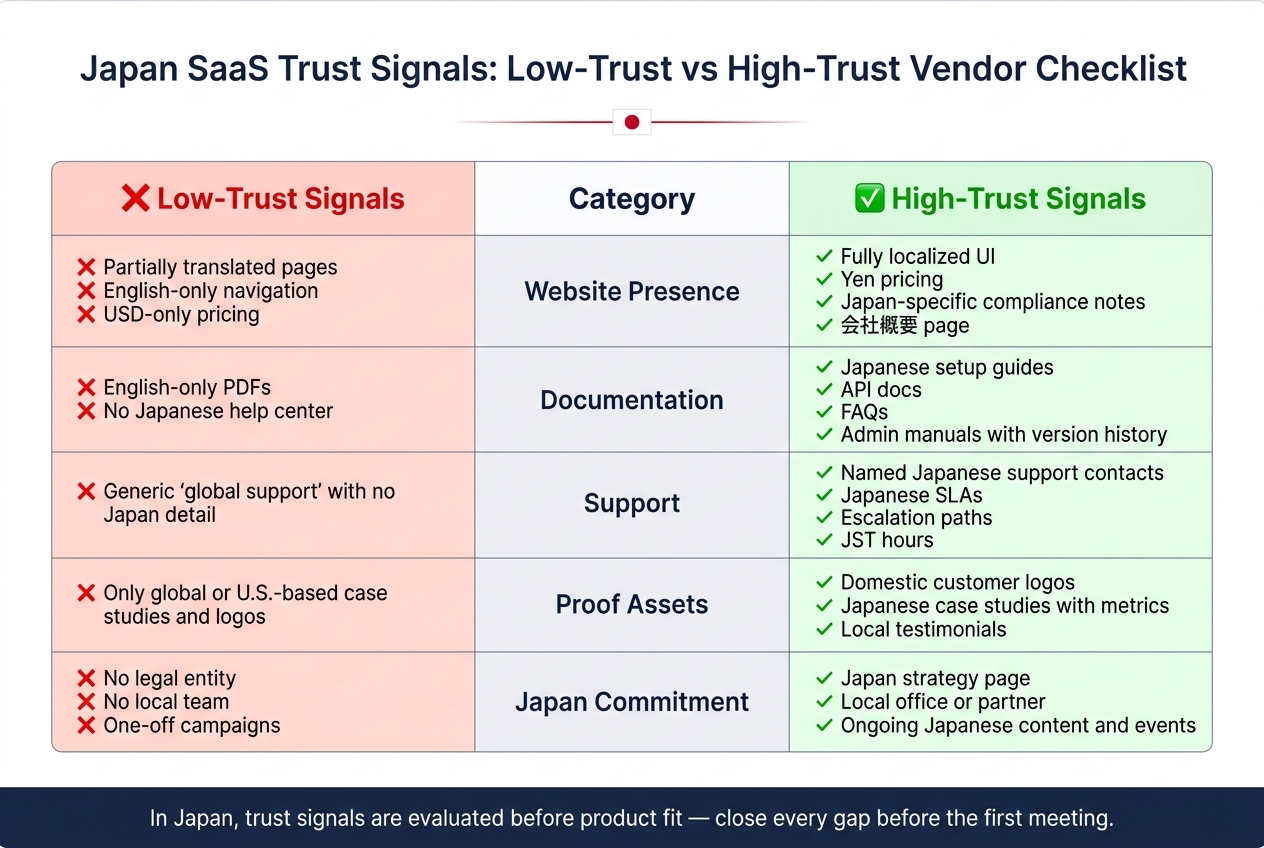
Japan SaaS Trust Signals: Low-Trust vs High-Trust Vendor Checklist
Credibility Signals Buyers Check Before Purchase
Japanese enterprise buyers often review vendors in Japanese before they ever talk to sales. They start by looking for visible proof that the vendor is ready for Japan. Once they notice those market signals, they want something more concrete: proof that the vendor can support a rollout in Japan from start to finish.
Trust is often judged through what buyers can see right away. The first thing many notice is the website. Fully localized product pages in Japanese – written in native-quality business Japanese – show that a vendor has put real effort into the market. Naoki Togawa, Manager at Nikkei Business Publications, says:
"Everything should be in high-quality, idiomatic Japanese. There’s nothing worse than bad translation. It’s easy to tell which vendors know what they are doing and are really committed to the market just through the quality of their materials and programs."
Website copy isn’t the only thing under the microscope. Buyers also look for a proper 会社概要 page that includes the legal entity name, physical address, representative director, and establishment date. They expect named Japanese support contacts too, along with SLAs in Japanese that show support hours in JST. And they want a clear onboarding roadmap that lays out each phase step by step, including who owns what. General promises don’t help much. Specific details do.
| Category | Low-Trust Signals | High-Trust Signals |
|---|---|---|
| Website Presence | Partially translated pages, English-only navigation, USD-only pricing | Fully localized UI, yen pricing, Japan-specific compliance notes, 会社概要 page |
| Documentation | English-only PDFs, no Japanese help center | Japanese setup guides, API docs, FAQs, and admin manuals with document version history |
| Support | Generic "global support" with no Japan detail | Named Japanese support contacts ✓ Japanese SLAs ✓ Escalation paths ✓ JST hours |
| Proof Assets | Only global or U.S.-based case studies and logos | Domestic customer logos, Japanese case studies with metrics, local testimonials |
| Japan Commitment | No legal entity, no local team, one-off campaigns | Japan strategy page, local office or partner, ongoing Japanese content and events |
Proof Assets That Reduce Internal Objections
Enterprise purchases usually involve a lot of people: IT, security, finance, risk, and business owners. Some of them may know very little about the product. That’s why each proof asset needs to answer one clear concern for one clear group.
A domestic case study with a named customer, a clear problem, an implementation story, and a quantified result tends to carry the most weight. It should spell out the problem, show how the rollout happened, and end with hard results – like a 40% reduction in manual reporting time or a 3-week faster onboarding cycle. Generic or anonymous testimonials don’t do much. Japanese B2B buyers want specifics they can check: company names, metrics, and the division responsible.
Security materials need that same level of detail. IT and compliance reviewers want Japanese-language summaries that cover data residency, encryption, backup policies, incident response, and APPI alignment. Implementation examples matter too. Sample project plans, integration architecture diagrams, and migration stories help internal IT teams judge feasibility before they commit. Put simply, these assets give each internal approver something concrete to attach to their sign-off.
Those signals matter most when they’re backed by local execution.
A Practical Plan to Build Trust and Shorten Sales Cycles
Trust in Japan rarely comes from one polished demo. It builds step by step, through steady signals at every touchpoint, from the first search all the way to post-sales support. The sequence matters: first, establish baseline credibility. Then help your buyer build internal support. Then show you’re in Japan for the long haul.
Start with Full Japanese Localization
Localization is not the same as translation. Translation changes words from one language to another. Localization shapes the whole buyer experience around Japanese business expectations.
That means localizing the product, website, documentation, and contracts for Japanese business use, not just translating them line by line. Your messaging should stress reliability, risk reduction, and long-term support. In enterprise deals, incomplete Japanese materials can signal weak commitment.
If you need to choose where to begin, start with the assets buyers see first and judge hardest:
- Your Japanese website and product overview pages
- Your security, compliance, and reliability documentation
- Your Japanese-language UI for key workflows
- Your core sales collateral
Once a buyer sees a local experience, the next question is simple: can internal stakeholders defend this choice?
Use Nemawashi to Align Stakeholders
Most enterprise SaaS deals in Japan involve a group of stakeholders across business, IT, security, finance, and procurement. Many of them may barely touch the product itself.
That’s where nemawashi matters. Make it easier by giving each stakeholder Japanese materials tied to their role. Share Japanese IT, business, and finance briefs built for each audience. After every pre-meeting, send a short Japanese summary that focuses on that stakeholder’s main concerns. This helps your internal champion represent your solution clearly and accurately.
Japanese-speaking customer success can also remove a common approval hurdle.
A limited pilot gives cautious stakeholders room to evaluate the product without agreeing to a full rollout right away. That makes internal consensus easier and helps surface concerns earlier, before they turn into late-stage objections.
After internal alignment, one issue still hangs in the air: will you stick around?
Show Commitment Through Local Presence
One of the biggest fears Japanese buyers have about foreign SaaS vendors is that they’ll exit the market the moment revenue targets aren’t met. The only way to ease that concern is through visible, steady local execution, not a one-off campaign.
Show commitment through Japanese support, local participation, and a clear Japan roadmap. A local office address or in-country partner can signal commitment early. If a global SaaS company doesn’t yet have a team in Japan, working with a specialized partner like Nihonium can help bridge that gap through localization, fractional sales support, and market entry strategies tailored to Japan.
Conclusion: Trust Building Is a Market Entry Requirement in Japan
Japan’s enterprise SaaS market is the second-largest in the world. But size doesn’t mean easy access.
What sets Japan apart is simple: buyers aren’t just judging your product. They’re judging your company as a partner they may work with for years. Reliability, clear communication, and visible follow-through matter more than a long feature list or a well-known global name. The same pattern shows up again and again across localization, proof, and implementation. That’s why trust, not product quality by itself, often decides whether a deal moves ahead.
In Japan, slow movement usually doesn’t mean doubt. It often means consensus-building. That’s the system doing what it’s supposed to do.
The three barriers covered in this article – poor localization, missing local proof, and unclear processes – all point to the same issue: a trust gap buyers are trying to close. Each asset you create should help one stakeholder reduce one clear risk. That can mean localized materials that feel made for the market, local proof that shows others have said yes, and documentation that makes internal approval easier. When those signals are in place, buyers have a much easier time defending the decision inside their company. Closing those gaps can shorten sales cycles and help open the door to expansion.
The shift is straightforward: treat Japan as a trust-first market, not a translation project. Build your entry plan around lowering perceived risk at every stakeholder touchpoint, and you’ll put yourself in a stronger position to build durable, profitable business over time. Nihonium helps global SaaS companies build credibility in Japan through localization, funnel creation, fractional sales support, and market entry strategy. In Japan, trust is the entry requirement, not a later-stage benefit.
FAQs
Why is trust more important than product fit in Japan?
In Japan, trust often carries more weight than product fit. That’s because business culture tends to favor long-term relationships, stability, and reliability over quick wins or feature-by-feature comparisons.
Buyers are usually cautious and careful about risk. They want clear proof that a vendor is committed for the long haul and can be relied on. And because decisions often move slowly and depend on group agreement, even a product that looks better on paper can still be turned down if that trust isn’t there.
What should I localize first for Japan?
Start with your website. In most cases, it’s the first touchpoint, and weak localization can lead to instant drop-off.
Then move to your product interface, technical documentation, and sales materials. Documentation matters a lot during onboarding, and sales assets should match Japan’s consensus-driven Ringi decision-making process.
How can I build credibility without Japanese customers yet?
Focus on the long game. In Japan, trust builds over time, not overnight. That means strong localization, clear proof that you’re here to stay, and steady credibility at every touchpoint.
Use high-quality Japanese across your website, sales materials, and documentation. If the language feels off, people notice right away. And that can slow things down fast.
You also need to show reliability in plain terms. Make your service terms easy to understand. Be clear about compliance with APPI. Offer Japanese-language support so buyers know they won’t be left struggling after the contract is signed.
Social proof matters too, but it often works best when it feels local and personal. Build trust through:
- Local partners
- Warm introductions
- Thought leadership, such as webinars and educational content
It also helps to work with people who know how decisions get made on the ground. Local experts or Nihonium can help you navigate the ringi process and shape a market-entry plan that fits how Japanese companies buy.
Related Blog Posts
- Why Long-Term Commitment Matters in Japan SaaS Sales
- How Risk Aversion Delays SaaS Deals in Japan
- Japanese SaaS Market: Positioning Case Studies
- Trust vs. Speed: Priorities in Japan SaaS Sales
 Japanese
  English