
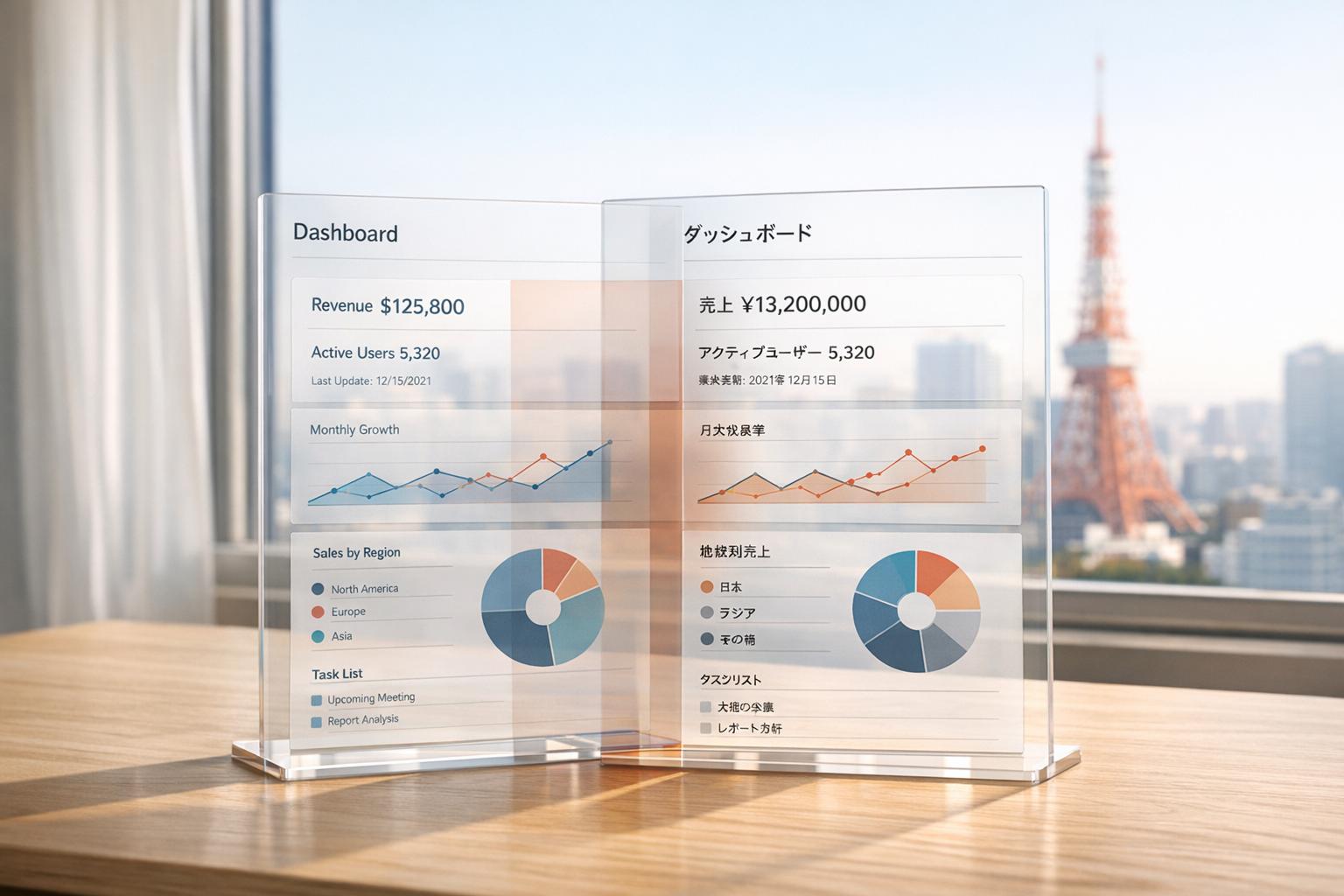
Localization and global branding are two distinct strategies for entering Japan’s SaaS market, valued at $13.4 billion in 2025. Here’s the key takeaway: Localization is critical for building trust and aligning with Japan’s unique business culture, while global branding works best for companies with strong international recognition targeting niche audiences. Choosing the right approach depends on your product, target audience, and budget.
Key Points:
- ローカライゼーション: Tailors your product and messaging to Japan, focusing on trust, detailed communication, and cultural alignment. Essential for high-value products and non-technical users.
- Global Branding: Maintains a consistent global identity but risks feeling distant. Works for technical users and low-cost products.
- Hybrid Strategy: Combines global branding with localized elements, balancing efficiency with local relevance.
Quick Comparison:
| Aspect | ローカライゼーション | Global Branding |
|---|---|---|
| Trust | High: Local presence, Japanese support | Moderate: Relies on global reputation |
| Scalability | Slower: Requires ongoing adjustments | Faster: Uses standardized assets |
| Cost | High: Demands local expertise | Lower: Reuses existing materials |
| Target Audience | Broader: Non-technical, high-value buyers | Niche: Technical, English-speaking |
To succeed in Japan, focus on trust, detailed materials, and long-term commitment. For many companies, a hybrid approach offers the best balance of global strengths and local relevance.
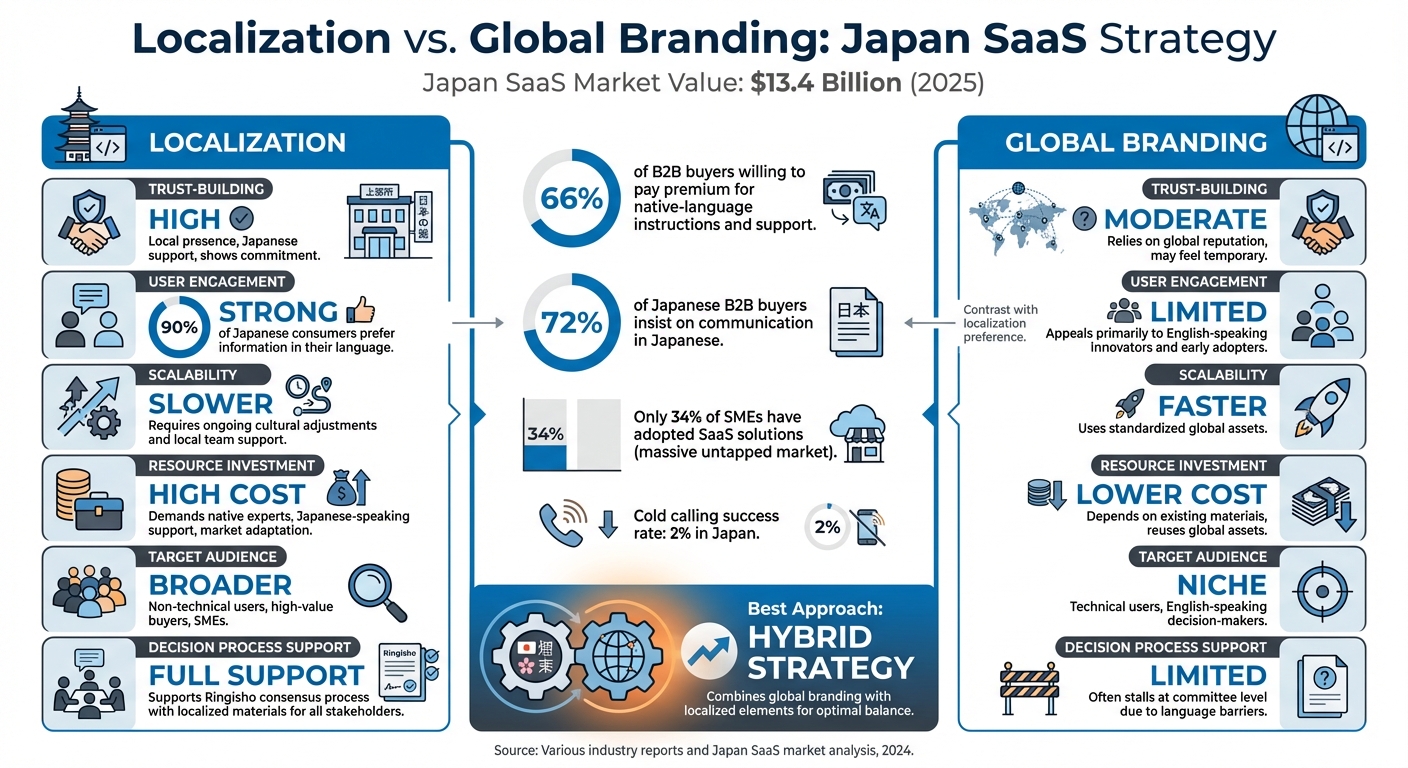
Localization vs Global Branding Strategy Comparison for Japan SaaS Market
Localization Strategy for Japanese SaaS Markets
SaaS localization in Japan goes far beyond just translating text – it’s about reshaping how your product communicates, functions, and builds trust in a market with unique expectations. As Yuga Koda from Nihonium puts it, "SaaS localization in Japan is a strategic endeavor that reaches far beyond language – it requires deep cultural calibration, robust technical adaptation, and ongoing compliance with sophisticated regulatory frameworks". This means adjusting everything from your software’s functionality to your support systems and compliance protocols to meet the specific needs of Japanese users.
Why does this matter? Japanese markets operate on high-context communication. For instance, while a Western SaaS company might use a tagline like "Automate your workflow", Japanese buyers expect something more detailed, like "Reduce manual work, prevent human error, and create a smoother workflow between teams". Broad, abstract promises don’t resonate here; specifics and actionable benefits do. With that in mind, let’s explore the four key components of effective localization.
Core Components of Localization
Successful localization in Japan involves tackling four major areas:
- Product Adjustments: Everything from date and time formats to currency displays and address structures needs to be updated. Japanese systems also require support for double-byte characters across input fields and databases. Beyond these technical tweaks, workflows should be restructured to align with Japanese business practices rather than being retrofitted from Western models.
- UI/UX Modifications: Japanese users often prefer interfaces that are rich in detail, with comprehensive menus, granular controls, and in-depth tooltips. What might feel sleek and minimalistic in the U.S. can come across as overly simplistic in Japan. A more information-dense design provides the reassurance Japanese users seek.
- Messaging Overhaul: English loanwords written in katakana often lack depth for Japanese audiences. Terms like "platform", "workflow", and "enablement" may require additional context or explanation to resonate with decision-makers. Clear, localized messaging is essential.
- Trust-Building Features: Trust is a cornerstone of doing business in Japan. Offer Japanese-language customer support, integrate local payment options like bank transfers (furikomi), and ensure compliance with local laws such as the Act on the Protection of Personal Information (APPI). Even small gestures, like listing a local address or coworking space, can significantly boost buyer confidence. For technical products, detailed Japanese documentation often matters more than a localized UI, as developers may tolerate English interfaces but demand native-language implementation guides.
Advantages of Localization in Japan
When done right, localization can deliver clear business benefits. It can improve conversion rates, build trust faster, shorten sales cycles, and enhance brand perception. Japanese buyers appreciate products that feel genuinely tailored to their needs and are often willing to pay more – 66% of B2B buyers say they’d pay a premium for products with clear local instructions and support. A localized website and support infrastructure reduce perceived risks, especially for software critical to business operations.
Japanese companies also value stability and low risk, often forming long-term relationships with vendors. The consensus-driven Ringi system means your materials must appeal to a variety of stakeholders, many of whom may not be fluent in English or particularly tech-savvy.
Drawbacks of Localization
Localization for Japan isn’t easy. It demands specialized knowledge of cultural norms and regulatory requirements, which many global teams lack. This complexity can stretch timelines and increase costs. Machine translation or inexperienced translators won’t cut it; proper use of honorifics (keigo) and adherence to formal business etiquette are essential.
Localization in Japan requires more than just tweaking your website – it’s a deep, iterative process that touches everything from LINE integrations to webinar content. Many companies underestimate this complexity, treating localization as a quick translation job rather than a full structural overhaul. This miscalculation can lead to delayed launches and wasted resources.
Another challenge lies in balancing local adaptations with global brand consistency. You need to maintain your brand’s identity, core values, and visual style while tailoring your messaging, UX design, and trust-building elements specifically for Japan. Achieving this balance takes both strategic focus and deep market insight.
Global Branding Strategy for Japanese SaaS Markets
Global branding in the SaaS world means maintaining consistent identity, messaging, and visuals across all markets while capitalizing on a strong international reputation. Instead of tailoring your product and messaging for every individual country, you stick to the same playbooks, marketing assets, and product design everywhere. While this approach works in many regions, Japan poses unique challenges.
Global brand equity doesn’t equate to local trust. Being a category leader in the U.S. or Europe doesn’t automatically earn you credibility in Japan.
"Japanese buyers don’t buy global reputation – they buy local credibility".
Even globally recognized brands are seen as "underdogs" in Japan until they prove their dedication to the local market. This creates a "perception gap" where your global status holds less weight compared to your visible efforts to connect with and serve Japanese customers.
Japan’s SaaS market is booming, valued at ¥1.4 trillion in 2023 and projected to hit ¥2 trillion by 2027 with an annual growth rate of 25%. Yet, only 34% of small and medium enterprises (SMEs) have adopted SaaS solutions, leaving a massive untapped market. However, 72% of Japanese B2B buyers insist on communication in Japanese. This means global brands can’t simply copy-paste their Western strategies and expect success. To thrive, companies need to rethink their core branding for Japan.
Core Components of Global Branding
Global branding hinges on uniform messaging, consistent visuals, and standardized product design across markets. This streamlined approach cuts translation costs and speeds up market entry.
The benefits are clear. You can reuse marketing materials and maintain a cohesive identity everywhere. Your global team doesn’t need to master different messaging frameworks for each region. However, in Japan, this strategy often requires what experts call a "reconstruction of meaning" to ensure your brand aligns with local decision-making processes.
Advantages of Global Branding in Japan
Global branding offers some practical benefits when entering Japan:
- Cost efficiency and scalability: By reusing existing playbooks, the upfront investment is lower compared to full localization.
- Leverage existing reputation: If your brand is already known in tech circles, it can attract Japanese companies seeking international solutions to modernize their operations.
- Operational simplicity: You don’t need deep cultural expertise or specialized local teams to launch. This approach is particularly useful for targeting English-speaking decision-makers at international firms in Japan.
For companies testing the waters, this lighter approach can make sense.
Drawbacks of Global Branding in Japan
The risks of global branding in Japan shouldn’t be ignored. The biggest challenge is reduced local resonance. What’s seen as "premium minimalism" in the West can come across as "lacking substance" in Japan. Japanese buyers expect detailed information – comprehensive feature lists, FAQs, and diagrams – to feel confident in their decision. A sleek, minimalist SaaS landing page that converts well in the U.S. might actually hurt conversions in Japan.
Global branding also risks feeling distant. Overusing English loanwords (katakana) can slow understanding and erode the perception of local relevance.
Perhaps most importantly, global branding struggles with Japan’s consensus-driven buying process. Even if your main contact speaks English, they’ll need to convince multiple stakeholders – legal, security, finance – who require Japanese-language materials to approve the purchase.
"Japan does not buy software. Japan buys commitment".
If your brand feels "too global" and not rooted locally, it raises concerns that you might pull out of the market, leaving customers unsupported.
Localization vs. Global Branding: Key Differences in Japan
Comparison Table: Localization vs. Global Branding
Choosing between localization and global branding isn’t just about translation – it’s about shaping trust and adoption in Japan’s SaaS landscape, where cultural nuances and consumer preferences heavily influence success.
| Aspect | ローカライゼーション | Global Branding |
|---|---|---|
| Trust-Building | High; shows commitment with native-quality materials and a local presence | Moderate; relies on global reputation but may feel temporary |
| User Engagement | Strong; 90% of Japanese consumers prefer information in their language | Limited; primarily appeals to English-speaking innovators and early adopters |
| Scalability | Slower; requires ongoing cultural adjustments, compliance, and local team support | Faster; uses standardized global assets but faces higher friction in Japan |
| Resource Needs | High; demands native experts, Japanese-speaking support, and market adaptation | Lower initially; depends on existing materials but may have hidden costs |
| Decision Process Support | Supports the Ringisho process with localized materials for all stakeholders | Often stalls at the committee level due to language barriers |
Japanese buyers strongly favor localized products. For example, 66% of B2B buyers are willing to pay more for native-language instructions and support. These preferences highlight how Japan’s market intricacies influence strategic decisions.
How Japanese Market Characteristics Affect Strategy Choice
The differences outlined in the table above are deeply tied to Japan’s market dynamics. This is a country where trust and cultural alignment are critical, especially in a SaaS environment that still leans on manual processes and on-premise software, impacting SaaS adoption in Japan.
A key factor is Japan’s consensus-driven business culture. Decisions typically go through the Ringisho process, requiring approval from multiple stakeholders, including legal, security, finance, and operations teams. Even when the primary contact speaks English, other decision-makers often rely on high-quality Japanese materials to fully understand the product. This makes localized content a vital trust signal. As Naoki Togawa from Nikkei Business Publications explains:
"There’s nothing worse than bad translation. It’s easy to tell which vendors know what they are doing and are really committed to the market just through the quality of their materials and programs".
The language barrier in Japan is more challenging than many companies expect. A majority of buyers demand Japanese-language communication, and 40% of consumers outright avoid products offered in other languages. This creates a significant hurdle for global branding strategies that don’t prioritize localization.
Service expectations in Japan are also shaped by omotenashi, the concept of providing exceptional, culturally sensitive customer support. Without Japanese-speaking customer success teams, global branding efforts often fall short, regardless of the product’s quality. The high standards for market entry are evident in the fact that only 10% of foreign products gain approval from Japanese distributors.
For developer tools, an English interface might be acceptable, but detailed Japanese documentation is still necessary for smooth onboarding and troubleshooting. For non-technical B2B products, full localization is essential to move beyond early adopters and achieve broader market success.
sbb-itb-a752276
How to Choose the Right Strategy for Your SaaS Business
When Localization Works Best
Localization is often the go-to strategy when your brand is new to Japan or if you’re offering complex, high-value products. Japanese buyers, especially those considering high-ACV and intricate tools, tend to need detailed, localized materials to feel confident in their decisions. This becomes even more critical when targeting non-technical users, such as small business owners or enterprise teams, who often depend on Japanese-language interfaces and customer support to adopt new software.
Research also shows that many B2B buyers are willing to pay extra for products that include localized instructions and support. For businesses entering Japan without an established reputation, localization serves as a trust-building measure, signaling your commitment to the market. This approach is especially effective in Japan’s consensus-driven purchasing culture, where trust is a key factor in decision-making. Furthermore, if your growth strategy leans heavily on Sales-Led Growth (SLG) rather than Product-Led Growth, localization becomes crucial to support the multi-stakeholder approval process.
When Global Branding Works Best
Global branding tends to work best for companies with strong international recognition, especially when targeting technical users like developers or early adopters. These groups are generally more comfortable using English interfaces. If your product is simple, transactional, or has a low ACV, the cost of full localization might outweigh the benefits. In such cases, focusing on localized documentation rather than fully translating the user interface can be a more cost-effective solution, particularly for companies with limited budgets or those testing the waters in a new market.
However, even globally recognized brands face hurdles in Japan. For instance, only 50% of Japanese consumers prefer major global brands over products with information in Japanese, compared to 69% globally. This highlights the need to weigh the advantages of global branding against the unique preferences of the Japanese market.
Combining Both Approaches with Nihonium Services
For many SaaS companies, a hybrid strategy offers the most effective way to enter the Japanese market. This approach balances the authority of your global brand with the localized trust signals that Japanese buyers value. Instead of immediately committing to a full local entity, you can gauge market interest through fractional services.
Nihonium provides the tools to execute this balanced strategy, offering localized marketing funnels, fractional sales support, and product localization – all without the overhead of hiring full-time staff. This allows you to maintain global branding while tailoring key elements like your website, documentation, and sales materials. The fractional sales model is particularly helpful in Japan’s consensus-driven buying culture, where cold-calling success rates are as low as 2%, making relationship-building essential.
Conclusion
Breaking into Japan’s $13.4 billion SaaS market takes more than just deciding between localization and global branding – it requires a deep understanding of what sets this market apart. Japanese buyers prioritize trust built through local connections over global reputation alone. To succeed, companies need to rethink their approach, tailoring decision-making processes, user experience design, and trust-building elements to align with Japan’s reassurance-focused buying culture. The key lies in crafting a strategy that blends global strengths with local nuances.
For many SaaS companies, a hybrid strategy works best. This approach maintains the global brand identity while establishing local credibility, leading to higher conversion rates and faster sales cycles. It’s about keeping your brand’s core voice and visuals intact while incorporating elements like detailed FAQs, clear value propositions, and social proof to address the scrutiny of Japan’s consensus-driven Ringi process.
Start with comprehensive market research, adjustments to user interfaces and pricing, B2B SaaS sales support, and strict adherence to APPI regulations. Instead of investing over $400,000 annually to set up a local entity, consider fractional services that let you test and refine your approach – especially in a market where cold calling has only a 2% success rate.
Nihonium offers a complete solution for this, covering everything from product localization and marketing funnels to fractional sales support. By combining your global brand’s strengths with a culturally tailored local presence, you can establish the trust that Japanese enterprise buyers demand for lasting success.
FAQs
What are the advantages of using a hybrid approach to enter Japan’s SaaS market?
A hybrid approach combines the strengths of global branding with local adaptation, creating a balanced strategy for SaaS companies entering Japan. This approach lets businesses maintain a consistent global identity while tailoring critical elements – like product features, marketing efforts, and customer support – to meet Japan’s specific business practices and customer expectations.
This blend works well because Japanese customers place high value on personalized experiences and dependable local support. By starting with lighter localization efforts, companies can test the waters and assess market interest. As they gain momentum, they can expand their localization efforts to deepen their connection with the audience. This flexibility helps reduce cultural gaps, encourages user adoption, and builds long-term customer loyalty in Japan’s competitive SaaS market.
How does Japan’s group-based decision-making culture impact SaaS market entry strategies?
In Japan, business decisions are rarely made by a single individual. Instead, they involve a collective process that reflects the country’s group-oriented culture. Two key practices shape this approach: nemawashi – an informal method of building consensus behind the scenes – and the Ringi system, which involves circulating formal proposals for approval. While this ensures thorough decision-making, it also means sales cycles in Japan can stretch from 12 to 24 months. Companies often favor stable, well-established solutions over anything experimental or untested.
For SaaS companies looking to enter the Japanese market, understanding and respecting these cultural norms is non-negotiable. Success often depends on building strong relationships, following formal procedures meticulously, and tailoring communication to resonate with local expectations. Trust and a demonstrated commitment to long-term engagement are critical. By aligning with these practices, businesses can navigate the complexities of Japan’s consensus-driven decision-making process more effectively.
Why is localization more important than global branding for SaaS companies in Japan?
Localization plays a crucial role in Japan’s SaaS market because Japanese customers place a high priority on relevance, trust, and personalized experiences. By focusing on localization, businesses can better align with local preferences, language, and expectations – key factors for building trust and nurturing long-term customer relationships.
Japan’s market also comes with its own set of unique characteristics, such as formal communication styles and specific regulatory requirements. These are details that broad global branding strategies often miss. Adapting your product and messaging to address these nuances shows a genuine commitment to the market, greatly increasing your chances of success.
Related Blog Posts
- Local vs Global SaaS Pricing: Japan Market Guide
- AI in Japan SaaS: Market Insights
- Study: Impact of Cultural Nuances on SaaS Partnerships in Japan
- 5 Customer Acquisition Tips for SaaS in Japan
 Japanese
  English