
Japan’s Looming Shortage of IT Talent
Introduction
Japan has a looming labor shortage across all industries. This expected labor shortage is commonly referred to as the 2030 problem. The government and companies have initiatives in place to address this problem, including hiring foreign workers and accelerating the adoption of technology. The need for talent in IT-related fields is no exception to the expected shortage. Resolving the lack of technical talent will be key for innovation to come out from Japan moving forward.
Expected Shortage of Technical Talent
In 2019, The Ministry of Economy, Trade and Industry (METI) released a report on the supply and demand of IT workers. The report portrays three scenarios with different levels of growth and demand. In all three scenarios, the expected increase in productivity is 0.7% and the supply of IT workers is set at 1.13 million workers.
1. Scenario 1—Low demand in IT: The first scenario expects low demand for IT workers. The increase in demand is set at 1%. In this scenario, there is an expected shortage of 164k IT workers.
2. Scenario 2 — Medium demand in IT: The second scenario expects medium demand for IT workers. The increase in demand is set at 2-5%. In this scenario, there is an expected shortage of 449k IT workers.
3. Scenario 3 — High demand in IT: The third scenario expects high demand for IT workers. The increase in demand is set at 3-7%. In this scenario, there is an expected shortage of 787k IT workers.
In all three scenarios, there is an expected shortage of IT workers. Even assuming lower demand for IT workers, the expected shortage is 164k workers.
Potential Threat to Innovation
The lack of workers in IT poses a real threat to both innovation and entrepreneurship. Though many processes can be streamlined with technology, there is a massive human aspect to innovation. There needs to be people to implement and execute the technological progress. As is startups, Japan is already facing a lack of entrepreneurs.
Limited Talent to Build In-House Teams
The IT workers in the report include both technical and non-technical people. Regardless, of the lack of IT workers, technical or non-technical, companies struggle to build and develop in-house teams. On top of the overall lack of talent, Japanese workers tend to switch jobs less. As a result, the large corporations that need the most digital transformation and innovation are unable to their own teams.
A survey going over the relationship between System Integrators (SIs) and Japanese companies showed that Japanese companies want to build in-house teams, but are unable to due to the lack of talent.
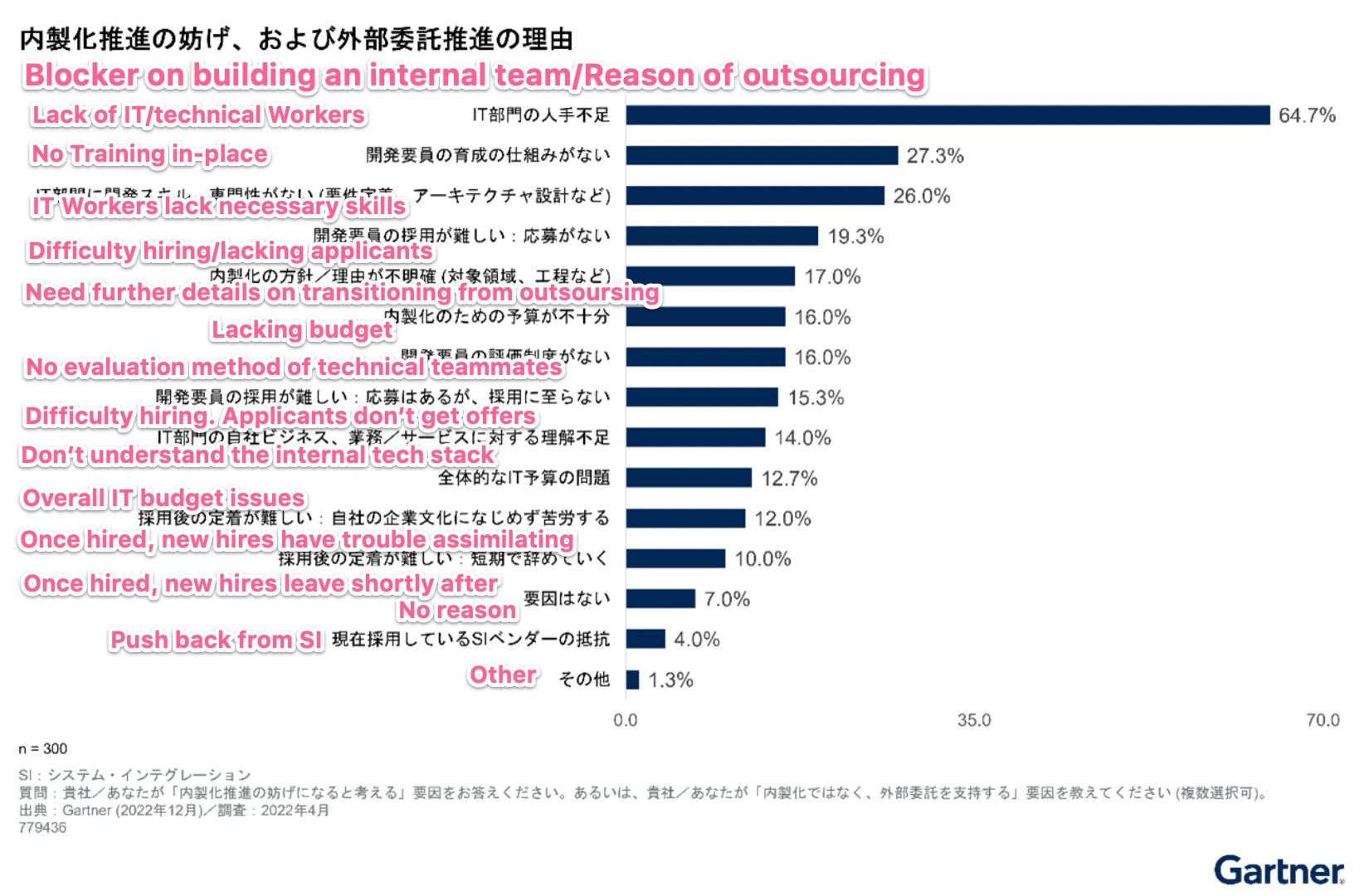 These companies are having trouble hiring, and therefore, aren’t able to increase their agility, as important technical work is outsourced. The inability to build in-house teams creates an unbalanced and unhealthy relationship with SIs and helps maintain their importance in the Japanese tech ecosystem.
Lack of Technical Entrepreneurs
The overall lack of IT workers means that there is a lack of entrepreneurs in the IT space. Though anecdotal, there does seem to already be a significant shortage of technical entrepreneurs. Though technical co-founders are in demand everywhere, there does seem to be an even stronger need in Japan.
In addition to the lack of talent in the IT space, Japanese people have a preference for stability and safety and working for large Japanese corporations. Once they land these positions, they are also less likely to seek new roles compared to other countries. The lack of people in general and the preference towards working at large corporations are significant roadblocks for innovation in Japan. Without entrepreneurs in the IT space, technological innovation cannot be born.
Conclusion
The current and expected lack of IT workers in Japan is a potential threat to innovation in Japan. By 2030, an IT worker labor shortage of anywhere between 164k and 787k is expected. Though Japan is encouraging innovation through the Startup Development Five-year Plan and is pushing hard on digital transformation (DX), but without the people to experiment, implement, and execute, all this effort will go to waste. Solving the lack of IT talent will be paramount for Japan to innovate moving forward. If you’re interested in learning more about the Japanese market or are considering Japan market entry, book a free consultation here.
 Japanese
  English