
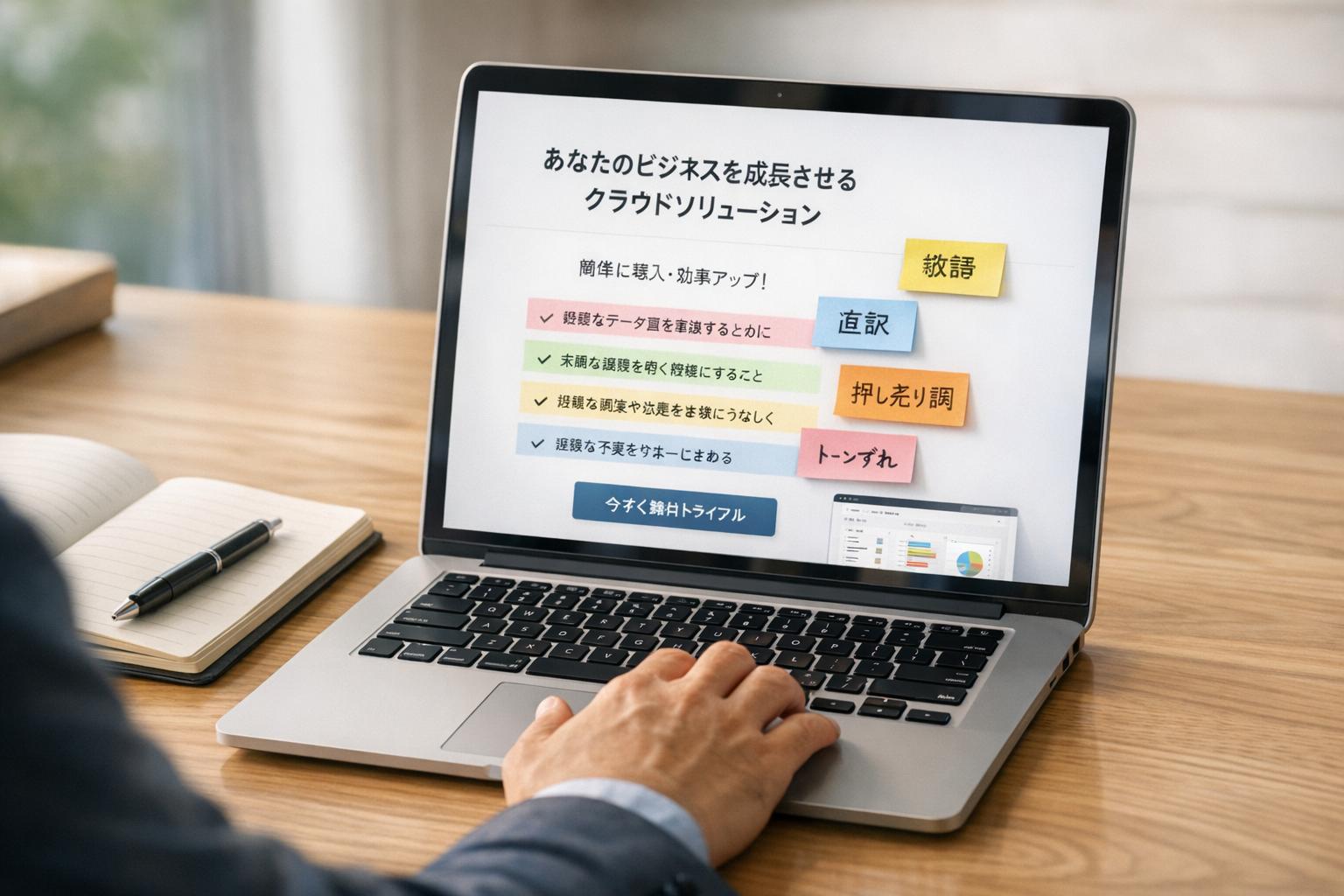
Reaching Japanese enterprise buyers? Tone matters more than you think. Missteps in tone can signal a lack of understanding, erode trust, and cost you deals. Here’s what you need to know:
Key Mistakes:
- Inconsistent Formality: Misusing keigo (formal Japanese) confuses readers and damages credibility.
- Overly Direct Messaging: Pushy, aggressive language feels off in Japan’s modest, harmony-focused business culture.
- Literal Translations: Word-for-word translations often sound unnatural, robotic, and unprofessional.
- Tone Drift Across Content: Disconnected tone across marketing, UI, and support content signals poor commitment to the market.
- Ignoring Hierarchy and Risk Sensitivity: Overconfident messaging clashes with Japan’s preference for humility and measurable outcomes.
Quick Fixes:
- Use a tone style guide to define appropriate keigo levels for different content types.
- Replace bold claims with clear, specific outcomes (e.g., "Reduce approval time by 80%").
- Avoid machine-like translations; have native editors refine your content for naturalness.
- Ensure consistent tone across all touchpoints – marketing, product, and support.
- Focus on trust-building: highlight local case studies, certifications, and risk-reducing results. (Learn more about the importance of case studies in Japanese SaaS sales.)
Why It Matters:
- 90% of Japanese buyers prefer content in their language.
- Companies with well-localized content see 25–30% higher adoption rates and 15–20% revenue growth.
Tone isn’t just about words – it’s about trust. Fix these issues to connect with Japanese buyers and grow your SaaS business.
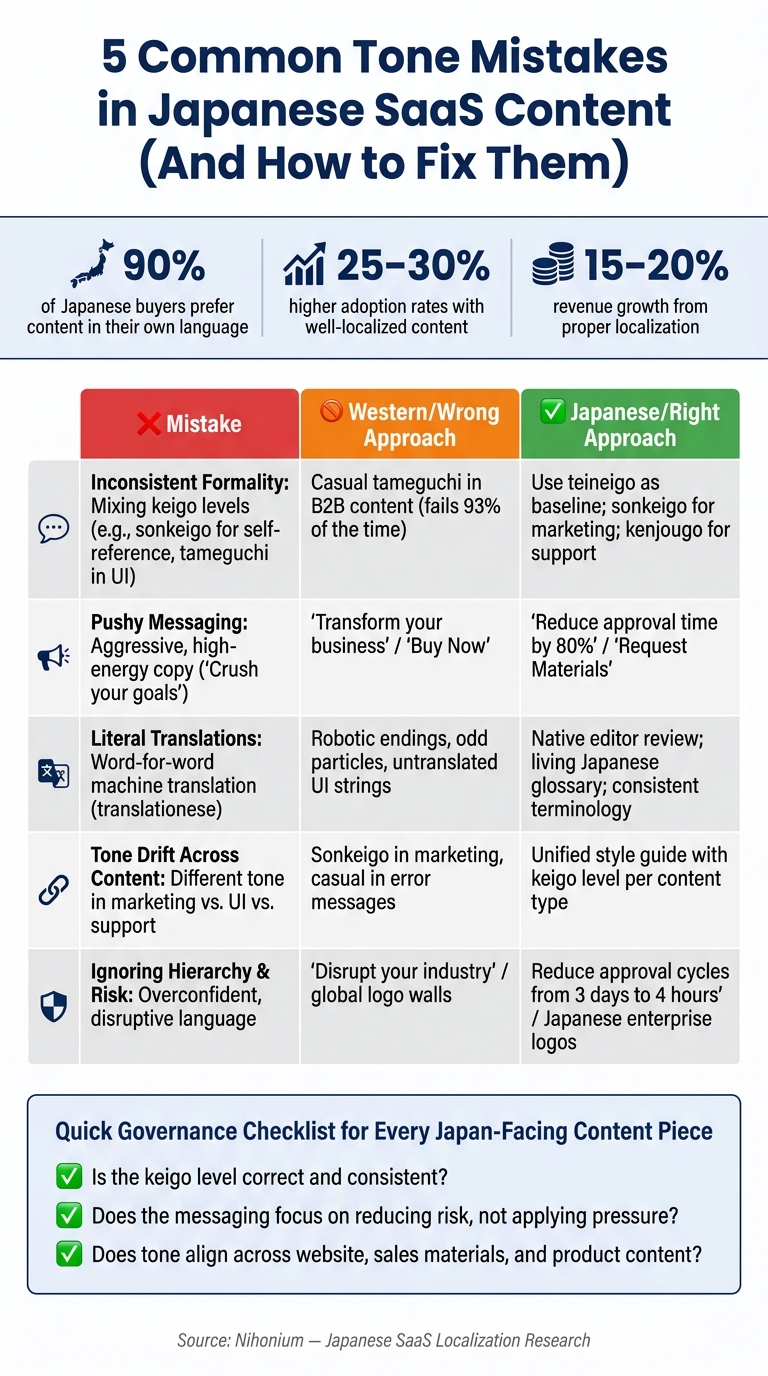
5 Japanese SaaS Tone Mistakes vs. Fixes: Western vs. Japanese Messaging
Mistake 1: Inconsistent Formality and Misuse of Keigo
Japanese communication relies heavily on keigo, a structured system of respectful language. It’s a cornerstone of professional interactions and includes three main levels: teineigo (general politeness using desu/masu forms), sonkeigo (respectful language that elevates the listener), and kenjougo (humble language that lowers the speaker). Misusing or mixing these levels can confuse your audience and send unintended messages.
The Problem: Mixed Politeness Levels
One of the most frequent keigo mistakes in SaaS content is inconsistency. For example, a product interface might use polite desu/masu forms on one screen but switch to casual tameguchi on another. Similarly, a marketing page might use sonkeigo to address the customer but mistakenly apply respectful language to describe the company’s own team, where humble kenjougo would be appropriate. Using sonkeigo for self-reference often comes across as arrogant – and fails in most cases.
Another common error is double keigo (nijuu keigo), where multiple honorifics are stacked onto a single verb. This grammatical mistake is an immediate red flag for native readers and signals a lack of fluency.
How This Affects Japanese SaaS Buyers
Keigo mistakes may seem minor, but they can have significant consequences. In Japan, these errors are often perceived as signals that a company hasn’t fully understood or committed to the market. For procurement teams and decision-makers navigating the consensus-driven ringi process, even subtle tone mismatches can give stakeholders a reason to quietly reject a proposal.
"Using the wrong level of formality – or inconsistently mixing levels – is immediately noticeable to Japanese users and undermines trust in the product." – Yuga Koda, Co-Founder, Nihonium
Opting for casual tameguchi to appear modern is particularly risky. In professional B2B settings, this approach fails 93% of the time. At a minimum, teineigo is expected. When these errors occur, they compromise trust and reinforce broader concerns about tone consistency in localized content.
How to Keep Formality Consistent
To avoid these pitfalls, create a tone of voice style guide that outlines the appropriate keigo level for each type of content. Here’s a simple framework to get started:
| Content Type | Recommended Register | Why |
|---|---|---|
| Product UI, error messages | Teineigo (Polite) | Maintains clarity and professionalism |
| Marketing copy, headlines | Sonkeigo (Respectful) | Elevates the customer and establishes authority |
| Support responses, onboarding | Teineigo & Kenjougo | Shows humility and a commitment to service |
Supplement the style guide with a glossary of standardized honorific phrases for recurring actions. Additionally, ensure high-visibility content undergoes native reviews to catch potential issues before they reach your audience. This proactive approach helps maintain consistency and builds trust with Japanese users.
sbb-itb-a752276
Mistake 2: Overly Direct or Pushy Messaging
The Problem: Aggressive Copy That Misses the Mark in Japan
Western marketing often leans on high-energy phrases like "Crush your goals" or "Dominate your market." While these might energize audiences in the U.S., they have the opposite effect in Japan. Such language can come across as boastful, overconfident, and even untrustworthy.
In Japanese business culture, modesty and collective success are deeply valued. Messaging that emphasizes individual dominance or dramatic change clashes with the principle of wa (harmony), which underpins decision-making and teamwork. Bold claims not only appear risky but also fail to provide the detailed data that Japanese decision-makers need for internal approvals.
How This Affects Japanese SaaS Buyers
The impact of overly direct messaging often goes unnoticed because feedback isn’t given directly. As Munehiro Hiraki, a Japanese Localization QA Specialist, explains:
"Japanese enterprise buyers do not explicitly say ‘your Japanese is bad.’ They simply do not proceed."
When messaging feels too aggressive, internal advocates for your product are left with vague slogans instead of actionable details. This makes the ringi process – Japan’s consensus-driven decision-making system – much harder. A phrase like "Unlock your potential" offers no substance, whereas a claim such as "Reduce approval flow from 3 days to 4 hours" provides clear, usable information for proposals.
There’s also a longer-term issue of trust. Pushy, sales-heavy language signals a short-term focus, which doesn’t align with Japanese buyers’ preference for vendors who demonstrate commitment to the market over time. The quality of your localized content is a key indicator of that commitment.
To avoid these pitfalls, focus on communicating your value with language that is clear, measured, and supportive.
How to Write Relationship-Focused Messaging
The key to avoiding tone missteps is to adopt a communication style that emphasizes collaboration and concrete results. This doesn’t mean being vague or overly cautious – it means being specific and encouraging, rather than forceful. Replace aspirational buzzwords with measurable outcomes, and swap aggressive calls-to-action (CTAs) for softer, more inviting alternatives. Here’s how this approach looks in practice:
| Messaging Element | Western/Direct Approach | Japanese/Relationship Approach |
|---|---|---|
| Headline Tone | Aspirational ("Transform your work") | Functional/Specific ("Reduce costs by 20%") |
| CTA Focus | Direct CTA ("Buy Now") | Information gathering ("Request Materials") |
| Value Prop | Individual achievement | Organizational harmony and stability |
| Social Proof | Global logo walls | Local case studies and certifications |
When it comes to CTAs, avoid literal translations of phrases like "Get Started" (今すぐ始める), which can feel like a command. Instead, use alternatives like 無料で試してみる ("Try for free"), which respects the user’s autonomy and fits the tone of Japanese B2B communication. Additionally, placing trust indicators – such as Japanese client logos, ISO or ISMS certifications, and local support details – prominently on your page can reassure cautious buyers far more effectively than bold headlines.
Mistake 3: Overly Literal or Machine-Like Translations
The Problem: Translationese in SaaS Content
When crafting Japanese SaaS content, one major pitfall is the reliance on overly literal translations – often referred to as translationese. This happens when English content is converted word-for-word into Japanese without considering the language’s natural rhythm and flow. While the result may be grammatically correct, it often feels awkward and unnatural to native speakers. Machine translations, in particular, tend to produce robotic sentence endings and odd particle usage that stand out immediately to Japanese users.
Other common issues include inconsistent terminology – like using different names for the same feature across your homepage, pricing page, and help center – as well as excessive reliance on katakana for words that have well-established kanji equivalents. Another glaring problem is untranslated UI strings, such as English buttons or error messages, in an otherwise Japanese interface. On top of that, Japanese text typically expands by 30–50% compared to its English counterpart. This can wreak havoc on layouts, causing buttons to overflow, menus to truncate, and interfaces to look broken. Such errors not only disrupt the user experience but also damage the product’s credibility in a market where a polished, professional presentation is non-negotiable.
How This Affects Japanese SaaS Buyers
These translation issues go beyond aesthetics – they create genuine obstacles for users. For example, if the terminology in your help center doesn’t match the labels in your product’s UI, users can easily become confused and frustrated. This confusion leads to more support tickets and lowers overall satisfaction with the product.
There’s also a trust factor at play. As Munehiro Hiraki, a Japanese Localization QA Specialist, explains:
"In Japan, the localization gap is not a quality issue. It is a commercial issue. Trust is built one touchpoint at a time – or lost the same way."
The numbers back this up: 90% of Japanese consumers prefer products with information available in their own language. Yet, only 50% of Japanese buyers would choose a global brand over a local competitor offering native-language content – far below the global average of 69%. Fully localized SaaS products consistently outperform their merely translated counterparts, achieving 25–30% higher adoption rates and boosting revenue by 15–20% in the Japanese market.
How to Produce Natural, Consistent Localization
To address these challenges and rebuild trust, focus on creating a smooth and natural localization process. Start by developing a living Japanese glossary to ensure consistent terminology across all customer-facing content. Then, have all content reviewed by native Japanese editors who can refine robotic phrasing, adjust keigo usage, and ensure proper balance between hiragana, katakana, and kanji. While machine translation can be helpful for internal drafts or low-priority documents, anything visible to buyers should be polished by a professional with SaaS expertise.
Pay special attention to what Nihonium calls the "trust trio": the homepage hero section and primary CTAs, the pricing page, and the legal disclosure page (特定商取引法). These are critical touchpoints where procurement teams assess your commitment to the local market.
Mistake 4: Inconsistent Tone Across Content Types
The Problem: Tone That Shifts Across the User Journey
Inconsistent tone across different types of content can seriously undermine trust. This problem often arises when localization is treated as a one-time task, leaving a mix of polished marketing copy, overly formal or robotic help-center text, and overly casual error messages. Without shared guidelines, different teams create content that feels disconnected.
This lack of consistency sends a clear message: the Japanese market is not a priority. For Japanese buyers, especially those operating under the ringi system, such inconsistencies can be a dealbreaker.
How This Affects Japanese SaaS Buyers
In Japan, B2B purchasing decisions are rarely made by one person. The ringi system requires proposals to pass through multiple stakeholders – IT teams, legal departments, end-users, and upper management. Each group interacts with different parts of your content. If your marketing materials use respectful sonkeigo but your onboarding emails feel overly casual, stakeholders may form conflicting impressions of your brand. This fragmented experience can signal a lack of commitment to the Japanese market, reinforcing doubts about your product or organization.
Munehiro Hiraki, a Japanese Localization QA Specialist, explains:
"Japanese enterprise buyers interpret inconsistency as a sign of organisational immaturity or an incomplete product."
Naoki Togawa of Nikkei Business Publications adds:
"It’s easy to tell which vendors know what they are doing and are really committed to the market just through the quality of their materials."
Japanese buyers are also less likely to remain loyal to a brand when local relevance is lacking. Only 50% would choose a globally recognized brand over a local competitor offering a more cohesive Japanese-language experience. This is a sharp contrast to the global average of 69%.
To address this, a unified tone strategy across all touchpoints is essential.
How to Align Tone Across All Content
A centralized style guide is the foundation for maintaining consistency and ensuring your tone resonates with Japanese buyers. This guide should be a living document that defines key elements such as terminology, formality levels, and tone for every content type. Below is an example of how tone can be calibrated for different content surfaces:
| Content Type | Recommended Keigo Level | Tone Objective |
|---|---|---|
| Product UI | Teineigo (Polite) | Clarity and professional guidance |
| Marketing/Sales | Sonkeigo (Respectful) | Building trust and showing respect |
| Support/Help Center | Teineigo / Kenjougo | Helpful, humble, and detailed |
| Error Messages | Teineigo (Polite) | Calm and actionable; never blunt |
In addition to the style guide, appoint a tone owner. This person ensures global messaging aligns with local execution across all teams. Every piece of content – whether it’s a new feature, updated pricing page, or seasonal campaign – should undergo a native QA review to maintain cultural and linguistic consistency.
Lastly, ensure that UI labels align with help center terminology. Inconsistent labeling creates confusion, and in Japan, this can easily result in lost buyers.
Mistake 5: Ignoring Hierarchy, Humility, and Risk Sensitivity
This section dives into how overlooking hierarchy, humility, and risk sensitivity can damage trust with Japanese enterprise buyers.
The Problem: Tone Misaligned with Japanese Corporate Norms
Even when the level of formality seems right, many SaaS companies miss the deeper cultural cues that shape business communication in Japan: hierarchy, humility, and a cautious approach to risk.
Western SaaS messaging often leans on bold, ambitious language. Phrases like "Transform your business" or "Disrupt your industry" are commonplace. However, in Japan, such language can come across as overconfident or even unreliable. Japanese executives are often skeptical of aggressive self-promotion. As the Intercultural Press explains:
"The degree of politeness shown in messaging is considered not merely etiquette but a reflection of a brand’s seriousness and reliability."
When tone doesn’t align with these norms, it can harm your brand’s image and complicate the internal decision-making process.
How This Affects Japanese SaaS Buyers
Tone misalignment can create significant hurdles for Japanese buyers trying to advocate for your solution. If your sales materials are filled with bold claims and vague promises, your internal champion will struggle to present a convincing case during the consensual decision-making process. Materials that feel overly casual, pushy, or self-promotional are unlikely to make it through the ringi approval process – the structured, multi-step system used to gain stakeholder agreement. Even a small tone mismatch can erode confidence in your brand, potentially derailing the deal without any explicit feedback.
How to Adjust Tone for Enterprise Audiences
To resonate with Japanese enterprise buyers, shift your focus toward stability and measurable outcomes. For example, instead of saying, "Unlock your team’s potential", use specific, risk-reducing language like, "Reduce approval cycles from 3 days to 4 hours." Concrete outcomes provide internal sponsors with clear, defensible points for building consensus.
Modify your calls-to-action (CTAs) to match the consultative nature of Japanese enterprise buying. High-pressure prompts like "Buy Now" should be replaced with softer options such as "Request a Demo" (デモを申し込む) or "Learn More" (詳しく見る). Additionally, prioritize locally relevant social proof. A logo wall featuring unfamiliar foreign startups won’t carry much weight. Instead, showcase logos from well-known Japanese enterprises or global brands with a strong presence in Japan.
Finally, involve your sales team in tone reviews. Since they engage directly with Japanese executives, they can provide valuable insights into what resonates. Their feedback can help identify tone issues that might slip past native QA reviewers focused solely on linguistic accuracy.
Here’s a quick comparison to help recalibrate your messaging for Japanese enterprise buyers:
| Content Type | Western Default | Japanese Enterprise Expectation |
|---|---|---|
| Value Proposition | "Transform your business" | "Reduce [specific risk] by [measurable outcome]" |
| CTA | "Start Now" / "Buy Today" | "Request a Demo" / "Inquire for Details" |
| Case Studies | Individual productivity wins | Organizational stability and compliance gains |
| Social Proof | Global user count | Local Japanese enterprise logos and references |
| Sales Decks | Bold, disruptive, aspirational | Stable, risk-mitigating, evidence-based |
Conclusion: Building a Tone Governance Process That Holds Up
The five mistakes discussed – inconsistent keigo, pushy messaging, translationese, tone fragmentation across the user journey, and ignoring hierarchy and risk sensitivity – all stem from a common issue: treating Japanese content as a simple translation exercise instead of a strategic branding effort. Tackling these issues individually can lead to a fragmented customer experience. A unified approach is necessary to build trust and ensure consistency at every touchpoint.
Key Takeaways for SaaS Teams
SaaS teams need to shift from quick fixes to a structured governance process. This involves creating a Japan-specific brand voice guide, maintaining a centralized Japanese termbase, and setting up a clear review workflow before any content goes live.
A good first step is adopting a "three-check" rule for all Japan-facing content:
- Is the keigo level correct and consistent?
- Does the messaging focus on reducing risk rather than applying pressure?
- Does the tone align with the website, sales materials, and product content?
To ensure consistency, assign a dedicated owner to keep the style guide updated and audit key touchpoints like SaaS landing pages, pricing page, onboarding flows, and email sequences. Without someone accountable, guidelines tend to fall by the wayside. Industry benchmarks show that using native reviewers alongside clear style guides can cut post-translation edits by 30–50%, speeding up time-to-market and improving content quality.
Naoki Togawa from Nikkei Business Publications highlights the importance of quality:
"It’s easy to tell which vendors know what they are doing and are really committed to the market just through the quality of their materials."
That judgment happens quickly – often before any sales conversation. These principles help ensure every interaction reflects your dedication to the Japanese market.
How Nihonium Can Help
For SaaS teams lacking in-house Japanese expertise, finding the right partner is crucial. Nihonium works with global SaaS companies to define tone guidelines, audit Japanese content, and ensure consistent messaging throughout the marketing and sales funnel. Their services include product localization, marketing funnel creation, and fractional sales support – all tailored to meet the expectations of Japanese enterprise buyers. Collaborating with experts who understand both the language and the local market can accelerate your progress and improve outcomes.
FAQs
Which keigo level should we use in our UI vs. marketing vs. support?
The right level of keigo (Japanese honorific language) hinges on who you’re addressing and the situation. For most business interactions, teineigo (polite language) serves as the standard for maintaining professionalism. In the world of enterprise SaaS, blending teineigo with kenjougo (humble language) in user interfaces and customer support can help establish trust and reliability. On the other hand, marketing materials often lean on sonkeigo (respectful language) to convey deference and respect toward the audience.
One key to success here? Consistency. Mixing these levels inappropriately can erode trust and create confusion. That’s why Nihonium ensures your communication style stays in sync with Japanese business etiquette and your market strategy.
How can we make our messaging persuasive in Japan without sounding pushy?
When creating messaging for a Japanese audience, it’s crucial to prioritize building trust and fostering long-term relationships over aiming for quick sales. The tone should reflect humility, reliability, and respect, aligning with cultural values.
Avoid using aggressive commands like "Buy Now", which may come across as too forceful. Instead, opt for softer, more inviting calls-to-action such as "Learn More" or "Discover the Details." This approach feels more considerate and aligns with the preference for subtlety.
It’s also effective to emphasize collective benefits rather than individual gains. Use polite language, or keigo, to show respect and professionalism. Providing detailed and context-rich information is another key strategy. This reassures potential customers about your product’s safety and your company’s commitment to quality, which are highly valued traits in Japan.
What’s the quickest way to prevent tone drift across product, website, and support?
The quickest way to avoid tone drift is by relying on thorough style guides, centralized glossaries for industry-specific terms, and quality assurance (QA) reviews conducted by native speakers. For Japanese SaaS, paying close attention to honorifics (keigo) is essential. Automated tools often fail to grasp the nuances of context, so they should be avoided in this case. To maintain consistency across product interfaces, marketing materials, and customer support, it’s best to have native professionals review and confirm the appropriate levels of formality throughout the entire user experience.
Related Blog Posts
- How Japanese Culture Shapes SaaS Messaging
- Why Tone Matters in Japanese SaaS Marketing
- Translation Tools vs. Human Support for Japan SaaS
- Why Keigo Matters in Japanese Enterprise Sales
 Japanese
  English