
When serving Japanese customers, speed is more than just efficiency – it’s a sign of respect and reliability. In Japan, even minor delays in customer support can harm trust, especially for SaaS companies operating on standard global response times. Here’s why promptness is critical and how to meet these expectations:
- Cultural Expectations: Japanese hospitality (omotenashi) emphasizes anticipating customer needs and prioritizing their experience. Quick responses show respect for their time and trust.
- Business Impact: Slow support can damage reputation, increase churn, and hinder long-term relationships in Japan’s consensus-driven business environment. Understanding local market reviews can help teams gauge these specific expectations.
- Solutions: Automate acknowledgment messages, set up local support teams familiar with Japanese etiquette, and use tools to monitor and address issues proactively.
Japanese Customer Support Response Time Expectations and Market Statistics
The Problem: How Slow Responses Hurt SaaS Companies in Japan
The Gap: Standard SaaS Response Times vs. Japanese Expectations
In Japan, the cultural emphasis on promptness creates a noticeable disconnect between global SaaS practices and local customer expectations. While many SaaS companies worldwide operate with a standard 24–48 hour response time – common in the United States due to clearly defined SLAs – Japanese customers expect acknowledgment within hours, not days.
This expectation ties back to the concept of kikubari, where even a single day’s delay can be seen as a lack of care. Unlike the transactional nature of Western customer support, Japanese customers value a more relational approach, one that demonstrates empathy and attentiveness.
Time zone differences only make the situation worse. For instance, a support ticket submitted at 2:00 PM JST might not be addressed until the next day, further fueling concerns about a company’s dedication to the Japanese market. These delays aren’t just inconvenient – they bring real risks to business success.
Business Consequences of Delayed Responses
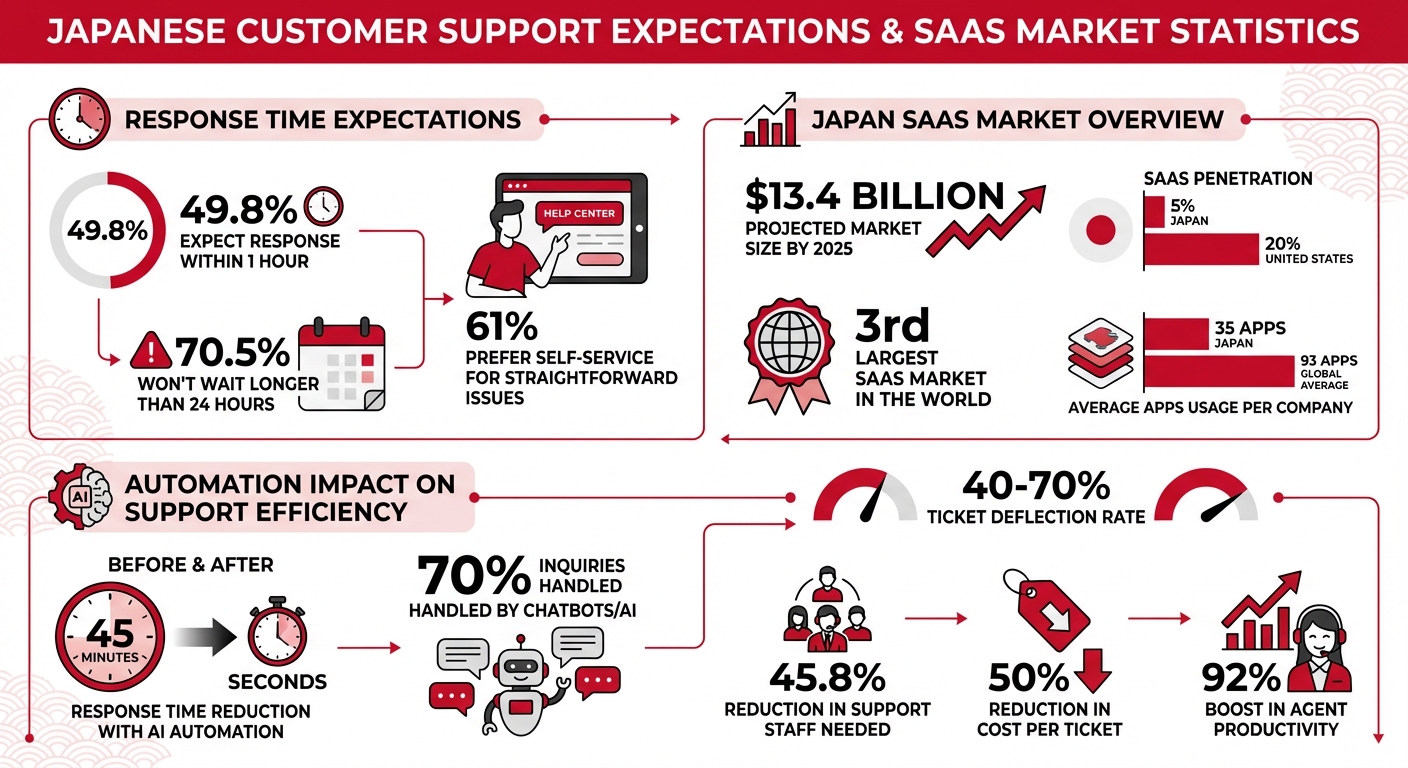
Slow response times don’t just frustrate customers in the moment – they can have long-term effects on trust and reputation. Japan is the third-largest SaaS market in the world, with projections estimating it will reach $13.4 billion by 2025. Yet, SaaS adoption in Japan lags behind other markets, with only about 5% penetration compared to around 20% in the United States. Japanese companies also use fewer apps – just 35 on average versus the global average of 93. For a market still warming up to cloud-based services, a single poor support experience can leave a lasting negative impression.
The issue goes beyond immediate customer dissatisfaction. Slow responses waste the investment made in acquiring customers. The Japanese sales process is lengthy and requires significant effort to educate and build trust with prospects.
"Japanese buyers tend to be highly attentive and diligent during evaluation, and once a decision is made, they are less likely to churn",
explains Yuga Koda from Nihonium.
However, failing to meet local support expectations can undo all that hard work, weakening trust and damaging long-term relationships.
The damage doesn’t stop at individual accounts. In Japan, B2B buying decisions often rely on a consensus-driven process called ringi, where multiple stakeholders must agree. Slow support responses can prevent an internal advocate from successfully promoting your product within their organization. Worse, delays can reinforce fears that foreign SaaS companies might eventually withdraw from the Japanese market, leaving customers without dependable support. Even small errors – like misusing honorifics or responding too slowly – can harm a company’s credibility and make it harder to build trust.
Japanese customers also tend to avoid voicing complaints when they feel let down, making it harder for companies to identify and resolve problems.
"Japanese customers are notorious for not complaining when they feel mistreated – while they quietly stew in their own juice",
notes Tim Sullivan.
Without direct feedback, companies risk missing the warning signs of rising churn and dissatisfaction, leaving them unprepared to address the underlying issues.
sbb-itb-a752276
Solutions: How to Meet Japanese Response Time Standards
Using Automation for Immediate Acknowledgment
To meet Japanese expectations for quick responses, start by automating the acknowledgment process. AI-driven ticketing systems can cut response times from 45 minutes to just seconds. Chatbots and AI agents can handle up to 70% of inquiries, providing 24/7 support and deflecting 40%–70% of tickets. This ensures constant availability, a crucial factor given that 61% of Japanese customers prefer self-service for straightforward issues.
A well-designed Japanese knowledge base is essential. Focus on covering the top 10–20 most common questions, using Japanese search terms and integrating the knowledge base into your support workflow. For more complex issues, AI can draft responses for quick human review, enabling faster follow-ups. Companies using these systems have reported a 45.8% reduction in support staff while managing higher ticket volumes. Start small by automating tasks like password resets, then gradually move toward handling more intricate issues.
It’s also important to integrate with platforms popular in Japan. For instance, connecting your support system to LINE, the leading messaging app, ensures you’re accessible where your customers are.
Setting Up Local Support Teams in Japan
While automation helps with speed, Japanese customers also value personalized, culturally aware interactions. A fractional support model, using local professionals, can deliver this without the overhead of a full-time team.
"Relying on automated or offshore customer service teams with little understanding of Japanese etiquette can erode trust rapidly",
- Nihonium.
Training local staff in Japanese etiquette, such as the proper use of business Japanese and honorifics (keigo), is non-negotiable. Even small errors in translation or honorifics can harm a brand’s reputation.
Having a physical presence in Japan, even through a coworking space, helps establish shinrai (trust) with enterprise clients. A local address signals your commitment to the market and adds credibility, which offshore-only setups can’t achieve. Local teams should also be prepared to handle Japanese invoicing practices, including bank transfers (furikomi) and monthly billing cycles, which are standard for B2B clients.
Training Support Teams on Japanese Time Standards
To align with Japanese expectations, consistent training is critical for both local and remote teams. Support staff must understand that prompt responses are seen as a sign of respect in Japanese business culture. Service Level Agreements (SLAs) should reflect this with clear escalation paths.
"Japanese business users… often prefer detailed menus, more granular control settings, and in-depth support documentation compared to Western users",
- Yuga Koda, Nihonium.
This means teams need to provide thorough, detailed responses rather than the brief, minimalist ones common in Western markets. Scripts and support materials should be reviewed by native experts to ensure they capture local nuances. Implement time-based escalations to flag tickets nearing SLA limits, ensuring punctual responses.
It’s also helpful to create feedback loops between Japanese frontline staff and your global product team. This allows you to address common issues early and offer culturally appropriate solutions that balance speed and care.
Monitoring Tools for Anticipating Customer Needs
Sometimes the best response is solving a problem before the customer even notices. Proactive support tools like "Anomaly Detection" can identify widespread issues early, allowing you to fix problems before they’re reported. This approach reinforces the importance of promptness in Japanese customer service.
AI tools can also prioritize tickets based on urgency and client value, ensuring high-priority enterprise clients in Japan get immediate attention while routine requests are routed appropriately. This kind of automated triage keeps response times fast for all customer segments.
Companies using proactive and automated systems have seen impressive results, including a 50% reduction in cost per ticket and a 92% boost in agent productivity. These tools not only save costs but also meet the high expectations of Japanese customers. Use monitoring systems to track response times by customer type, time zone, and issue category. This data helps identify trends and improve response speed continuously.
Results: Business Benefits of Fast Customer Support in Japan
Building Customer Trust Through Fast Responses
Quick response times are crucial for gaining shinrai (trust) in Japan, where customer expectations for promptness are high. Companies that adapt their support to meet local standards often see a noticeable drop in churn. Why? Because when service feels tailored and dependable, Japanese customers are more likely to stick around. Trust, in turn, becomes the bedrock of long-term relationships in a business culture that values strong connections.
Fast, polite support also opens doors for renewals and upselling. In Japan, where decision-making often involves multiple stakeholders (ringi), staying responsive throughout the relationship keeps your business top-of-mind. Japanese users expect thorough documentation and detailed answers, and providing these in a timely manner helps establish the credibility needed to secure renewals and uncover growth opportunities.
"Fulfilling your promise to take care of the problem immediately is not only your ticket to redemption; it’s an opportunity to grow even closer to your customer."
- Tim Sullivan, Writer and Cross-cultural Consultant
Resolving issues quickly can go a long way in building loyalty. In Japan, a speedy response signals sincerity and respect – qualities that often outweigh lengthy justifications or excuses. This approach not only strengthens trust but also elevates your brand in a competitive marketplace.
Using Speed as a Competitive Advantage
In Japan’s business landscape, where relationships are everything, speed isn’t just about trust – it’s a way to stand out. For SaaS companies in particular, swift customer support can set your brand apart. A smart strategy combines automation for instant acknowledgment with empathetic human agents to handle more complex concerns. This mix of efficiency and personal touch aligns with Japan’s cultural focus on meaningful connections, helping your company earn a reputation as a reliable and premium partner.
Speed also plays a role in shortening traditionally lengthy sales cycles. Japanese procurement often requires consensus from multiple parties, which can drag out decision-making. However, fast and thoughtful communication keeps the process moving and builds the credibility needed to navigate these complexities. Support teams that deliver timely, detailed responses to all stakeholders demonstrate the commitment Japanese buyers expect, keeping deals on track and reinforcing trust.
Conclusion: Meeting Japanese Customer Support Expectations
Providing customer support that aligns with Japanese standards is crucial for thriving in Japan. Studies show that 49.8% of Japanese customers expect a response within an hour, and 70.5% won’t wait longer than 24 hours for assistance. These expectations are rooted in cultural principles like omotenashi (hospitality), respect, and a deep focus on precision.
To meet these demands, businesses should take a multi-faceted approach. This includes automating acknowledgment messages, establishing local support teams well-versed in Japanese etiquette and keigo (formal honorific language), and using tools to monitor and address potential issues before they escalate. Combining automation with local expertise ensures that businesses can meet the high expectations of Japanese customers.
However, bridging the gap between cultural norms and operational practices requires specialized efforts. Companies must establish Japanese-language support, tailor service level agreements to align with local standards, and create detailed localized documentation. For these challenges, partners like Nihonium can provide valuable assistance. They offer services such as product localization, marketing funnel development, fractional sales support, and custom strategies for entering the Japanese market.
In Japan, speed isn’t just about resolving issues quickly – it’s about showing dedication to the customer. By delivering fast, culturally sensitive support, businesses can enhance customer satisfaction, build trust, and achieve long-term success in this market. Promptness, as an expression of omotenashi and respect, is a cornerstone of lasting growth in Japan.
FAQs
What response time should we target for Japanese customers?
For Japanese customers, it’s crucial to respond within the same business day. This reflects their strong emphasis on promptness and reliability when it comes to customer service.
How can we stay fast across the US–Japan time zone gap?
To bridge the time zone gap between the US and Japan, leverage tools like AI-driven support systems and multi-channel platforms to deliver prompt responses. Setting up local support teams in Japan is another effective way to handle inquiries within the same business day. Additionally, consider adjusting workflows by introducing shift schedules to ensure coverage aligns with Japanese business hours. These approaches not only ensure timely assistance but also help meet the high expectations of Japanese customers, fostering trust in the process.
When do we need a local Japan-based support team?
A local Japan-based support team plays a key role in providing prompt and culturally aware customer support. It aligns with Japanese expectations of trust, reliability, and politeness – qualities highly valued in building long-term relationships. Having such a team also ensures timely, same-day responses during business hours, meeting the high standards of service expected in Japan.
 Japanese
  English