

If your team handles Japanese support, I’d treat training as a launch gate, not a nice-to-have. The article’s point is simple: agents should not take live cases until they can use proper keigo, follow apology-first complaint flow, escalate the right cases, and give clear SLA timelines by channel. That matters because 50% of buyers prefer better local support over a known brand, and 75% of business users will not renew without Japanese post-sale support.
Here’s the short version of what I’d lock in before go-live:
- Language rules: use the right honorific level, correct name format, and approved phrases
- Tone rules: formal, calm, and apology-first when there is a problem
- Complaint flow: apologize, summarize the issue, state next steps, and add prevention notes when needed
- Escalation rules: move up unclear, repeated, risky, manager-requested, or abusive cases
- SLA wording: give a named owner, exact deadline, and next action
- Channel standards: email, chat, and phone each need different scripts, but the same level of politeness
- QA and sign-off: score agents before launch, then certify them with drills, simulations, and supervisor approval
A few numbers stand out. 70.5% of customers stop waiting if they do not hear back within 24 hours. Email users expect a first reply within 12 hours, and chat users expect a reply within 30–60 seconds. So for me, the takeaway is clear: Japan support training needs fixed rules for wording, timing, and handoffs.
| Area | What I’d standardize | What I’d check before go-live |
|---|---|---|
| Language | Keigo, honorifics, approved phrases | Written and oral assessment |
| Complaint handling | Apology-first reply order | Macro use and response drills |
| Escalation | Clear triggers and handoff notes | Owner, timeline, and timestamps |
| SLA messages | Exact dates, times, and next steps | Customer-facing macro review |
| Channels | Phone, email, and chat scripts | Response-time and tone checks |
| QA | Japan-specific scorecard | Minimum passing score and sign-off |
If I were setting up a Japan-facing team, I’d use this checklist as a pass/fail standard for readiness, not just a training outline.
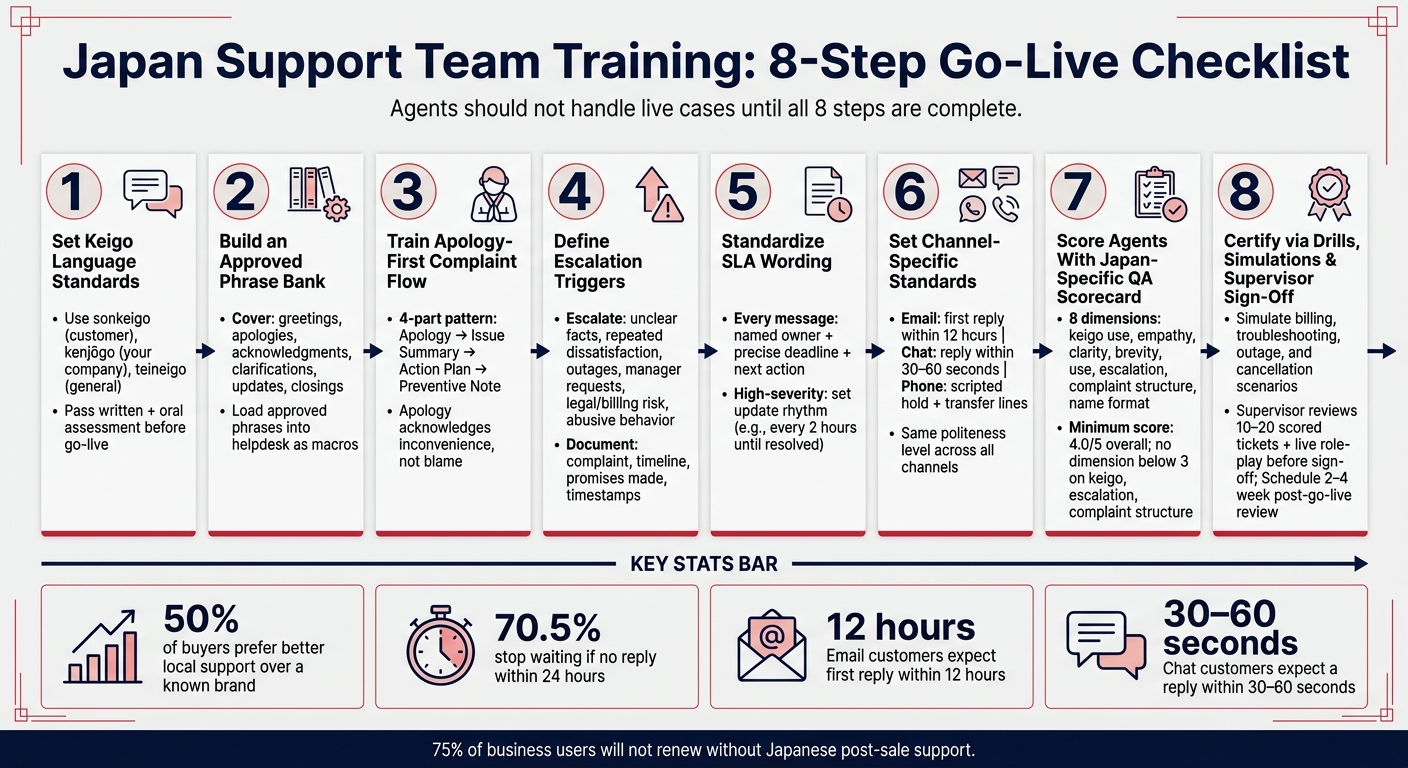
Japan Support Team Training: 8-Step Go-Live Checklist
2. Steps 1–2: Set Language and Tone Standards Before Go-Live
Before launch, put approved communication standards in place for Japanese support across email, chat, and phone.
Step 1: Review Keigo Basics and Honorific Usage
Japanese honorific speech (keigo) has three registers: sonkeigo for customers, kenjōgo for your company, and teineigo for general polite speech.
Here’s the rule to lock in:
- Customer’s actions → sonkeigo
- Your company’s actions → kenjōgo
- General statements → teineigo
That sounds simple on paper. In practice, agents need repetition. Run drills around login, billing, and outage scenarios, then ask agents to rewrite casual Japanese into the right register. That’s where mistakes usually show up.
For customer names, use family name + 様, such as 「佐藤様」. Do not use さん. Also, do not attach honorifics to your company or product names. If the customer’s name is unclear, use 「お客様」.
No agent should handle live Japanese cases until they pass written and oral assessments that show correct use of sonkeigo, kenjōgo, and teineigo across common support situations.
Once agents know the registers, the phrase bank gives them a consistent way to turn those rules into replies.
Step 2: Build and Approve a Formal Phrase Bank
A phrase bank cuts down guesswork and keeps tone steady across agents and channels. It should cover six core functions: greetings, acknowledgments, apologies, clarification requests, status updates, and closings.
The table below shows approved phrasing and what not to use for common support interactions:
| Function | ✅ Approved | ❌ Do Not Use |
|---|---|---|
| Greeting | 「いつもご利用いただきありがとうございます。○○サポートでございます。」 | 「どうも、○○サポートです!」 |
| Acknowledgment | 「お問い合わせいただきありがとうございます。」 | 「質問をありがとう。」 |
| Apology | 「ご不便をおかけしており、誠に申し訳ございません。」 | 「ごめんなさい。」 |
| Clarification request | 「差し支えなければ、該当の画面のスクリーンショットをお送りいただけますでしょうか。」 | 「スクショを送ってください。」 |
| Status update | 「現在、担当部署にて詳細を確認しております。結果が判明し次第、あらためてご連絡いたします。」 | 「確認しています。少々お待ちください。」 |
| Closing | 「今後とも○○をよろしくお願いいたします。」 | 「Best regards」 |
Also add softening phrases before customer requests. For example, 「恐れ入りますが」 and 「お手数ですが」 should come before asking the customer to do something, like upload logs or retry steps. In Japanese support, these phrases are expected. They’re not just extra polish.
Get sign-off from native Japanese CS leads, support leadership, and legal for any SLA or privacy wording. Then tag each phrase as approved, do not use, or use only in [context] so agents know exactly where it fits. After sign-off, load the approved phrases into your helpdesk as macros so agents default to correct keigo.
Once language is locked, move to apology-first complaint handling and escalation rules.
sbb-itb-a752276
3. Steps 3–4: Train Complaint Handling and Escalation Rules
Once language standards are set, complaint handling is where those rules stop being internal policy and start showing up in front of customers.
For Japanese customers, the order matters. When something goes wrong, they expect calm listening, a sincere apology, a clear summary of the issue, and a specific next step. That sequence shouldn’t be left to instinct. Agents should use the approved apology and status-update macros from Step 2 before they respond to complaints.
Step 3: Follow an Apology-First Complaint Flow
Train every agent to use the same four-part pattern for any complaint:
- Apology – Start with an approved apology macro before giving any explanation.
- Issue summary – Restate the problem and its impact on the customer in neutral, factual language so the customer knows they were understood.
- Action plan – Say exactly what happens next, who owns it, and when the customer will hear back.
- Preventive note – When it fits, briefly explain how the issue will be prevented going forward.
One point needs to be crystal clear: an apology acknowledges inconvenience, not blame. In billing or outage cases, agents should apologize for the impact first, then explain that the details are still under review.
Some phrases should be banned outright: That is not our fault, You must have misunderstood, and We already explained this. Those lines sound cold and dismissive. The same goes for any reply that starts with facts before regret. If the explanation comes first, the customer is likely to hear it as pushback instead of care.
After this response flow is set, the next job is to spell out which cases must move up to a supervisor.
Step 4: Define When Agents Must Escalate
Front-line agents should escalate cases they can’t resolve safely. The handoff rules need to be clear and non-negotiable so no one is left guessing.
| Trigger | Why It Requires Escalation |
|---|---|
| Facts remain unclear or conflicting | Agents should not guess or overpromise on unverified information |
| Customer remains dissatisfied or raises the same issue repeatedly | The issue needs more than frontline handling |
| Service-impacting incident, such as an outage or data issue | Broader impact requires senior oversight |
| Customer requests a manager | The request should be honored promptly |
| Legal, billing, or compliance sensitivity | These cases carry risk and need the right owner |
| Abusive, threatening, or harassing behavior | Japanese laws and guidelines require clear policies, training, consultation channels, and fact-finding procedures for customer harassment. |
Before handing a case off, agents must document the customer’s original complaint, a timeline of events, what has already been promised, and the relevant timestamps. Timestamps should use 07/28/2026 3:15 PM ET.
Each escalation also needs two things: a named owner and a customer-facing follow-up time.
4. Steps 5–6: Standardize SLA Wording and Channel Expectations
Once escalation paths are clear, the next rule is how agents set follow-up expectations. Vague promises like soon or as fast as we can usually backfire. Japan-facing customers want a clear time window, a clear owner, and wording that feels polite but steady. And the stakes are high: 70.5% will stop waiting if they don’t hear back within 24 hours.
Step 5: Write SLA Messages That Are Polite and Specific
Every SLA message sent to a Japan-facing customer should pass four checks before it goes out.
- Acknowledge receipt and state the owner
- Name who owns the case so the customer doesn’t feel bounced around
- Give a precise deadline, such as 07/29/2026, 2:00 PM JST
- State the next action
The tone should be careful and exact. Don’t promise what you can’t deliver. For high-severity cases like outages or data issues, don’t stop at one deadline. Set an update rhythm instead. For example: an initial update by 07/28/2026, 4:00 PM JST, then updates every 2 hours until resolution.
Set up three helpdesk macros:
- Standard inquiry
- High-severity issue
- Delay notice
Store dates in U.S. format, and show customer-facing deadlines as 07/29/2026, 2:00 PM JST.
Once the macro is ready, shift the wording to fit the channel.
Step 6: Set Clear Expectations by Support Channel
The channel changes the script, not the standard. That distinction matters.
Phone is still the top support channel in Japan, so agents need set lines for hold times, transfers, and post-call follow-up. Before placing a customer on hold, the agent should ask permission and give a time estimate. If the hold runs long, the agent should check back in before that estimate runs out.
Email needs to stay formal and include the next contact time. Japanese email customers expect a first response within 12 hours, and 61.3% say slow replies are their biggest frustration with email support. Every email should end with a specific follow-up date, not a soft line about getting back later.
Chat is faster and shorter, but it still needs polish. Agents should answer opening messages within 30–60 seconds. They should use polite acknowledgments and confirmation questions, not casual filler. If the issue can’t be solved during the chat, the agent should send an email follow-up with an exact time.
| Channel | Formality Level | First Response Target | Key SLA Wording Requirement |
|---|---|---|---|
| High – full sentences only | Within 12 hours | Specific follow-up date and owner in every message | |
| Chat | Moderate – concise but polished | Within 30–60 seconds | In-session or written follow-up with an exact time if unresolved |
| Phone | High – scripted respectful expressions | Immediate answer | Scripted hold, transfer, and post-call follow-up lines |
Use these channel rules as the baseline for the QA scorecard in the next step. These standards become the scoring criteria in Step 7.
5. Steps 7–8: Run QA Reviews, Certification, and Final Sign-Off
Once channel standards are in place, the last stretch is simple in theory and tough in practice: make sure agents can meet those standards when the pressure is on. The time to score readiness is before launch, not after the first unhappy customer shows up.
Step 7: Score Agent Readiness With a Japan-Specific QA Scorecard
Use a QA scorecard built for Japan so you can spot service issues that a generic review would miss. Each interaction should be rated across eight dimensions:
- correct keigo use
- empathy
- clarity of explanation
- polite brevity
- approved phrase use
- escalation compliance
- complaint-handling structure
- name format and apology placement
Use a 1–5 scale with clear behavior-based anchors for each score. For instance, a 5 for correct keigo use means the agent uses honorific verbs and set expressions correctly and consistently, with no mistakes. A 1 means frequent casual wording that doesn’t fit customer communication. Set a minimum overall average of 4.0 out of 5. Also require that no agent scores below 3 on the three high-priority dimensions: politeness level, escalation compliance, and complaint structure.
The numeric score isn’t enough on its own. QA reviewers should also check name format, apology placement, issue summary, next steps, and handoff notes in every audited interaction.
If QA audits show repeated low scores on complaint structure or escalation items across multiple tickets, mark those agents as medium- or high-risk for go-live. Agents who fall below the threshold should move into drills and lower-risk queues before sign-off.
Step 8: Certify Agents Through Drills, Simulations, and Supervisor Sign-Off
Use scorecard gaps to guide drills, then certify only the agents who clear the bar. Language drills should map to specific scorecard dimensions. One example: ask agents to rewrite responses that are factually correct but feel cold, adding empathy and a formal tone without changing the meaning.
Then move into complaint simulations. Cover both high-frequency cases, like billing questions and basic troubleshooting, and high-risk cases, like outages and cancellation risk. Each simulation should require a full response, including:
- greeting
- apology
- issue summary
- remediation steps
- closing
- internal handoff notes when escalation applies
After the simulations, supervisors should review 10–20 scored sample tickets and run a short live role-play session before giving formal sign-off. The sign-off document should record any queue limits, such as standard inquiries only until complex complaint scores improve. Schedule a 2–4 week post-go-live review to check that QA scores hold up once agents start handling live cases on their own.
FAQs
How long should Japan support training take before go-live?
Before go-live, your support coverage and infrastructure need to be fully up and running before you onboard the first Japanese customer.
This setup usually takes 12 weeks.
- 6 weeks to audit and localize support channels and documentation
- 6 weeks to set up customer success operations and define Japan Standard Time SLAs
For enterprise accounts, full business-hour support coverage is required for procurement.
Who should approve Japanese support scripts and macros?
Japanese support scripts and macros should be checked and approved by native Japanese speakers who know your product and how business is done in Japan.
They can review honorifics, formality, and subtle language choices that are easy to miss. A dedicated tone owner can also keep wording consistent across teams and in line with brand guidelines.
What mistakes most often block agents from certification?
The most common problem is keigo. More specifically, people often struggle with when to use respectful, humble, and polite language.
Other common blockers show up in day-to-day communication. People may miss indirect or subtle cues, come across as too direct or too casual, misunderstand consensus-driven decisions, or give too little detail in documentation. Apologies can also go off track. Instead of first acknowledging the customer’s inconvenience, the response may sound defensive.
Related Blog Posts
- Japanese Customer Support: Essential Best Practices
- Guide to Training SaaS Teams for Japanese Customers
- Why Promptness Matters in Japanese Customer Support
- Japan SaaS Localization Study: Common Language Errors
 Japanese
 English