

Bad Japanese copy can slow deals, hurt signups, and weaken trust from the first click. In this study, I found the same five problem areas show up again and again: literal translation, term mismatch, tone mismatch, formatting errors, and unclear messaging.
If you’re launching SaaS in Japan, here’s the short version:
- Product pages fail when headlines sound translated and CTAs feel too pushy
- Pricing pages lose trust when tax status, billing terms, and yen formatting are unclear
- UI copy breaks flow when tone shifts, terms change, or error messages don’t tell users what to do
- Emails fall flat when subject lines sound like English copy in Japanese or variables are inserted the wrong way
- Sales copy often misses when claims feel too direct for Japanese B2B buyers
- Forms create friction when name order, address fields, and validation don’t match Japanese input norms
- Help and support struggle when article titles don’t match user search terms or replies miss business email etiquette
A few numbers make the point fast:
- 90% of Japanese consumers prefer product information in their own language
- Direct currency conversion can lead to 30% lower conversion rates
- Mobile B2B email open rates are around 21.8%, so short, clear subject lines matter
What does this mean in practice?
You can’t treat Japan localization as simple translation. I’d sum the article up like this: set one writing style, lock your glossary early, review full user flows with native QA, and check every customer touchpoint – not just the homepage.
That’s the core lesson from the full study.
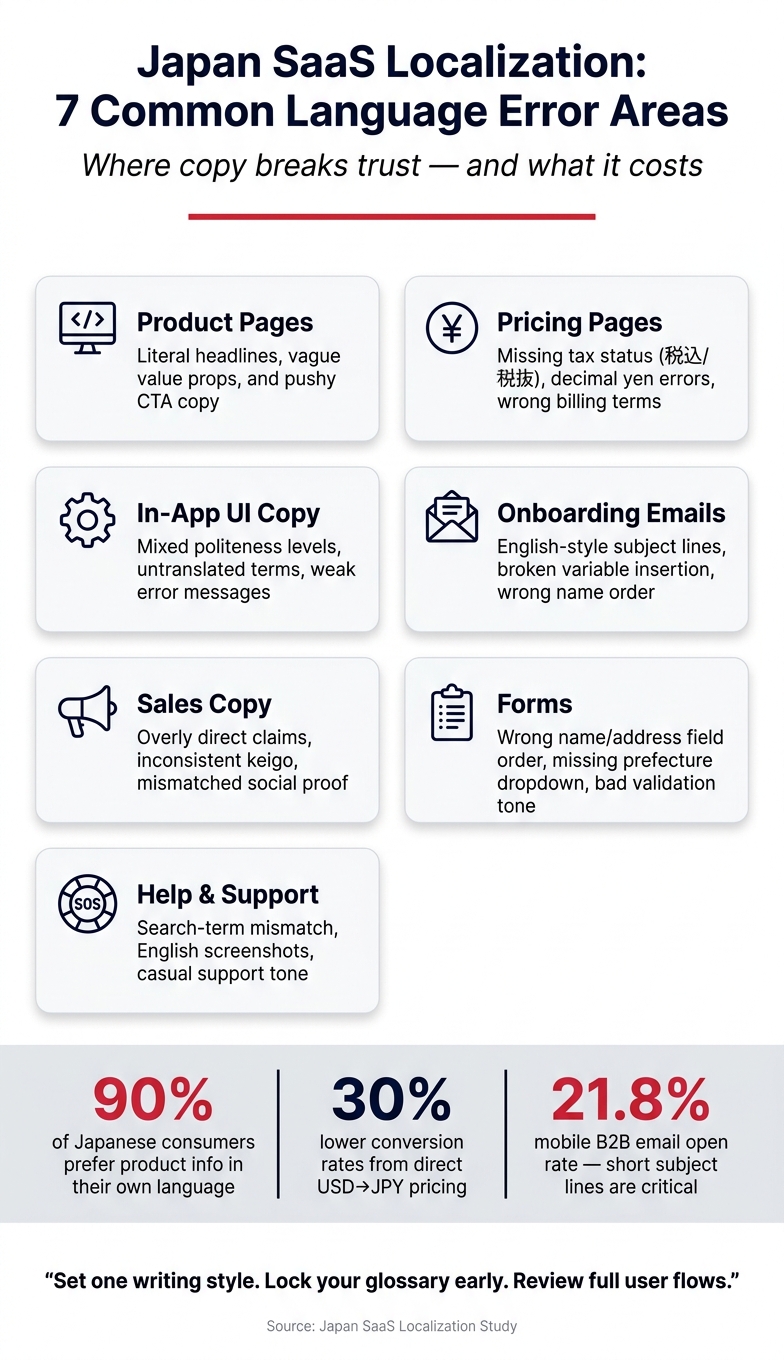
Japan SaaS Localization: 7 Common Language Error Areas
Language Errors on Product Pages, Pricing, and Core UI
Product Page Copy: Literal Headlines, Unclear Value Propositions, and Unnatural CTAs
Japanese product pages need to answer three things fast: who this is for, what problem it solves, and how it fits into the buyer’s day-to-day work. When that doesn’t happen, the page starts to feel vague.
A common mistake is translating English headlines word for word into Japanese. The meaning may be correct, but the result still feels like translated copy instead of something written for Japanese readers.
On these pages, abstract benefit statements usually don’t land well in Japan. Concrete, task-based copy tends to work better. Instead of broad claims, focus on clear use cases, job roles, and outcomes. That gives buyers something they can picture in their own workflow.
CTA copy is often where the trust gap shows up most clearly. Direct translations of English marketing phrases like 今すぐ購入する ("Buy Now") or すぐ登録する ("Sign Up Now") can sound abrupt and pushy, especially against the more measured tone common in Japanese business communication. Softer, evaluation-focused options such as 資料請求 (request materials), デモを申し込む (schedule a demo), or プランを選択する (select a plan) are usually a better fit. This matters even more in enterprise SaaS, where buyers often take longer to review options before they commit.
Pricing and Plan Language: Billing Ambiguity and Formatting Mistakes
Pricing pages carry a lot of trust in Japan. Small language or formatting issues can do more damage here than almost anywhere else.
Two mistakes show up again and again:
- Showing yen prices with decimal places, such as ¥1,500.00
- Converting USD prices directly instead of setting fixed yen tiers
Both can weaken pricing credibility. SaaS products that rely on direct currency conversion see 30% lower conversion rates than products with localized fixed-yen pricing.
The wording around billing is often just as shaky. Many Japan-facing pricing pages don’t clearly say whether prices are tax-inclusive (税込) or tax-exclusive (税抜). They also leave out whether a trial auto-renews and what happens when a billing period ends. Those missing details create doubt at the exact moment a buyer is close to saying yes.
Another issue is annual billing. Many teams miss the April-to-March fiscal year used in Japan. That can slow internal approval, especially in consensus-based processes like ringi. If pricing doesn’t line up with how companies budget and approve spend, even a good offer can stall.
Once users trust the pricing page, they expect that same level of care inside the product.
In-App UI Text: Mixed Politeness, Untranslated Terms, and Weak Error Messages
In-app Japanese should use the polite desu/masu form across navigation, prompts, tooltips, and system messages. If one screen is polite and the next switches to plain form, users can tell right away that the product was translated in pieces without a shared style. It makes the product feel unfinished.
English terms are fine when they are already standard in Japanese SaaS. If they aren’t, they should be localized and used the same way everywhere. When one term stays in English, another gets translated, and a third shifts back again, the product starts to feel patched together.
Error messages need to do three jobs clearly:
- Name the field
- Explain the required format
- Tell the user what to do next
The tone should match the rest of the UI, and the message should end with a direct instruction like 〜してください so users know how to move forward. A vague error message is frustrating in any language. In Japanese, it also chips away at trust.
Those same tone and consistency problems often carry over into onboarding emails and sales copy, where one awkward line can break momentum right after signup.
sbb-itb-a752276
Language Errors in Onboarding Emails and Sales Copy
Onboarding and Transactional Emails: Subject Lines, Grammar Flow, and Variable Insertion Issues
Onboarding emails are often the first serious trust check after someone signs up. If the Japanese feels weak, trust drops fast, and activation can slow down. The same localization problems that hurt trust in the UI often show up in email flows too.
Subject lines are a common weak spot. English-style lines like "Welcome to [Product]!" or "Get started today!" can sound promotional or robotic in Japanese. Japanese business subject lines tend to be short and purpose-led. Common patterns include 〇〇の件, 〇〇についてご連絡, and 〇〇のご案内. In some cases, a bracketed label like 【ご案内】 or 【至急】 also fits. Keep subject lines short. Long ones get cut off on mobile, where B2B open rates are around 21.8%. That same sensitivity carries into the body copy and field insertion, where even small mistakes stand out.
Grammar flow often breaks when teams translate line by line from English. Japanese readers pick up on English word order, passive-heavy phrasing, and main points that arrive too late. Onboarding emails in Japanese work better when they are short, direct, and easy to scan. The action or request should appear early, especially in messages about:
- verification
- trial setup
- password resets
- billing notices
Variable insertion causes problems too. Many templates assume English name order, but Japanese names are written with the surname first. Honorifics like 様 also need careful handling. Name order and date format should be localized. If dynamic fields for names, company names, dates, or plan names are dropped in without adjusting the grammar around them, the message can feel awkward or impolite. Date fields should match normal Japanese business format, such as YYYY/MM/DD.
Lifecycle and Sales Copy: Overly Direct Claims and Inconsistent Business Tone
Japanese B2B buyers usually respond better to measured, proof-based language than to hard-selling copy. Credible proof matters more than hype. Claims like "fastest", "best", or "guaranteed results" can weaken trust when there’s no clear evidence behind them. Heavy urgency can also feel off in B2B buying environments where decisions often involve group alignment.
Tone also needs to stay consistent from start to finish. That includes the subject line, body copy, CTA, and testimonial sections. If an email starts in formal keigo and then slips into casual marketing language, readers notice right away. The same goes for social proof. Directly translated English quotes, Western company names with no context, or high-energy wording that sounds normal in English can feel overstated in Japanese. Social proof tends to work better when it uses:
- company references that people can place
- properly formatted titles and surnames
- a tone centered on reliability and long-term value
Honorific handling matters just as much in outbound sales emails. Cold outreach can feel careless if it uses a first name too soon, skips 様, or gets company name and title formatting wrong. In Japanese business communication, those details say a lot about whether the sender understands the market.
These same problems often show up again in forms and support content, where etiquette and formatting matter even more.
Language Errors in Forms, Help Content, and Support Workflows
After signup, the same language standards need to carry into forms, help content, and support replies.
Forms and Workflows: Name Order, Address Structure, and Field-Level Friction
Form errors create real operational drag. Use surname-first name fields that match Japanese naming order. When a form ignores this, people may enter their name the wrong way or drop off before finishing. Then that bad data moves into CRM, billing, and compliance workflows, which means manual cleanup and a slower sales cycle.
Japanese addresses follow prefecture > municipality > ward > block > building > room, so standard Western street-address forms don’t fit. Add a required prefecture dropdown (都道府県), a postal code field checked for the XXX-XXXX format, and flexible address lines that can hold building names and apartment details.
Validation messages are the third pressure point. Use polite です/ます phrasing that names the field, explains the fix, and tells the user what to do next. Keep these messages consistent across sign-up, billing, and KYC flows. If the tone changes from screen to screen, the whole experience feels patched together instead of planned.
When forms collect bad data, help content has to do more work to get the user back on track.
Help Center and Support Content: Search Mismatch, Register Inconsistency, and Email Etiquette Problems
FAQ titles built around internal product names are a common reason help centers miss the mark. If a user searches with a broad, task-focused phrase in kanji or hiragana, but the article uses an English loanword or a literal translation, that article simply won’t appear. Rewrite article titles to match the terms people actually search for, not the names used inside the company.
English screenshots create another gap between help content and the live product. If the documentation shows an English UI but the live product is in Japanese, users can’t line up the article with what they see on screen. That confusion leads to support tickets that never should have been opened. Localized screenshots, matched UI labels, and step-by-step instructions that reflect the actual Japanese product cut that friction fast.
When self-serve content falls short, support tone becomes the next trust test.
Japanese business communication follows formal business etiquette and expects keigo – especially when dealing with billing problems or technical issues. If the tone is too casual, it can feel careless. If it’s too formal, it can slow things down. The right balance acknowledges the issue, states the next step clearly, and avoids extra emotional language. A weak reply can undercut the trust built on product pages, onboarding, and sales copy.
Inconsistent terminology across UI, help, and support adds confusion and drives up ticket volume. Use one glossary across every customer touchpoint to prevent avoidable friction.
These issues point to the same root problem: language consistency across the full launch journey.
Cross-Study Patterns, Root Causes, and Lessons for Future Launches
What These Errors Have in Common
The thread running through these mistakes is simple: teams treat localization like translation, when it’s actually a messaging issue.
The same problems show up again and again: split ownership, no shared glossary, and weak native QA. When nobody agrees on terminology, every surface starts to drift. Product pages say one thing, the UI says another, emails use a different tone, and forms and support copy add even more variation. On paper, the wording may be correct. But to a Japanese buyer, it can still feel slightly off.
And that slight mismatch matters. For a Japanese enterprise buyer, it can signal that the product wasn’t made with their market in mind.
"A partially localized product signals to potential customers that the vendor is not serious about the market." – Yuga Koda, Co-Founder, Nihonium
That points to a clear next step: build a shared language process before launch.
Lessons for Future Japan Launches
These patterns don’t point to random translation slipups. They point to a broken process.
The fix starts early. Teams need to choose one polite register – usually desu-masu – before any translation work begins. Then they need a Japanese style guide and glossary that sets approved terms for features, billing, plan names, and button labels across product pages, UI, emails, forms, and support.
Native QA also has to go beyond spot-checking screens. It should cover full user flows, including:
- signup
- billing
- password reset
- support submission
When a native reviewer moves through those flows in order, they’re much more likely to catch tone shifts and terminology gaps that isolated checks miss.
"SaaS localization in Japan is partly a strategic exercise in lower launch risk, protect brand trust, and improve consistency." – Yuga Koda, Co-Founder, Nihonium
Conclusion: Language Quality Is Part of Japan Go-to-Market Execution
In Japan, language quality isn’t a last-minute polish step. It’s a business signal.
Japanese enterprise buyers rank product localization among their top three evaluation criteria when choosing a foreign SaaS vendor. If localization feels weak, customer acquisition cost goes up and buyer confidence drops across the funnel.
Teams that put time into terminology control, register-consistent copy, and end-to-end workflow review tend to launch with less friction and earn trust faster. Teams that skip those steps often spend months handling support tickets they could have avoided, while trying to figure out why conversion slowed.
For companies entering Japan, Nihonium offers product localization, funnel creation, fractional sales support, and market-entry strategy.
FAQs
What should we localize first for Japan?
Start with a phased approach. Localize your core product UI, key documentation, and main marketing pages first so you can test market interest without overcommitting. At the same time, build a living Japanese glossary and termbase so your wording stays consistent across every touchpoint.
As traction grows, expand into full localization. That includes UI/UX updates, yen-denominated pricing, local payment methods, APPI compliance, and native review of keigo so the experience feels polished and trustworthy.
How can we make Japanese SaaS copy sound natural?
Go beyond direct translation and tailor the copy to fit Japanese business culture.
Use a formal, steady tone with proper keigo. Avoid hard-sell language or forceful commands, and lean toward softer calls to action.
Put the focus on specific details, trust, and clear outcomes instead of big promises. It also helps to have native Japanese editors review the copy so they can fine-tune tone, script balance, and overall flow.
What process prevents localization mistakes?
Use a clear governance process built around native expertise, not just automated tools. Keep a living style guide, a central glossary, and one dedicated tone owner so language and keigo stay consistent.
Make the three-check rule mandatory. That means every piece goes through QA by native Japanese editors who understand SaaS, not just language in the abstract.
After that, keep refining the content through A/B testing and user interviews. That’s how you catch what sounds right on paper but falls flat with actual users.
Related Blog Posts
- Common Issues in Japanese SaaS Localization
- Translation vs. Localization: What Works for Japan
- How Japanese Culture Shapes SaaS Messaging
- Why Tone Matters in Japanese SaaS Marketing
 Japanese
  English