

If you sell SaaS in Japan, don’t treat silence like a “no.” In many cases, it means the buyer is still building internal agreement. Deals often take 6 to 18 months, involve 6 to 10 stakeholders, and can add 2 to 4 extra weeks just for formal approval.
Here’s the short version:
- Japan enterprise deals run on risk control, not fast closes
- A strong demo is not enough because IT, legal, finance, procurement, and executives all review the vendor
- Nemawashi means quiet, early buy-in before formal review
- Ringi means formal step-by-step approval across teams
- Buyers often expect Japanese-language materials, local support, APPI and security answers, and signs that you plan to stay in Japan
- Things like USD pricing, English-only contracts, pressure tactics, and thin documentation can slow or stop a deal
I’d sum it up like this: if you want to win in Japan, stop pushing for urgency and start making internal approval easier. That means giving your champion documents they can share, answering questions in Japanese, and showing that your company will still be there years after the contract is signed.
Why Trust Takes Longer in Japan Enterprise Sales
Japanese enterprise buyers tend to move slowly because they’re managing risk, not chasing speed. When a new vendor shows up, the first reaction is caution. The main issue isn’t just whether the product works. It’s whether the vendor can be trusted for years.
A demo can show product fit. Trust in the vendor comes from stability, a clear process, and proof in the local market. That’s why vendor review in Japan rests on more than product fit.
Consensus, Risk Reduction, and the Need for Internal Alignment
Each team reviews the deal through its own risk lens, so internal alignment becomes the hard part. IT checks security and APPI compliance. Finance looks at contract structure and billing format. Legal reviews liability and data handling. Procurement focuses on cost and continuity. The executive team weighs vendor reputation, strategic fit, and stability.
So the deal doesn’t move forward just because one team likes the product. It moves when risk has been cleared across departments.
Why a Strong Demo Rarely Closes the Deal on Its Own
A polished demo answers one question well: does the product work? But it doesn’t answer the questions that matter most during internal review – what happens if there’s a security incident, who handles support in Japanese, and whether the vendor will still be operating in this market over the long run.
Buyers worry that an overseas company might exit the Japanese market if revenue targets aren’t met. That skepticism toward foreign vendors means product quality alone won’t carry the deal. What builds confidence is a steady paper trail: security documentation, Japanese-language case studies, clear onboarding plans, and proof that leadership is seriously invested in the market.
"In a culture that prizes brick-and-mortar, long-term bonds and risk avoidance, a ‘remote-first’ overseas vendor without a real footprint or a clear strategy for Japan entry is treated as a corporate yūrei [ghost]: something that is here one day and gone the next." – Stefan Sandström, Biosector Ltd.
That proof has to hold up during internal review, not just sound good on a sales call.
sbb-itb-a752276
How Older Business Norms Still Shape Vendor Review in Japan
Two older review habits still shape enterprise deals in Japan: nemawashi and ringi. They turn trust into a consensual decision-making process. That’s a big reason vendor review moves slowly, even when the product is a good fit.
Nemawashi: Building Informal Agreement Before Formal Approval
Nemawashi literally means "going around the roots", a gardening term for preparing soil before transplanting a tree. In business, it means getting key stakeholders aligned informally before anyone asks for formal approval.
In plain English, your internal champion is doing a lot of behind-the-scenes work. They’re talking with IT, Finance, Legal, and department leaders well before the formal review starts. The goal is simple: bring up objections early and deal with them in private.
Why does that matter? Because if someone feels blindsided in the official review, the deal can stall or fall apart. Since most concerns get worked through before anything becomes official, nemawashi often takes weeks.
Ringi: The Formal Sign-Off Process Across Departments
Once that informal alignment is in place, the deal moves into the ringi stage. At this point, a formal document called a ringisho is drafted and passed through the management chain one step at a time. Each approver reviews it and signs off – on paper or digitally – before it goes to the next person. For larger purchases, that chain can include 3 to 7 approvers, sometimes all the way up to the CEO.
The ringisho usually covers:
- business justification
- total cost
- security assessment
- APPI compliance confirmation
- a comparison of alternatives
Even after the vendor has already been picked, the ringi stage usually adds 2 to 4 weeks to the timeline. Its purpose is to formalize consensus.
What These Norms Mean for SaaS Buyers Today
Today, these norms show up as more documentation, more cross-team meetings, and closer review of security and support readiness. Japanese enterprise buyers often send security questionnaires with 50 to 200 questions. If a vendor can’t respond in Japanese, momentum often slows at this stage.
The same norms also shape which vendor signals build confidence and which ones create hesitation.
What Builds Trust and What Gets in the Way
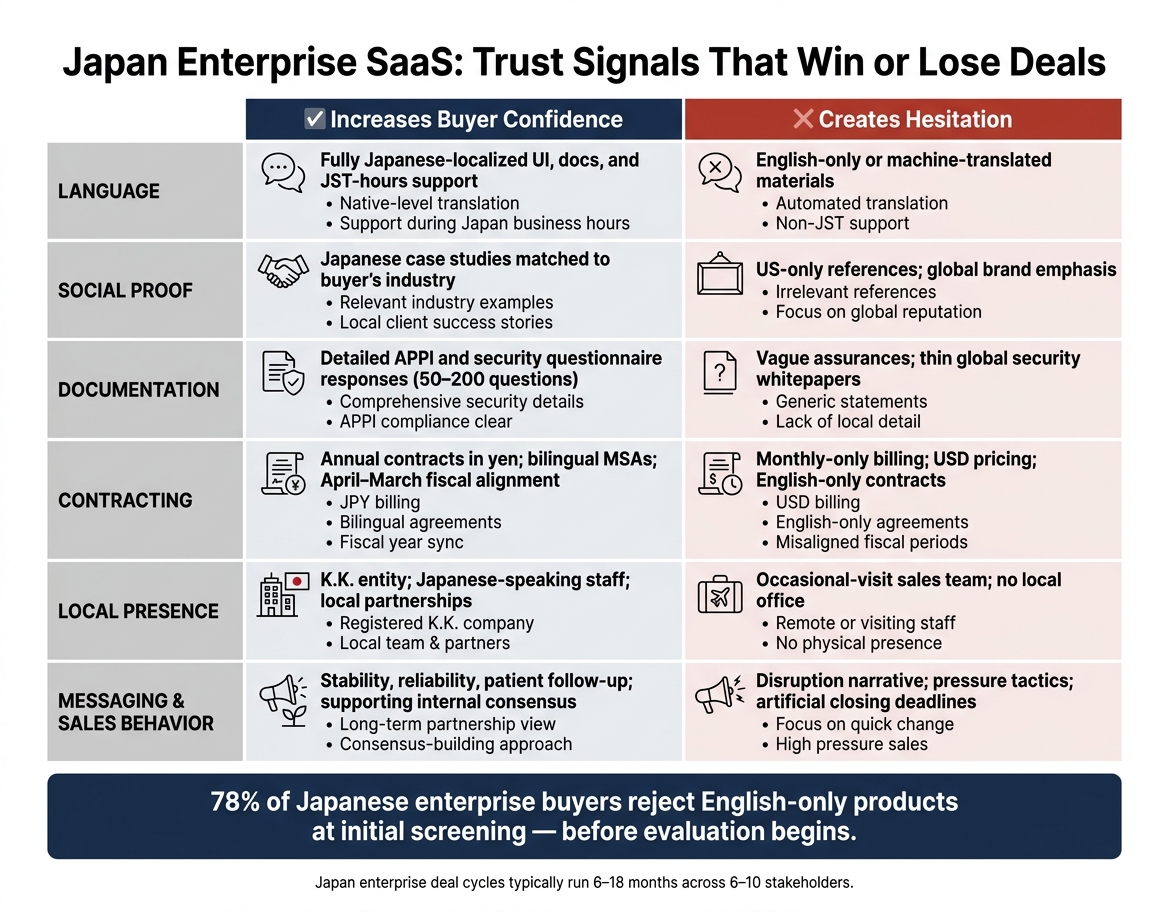
Japan Enterprise SaaS Sales: Trust Signals That Win or Lose Deals
Every vendor signal passes through several people on the buyer’s side, so trust is won or lost during review. In practice, that means every email, document, and follow-up call becomes part of the trust test.
Signals That Increase Buyer Confidence in a SaaS Vendor
For Japanese enterprise buyers, fully Japanese-localized UI, documentation, and support aren’t a nice extra. They’re the starting point. Research shows that 78% of Japanese enterprise buyers reject English-only products at the initial screening stage, before evaluation even begins.
Language is just one part of it. Buyers also look for organizational stability. A local entity such as a K.K. or G.K., Japanese-speaking staff, and a visible long-term roadmap for Japan help calm a common concern: that a foreign vendor might sign the deal, then slowly fade from the market. Japanese references matter too. And they matter more when they match the buyer’s industry or use case, because those examples carry more weight than broad global brand recognition.
Documentation is another big trust signal. Buyers want detailed responses in Japanese, especially for security questionnaires. They also expect clear APPI compliance materials and a plain implementation roadmap. As Yuga Koda, Co-Founder of Nihonium, puts it:
"Japanese enterprise buyers routinely send security questionnaires of 50 to 200 questions before finalizing any SaaS purchase. Vendors who respond quickly and completely in Japanese reduce friction significantly."
Contract structure sends a message as well. Annual contracts priced in yen, aligned with Japan’s April–March fiscal year, show commitment. Monthly billing tends to send the opposite signal.
Once buyers see those signs, the next question is simple: how much work is still left to remove internal objections?
Signals That Create Hesitation During Review
Hesitation often comes from what’s missing. Still, a few problem areas show up again and again with foreign SaaS teams entering Japan.
One of the biggest is generic global messaging. Claims built around "disruption", "innovation", or U.S. market wins often miss the mark. Japanese enterprise buyers tend to care more about risk mitigation and long-term stability than speed or ROI-led pitches. So messaging meant to sound bold can end up sounding risky instead. The same goes for pressure tactics. Artificial deadlines, scarcity language, and aggressive closing behavior usually read as instability, not progress.
Here’s the split in plain terms:
| Signal Area | Increases Buyer Confidence | Creates Hesitation |
|---|---|---|
| Language | Fully Japanese-localized UI, docs, and JST-hour support | English-only or machine-translated materials |
| Social Proof | Japanese case studies matched to buyer’s industry | US-only references; global brand emphasis |
| Documentation | Detailed APPI and security questionnaire responses | Vague assurances; thin global security whitepapers |
| Contracting | Annual contracts in yen; bilingual MSAs | Monthly-only billing; USD pricing; English-only contracts |
| Local Presence | K.K. entity; Japanese-speaking staff; local partnerships | Sales team that only visits occasionally; no local office |
| Messaging and Sales Behavior | Stability, reliability, patient follow-up; supporting consensual decision-making | Disruption narrative; pressure tactics; artificial closing deadlines |
These signals shape whether a deal moves forward with momentum or gets stuck in review.
How SaaS Teams Can Build Trust Through Follow-Up, Proof, and Local Presence
Once the trust signals are in place, the next job is to make the deal easier to move through the buyer’s company. That usually comes down to three things: steady follow-up, proof people can pass around, and support that feels local.
Use Steady Follow-Up to Reduce Buyer Uncertainty Over Time
Follow-up should lower uncertainty, not push for a signature. Reply to questions within hours, not days. And if a champion goes quiet for more than two weeks, skip the contract nudge. Send proof that handles the next likely objection instead.
That small shift matters. It keeps the deal moving through nemawashi instead of making the buyer feel cornered.
Bring Proof That Fits Internal Review Requirements
Proof matters because many of the people who shape the decision never join the sales call. They still need enough detail to review the deal and pass it along.
A simple way to handle this is to prepare role-specific one-page internal briefs in Japanese, such as:
- Security questionnaire responses for IT
- ROI models for Finance
- Workflow impact summaries for department heads
For IT review, keep a pre-built Japanese-language template ready for APPI compliance and data residency. That saves time and makes the review process smoother.
Timing matters too. Match proof delivery and proposal timing to Japan’s fiscal year, which runs from April through March. Budget planning usually happens between October and December. If you miss that window, even a strong deal can stall.
Show Commitment Through Local Language and In-Market Support
Local language support matters because it makes internal circulation easier. Poor translation sends the wrong message. It suggests weak commitment, slows internal review, and can block consensus altogether.
For teams that need stakeholders to share materials across departments, clear Japanese copy isn’t a nice extra. It’s part of the sales process.
If a global SaaS team isn’t ready to open a local legal entity, a phased approach can work well. Start with a Japanese landing page, a localized sales deck, and yen-denominated pricing. Then add full UI localization and JST-hours support as pipeline grows.
Nihonium (nihonium.io) supports this kind of staged market entry. It provides localization, marketing, fractional sales support, and a custom Japan market entry strategy, helping global teams build a credible local presence.
Conclusion: A Clear Playbook for Winning Trust in Japan Enterprise Deals
These norms boil down to one plain rule: if you want to win enterprise deals in Japan, you need to make it easier for buyers to say yes inside their own company. The sales cycle will likely run 6 to 18 months because trust, consensus, and internal alignment drive the deal more than vendor pressure or product quality by itself.
The playbook is simple. Give your internal champion Japanese, stakeholder-specific materials that help the deal move through nemawashi and into ringi with less friction. Make the ringi process easier by preparing clear documentation your champion can share, explain, and defend when you’re not in the room.
Once those materials are circulating, your follow-up should keep lowering risk. Reach out every 10 to 14 days, and lead with something useful: a rollout flow, a summary of support and security protocols, or a relevant case study.
Local credibility closes the gap that’s left. Local presence shows long-term commitment. A phased approach, starting with Japanese-language support and localized services during JST hours, a localized UI, and a visible in-market presence, builds the trust that lowers risk across the buyer’s organization. Monthly billing can signal weak commitment; annual contracts in yen send the opposite message.
The shift at the center of all this is simple: stop selling, start reducing risk. Every document you prepare, every follow-up you send, and every localization choice you make either helps the deal move through the buyer’s organization or quietly slows it down.
FAQs
Why are Japan enterprise deals so slow?
Japan enterprise deals often take 6 to 18 months. That slower pace usually comes from a consensus-based process built to lower risk, not from a lack of interest.
In many cases, decisions move through the ringi system, where multiple stakeholders review and weigh in across departments. So instead of one fast yes or no, the process tends to unfold step by step.
Buyers also spend a lot of time reviewing security, compliance, and integration requirements. On top of that, they often ask for localized materials, which adds more work before anything moves ahead.
Vendor relationships are often viewed as long-term commitments. Because of that, trust tends to build more slowly and usually depends on stability, reliability, and a steady local presence.
What do nemawashi and ringi mean for vendors?
In Japanese enterprise sales, nemawashi and ringi describe a slow, consensus-based way of making decisions.
Nemawashi is the informal stage. This is where people build support, talk through concerns, and smooth out objections before anything becomes official.
Ringi is the formal approval stage. At that point, the written proposal moves through management for sign-offs.
For vendors, the takeaway is pretty simple: be patient, help your internal champion do their job, and come prepared with strong Japanese-language documentation.
How can SaaS teams build trust faster in Japan?
SaaS teams tend to earn trust faster in Japan when they stop treating sales like a quick transaction and start treating it like a long-term relationship.
That means leading with patience, steady follow-up, and a clear commitment to staying for the long haul. In practice, a few moves matter most:
- Establish a local presence
- Fully localize the product, documentation, and workflows
- Support nemawashi and provide ringi-ready proof, such as ROI analysis, security certifications, and local case studies
This approach works because buyers often want more than a polished pitch. They want to see that your team will show up, communicate clearly, and make internal approval easier. If your product looks good but your proof is thin, deals can stall. If you make the internal process simpler, trust tends to build much more smoothly.
Related Blog Posts
- Why Long-Term Commitment Matters in Japan SaaS Sales
- Ultimate Guide to Japanese Enterprise Sales Pitches
- Trust vs. Speed: Priorities in Japan SaaS Sales
- Japan vs West: Client Relationship Style in SaaS
 Japanese
 English