

If I were entering Japan with a SaaS product, I’d build around trust, Japanese-language education, and local proof – not raw reach. Japan’s B2B SaaS market is set to reach $13.8 billion in 2026, yet only 34% of SMEs use cloud or SaaS tools. That means there’s room to grow, but buyers move with care, often through group approval, long review cycles, and local trust signals.
Here’s the short version:
- I’d pick expert voices over large followings
- I’d use YouTube, X, LINE, ITreview, and BOXIL based on buyer stage
- I’d build Japanese landing pages, ROI docs, and proposal materials
- I’d test with a small creator group first
- I’d measure qualified leads, trials, webinar performance, and pipeline
- I’d lock down #PR / #広告 disclosure and local claim review before launch
If you want influencer marketing to work for SaaS in Japan, the job is simple to describe: help buyers explain your product inside their company. That means your content must do more than get attention. It needs to support internal review, answer risk questions, and give local-language proof people can share.
Quick comparison
| Area | What I’d do in Japan |
|---|---|
| Creator choice | Pick subject-matter experts with the right audience |
| Best channels | Use YouTube for education, X for visibility, LINE for follow-up |
| Review support | Send traffic to ITreview, BOXIL, and local partner paths |
| Good formats | Product explainers, walkthroughs, webinars, ROI-focused assets |
| Best for enterprise | Pair creator work with SIers and local partners |
| Tracking | Use UTM links, local landing pages, promo codes, and CRM tags |
| Success metrics | Watch MQLs, PQLs, trial starts, webinar follow-up, and pipeline |
| Main risks | Poor Japanese copy, weak localization, bad attribution, missing disclosure |
My takeaway: in Japan, influencer marketing for SaaS works best when I treat it as a trust-and-sales-support program, not just an awareness play.
sbb-itb-a752276
Influencer Models That Fit SaaS in Japan
Not every influencer setup works for Japanese B2B SaaS. The right format depends on product complexity, ACV, and what the campaign needs to do.
B2B Key Opinion Leaders (KOLs), Expert-Led Product Explainers, and Joint Webinars
In niche SaaS categories, industry experts with deep subject-matter trust tend to beat creators with big but broad audiences.
Expert-led product explainers are a strong fit for awareness and early education. When a local expert walks through a product’s main use case in fluent, natural Japanese, buyers get something they can pass around internally and use to build agreement.
Joint webinars work especially well for mid-market and enterprise SaaS. They help with internal review and consensus-building, and they give buyers the proof and detail they want before they buy. They can also bring in high-intent leads, because attendees have already spent time learning about the product.
As ACV goes up, it makes sense to move from lighter creator content to ringi-ready ROI tables and Japanese case studies.
That leads straight into the next choice: which channels and buyer stages each format should support.
When Affiliate or CPA-Style Programs Can Work
Performance-based programs can work in Japan when the product has a clear, low-friction value proposition and the offer is simple enough to explain without confusion. They usually don’t fit complex enterprise SaaS with many approvals and long sales cycles.
For clean attribution, use:
- Localized landing pages
- UTM parameters
- Affiliate links
- Dedicated promo codes
If the trial or onboarding flow isn’t localized, affiliate traffic is far less likely to convert.
In Japan, compensation can take the form of revenue-share payments or hybrid deals with a flat fee plus a performance bonus. Either way, the creator needs to understand the product well enough to explain it correctly. If the promise is off, trust can drop fast.
How Expert Communities and Local Partners Support Distribution
Influencer content works best when it feeds into the channels Japanese buyers already use to evaluate software. For developer tools, that often means community-led growth on platforms like Qiita and GitHub Japan. For SME software, review platforms such as ITreview and BOXIL play a big role in building trust.
43% of SME SaaS purchases in Japan originate from IT review sites or local IT vendors. So it helps to seed reviews early. That gives influencer content somewhere useful to send interested buyers and pushes prospects into the review and partner ecosystem.
For enterprise SaaS, influencer reach tends to work best when it connects with local partners that can move the deal through approval.
Local partners, especially Systems Integrators (SIers), drive a large share of enterprise distribution. In Japan, 70% of B2B SaaS sales flow through partner channels. For enterprise software, SIers often act as the outsourced IT function for the customer and provide the endorsement needed to get through internal approvals.
Best Channels and Buyer-Journey Fit in Japan
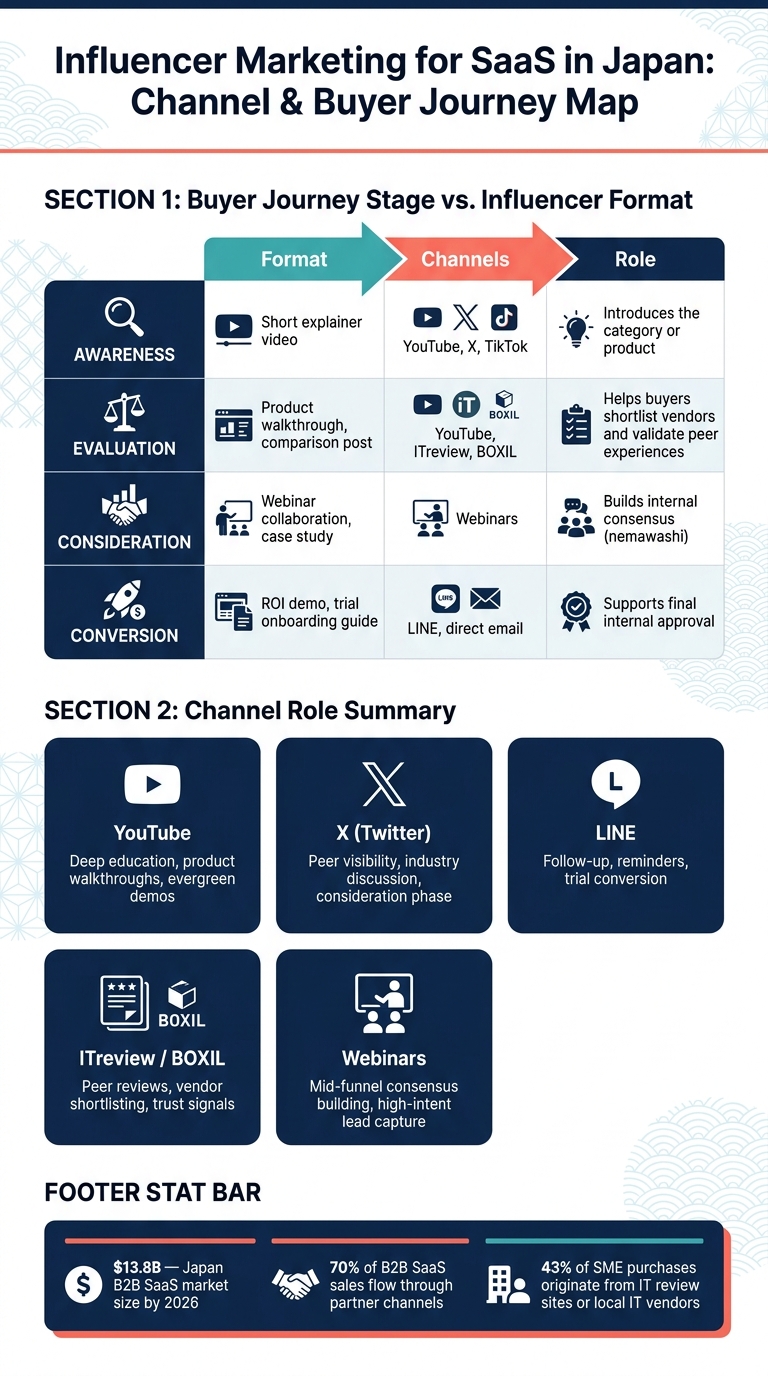
Influencer Marketing for SaaS in Japan: Channel & Buyer Journey Map
Pick channels by buyer stage, not by platform size. In Japan, buyers use different places to research, check claims, and move toward a decision. So the order of channels often matters more than raw reach.
YouTube, X, and LINE as the Core Channel Mix
YouTube is a main channel for SaaS education in Japan. It works best for detailed product walkthroughs, category explainers, and demo content that buyers can watch, pause, and pass along inside their company. A polished Japanese-language walkthrough can be especially helpful when a prospect is trying to figure out whether a product fixes their problem.
X (formerly Twitter) helps with peer discussion and visibility. Business professionals use it to follow industry talk, share opinions, and spot new tools. It’s less about deep education and more about staying present during the consideration phase.
LINE works better later in the journey. Use it for reminders, follow-up, and trial conversion.
Once those channel roles are clear, map creators to the formats each stage needs.
Where Instagram and TikTok Fit, and Where They Do Not
Instagram and TikTok can help with top-of-funnel awareness for SaaS products that have strong visual workflows or short-form educational hooks. If your product has a strong UI, a founder with a clear point of view, or a use case that works well in a short clip, these platforms can drive early discovery.
That said, they play a secondary role for most B2B SaaS brands. In most cases, they work better for awareness than for deep evaluation. For products that need more explanation, YouTube and local review platforms do much more of the work.
Match Influencer Formats to Each Stage of the Buyer Journey
Japanese buyers often need creator content both before lead capture and during internal review. An explainer video might introduce the product. A webinar recording might be the asset an internal champion shares during the ringi approval process.
The table below shows where each influencer format tends to do its best work:
| Buyer Journey Stage | Influencer Format | Primary Channel | Role |
|---|---|---|---|
| Awareness | Short explainer video | YouTube, X, TikTok | Introduces the category or product |
| Evaluation | Product walkthrough, comparison post | YouTube, ITreview, BOXIL | Helps buyers shortlist vendors and validate peer experiences |
| Consideration | Webinar collaboration, case study | Webinars | Builds internal consensus (nemawashi) |
| Conversion | ROI demo, trial onboarding guide | LINE, direct email | Supports final internal approval |
Evergreen YouTube demos can show up again during evaluation when buyers go looking for proof.
With channel fit set, the next step is choosing creators who can handle each format.
How to Select Partners and Set Up Campaigns
Shortlist Creators by Expertise, Audience Match, and Language Quality
Once you’ve picked your channel mix, the next step is choosing creators who can explain your product in Japanese and help prospects get internal buy-in.
For B2B SaaS in Japan, follower count is a weak filter. A much better signal is category authority. Micro- and nano-influencers with deep subject-matter knowledge and a tightly matched audience often do better than bigger accounts with broad reach.
A couple of early checks can save you time:
- Does the creator already engage with Japanese B2B review platforms like ITreview or BOXIL?
- Have they kept long-term brand partnerships before?
Those two signals can tell you a lot. They hint at audience fit, trust, and whether the creator can work in a B2B setting where consistency matters.
Language quality is also non-negotiable. If a creator’s content sounds awkward or unnatural in Japanese, that friction shows up fast. And it can hurt your brand before a prospect even gets to your landing page.
Build the Campaign Brief, Approval Flow, and Lead Tracking
Your campaign brief should be in Japanese. That part isn’t optional.
It also needs to include ringi-ready materials, such as ROI documentation and proposal templates that an internal champion can pass around for approval. In other words, build the brief for two audiences at once: the creator and the person inside the buyer’s company who needs to move the deal forward.
On the tracking side, use UTM parameters tied to dedicated localized landing pages for each creator. This keeps creator-driven traffic separate from general site traffic, which makes comparison a lot cleaner across your test group.
From there, send leads straight into your CRM with clear tagging. Make sure demo follow-up steps are set before the campaign goes live. If that handoff is fuzzy, good leads can slip through the cracks.
Budget planning should also cover more than creator fees. You’ll want to account for content usage rights too.
Start with a Test Cohort Before Scaling
Start small before you go all in.
A pilot cohort gives you actual market signals: which audience segments respond, what objections show up, and where your localization still needs work before you spend more.
Think of the pilot as a test of fit and friction in a consensus-driven market, not a final judgment on whether the campaign “worked.” That framing matters. It helps your team look at the right signals instead of expecting instant scale.
Track signs of buying intent, such as:
- Trial starts
- Webinar attendance
- Pipeline signals tied to serious interest
Use the pilot to spot which creators are a fit, where friction appears in the funnel, and which formats or channels are worth more budget. That way, scaling becomes a decision based on evidence, not guesswork.
How to Measure Results and Compare Channel Performance
Track Qualified Leads, Trial Starts, and Pipeline Impact
Once the pilot cohort is live, use that first batch to set baseline conversion rates before you scale. It’s easy to get distracted by vanity metrics, but impressions and view counts don’t tell you much about whether your influencer program is helping close deals in Japan.
What matters sits lower in the funnel: qualified leads, demo requests, trial starts, and pipeline impact. Those signals show whether creator content is helping buyers move through Japanese approval cycles. For enterprise campaigns, track pipeline influenced by creator content so you can see where that content helped push a deal forward.
Webinars often drive strong mid-funnel conversion in Japan. That makes attendance rate and post-webinar follow-up conversion two of the steadiest signals to watch.
| Funnel Stage | Early Signal | Conversion Signal |
|---|---|---|
| Awareness | Reach, Impressions, Sentiment | ITreview/BOXIL Profile Visits |
| Lead Generation | Webinar Registrations | Qualified Leads (MQLs), CPL |
| Trial Starts | Trial Sign-ups | Product Qualified Leads (PQLs) |
| Sales Pipeline | Influenced Pipeline | Sales-Accepted Opportunities |
Japan’s sales cycles can run 3 to 18 months, so review results over a longer window.
Separate Creator Performance from Localization and Offer Quality
Before you swap out a creator, make sure the funnel itself isn’t dragging down conversion. Audit the whole path before putting the blame on the creator. Weak results often come from issues like landing page localization, response speed, and trial onboarding.
Also check whether your demo or trial materials are built for internal approval. In Japan, that often means Japanese ROI documentation and proposal templates that an internal champion can use without a lot of extra work.
Pin down the exact failure point. If the funnel is broken, the issue is localization or operations, not the creator. Keep those variables separate before you make scaling or replacement calls.
Once the funnel is working, validate promotion and review handling before you put more spend behind it.
Compliance Risks, Execution Mistakes, and Key Takeaways
Paid-Promotion Disclosure and Local Review Requirements
Before you scale creator spend, get disclosure and claim review sorted out first.
Since Oct. 1, 2023, Japan has regulated stealth marketing. That means every sponsored video, Short, Story, and live stream needs a clear disclosure. Put #PR or #広告 at the very top of the description. Regulators can issue corrective orders to the business operator, so this can’t be left to chance. Make sure every partner asset follows the same rule.
Disclosure is only one part of the job. You also need a local legal or compliance reviewer to sign off on all marketing claims before anything goes live. This matters even more in regulated categories like fintech and healthcare, where product claims can trigger extra sector-specific issues.
Common Mistakes Global SaaS Teams Make in Japan
When teams pick reach over expertise, trust slips. And when the Japanese copy sounds awkward, conversion usually drops with it.
Another common problem is importing a US channel mix and assuming it will work the same way in Japan. It often doesn’t. In Japan, LinkedIn is a weaker fit than platforms like YouTube, X, and LINE. Teams also get stuck looking at impressions as the main success metric. That number may look good in a deck, but it doesn’t show whether your program is helping buyers move through a ringi approval cycle.
Key Takeaways for SaaS Teams Entering Japan
If you want to turn a pilot into a repeatable Japan playbook, keep the basics tight:
| Principle | Action |
|---|---|
| Credibility over reach | Select creators with recognized expertise in your category |
| Channel-funnel alignment | Match each channel to the right buyer stage |
| Localize every asset | Produce briefs, landing pages, and documentation in business-grade Japanese |
| Compliance before launch | Verify disclosure placement and have claims reviewed before anything goes live |
| Test before scaling | Validate qualified lead flow and funnel conversion with a small test cohort first |
FAQs
How long should a SaaS pilot in Japan run?
Plan for three to six months for a SaaS pilot or proof of concept in Japan. That lines up with the early milestones most teams set for pilots and POCs.
In Japan, enterprise sales cycles often run 6 to 18 months. So the pilot isn’t just a test period. It’s the stretch where teams work through procurement hurdles, build trust with stakeholders, and get validation that means something within one to two quarters.
What makes a creator credible for B2B SaaS in Japan?
In Japan, B2B SaaS credibility is built on reliability, trust, and long-term commitment, not hard-selling.
The creators and partners people trust tend to show deep industry knowledge, ties to respected local agencies or networks, and a steady history of publishing high-quality educational content. Buyers also look for proof. That includes case studies, technical documentation, peer reviews, and clear, honest guidance that feels sincere rather than promotional.
Which assets should we localize first for Japan?
Start with Minimum Viable Localization (MVL) to test the market before you sink more time and money into it.
At this stage, focus on the basics that shape a buyer’s first impression and help them get started without friction. That usually means localizing your product UI, support documentation, onboarding materials, and your Japanese-language website.
For sales, go a step further and localize proposal templates and contract documents too. In Japan, internal approval cycles often involve several stakeholders, so these materials can’t be an afterthought.
Once you start seeing early traction, you can move into deeper localization around pricing, compliance, and UX.
Related Blog Posts
- Ultimate Guide to Content Partnerships in Japan
- B2B SaaS Video Marketing in Japan
- Ultimate Guide to Co-Marketing in Japan
- 5 Customer Acquisition Tips for SaaS in Japan
 Japanese
 English