

How To Create a Win-Win Relationship with Partners
Introduction
Working with resellers and distributors can accelerate the Japan entry. These partners have existing clients to whom they can sell to. Working with partners could jump start the Japan market entry. Though the ideal working relationship with partners can prove to be fruitful, these relationships are very rare. These relationships require significant alignment of incentives. Most relationships start with high expectations and end with disappointment, but there are cases where the engagements yield great results.
Finding the Right Partners
The importance of resellers and distributors is unique to Japan. Their value proposition is to sell to customers who may not come through a direct sales or marketing channel, especially SMEs. The first step to having a successful relationship is to find the right reseller or distributor.
There are many resellers and distributors to work with. The size, customer base, and niche of the reseller or distributor should be considered. The size of the partner is an important characteristic to take into consideration. The benefit of working with a large reseller or distributor is the size of their customer base. The larger the resellers, the more customers they’ll have to sell to. If the product is deemed to have potential, the partners have a larger customer base to sell to. On the other hand, they probably have more products in their catalog. The larger partners may prioritize other products or may not sell your product at all. Your product will end up in a catalog with very little engagement.
The second consideration is the niche of the partner. Larger resellers will often work with a broader range of products. Some resellers or distributors will consider anything in the technology sector. Other resellers may work with a narrower subset of cloud services or SaaS products, which is still pretty broad. Some boutique resellers may have a specific niche. For example, some resellers focus on strictly digital marketing products. Your product may align and be more appealing to niche resellers.
The last characteristic to consider is the partner’s customer base. Most resellers will sell to SMBs but some will focus on enterprises. Understanding the customer base and aligning it with your existing customers will ensure that the ideal customer profile is being reached. It also helps to understand the level of technology adoption. If the reseller’s customer base is behind in technology adoption, selling an advanced technology product is hard. Though it’s hard to get a clear picture of the reseller’s customers, many resellers will publish case studies. These case studies can provide some insight into their customer base.
Benefits of Working with Partners
The obvious benefit of working with a reseller or partner is accessing their leads. They have a list of leads and companies that they work with that they can sell into. Especially for companies that are struggling with lead generation, accessing these leads may seem like a huge step forward. These partners also have experience selling to Japanese buyers and can navigate Japan’s unique sales process.
Beyond gaining access to leads, working with resellers provides exposure. Getting exposure through the usual channels such as SEO will take time. Other channels may be expensive. Resellers and partners already have an established presence in Japan. Being featured by the reseller can provide the initial exposure to get the product on the map.
Arguably, the most valuable benefit of working with a partner is gaining the trust of the local market. Resellers and distributors don’t take on any product. They bring on products that they believe will succeed in the Japanese market. Only about 10% of products get approved by distributors. The approval process is strict from both a business and brand perspective. The product has to have business potential for the partner to take it on. The product also has to be robust as the reseller is taking on any brand risk on behalf of the product. The product gets to skip establishing a local presence and rely on the reseller’s local presence. Given that trust is a big part of the buying process in Japan, the product can leverage the partner’s local presence.
Aligning Incentives is Foundational to Success
One of the main reasons why the working relationship with the partner fails is due to misaligned incentives. The main incentive is the percentage of revenue share. Resellers and distributors run a business and will sell the product that will be most profitable for them. The incentives will be the foundations of the working relationship.
If the revenue share is too low, the reseller has no incentive to sell. Especially if your product is new to the market and has no local presence, negotiating too heavily on the revenue share may have adverse effects. Since the partner will have no incentives to sell the product, you won’t receive the benefits of leveraging their brand and customers. Having partner-friendly terms can benefit the initial phase of the relationship. Once the product is selling and has a marketing presence renegotiating the terms may be considered.
Giving Before Taking
If you are in the fortunate position of having leads before entering the Japanese market, sharing the leads with resellers is a great way to start the relationship. Sharing the leads will show the resellers that there’s clear interest from the Japanese market. The resellers will also be able to work through these leads and generate revenue before selling to their customer base. Resellers will be highly incentivized once they see the potential of the product. Sharing leads is great to start the relationship-building with the resellers.
Though they are rare, I’ve come across symbiotic relationships between the service provider and the reseller. The provider uses the reseller as an outsourced Japan sales team. Since the product has strong interest from the Japanese market without any localization, the provider routes all the leads to the reseller. The reseller benefits by getting quality leads without any marketing or outbound sales. The provider benefits by being able to outsource Japan sales to the reseller. The revenue share is less than the cost of setting up a team in Japan.
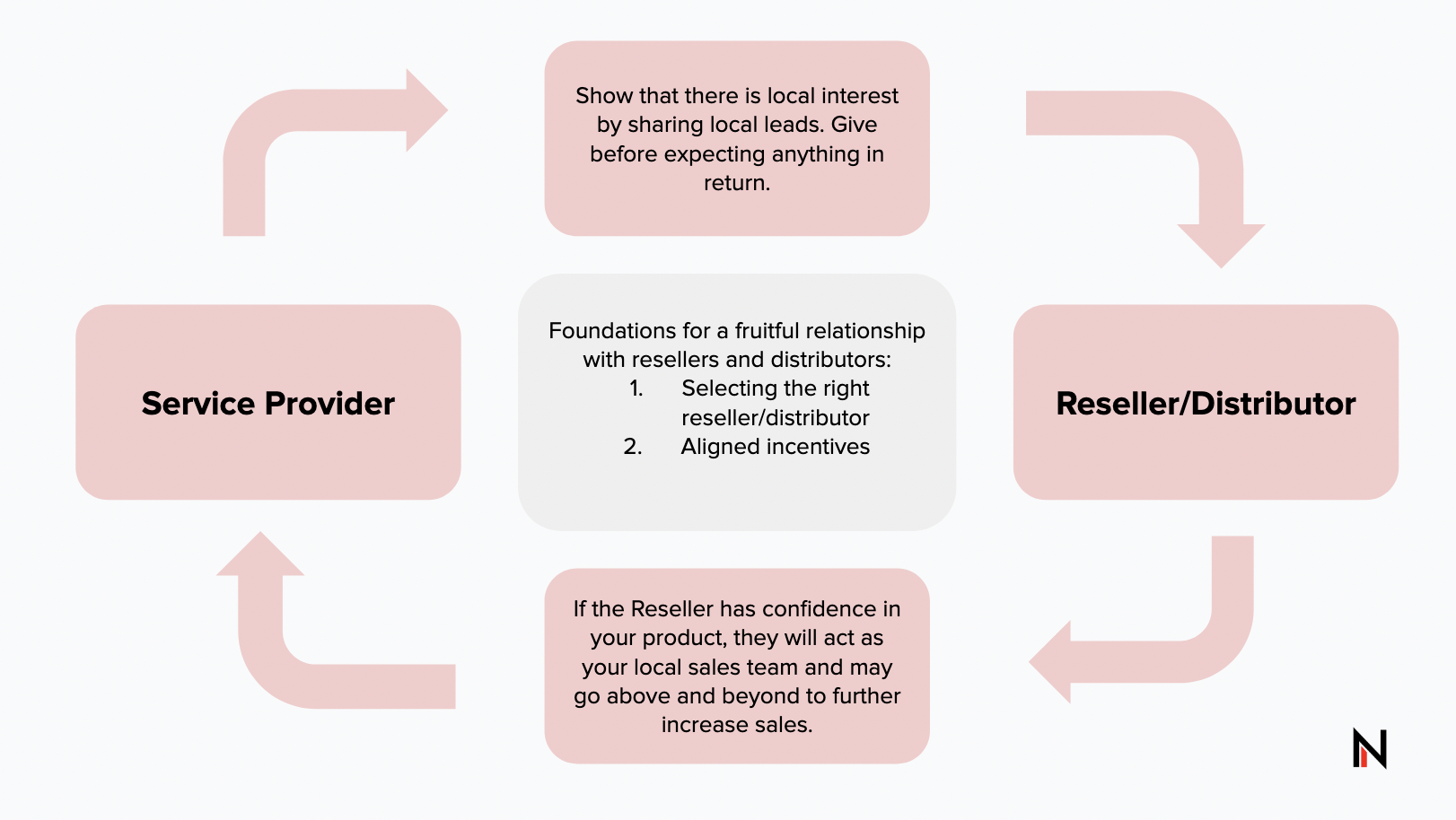 This will likely be a temporary solution. As sales increase, the revenue share portion will become more expensive than building a team. Also, ultimately the provider is not in the driver’s seat, so if there’s any change in process or direction, the reseller may not accommodate. These relationships are rare and amazing as an initial market entry model. This relationship is built on two assumptions. The first is that the provider was able to find the right reseller. The second is that the provider had leads from Japan. That being said, giving the resellers something to work with often yields greater returns.
Conclusion
Building a strong relationship with resellers and distributors is hard. These partners want to sell what is most likely to sell. Selling new and unproven products is a risk for them. To create a strong relationship, it’s important to find the right partner. If they find value in the product, these partners will take the risk and sell the product. It also helps if you’re able to give the resellers something to work with, including leads in Japan. This will jump-start the relationship and the resellers will be more willing to give your product a go. If you’re interested in finding local partners or putting together a reseller strategy, book a free consultation here.
 Japanese
  English