

In Japan, SaaS onboarding requires a different approach compared to Western markets. Success hinges on understanding local business practices and user expectations. Key factors include:
- Language: 72% of Japanese buyers prefer communication in Japanese. Poor translations can harm trust.
- Consensus-Building: Decision-making involves multiple stakeholders through informal (nemawashi) and formal (ringi) processes.
- Detailed Documentation: Japanese users value thorough, step-by-step guides, case studies, and ROI analyses.
- Structured Communication: Practices like hourensou (reporting, informing, consulting) ensure transparency and alignment.
- Personalized Support: Users expect dedicated account managers and proactive guidance.
- Extended Onboarding: Longer timelines reflect a preference for risk reduction and relationship-building.
Japanese onboarding emphasizes clarity, trust, and relationship-driven processes, making localization for SaaS products and long-term support critical for success.
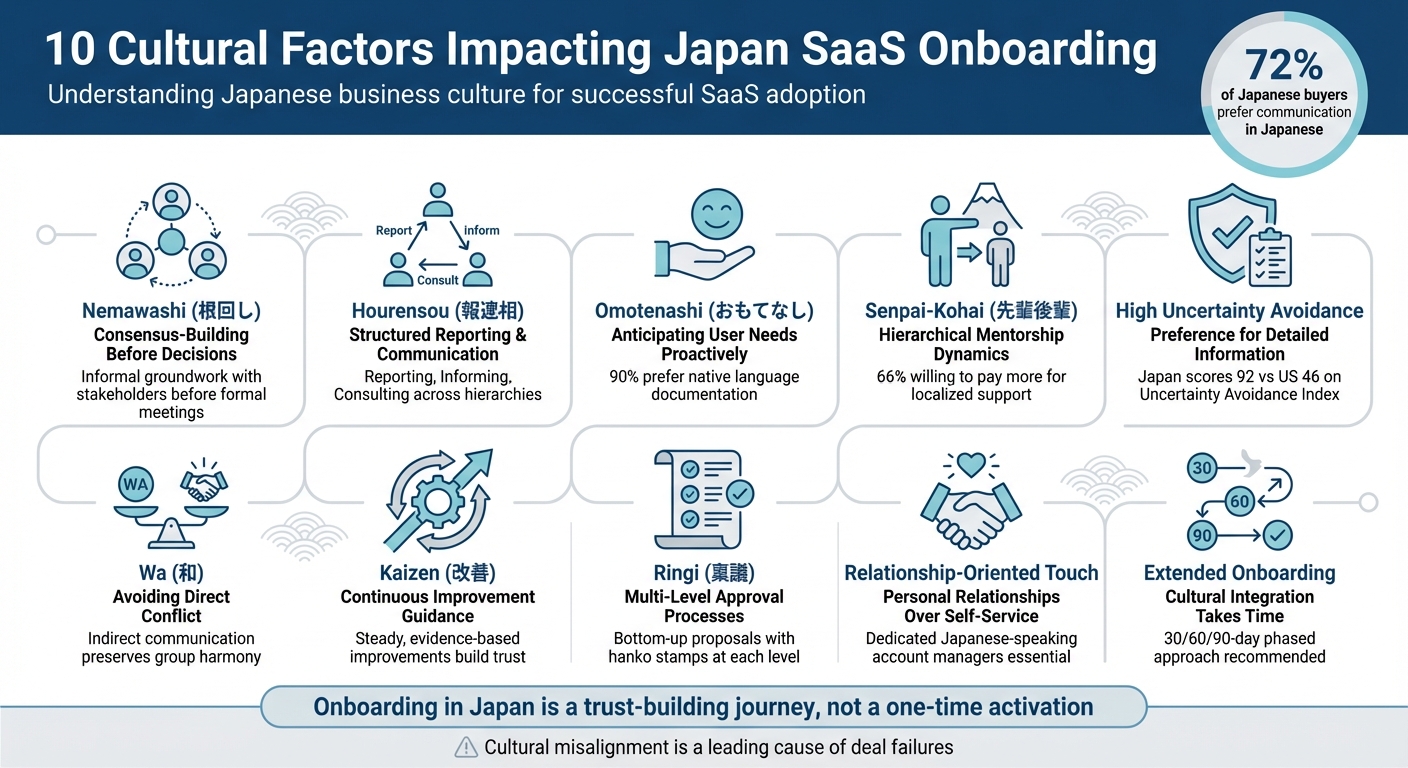
10 Cultural Factors Impacting Japan SaaS Onboarding
1. Nemawashi: Consensus-Building Before Decisions
Nemawashi, which translates to "laying the groundwork", refers to the informal, behind-the-scenes discussions held before formal decisions are made. It’s a way to align stakeholders individually, ensuring everyone is on the same page before an official meeting takes place. In the B2B SaaS sales market, this approach is essential for securing agreement among a wide range of decision-makers.
"Nemawashi is a context-sharing process – Nemawashi provides the stakeholders with the necessary information to make a decision", says Yuga Koda, CEO of Nihonium.
For SaaS providers, this process adds complexity to decision-making. Evaluations often involve numerous stakeholders beyond the end users, including IT managers, finance teams, department heads, and legal advisors. To navigate this, your internal champion must be armed with a full suite of resources to share during these informal conversations. Think detailed presentations, security assessments, ROI calculators, and efficiency metrics – all carefully crafted in polished Japanese.
Make these materials easily accessible by offering clear "Download Document" options on your website or onboarding platforms. Additionally, pre-onboarding workshops can be invaluable, giving non-user stakeholders the context they need to understand the product’s value.
When nemawashi is done right, formal approvals become little more than a formality. But skip these behind-the-scenes steps, and even the most impressive product can find itself stuck in endless committee discussions.
2. Hourensou: Structured Reporting and Communication
After building consensus through nemawashi, the next step is maintaining open and structured communication, which is where Hourensou comes in. This approach is a key part of Japanese business practices and stands for three core elements: Hokoku (reporting), Renraku (informing), and Soudan (consulting). Together, these elements ensure a steady flow of information across teams and organizational hierarchies, making Hourensou essential for successful SaaS onboarding in Japan.
When your internal champion evaluates your product, they’ll need to gather insights to report, inform, and consult with decision-makers at various levels. To align with this process, provide shareable materials like product benefits, ROI analyses, and case studies that can be easily reviewed internally. These resources lay the groundwork for transparency, a critical factor in Japanese onboarding practices.
"Digital tools create accessible avenues for honest feedback, leading to better program calibration and sustained onboarding success… particularly valuable in Japanese contexts, where junior staff may be reluctant to voice issues directly", explains Yuga Koda, CEO of Nihonium.
To support transparency, introduce shared dashboards that offer real-time visibility into the onboarding process. These dashboards should include detailed progress reports to track user engagement and meet the high expectations for thoroughness in Japan.
Additionally, schedule formal consultation opportunities, such as feedback sessions or a "buddy" system, to encourage collaborative problem-solving. This approach reduces the pressure on junior staff, who may otherwise hesitate to raise concerns. Since consensus is highly valued in Japanese business culture, your onboarding process should combine clear context with effective training.
3. Omotenashi: Anticipating User Needs Proactively
Omotenashi, a concept deeply rooted in the Japanese tea ceremony (sado), is all about anticipating needs before they’re voiced. It’s a hospitality philosophy that goes beyond functionality, creating experiences that feel thoughtful and personalized during SaaS onboarding in Japan.
"Omotenashi is more than just a simple gesture of kindness. It is an approach to life, a way of making others feel valued and special", explains RoYuMi.
To bring this principle into SaaS onboarding, focus on tailoring the experience to individual users. Leverage AI-driven platforms to address specific knowledge gaps, whether it’s language-related or about understanding particular features. Japanese users tend to appreciate extra confirmation steps and detailed instructions that help them feel confident and in control.
Your documentation should be thorough and detailed. Japanese users often associate comprehensive information with reliability. They value help centers packed with granular details and tooltips over minimalist designs. This preference aligns with Japan’s high uncertainty avoidance culture, where having access to complete information eases anxiety during the learning process. For example, 90% of Japanese consumers prefer products with documentation in their native language, and 66% of B2B buyers are even willing to pay more for localized solutions with strong local support.
Take a proactive stance in providing onboarding support. Share pre-onboarding materials, like company introductions and case studies, to help users prepare and gather the resources they need for internal decision-making. This anticipatory approach elevates onboarding from a routine process to an experience that embodies the spirit of omotenashi. It also lays the groundwork for understanding how hierarchical mentorship dynamics influence onboarding in Japan.
4. Senpai-Kohai: Hierarchical Mentorship Dynamics
The Senpai-Kohai relationship is a mentorship structure deeply rooted in hierarchy, where the senior member (Senpai) provides guidance and support to the less experienced member (Kohai). Unlike a traditional boss-employee dynamic where tasks are assigned, this system is based on seniority within the organization. Even someone who joined just a few months earlier assumes the responsibility of mentoring newer members.
When comparing Japanese SaaS companies vs. global comps, onboarding expectations differ; in Japan, this concept is often applied through structured, one-on-one mentorship. Here, the account manager takes on the Senpai role, guiding the new user (Kohai) step by step. Japanese users often expect proactive support rather than being left to navigate the system independently, as a lack of guidance can erode their confidence.
To align with this cultural expectation, assign a consistent point of contact during onboarding. This dedicated manager should maintain respectful communication, including the use of proper Keigo (formal Japanese), to honor the hierarchical relationship. Structured plans, such as 30/60/90-day enablement strategies, can help systematically build the user’s skills and ensure steady progress.
Beyond the initial onboarding, consider leveraging internal champions within the client’s organization to act as Senpai for their peers. This approach not only reinforces the hierarchical mentorship model but also promotes peer learning. With 66% of B2B buyers in Japan willing to pay more for localized products with ongoing local support, creating programs that encourage long-term mentorship can significantly boost adoption and satisfaction. Position your onboarding process as the foundation for a lasting partnership, rather than a one-time interaction.
5. High Uncertainty Avoidance: Preference for Detailed Information
Japan scores an impressive 92 on Hofstede‘s Uncertainty Avoidance Index, highlighting a strong preference for clear rules, structured processes, and detailed information. In contrast, the United States scores 46, reflecting a more flexible, trial-and-error approach to decision-making. Japanese professionals tend to avoid ambiguity, opting to fully understand systems and processes before engaging with them.
This cultural tendency heavily influences how onboarding and software evaluation are approached. For instance, 72% of Japanese buyers expect communication in Japanese. But it’s not just about translating the user interface – comprehensive resources like user manuals, FAQs, troubleshooting guides, and step-by-step instructions are essential. This aligns with the broader need for detailed, culturally specific onboarding experiences.
To meet these expectations, consider implementing guided wizard flows with inline tips explaining each field’s purpose. Add detailed confirmation dialogs for actions that might have significant consequences and include rollback options to minimize risk for users. These features help address the preference for clarity and minimize uncertainty.
Building a robust documentation stack tailored for Japanese users is equally important. This should include fully localized user manuals, role-specific playbooks, and FAQs with examples that use yen. A searchable Help center with categorized articles and video walkthroughs in Japanese can provide ongoing support. Post-signup email sequences summarizing completed steps, outlining next actions, and linking to additional resources can further instill confidence in users.
Interestingly, on Japanese SaaS landing pages, "Download Document" calls-to-action often outperform "Free Trial" offers. This preference stems from the measuring early traction through the extensive research buyers conduct before committing to a product. Offering downloadable PDF guides with company introductions, product overviews, implementation benefits, and case studies featuring well-known Japanese brands can help build trust and support the multi-level approval processes often required in Japanese organizations. These materials play a crucial role in easing decision-making and reinforcing buyer confidence.
6. Wa (Harmony): Avoiding Direct Conflict in Interactions
Expanding on the earlier ideas of consensus-building and structured communication, Wa – a Japanese principle focused on maintaining harmony – plays a crucial role in shaping expectations around feedback, problem-solving, and communication. Unlike Western norms that often favor straightforward, direct feedback, Japanese communication leans heavily on indirect signals and contextual cues to uphold group cohesion. This perspective is essential when designing feedback and support systems that align with the value of harmony.
For SaaS onboarding, this means rethinking how error messages and feedback are presented. Instead of using abrupt messages like "Error: You entered the wrong password", opt for gentler phrasing like "Let’s try entering your password again." This shift in tone transforms the issue into a shared challenge, protecting the user’s sense of dignity while guiding them toward a solution.
Another way to align with the principle of Wa is by introducing a mentorship system. Assigning new users a guide to help them navigate the software turns feedback into a form of supportive guidance rather than criticism. This approach fosters a relaxed environment where users feel comfortable asking questions without the fear of being judged. It’s a subtle but effective way to build trust and encourage open communication.
Your onboarding process should also incorporate collaborative problem-solving through structured communication loops. For example, instead of presenting users with a single solution when they encounter an issue, offer several options so they can choose the one that best suits them. This avoids forcing a specific path and respects their autonomy. Additionally, silence or delays in response are often signs of careful consideration in Japanese culture, not confusion – an important nuance to understand when interpreting user behavior.
This approach contrasts sharply with Western methods, where direct feedback and quick resolutions are often prioritized. Japanese users, on the other hand, tend to prefer suggestions framed as possibilities. Incorporating confirmation steps into workflows can reassure users by allowing them to verify their actions before proceeding. This not only builds confidence but also acknowledges the cultural emphasis on harmony over speed in Japanese business practices.
sbb-itb-a752276
7. Kaizen: Expectation of Continuous Improvement Guidance
Kaizen, meaning "change for the better", is a guiding principle for how Japanese users assess SaaS adoption over time. Unlike the fast-paced, trial-and-error approach often seen in Western markets, Japanese businesses value steady, thoughtful improvements that are supported by clear evidence and consensus. This perspective means your onboarding process must show visible, ongoing refinement.
For Japanese users, continuous improvement demonstrates your commitment to their needs. Regular updates – whether it’s enhancing documentation, adding features, or streamlining workflows – build a "sense of security", particularly for risk-averse buyers. Since 90% of Japanese consumers prefer products with information in their native language, it’s crucial that all updates are localized into natural, idiomatic Japanese.
"SaaS products evolve as new features get added. Ongoing localization is necessary for the end user to maximize the usage of the product." – Nihonium Blog
Interestingly, adding a bit of friction can actually enhance the onboarding experience for Japanese users. Steps like extra confirmations or detailed verification processes may seem counterproductive elsewhere, but they provide reassurance in this market. This approach aligns with the Kaizen philosophy, where thoroughness and precision take precedence over speed, gradually building trust.
To deepen this trust, implement a structured feedback system rooted in Kaizen principles. Replace informal check-ins with scheduled sessions where users can share their thoughts. Use digital surveys and anonymous feedback portals, as these align with the cultural preference for polite and indirect communication. When acting on feedback, support changes with data and evidence, as Japanese users prefer low-risk, well-tested updates. Committing to this cycle of improvement not only strengthens trust but also enhances localization efforts, ensuring every aspect of the onboarding process resonates with the market.
8. Ringi: Multi-Level Approval Processes
Ringi is a structured, bottom-up decision-making process where proposals move up the corporate ladder. At each level, managers indicate their approval by stamping the ringisho (proposal document) with their hanko (personal seal).
A ringisho typically includes a detailed project summary, its purpose, an implementation plan (with onboarding requirements), ROI calculations, and risk analysis. This format emphasizes the importance of having a thoroughly documented onboarding plan from the start. Once the proposal is approved, implementation tends to face less internal resistance because all key stakeholders have already signed off.
"The ringi process ensures that all relevant parties are on board before making a decision… This buy-in and unified stakeholders smoothen the implementation and onboarding processes." – Yuga Koda, Nihonium
To streamline this process digitally, companies can adopt tools that mimic the Ringi workflow. These should include sequential approval workflows, digital hanko integration, status tracking, and role-based access. Additionally, providing downloadable resources – like ROI projections, case studies, and technical feasibility studies – can empower internal advocates to attach essential documents to their ringisho. Case studies, in particular, are highly valued as they offer concrete proof of successful implementations.
Given the extensive documentation required for Ringi, SaaS landing pages targeting Japanese buyers should prioritize a "Download Document" option over the usual "Book a Demo" call-to-action. Japanese decision-makers often need comprehensive materials to prepare their internal proposals, and a company introduction deck is frequently a must during the review phase. While this approach requires more effort upfront, it lays the groundwork for stronger, long-term partnerships. Decisions made through the Ringi process are typically viewed as lasting commitments.
9. Relationship-Oriented Personal Touch
In Japanese business culture, building trust goes beyond offering great product features – it’s about fostering genuine personal relationships. Unlike regions where self-service onboarding is the norm, Japanese customers expect a dedicated, long-term point of contact who understands their unique needs and business context. This relationship-driven approach is a cornerstone of SaaS adoption in Japan.
Without direct, Japanese-speaking support, many decision-making committees view SaaS solutions as risky. Japanese buyers value the security of having a consistent account manager who can communicate fluently in their language, grasp their specific challenges, and take full responsibility for resolving any issues. This personal connection is critical in addressing the high levels of uncertainty avoidance that define Japanese business practices.
To meet these expectations, assign a Japanese-speaking account manager who uses formal Japanese (keigo) and maintains regular communication through in-person meetings and video calls. They should provide detailed issue analyses, demonstrate a long-term commitment, and prioritize face-to-face interactions during key milestones. When problems arise, Japanese clients expect not just quick solutions but thorough root-cause analyses and actionable prevention strategies.
For companies without fully staffed local teams, fractional sales support can be a practical alternative. These professionals bring a deep understanding of unwritten cultural norms and nuances, enabling them to ease onboarding processes and help clients feel confident. They also create an environment where junior staff feel comfortable voicing concerns, which is often a challenge in hierarchical business settings.
While AI-powered tools can enhance the onboarding experience by offering personalized learning paths to address specific knowledge gaps, they should only serve as a complement. The human connection remains irreplaceable in Japanese business culture. This personal touch not only builds trust but also sets the stage for deeper integration of cultural nuances into your extended onboarding strategy.
10. Extended Onboarding for Cultural Integration
In Japan, onboarding takes on a different rhythm compared to Western markets. The process tends to be longer, reflecting cultural priorities like risk mitigation, consensus-building, and relationship development. While many SaaS companies focus on quick time-to-value with self-service onboarding, this strategy often misfires in Japan. Research highlights a strong preference for native language support and thorough, step-by-step guidance.
To align with these cultural nuances, onboarding should be structured in phases. The extended timeline is shaped by several factors. High uncertainty avoidance in Japanese business culture means buyers thoroughly vet tools through research, security checks, and proof-of-concept testing before committing. Additionally, the Ringi system requires detailed documentation to circulate across multiple organizational levels for approval, while Nemawashi involves informal discussions to build consensus across departments. According to HubSpot Japan, 72% of Japanese buyers insist on communication in Japanese, emphasizing the importance of localized and detailed support in a market known for its lengthy sales cycles and hierarchical decision-making.
A phased approach – such as 30/60/90-day plans – can help users build proficiency gradually rather than rushing through the initial setup. At each milestone, provide localized resources like documentation, explainer videos, and process diagrams tailored to support internal approvals. Naoki Togawa, Manager at Nikkei Business Publications, underscores this point:
"Everything should be in high-quality, idiomatic Japanese. There’s nothing worse than bad translation. It’s easy to tell which vendors know what they are doing and are really committed to the market just through the quality of their materials".
Incorporate the concept of Omotenashi – a proactive, customer-first approach – by scheduling regular check-ins with a Japanese-speaking account manager and offering clear RACI frameworks (Responsible, Accountable, Consulted, Informed) to guide each stage. Use case studies from respected Japanese companies to build trust and demonstrate success. This level of attention not only supports smooth onboarding but also lays the groundwork for the long-term relationships vital in Japanese markets.
In Japan, closing a sale is just the beginning of the journey. Extended onboarding and support are investments in customer success and loyalty. Companies entering this market should anticipate longer onboarding timelines, dedicating resources to localized guidance and consistent follow-ups that respect and align with Japanese cultural expectations.
Nihonium‘s Localization Strategies for Onboarding Adaptation
Nihonium has crafted its onboarding process to align with Japan’s distinct business practices, building on the cultural factors that shape the market. Acting as a local partner for global companies, Nihonium helps navigate the intricate landscape of Japanese SaaS onboarding. Instead of requiring a hefty $400,000 upfront investment to establish a local presence, the company offers scalable services like product localization, marketing funnel development, and fractional sales support. This allows SaaS companies to explore the Japanese market without overcommitting while still providing the culturally sensitive experience that Japanese buyers expect.
The localization strategy is tailored to fit the structured decision-making processes common in Japan. Nihonium incorporates detailed digital calls-to-action (CTAs) on landing pages, offering company introductions, product details, and case studies – key elements for the Ringisho, the formal proposal reviewed at multiple organizational levels. They also create custom sales decks designed to meet the documentation-heavy requirements of consensus-building within Japanese companies.
Quality is non-negotiable in this market. Naoki Togawa from Nikkei Business Publications highlights the importance of precision:
"There’s nothing worse than bad translation. It’s easy to tell which vendors know what they are doing and are really committed to the market just through the quality of their materials and programs".
Nihonium prioritizes idiomatic Japanese localization to demonstrate genuine market commitment. This is crucial, as 72% of Japanese buyers prefer native-language communication, even when interacting with global platforms.
Embracing the Omotenashi principle, Nihonium takes a proactive approach to onboarding. Local professionals schedule meetings in Japan Standard Time and ensure all materials integrate smoothly into existing workflows. They also provide feedback channels that respect Wa – the cultural emphasis on harmony – by avoiding direct confrontation. From the outset, they localize in-app guides, onboarding flows, and technical documentation to prevent user frustration when encountering English during critical setup stages. This proactive strategy aligns with the cultural expectations previously discussed.
Nihonium also recognizes the extended timelines often required by Japanese companies for onboarding. Their phased implementation strategy reflects this, supporting the trust-building process essential in Japan. They provide thorough documentation for Nemawashi (informal pre-proposal discussions), prepare detailed proposal decks for Ringi circulation, address technical questions from stakeholders, and anticipate executive-level revisions. This structured rollout respects Japan’s consensus-driven culture while ensuring organizational harmony.
Conclusion
SaaS onboarding in Japan requires a thoughtful, tailored approach that goes beyond the Western self-service model. Japanese buyers value detailed documentation, formal approval processes, and relationship-driven support that extends well past the initial setup phase. These preferences aren’t just cultural quirks – they’re essential strategies for success in this market.
Consider this: 72% of B2B buyers in Japan require communication in Japanese, and cultural misalignment is a leading cause of deal failures. Neglecting localization can come across as a lack of commitment. Companies that view onboarding as a trust-building journey, rather than a one-time activation, set themselves up for long-term customer loyalty and growth in a market where relationships truly begin after the sale.
For U.S.-based SaaS providers, this doesn’t mean overhauling their platforms entirely. Instead, it calls for adjustments to meet the expectations of Japanese users. These include offering information-rich layouts, providing downloadable materials for multi-stakeholder decision-making, and shifting from reactive to proactive support. Such efforts highlight the importance of shinrai (trust) and demonstrate the long-term dedication that Japanese enterprise buyers expect.
Services like Nihonium (https://nihonium.io) make this transition smoother. By offering product localization, culturally aligned marketing materials, and Japanese-speaking customer success teams, Nihonium helps SaaS companies deliver the relationship-focused onboarding experience Japanese businesses look for – all without the need to establish a local entity. This scalable approach allows companies to enter the market thoughtfully and effectively.
In Japan, onboarding isn’t just about user experience – it’s a strategic tool for market entry. By embracing the cultural insights outlined here, SaaS providers can turn potential challenges into opportunities, building trust and forging lasting customer relationships in this unique and rewarding market.
FAQs
How does the Japanese concept of ‘Nemawashi’ impact SaaS onboarding?
The Japanese idea of Nemawashi emphasizes the importance of laying the groundwork and building consensus informally before making formal decisions. When it comes to SaaS onboarding, this translates into involving key stakeholders – like product managers, end users, and IT teams – early in the process. This proactive engagement helps address potential concerns, align expectations, and create a unified approach, ultimately leading to smoother adoption and minimizing resistance during implementation.
To apply Nemawashi in onboarding, SaaS providers can focus on sharing information gradually and gathering feedback in stages. For instance, rolling out training materials or demos step by step and actively incorporating input from stakeholders can help shape a plan that resonates with everyone involved. This method not only builds trust but also lays the foundation for long-term user satisfaction and loyalty.
Why is a longer onboarding process crucial for SaaS in Japan?
In Japan, SaaS onboarding is about much more than just teaching users how to navigate a product. It takes into account the cultural nuances of consensus-driven decision-making, often referred to as nemawashi or Ringi. These practices, paired with hierarchical approval processes, mean that companies take their time to thoroughly assess a product’s reliability and support systems before committing to it. Risk mitigation is a top priority.
This extended onboarding process plays a crucial role in building trust – a cornerstone of business relationships in Japan. Buyers place a high value on long-term partnerships and dependable support, so a slower, more deliberate approach aligns perfectly with their decision-making style. Since multiple stakeholders are usually involved, this process helps streamline internal approvals. It also provides an opportunity to address localization needs, like creating Japanese-language manuals or ensuring compliance with local regulations, which can prevent challenges down the road.
With Japan’s SaaS market expected to grow from $12.2 billion in 2027 to $20.86 billion by 2029, companies that embrace longer onboarding processes can gain a real edge. Nihonium helps global SaaS providers navigate this landscape by delivering customized onboarding solutions tailored to Japan’s unique business culture. This ensures trust, smooth adoption, and long-term success in a rapidly expanding market.
How does language impact trust during SaaS onboarding in Japan?
Language plays a key role in earning the trust of Japanese users during SaaS onboarding. In Japan, customers expect product information, support, and onboarding materials to be presented in precise and natural Japanese. If the content is poorly translated or only available in another language, it can quickly erode trust and cause users to disengage.
Politeness and formality are especially important in Japanese communication. High-quality localization that respects cultural norms – like the use of honorifics and context-appropriate phrasing – demonstrates that your company genuinely values the Japanese market. This thoughtful approach not only improves the user experience but also reassures customers that your product is dependable and designed with their needs in mind, building trust and encouraging long-term loyalty.
 Japanese
  English