

Japan’s SaaS market is booming, projected to grow from $13.8 billion in 2026 to $38.1 billion by 2035 at a 13.5% CAGR. This makes Japan the third-largest SaaS market globally, after the U.S. and U.K. Key drivers include workforce challenges, government digital initiatives like the "cloud-by-default" policy, and increasing demand for productivity tools. However, with Japanese businesses using only 35 SaaS apps on average (compared to the global average of 93), there’s still massive untapped potential.
Here are the top 10 SaaS companies in Japan in 2026, leading the charge with cutting-edge solutions tailored to the local market:
- SmartHR: Dominates HR tech with a user base of 80,000+ companies and plans for a Tokyo IPO in late 2026.
- freee: Leading cloud accounting platform, serving 607,000+ customers with deep integrations into Japanese workflows.
- Plaid: Known for its CX platform KARTE, focusing on real-time, personalized customer engagement.
- LegalOn Technologies: AI-driven legal solutions with tools like contract review and governance management.
- RevComm: Offers AI-powered voice analytics for better communication insights, used by 3,100+ companies.
- Notta: Provides advanced AI transcription and meeting automation tools, trusted by 72% of Nikkei 225 companies.
- FactBase: Simplifies manufacturing workflows with its ZUMEN platform, targeting small and mid-sized manufacturers.
- Qasee: Automates daily work reports and attendance tracking, addressing Japan’s administrative inefficiencies.
- Cascade: AI-powered advertising platform for SMEs, reducing ad management times by 90%.
- Shizai: Streamlines packaging procurement and supply chain management for 700+ companies.
These companies succeed by addressing local business needs, integrating regulatory requirements, and prioritizing features like compliance, data residency, and customer experience.
Quick Comparison:
| Company | Focus Area | Key Metrics (2026) | Notable Features |
|---|---|---|---|
| SmartHR | HR Tech | ARR: $133M+; 80,000+ customers | Comprehensive HCM platform; Tokyo IPO in 2026 |
| freee | Cloud Accounting | ARR: ~$229M; 607,000+ customers | Localized tax and payroll tools; AI integrations |
| Plaid | Customer Experience | Revenue: ~$90M (FY2025) | KARTE CX platform; focus on first-party data |
| LegalOn | Legal AI | ARR: ¥10B (~$68M); 7,500+ customers | Contract review and governance tools |
| RevComm | Voice Analytics | 120,000+ users; 3,100+ companies | AI-driven voice insights; real-time coaching |
| Notta | AI Transcription | 10M+ users; 300% YoY enterprise growth | Multilingual transcription; meeting automation |
| FactBase | Manufacturing SaaS | Present in 12 countries; $28.5M funding | Workflow tools for small/mid-sized manufacturers |
| Qasee | Workforce Automation | Clients: eplus, RareJob, Silver Lining | Automated work reports; AI business diagnostics |
| Cascade | Digital Advertising | Techstars Tokyo 2025-backed | AI ad management for SMEs; supports Yahoo! Japan Ads |
| Shizai | Supply Chain | 700+ companies; ¥420M Series B funding | Packaging procurement; cost-saving solutions |
These companies highlight Japan’s SaaS growth potential and the importance of localizing SaaS products for Japanese business practices.
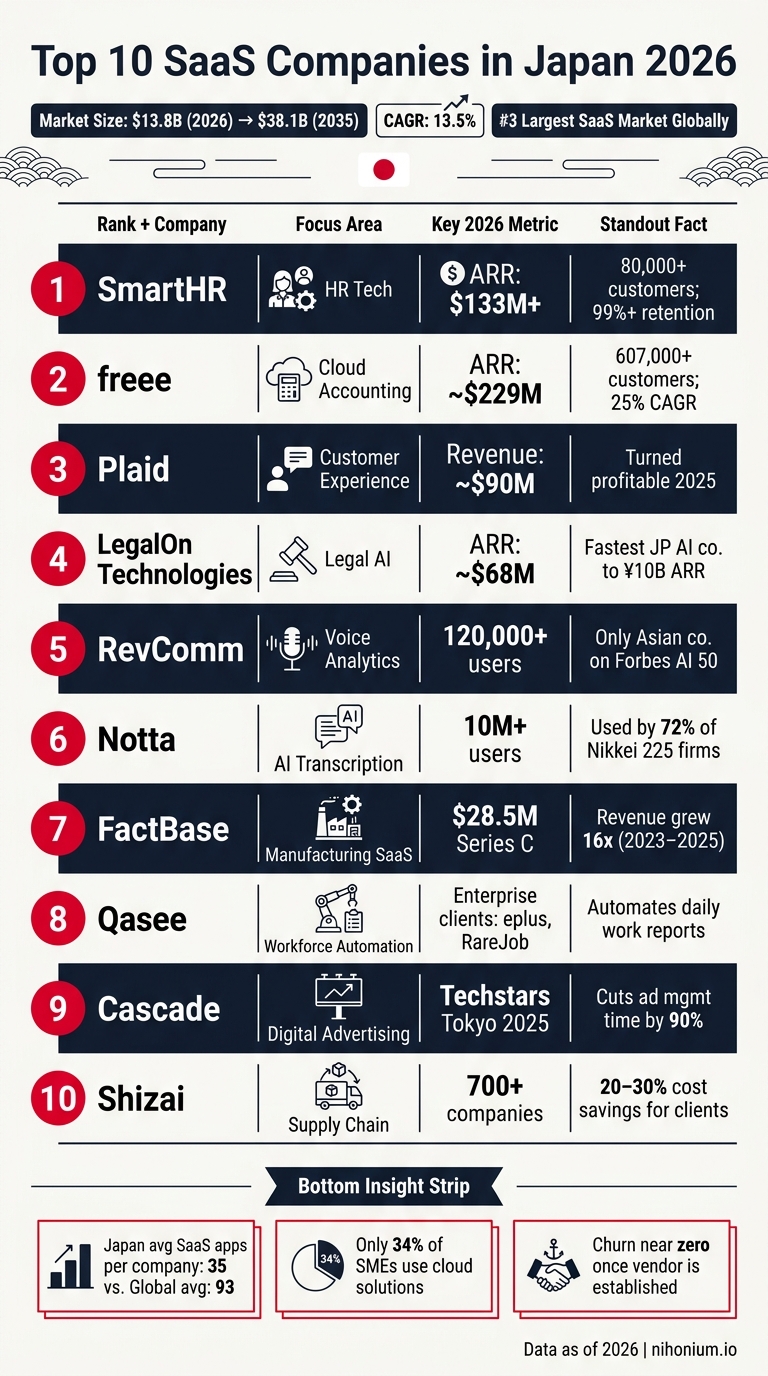
Top 10 SaaS Companies in Japan 2026: Key Metrics Compared
1. SmartHR
Founded: 2013 | Headquarters: Tokyo, Japan | ARR: $133M+ | Customers: 80,000+
SmartHR has established itself as the leader in Japan’s HR tech market, holding the top spot in the labor management cloud sector for seven consecutive years (2018–2024). By 2026, the platform is relied upon by over 80,000 companies daily, with an impressive user retention rate of more than 99%.
Initially created to address Japan’s reliance on paper-heavy HR processes, a common driver for SaaS adoption in Japan, SmartHR has grown into a comprehensive Human Capital Management (HCM) platform. It now handles a wide range of tasks, including employment contracts, payroll, talent evaluations, skill management, and human capital disclosure reporting. The platform significantly reduces HR workloads – for instance, a company with 1,000 employees can cut HR work hours by 88% using SmartHR. A great example is pixiv Inc., which managed to slash the time needed for organizational changes by one-third during a period of rapid expansion after implementing SmartHR.
"SmartHR will become a ‘Human Capital Management Platform’ to promote data-based human capital management." – Masato Serizawa, CEO, SmartHR
SmartHR has ambitious plans for growth. By May 2025, its ARR exceeded 20 billion JPY (approximately $133M), with its talent management segment contributing 5 billion JPY. The company is preparing for a Tokyo IPO in late 2026, targeting a valuation of around 160 billion JPY (roughly $1 billion). It also aims to hit 100 billion JPY in revenue by 2030. To support enterprise clients, SmartHR acquired IT consulting firm KICK ZA ISSUE in January 2026, enhancing its human-led implementation services. Additionally, the platform integrates with over 120 external tools, including a new data link with kintone, launched on May 27, 2026.
Next, we’ll dive into freee, another prominent name in Japan’s SaaS scene.
sbb-itb-a752276
2. freee
Founded: 2012 | Headquarters: Tokyo, Japan | ARR: ~$229M | Customers: 607,000+
freee holds the second spot in Japan’s SaaS market and dominates the country’s cloud accounting and back-office management sector. By early 2026, it serves around 607,000 customers and showcases impressive growth, with a 25% compound annual growth rate (CAGR) in customer numbers and 39% in revenue. This success is particularly notable in a market where cloud accounting adoption remains at just 25–30%. At its core, freee focuses on simplifying back-office operations for Japanese businesses.
The company’s mission is clear: replace outdated tools like spreadsheets, paper forms, and legacy desktop software that many small and medium-sized enterprises (SMEs) in Japan still use. Its software suite – freee Accounting, freee HR, freee Sales, freee Sign, and freee Tax – integrates seamlessly to handle tasks from invoicing to payroll and tax filing, eliminating redundant manual data entry. With connections to over 1,000 banks, freee drastically reduces reconciliation time for its users.
"freee sits on proprietary transactional data from its half-million customers with more than 1,000 banking and financial integrations that are not replicable by vibe-coded alternatives." – Michael Fritzell, Analyst, Asian Century Stocks
What sets freee apart is its deep integration with Japanese business workflows. It supports processes like furikomi (bank transfers), the Blue Return tax filing system, and complex year-end tax adjustments. These features are tailored to local needs, giving freee a significant edge over global SaaS competitors that would require extensive localization to offer similar functionality. For example, Mr. Fujii, owner of Hitoiki-so Outdoor Service, shared in January 2026 that after adopting freee Accounting, his monthly and yearly bookkeeping tasks were practically eliminated, allowing him to focus more on growing his business.
freee is also leveraging AI to enhance its platform. With a newly appointed Chief AI Officer, the company has introduced features like automated receipt capture, a ChatGPT-powered tax guidance app, and an "AI Year-end Adjustment" tool – critical innovations as Japan faces a projected shortage of 2.3 million digital workers by 2026. In December 2025, freee expanded its offerings further by adding consolidation accounting and manual double-entry bookkeeping capabilities. These updates position freee to transition toward enterprise-grade ERP tools, making it increasingly attractive to larger corporations.
3. Plaid

Headquarters: Tokyo, Japan (Ginza Six, Chuo-ku) | Revenue (FY2025): ~$90M (¥13,396.47M JPY) | Stock: TYO: 4165
Plaid is best known for its CX platform, KARTE, which uses real-time data to deliver personalized messages. This approach aligns perfectly with Japan’s omotenashi culture, where anticipating customer needs is not just appreciated but expected.
From a financial perspective, Plaid has seen a remarkable transformation. Between 2023 and 2025, revenue jumped 55% – from ¥8,633.6M to ¥13,396.5M. Even more striking, the company moved from a ¥2,108.6M loss in 2023 to a ¥1,099.1M profit in 2025. These numbers highlight the growing maturity of its business model.
One of Plaid’s standout initiatives is KARTE Signals, which emphasizes first-party data over third-party cookies. This shift prioritizes long-term customer value rather than short-term metrics like clicks. A great example of its impact comes from April 2026, when SBI Securities introduced the KARTE Signals Dashboard. This tool enabled them to move beyond last-click attribution, helping them better assess how advertising contributes to key outcomes, such as NISA account openings. Hiroki Kaibara of SBI Securities summed it up well:
"Beyond being a mere analysis tool, by fusing our own data with advertising data, we expect to build a system that can visualize the degree of contribution that advertising investment has on business profit."
In another collaboration, Plaid worked with the Colowide Group in February 2026. As the parent company of restaurant brands like Ootoya and Gyukaku, Colowide used KARTE for App and KARTE Datahub to integrate app behavior data with in-store POS data. With support from Plaid’s professional services team, PLAID ALPHA, this project identified high-value customers by connecting menu preferences with repeat visits.
Plaid’s focus on innovation and customer insights positions it as a leader in Japan’s SaaS market, blending cutting-edge technology with a deep understanding of customer behavior.
4. LegalOn Technologies
Headquarters: Tokyo, Japan | ARR (October 2025): ¥10 billion (~$68M) | Customers: 7,500+
LegalOn Technologies achieved a major milestone in October 2025, becoming the fastest Japanese AI company to reach ¥10 billion ARR – just 6.5 years after its launch. Backed by prominent investors, the company has grown from offering a contract review tool to establishing itself as a Professional AI for Legal platform. This remarkable progress highlights LegalOn’s expanding role in reshaping legal workflows through AI.
As part of its growth, LegalOn introduced the LegalOn Assistant in April 2026. This tool comes equipped with over 40 attorney-approved skills, ready for immediate use. That same month, Hino Motors adopted the platform to streamline its legal operations.
LegalOn’s product suite has also expanded to include:
- GovernOn – streamlines corporate governance and group management.
- AI Counsel – focuses on managing post-signature contract risks.
- Fides – leverages AI to improve board management (acquired in October 2025).
These offerings work together to create a seamless legal and compliance workflow.
"We have created high-quality products with unique development power by fusing the advanced specialized knowledge of lawyers with the latest AI technology." – LegalOn Technologies
In addition to its product advancements, LegalOn achieved several key milestones in 2026. It earned SOC2 Type 2 certification in April, won the Zaikai BEST AI 100 Grand Prize in May, and formed a strategic partnership with OpenAI in July 2025. These achievements underscore the company’s commitment to secure and forward-thinking legal AI solutions.
5. RevComm
Headquarters: Tokyo, Japan | Users (January 2026): 120,000+ | Customers: 3,100+ companies
RevComm’s standout product, MiiTel, is an AI-driven voice analytics platform designed to transform business conversations into actionable insights. What sets it apart is its ability to leverage proprietary Japanese-language models to analyze elements like pitch, tone, speaking speed, and even fillers such as "ano" and "eto" – key to detecting emotion and intent in conversations. This focus on nuanced voice analytics has allowed RevComm to expand its offerings over time.
"Japanese voice recognition and TTS (Text-to-Speech) are truly difficult. There are issues with phrasing and style, and adjusting the ‘human-like’ quality by incorporating fillers like ‘ano’ or ‘eto’ is very challenging." – Takeshi Aida, CEO, RevComm
The MiiTel suite now supports various communication formats, including phone calls, web conferences, and in-person meetings, through its four main products: MiiTel Phone, MiiTel Meetings, MiiTel RecPod, and MiiTel Synapse. A notable example of its application is KDDI’s corporate sales division, which adopted MiiTel RecPod and MiiTel Meetings in early 2026. Around 650 sales representatives now use these tools to automate meeting summaries and consolidate customer feedback from both face-to-face and online interactions.
RevComm’s growth is also tied to addressing a critical issue in Japan – labor shortages. This is one of several SaaS adoption blockers in Japan that local startups are solving. In 2026, the company introduced its Real-time Talk Assist feature, which offers live coaching and counter-argument suggestions during calls. This tool helps less experienced employees perform at a level closer to their seasoned counterparts. CEO Takeshi Aida describes this approach as enhancing, not replacing, human potential:
"We define our philosophy not as Artificial Intelligence, but as Augmented Intelligence – intelligence that expands human capabilities rather than replacing them." – Takeshi Aida, CEO, RevComm
RevComm’s innovations have earned it recognition well beyond Japan. It was the only Asian company featured on the Forbes AI 50 list and received the Minister of Internal Affairs and Communications Award at the Japan Startup Awards 2025. With ¥4.95 billion (around $33.7 million as of July 2024) in cumulative funding and an expanding presence in Southeast Asia, RevComm is steadily building a robust voice data infrastructure.
6. Notta
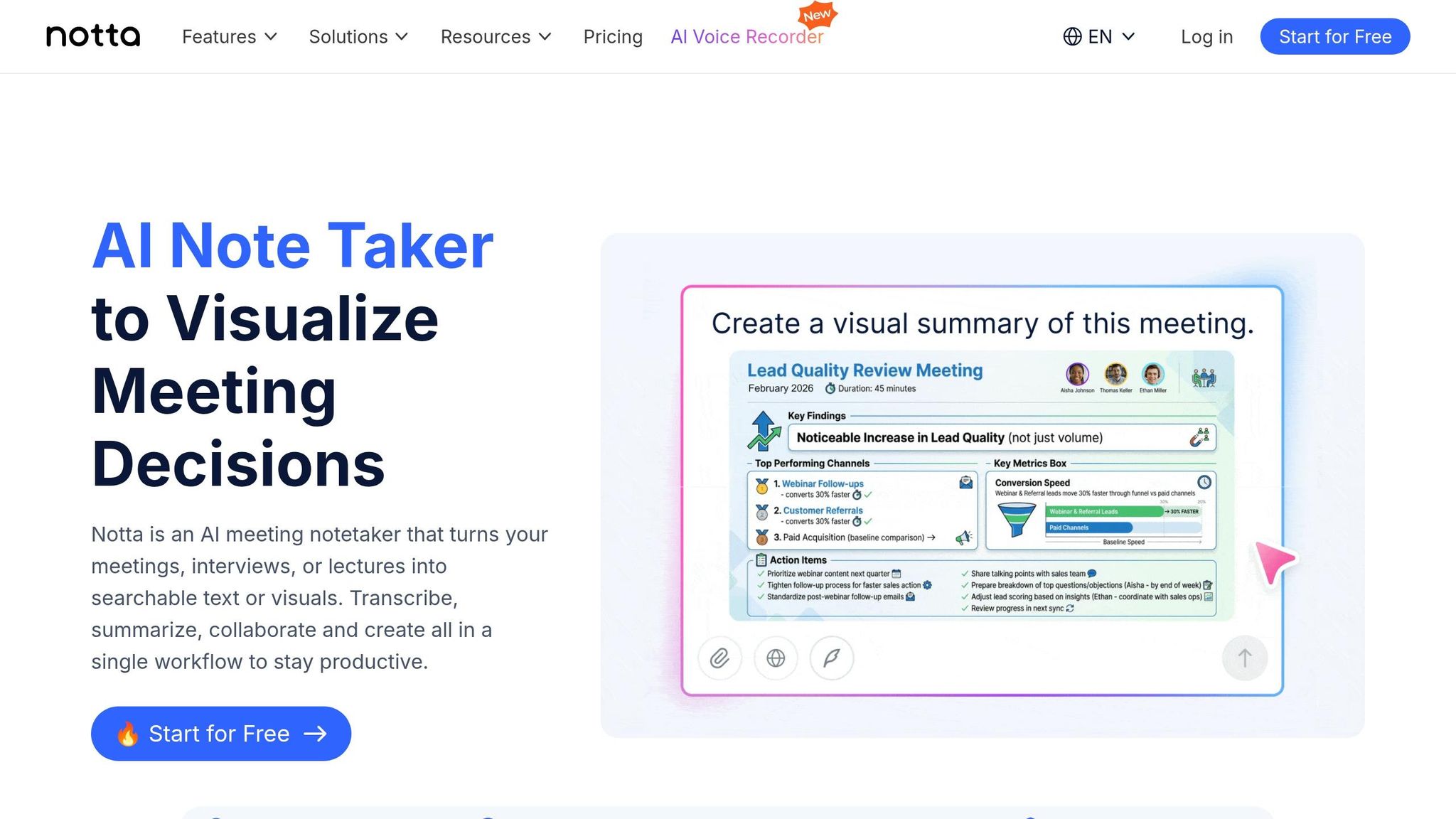
Headquarters: Japan | Global Users: 10 million+ | Enterprise Growth: 300% YoY (May 2025)
Notta stands as a leader in Japan’s AI transcription market, offering much more than basic speech-to-text services. Its platform supports transcription in 58 languages, with exceptional accuracy in Japanese – a language where localization for SaaS products is notoriously difficult for AI to process. Impressively, about 72% of Nikkei 225 companies rely on Notta’s services.
What sets Notta apart is its focus on solving real-world workflow problems. In December 2025, the company secured ¥2.3 billion (around $15.3 million) in Series B funding, a clear sign of investor confidence. By January 2026, Notta introduced Notta Brain, an "audio-first" AI agent capable of transcribing, summarizing key points, generating presentation slides, and even creating infographics directly from meeting data.
Notta has also ventured into hardware with the Notta Memo AI voice recorder. Designed for Japan’s diverse business settings, this device captures high-quality audio and earned the prestigious Good Design Award in 2025.
On the partnership side, Notta’s transcription technology was integrated into MAXHUB’s "All in One Meeting Board" through a collaboration with Nice Mobile in May 2026. This innovation brought AI-powered note-taking directly into conference room hardware. Additionally, in April 2026, the Hinokiya Group adopted Notta across its operations to automate meeting minutes for housing sales, allowing sales teams to focus more on client interactions.
To meet the rigorous compliance standards of Japanese corporations and government bodies, Notta obtained ISO 27001 and SOC 2 Type 2 certifications. The company also achieved major recognition in May 2026, winning top honors in both the "Generative AI" and "Transcription Software" categories at the ITreview The Best Software in Japan 2026 awards.
Next, we explore FactBase’s approach to transforming data into actionable business intelligence.
7. FactBase
Headquarters: Japan | Global Presence: 12 countries, 11 offices | Series C Funding: $28.5 million (December 2025)
FactBase is making waves in Japan’s evolving SaaS landscape, transforming how small and mid-sized manufacturers manage their workflows. With its cloud-based drawing management system, ZUMEN, FactBase addresses the needs of nearly 99% of Japan’s manufacturing sites, most of which still rely on manual processes. This shift reflects broader SaaS trends in Japan where digital transformation is finally reaching legacy sectors. ZUMEN centralizes everything from technical drawings to quotes, process instructions, and inspection reports, simplifying operations for these manufacturers.
The system’s success lies in its thoughtful design. CEO Masataka Takeuchi, who visited around 5,000 factories during his time at Keyence, used his firsthand knowledge of manufacturing inefficiencies to shape ZUMEN’s development. The platform follows the philosophy of "Chōdo ii DX" or "Just Right DX", emphasizing simplicity and practicality over complexity. Takeuchi explains:
"The right approach is not to create bespoke systems for each company. The right approach is to package the essential processes and deliver them as a cloud service."
This philosophy highlights how well-designed SaaS solutions can modernize traditional industries without overwhelming them.
FactBase’s growth between 2023 and late 2025 has been impressive. Revenue surged 16-fold, the client base grew 13-fold, and the team expanded sixfold to over 260 employees by April 2026, with 34% of the workforce being international. The $28.5 million Series C funding round in December 2025, led by Insight Partners, further validated the company’s potential. Max Wolff, Managing Director at Insight Partners, praised ZUMEN’s impact:
"With ZUMEN, FactBase is not only freeing up manufacturers to perform more critical tasks – they are also creating a one-stop shop that minimizes manual searches, reduces errors, and accelerates time-to-delivery."
Looking ahead, FactBase is moving beyond document management. The company is working on integrating ZUMEN with machine tools to automatically capture production data, pushing further into factory automation. With plans to enter the European market in 2026 and operations already established in 12 countries, FactBase is showing how a solution tailored to Japan’s manufacturing sector can grow into a global success story. This momentum sets the bar high for the next standout innovator on the list.
8. Qasee
Headquarters: Japan | Notable Clients: eplus, RareJob, D&I, Silver Lining | First Graduate Hire Class: April 2026
Qasee addresses a long-standing challenge in Japanese corporate culture: the nippo, or daily work report. By automating this process, Qasee captures PC activity, classifies tasks based on keywords and app usage, and generates attendance records directly from work patterns. This emphasis on visual clarity and data presentation is also reflected in the design of SaaS landing pages in Japan. This aligns with Japan’s ongoing push for more efficient and automated administrative systems.
Tailored for the nuances of Japanese workplaces, Qasee’s calendar sync feature tracks meeting times and non-desk activities – filling gaps often missed by digital trackers. Its API integration with freee HR & Labor ensures accurate attendance data flows seamlessly into payroll systems, reducing manual errors.
"PC log data from ‘Qasee’ can be used to perform payroll calculations based on accurate attendance information data… preventing human error and improving efficiency." – Nikkei Press Release
Qasee also offers an AI Business Diagnosis tool that evaluates team health on a weekly and monthly basis. By benchmarking against industry peers, it highlights risks like overwork. Companies such as Silver Lining have leveraged these insights to make critical organizational decisions:
"By accurately grasping work costs… it became possible to make organizational decisions such as terminating deficit projects and providing highly transparent additional billing to clients." – Qasee Official Site
Qasee’s forward-thinking approach in automating traditional administrative tasks is paving the way for advancements in Japan’s SaaS landscape.
To support growth, Qasee combines its digital platform with in-person engagement. The company regularly participates in events like the DX General EXPO in Osaka (May 2026) and Tokyo (July 2026), building trust with enterprise buyers in a market that values face-to-face interactions, a key component of SaaS GTM in Japan. With Japan’s HR tech market estimated to reach $3.9 billion by 2033, Qasee’s targeted strategy positions it well for future success.
9. Cascade
Headquarters: Japan | Backed By: Techstars Tokyo 2025 | Research Partner: Tokyo University of Science
Cascade is an AI-powered digital advertising platform designed for Japanese SMEs and startups that don’t have dedicated marketing teams. This platform takes care of everything from budget allocation and keyword selection to creative creation and reporting. It works seamlessly across major advertising channels, including Google, Meta, Yahoo! Japan, TikTok, Amazon, and Apple Search Ads.
During a pilot program in April 2026, a Japanese D2C company using Cascade managed to cut its daily ad management time from 60 minutes to just 5 minutes – without sacrificing performance on Google and Meta. That’s a 90% reduction in workload, perfectly aligning with Cascade’s mission. As CEO Kazuki Miyauchi puts it:
"Our mission is the ‘democratization of marketing.’ We want to deliver the advertising expertise and speed that previously only large companies and agencies possessed to every business in Japan." – Kazuki Miyauchi, Founder and CEO, Cascade Corporation
What makes Cascade stand out is its focus on localization for the Japanese market. It fully supports Yahoo! Japan Ads, a key platform for reaching local consumers, and integrates with Slack to provide real-time optimization alerts and budget suggestions directly into team workflows. Taking things further, in May 2026, Cascade introduced Japan’s first AI-generated apparel try-on UGC videos. This feature allows fashion brands to create diverse ad variations instantly, eliminating the need for physical photoshoots.
Cascade’s selection for the Techstars Tokyo 2025 accelerator highlights its potential. From a highly competitive global pool, it earned its spot in a program with an acceptance rate of less than 1%. Businesses can try Cascade risk-free with a 2-week free trial and an easy OAuth-based setup. This platform is redefining automated advertising for Japanese businesses and sets the stage for the final standout on our list.
10. Shizai
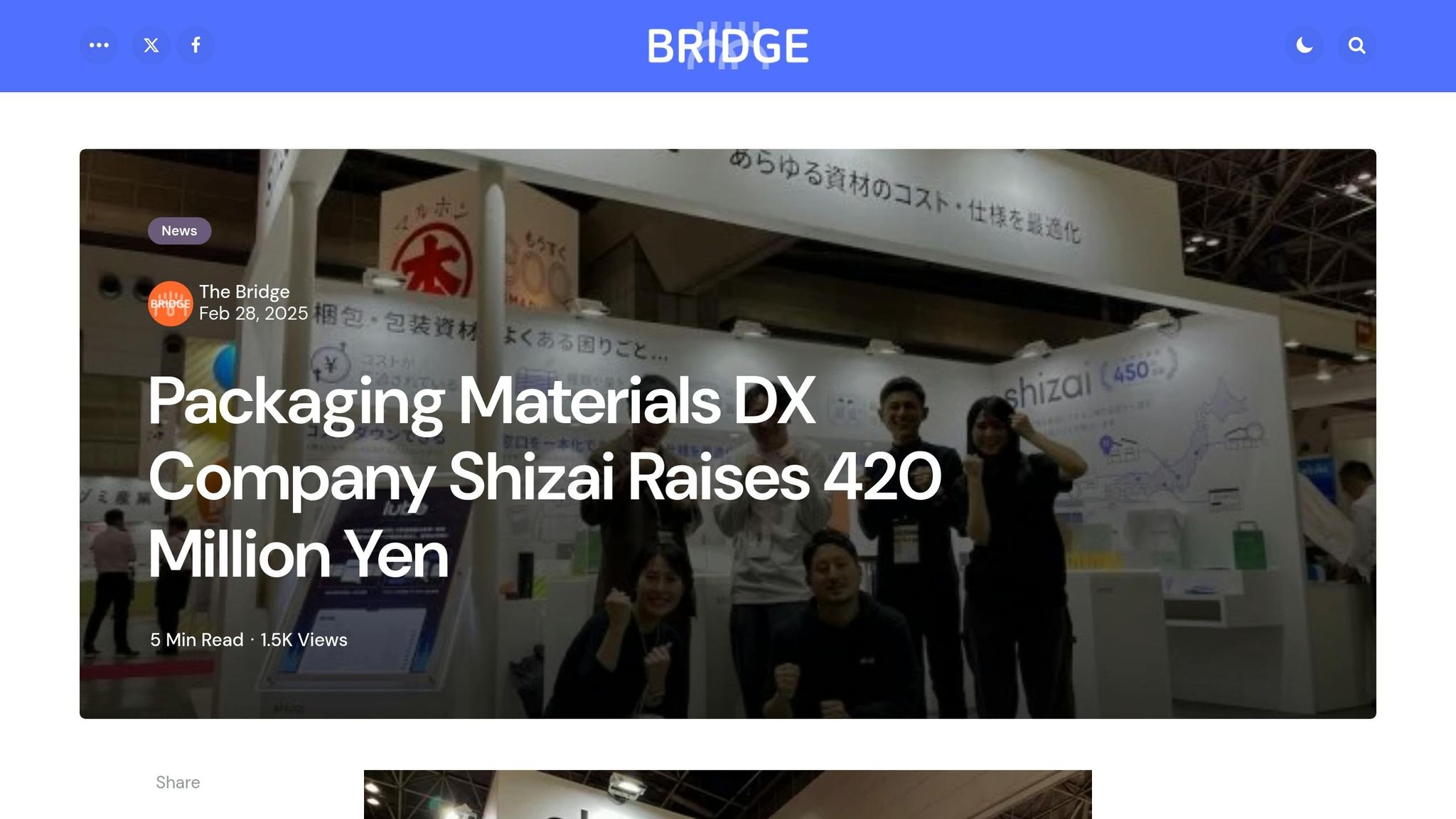
Headquarters: Japan | Series B Funding: ¥420 million (February 2025) | Customers: ~700 companies
Shizai started as a packaging procurement platform but has since transformed into a supply chain powerhouse. Its flagship product, shizai pro, is a purchase order (PO) management tool that simplifies procurement by centralizing communication – emails, chats, order adjustments, and approvals – onto one screen. This streamlined approach aligns with Japan’s strict approval standards, setting Shizai apart in terms of pricing and efficiency.
With a network of over 500 manufacturing bases and a deep understanding of Japan’s cardboard factory ecosystem (which includes 2,000–3,000 factories), Shizai has carved out a unique position in the market. By consolidating orders, the company secures volume discounts from mid-sized factories and passes those savings on to its clients. On average, customers see a 20% reduction in costs, with some achieving up to 30% savings on shipping expenses.
Shizai’s client list highlights its versatility. Brands like Tsuchiya Kaban and TENTIAL rely on shizai pro to handle frequent SKU changes. Larger enterprises, including Suntory and Nishimatsuya, have adopted the platform to streamline their large-scale packaging procurement needs. CEO Nobuyuki Suzuki explains the value Shizai brings:
"Packaging manufacturing information is often a black box; even if a company has a website, it may not reflect recent changes in machinery or product capabilities. We act on behalf of the business to select the optimal supplier from our network." – Nobuyuki Suzuki, CEO, Shizai
This approach has cemented Shizai’s position as a leader in Japan’s SaaS supply chain space. Over the two years leading up to its Series B funding, the company achieved a 5× increase in monthly revenue. Now, Shizai aims to expand its reach to 2,000–3,000 companies while branching into new areas like cosmetic bottles, kitting services, and warehouse referrals. With support from Japan Post Capital and Monoful Venture Partners, the company is well-positioned for growth.
What Global SaaS Companies Can Learn From Japan’s Leaders
Looking at the top 10 companies on this list, a clear pattern emerges: success in Japan isn’t about simply translating a product – it’s about reimagining the experience to align with Japanese business norms. This includes accommodating seniority-based pay structures, managing nenmatsu chosei (year-end tax adjustments), and handling My Number data with specialized workflows. These aren’t optional features – they’re the baseline. Any global SaaS company hoping to thrive in Japan must treat these as essential components of their offering.
Compliance as a Competitive Advantage
One of the standout lessons is how compliance can act as a differentiator. Take SmartHR, for example. Its seamless alignment with Japan’s labor laws demonstrates how integrating regulatory requirements directly into the product can build trust and loyalty. This is a stark contrast to global platforms, which often require costly retrofitting to meet local standards. Similarly, companies like LegalOn and freee have embedded Japan’s regulations into their platforms, proving that regulatory precision earns customer confidence.
Data Residency: A Must-Have for Enterprise Deals
Data residency has become non-negotiable for enterprise-level agreements. In March 2026, Notion Labs Japan announced the rollout of domestic data centers using AWS regions in Tokyo and Osaka, set to launch in Fall 2026. This ensures that Enterprise plan customers can store data within Japan’s borders. Microsoft has gone even further, committing ¥1.6 trillion (roughly $10 billion) to expand AI and cloud infrastructure in Japan through 2029. These investments highlight that local data storage is no longer a “nice-to-have” but a procurement necessity. This shift also underscores the importance of tailoring every aspect of the user experience to local expectations.
Customer Experience as the Key to Market Fit
In Japan, customer experience can make or break market success. Japanese users expect interfaces packed with features, highly detailed controls, and support available during JST business hours. Payment preferences also differ – bank transfers (furikomi) are favored over credit cards for B2B transactions. Localization expert Munehiro Hiraki sums it up perfectly:
"Japanese enterprise buyers do not explicitly say ‘your Japanese is bad.’ They simply do not proceed." – Hiraki Localization
This highlights how critical it is to adapt to local expectations, not just linguistically but culturally and operationally.
For global SaaS companies, the gap between a product that’s merely localized and one that’s fully tailored for Japan is where deals often fall apart. That’s precisely where Nihonium comes in, offering comprehensive go-to-market solutions. Their services include product localization, marketing funnel development, fractional sales teams, and customized entry strategies.
As Yuga Koda puts it:
"SaaS localization in Japan is a strategic endeavor that reaches far beyond language – it requires deep cultural calibration, robust technical adaptation, and ongoing compliance." – Yuga Koda, Nihonium
Conclusion
Japan’s top SaaS companies have demonstrated an ability to tackle structural challenges, adapt to local workflows, and broaden their offerings to deliver more value to customers. Take SmartHR, for example – it started as a simple HR tool and has grown into a full-fledged human capital management platform, now serving over 80,000 companies. Companies like SmartHR and freee show that succeeding in Japan isn’t just about flashy marketing; it’s about deeply understanding and integrating with local business practices and compliance requirements.
The market dynamics in Japan highlight a significant growth opportunity for SaaS companies. For instance, Japanese businesses currently use an average of 35 SaaS apps, far fewer than the global average of 93. Additionally, only 34% of small and medium enterprises (SMEs) have adopted cloud-based solutions , presenting a significant opportunity for SaaS companies targeting various market segments. While B2B procurement cycles in Japan can be lengthy – often taking 6 to 12 months – customer loyalty is exceptionally high, with churn rates near zero once a vendor is established. The companies that thrive in this environment treat localization, compliance, and customer success as fundamental aspects of their product, not as secondary considerations. For global SaaS providers, the key to success lies in prioritizing these local needs.
For those aiming to enter Japan’s SaaS market, partnering with local experts like Nihonium can make all the difference. Nihonium offers services such as product localization, building marketing funnels, fractional sales support, and tailored market entry strategies, helping companies establish a lasting foothold in this unique and promising market.
FAQs
How were these top 10 SaaS companies chosen?
The top 10 SaaS companies were chosen based on the ITreview The Best Software in Japan 2026 awards. These rankings were calculated using the proprietary ITreview Score, which considers several key factors: the volume and quality of user reviews, brand awareness, search trends, and interest from decision-makers. Additionally, companies were evaluated on customer satisfaction and their ability to address the changing demands of Japanese businesses.
What drives SaaS success in Japan beyond translation?
Success in Japan’s SaaS market involves much more than just translating your product. Success hinges on building trust and credibility – two things Japanese businesses hold in high regard. Companies look for evidence-backed validation, such as local case studies that highlight measurable results like ROI and retention rates.
Your product also needs to align seamlessly with local workflows. Achieving this requires conducting structured interviews and analyzing which features resonate most with Japanese users.
Other critical factors include forming partnerships with local companies, adhering to regulations like Japan’s APPI (Act on the Protection of Personal Information), and providing dedicated local customer support. These steps help address both operational needs and cultural expectations, paving the way for long-term success.
How can a global SaaS company enter Japan faster and avoid common localization mistakes?
Global SaaS companies aiming to enter Japan should approach the market with a well-structured strategy. Relying on DIY efforts can lead to delays of 18–24 months, making it crucial to plan carefully. Here’s how to streamline the process:
- Validate market fit: Conduct buyer interviews and analyze necessary features to ensure your product aligns with local needs.
- Localize your product completely: This includes adapting the user interface (UI) and providing fully translated support materials tailored for Japanese users.
- Utilize indirect sales channels: Keep in mind that 70% of enterprise software sales in Japan go through system integrators, making them an essential part of your strategy.
By following these steps, SaaS companies can navigate the complexities of the Japanese market more effectively.
Related Blog Posts
- Local vs Global SaaS Pricing: Japan Market Guide
- AI in Japan SaaS: Market Insights
- Why Long-Term Commitment Matters in Japan SaaS Sales
- Case Studies: SaaS Success Through Japanese Partnerships
 Japanese
  English